TD
TD
Key Takeaways
- The single biggest reason qualified veterans get filtered out is language, not capability.
- Replace ranks, MOS codes and acronyms with civilian equivalents - a reader should never have to Google a term.
- Employers value what the military builds better than almost any institution: leadership, project management, logistics and calm under pressure.
- Open with a civilian-facing summary, since your job titles may not map cleanly.
- Complex layouts break the ATS, and veterans often over-format a first resume.
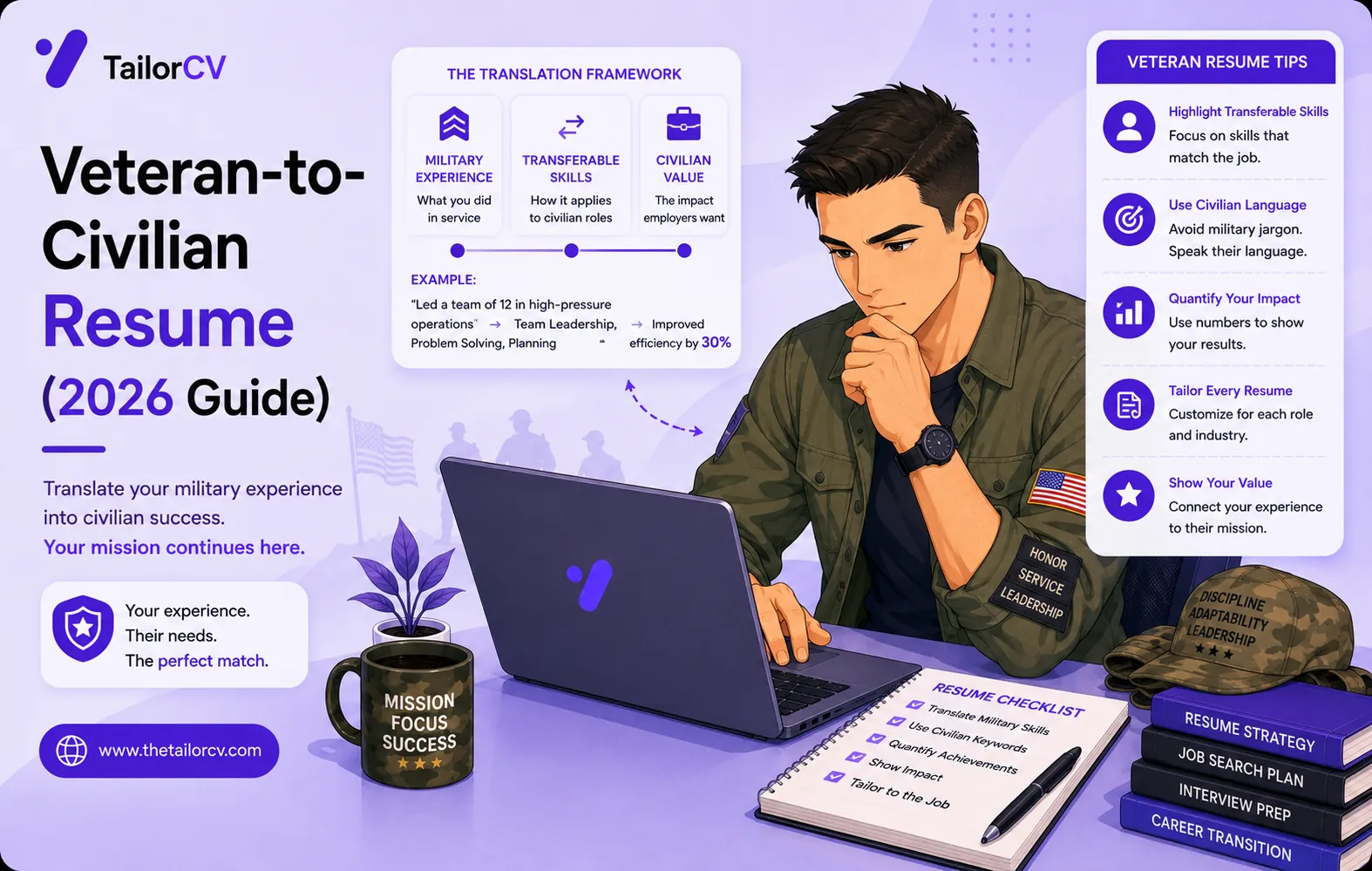
Leaving the military for a civilian career is one of the biggest transitions you will ever make, and your resume is where it begins. Service members carry leadership, discipline, and real responsibility under pressure — but if that experience is written in military language, a civilian recruiter or an ATS may miss it entirely. The job of a veteran-to-civilian resume is translation: turning what you did in uniform into language a hiring manager instantly understands.
In this complete guide you'll learn how to translate military experience, which civilian keywords to use, how to pass the ATS, and how to structure every section. Before you apply anywhere, it's worth checking your draft against the free ATS score checker, picking an ATS-friendly template, and reading the ATS score guide so you understand exactly how the software reads your resume.
Why a veteran resume needs translation
The single biggest reason qualified veterans get filtered out is language. A civilian recruiter has never served, and the ATS is only scanning for the exact keywords in the job description. If your resume says "11B Infantryman" and the posting says "Team Lead" or "Operations Coordinator," the match is lost — even though you did the work.
That's why translation matters more than anything else here. When you paste a posting into the resume optimizer, it shows you the civilian keywords the role wants, so your military experience maps to the exact terms the ATS is scoring. If you're not sure what a good ATS result looks like, read what is a good ATS score and how to increase your ATS score.
Step 1: Drop the jargon and decode your role
Start by replacing ranks, MOS codes, and acronyms with civilian equivalents. A civilian reader should never have to Google a term on your resume.
- Platoon Sergeant → "Team Lead managing 30+ personnel and $4M in equipment."
- Logistics NCO → "Operations & Supply Chain Coordinator."
- Squad Leader → "Frontline Supervisor leading a team of 9."
- Communications Specialist → "IT & Network Support Technician."
Write every line for someone who has never served. If you're moving into a technical field, the career change to tech guide and the career change resume guide show how to reframe experience for a brand-new industry. When you're done, run the draft through the ATS score checker to confirm the civilian keywords actually register.
Step 2: Lead with transferable skills
Employers value what the military builds better than almost any institution: leadership, project management, training, security, logistics, and calm decision-making under pressure. Put these transferable skills front and center, and back each one with a quantified result.
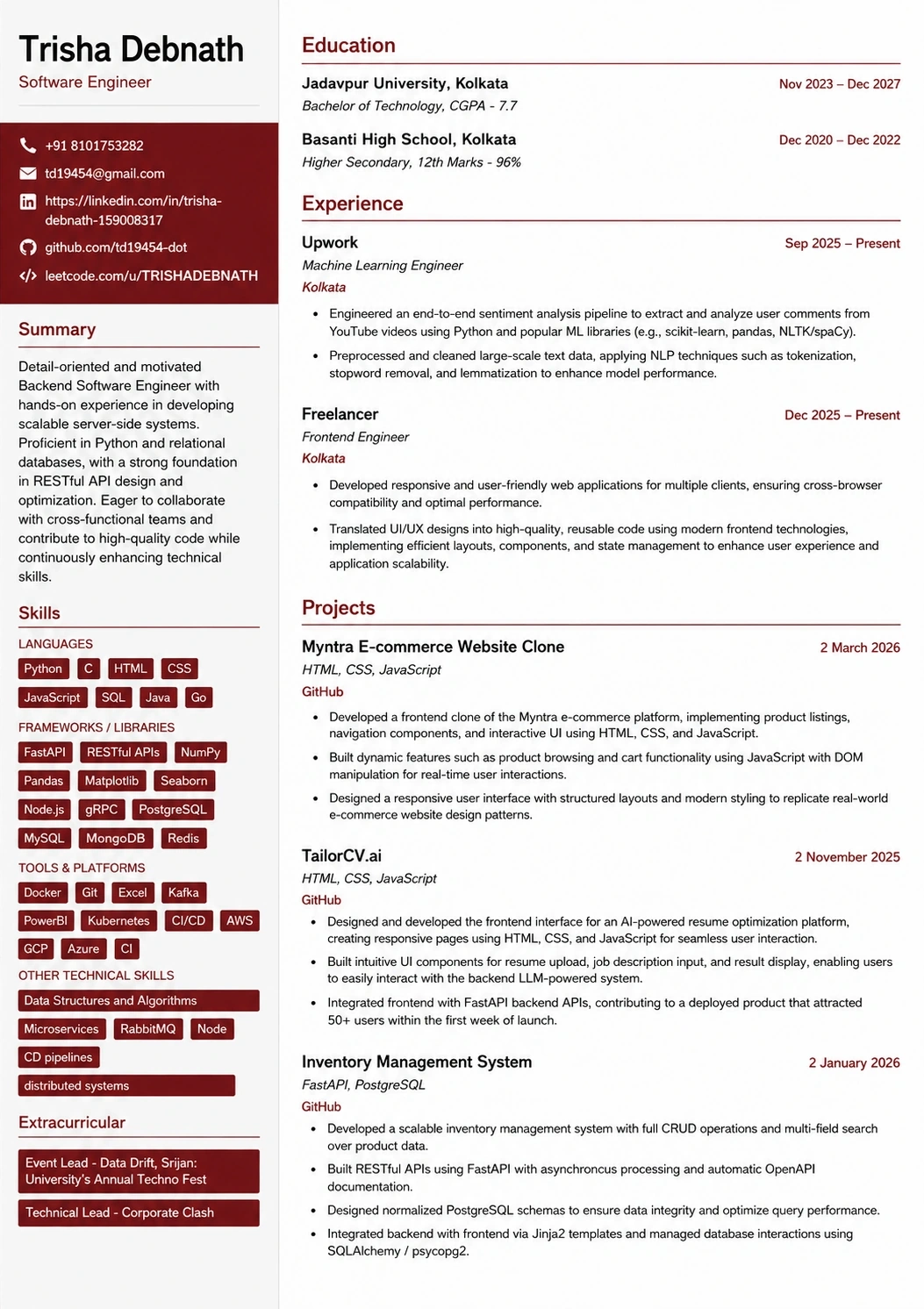
Your resume after optimization
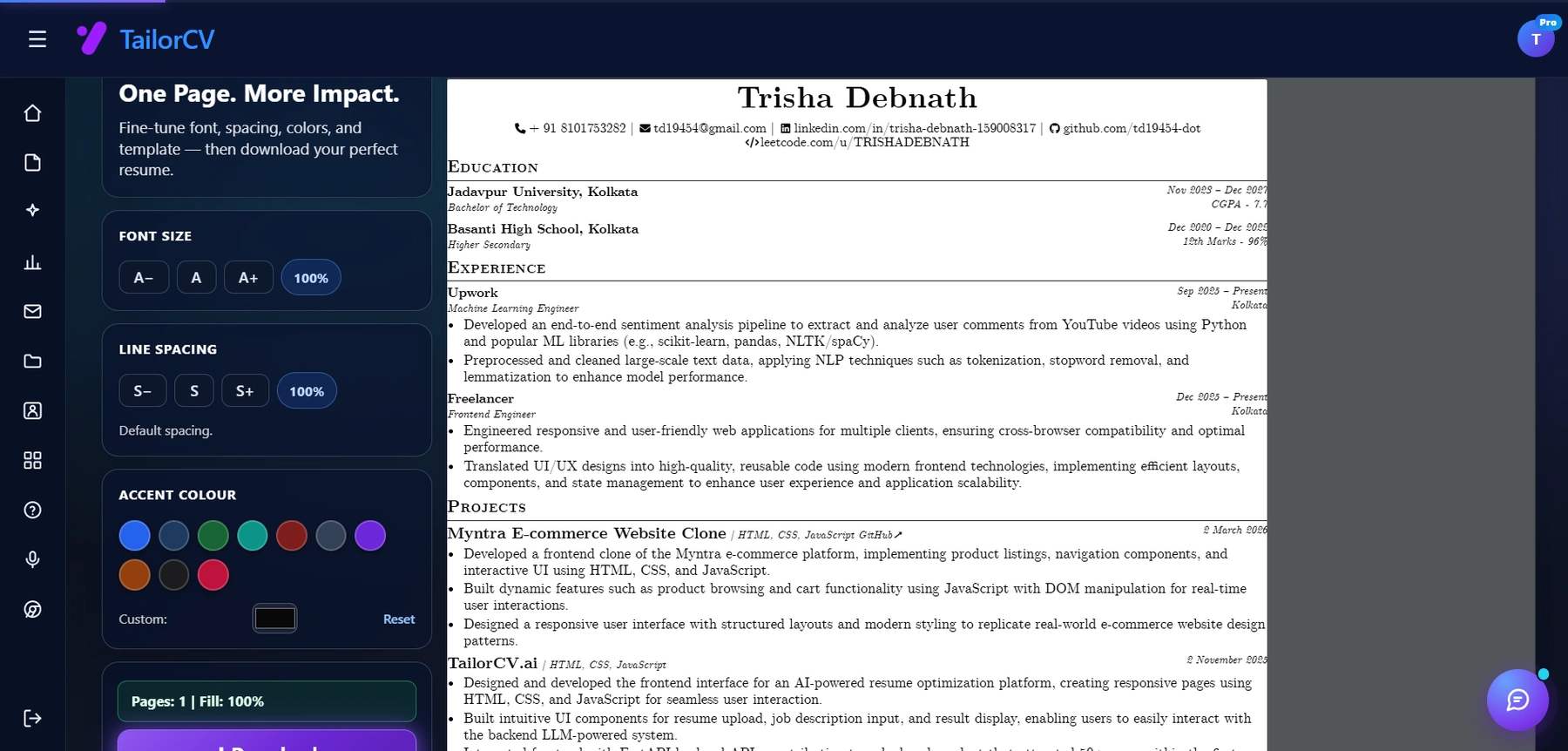
This is the resume after tailoring - the content is already matched, and these controls are how you fit it onto one page.
- "Led a 25-person team maintaining $4M in equipment at 100% operational readiness."
- "Trained 60+ personnel, cutting onboarding time by a third."
- "Coordinated logistics across three sites with zero supply failures over 18 months."
Notice the pattern: an action verb, what you did, and a measurable outcome. That's the core formula in how to write resume bullet points, and it's the difference between a resume that lists duties and one that proves impact. If your bullets feel generic, the quantify achievements guide will sharpen them fast.
Step 3: Write a civilian-facing summary
Since your job titles may not map cleanly, open with a strong summary that tells the reader who you are in civilian terms. A resume summary is your two-to-three-line pitch, and for veterans it's where translation does the heavy lifting.
"Operations leader with 8 years of U.S. Army experience managing teams of 25+ and multimillion-dollar assets. Proven in logistics, training, and crisis decision-making. Seeking an operations or program management role in the private sector."
Lead with a clear target job title so the ATS and the recruiter both see the fit immediately. For more examples and the difference between a summary and an objective, see resume objective vs summary.
Step 4: Build the skills section around the job description
The skills section is prime ATS real estate. Mirror the job description — if a posting lists "project management, logistics, and stakeholder communication," those exact phrases should appear where they're true for you. Group them for readability, as shown in how to list skills on a resume.
If you earned certifications in service or afterward — PMP, Security+, CDL, Six Sigma — list them prominently and read how to list certifications on a resume. Certifications double as ATS keywords, so use the exact official names.
Step 5: Keep the format ATS-safe
Veterans often over-format a first resume, and complex layouts break the ATS. Use a single-column, ATS-friendly template, standard section headings, and a readable font. Keep it to the right length — usually one page early on, two if you have extensive relevant experience.
Avoid tables, text boxes, and graphics for key content — they're the top reasons an ATS misreads a resume, as covered in how to make your resume ATS-friendly and ATS formatting mistakes. Then confirm it parses cleanly with the ATS score checker.
Step 6: Handle the transition gap and dates
If there's a gap between service and your job search, don't hide it — frame it. A short line about transition, education, or a certification course is enough. The employment gap guide walks through this, and if it comes up in interviews, how to explain a career gap in an interview has the script.
Step 7: Tailor every single application
There is no universal veteran resume. Different civilian roles want different language, so tailor each application. Paste the posting into the resume optimizer so your military experience maps to the exact keywords the role uses, then re-check your ATS match. The habit takes minutes once you have a base resume — see how to tailor your resume fast and how much to change your resume for every job.
How to choose your civilian career path first
Before you can translate your experience, you need a target. A resume written for "any job" reads as generic to both recruiters and the ATS. Start by mapping your military role to two or three civilian career paths — operations, logistics, project management, security, IT, or trades are common landing spots — and then write toward those specific titles.
Research the target role the way you'd plan a mission: read ten real postings, note the repeated keywords and required skills, and use the job description analysis checklist to extract what matters. If you're aiming for a technical field, the career change to tech guide shows how to bridge the gap, and the how to get your first tech job guide covers early-career strategy. Once you know the target, every line of your resume can point at it, and the resume optimizer can score how well you match.
Federal and government roles for veterans
Many veterans move into federal or government positions, which come with their own resume rules — they're longer, more detailed, and screened against explicit criteria. If that's your path, read the federal government resume guide, which explains how to include months and years, hours per week, and duty details tied to each posting's requirements.
Government systems are often older and less forgiving of complex layouts, so a plain, ATS-friendly template is safest, and accuracy is critical because these roles usually involve verification — never inflate a title or date, as covered in should you lie on your resume. Whether you go federal or private, the ATS score checker helps you confirm your keywords align with the announcement.
Put your security clearance and education to work
An active security clearance is a genuine asset in defense, government, and many private-sector roles — list it clearly (level and status) near the top, because it's a high-value ATS keyword that many postings require. The security clearance resume guide shows how to present it without oversharing sensitive details.
Education earned through the GI Bill, military schools, or certifications belongs on your resume too. Add degrees, relevant coursework, and credentials, and read how to list education on a resume and how to list certifications on a resume so they're formatted the way recruiters expect. If you're early in your career and light on civilian experience, the resume with no experience guide shows how to lean on training, projects, and transferable skills instead.
Sample veteran resume bullets, translated
| In uniform | On a civilian resume |
|---|---|
| "Managed arms room" | "Oversaw $2M inventory with 100% accountability across 24 audits." |
| "Led PT" | "Coached and developed a 30-person team, improving readiness scores 18%." |
| "Ran convoy ops" | "Directed logistics operations across multiple sites with zero safety incidents." |
| "NCOIC of comms" | "Supervised IT and network operations for a 200-person organization." |
Each translation follows the bullet point formula and leads with a strong action verb. Run your finished bullets through the resume optimizer to confirm they carry the right keywords.
Beyond the resume: the rest of your job search
A great resume opens the door, but the transition is a full campaign. Build a LinkedIn profile with a strong headline, and consider a portfolio website if your field rewards proof of work. Networking matters more than most veterans expect — read networking tips for your job search and how to write a cold email to a recruiter.
When interviews come, translate your stories the same way you translated your resume. Build a STAR story bank, practice with a free AI mock interview, and prepare with the interview prep tool. Afterward, send a thank-you email and follow up on the right timeline. If you write a cover letter, the AI cover letter tool can tailor it to each role.
Common veteran resume mistakes to avoid
- Leaving jargon in. Every acronym you keep is a line a recruiter skips.
- Listing duties, not results. Always quantify.
- One resume for every job. Tailor each application.
- Over-formatting. Keep it ATS-safe.
- Skipping the score check. Always run the ATS score checker before applying.
For more on what silently sinks applications, read why your resume gets no responses and generic resume mistakes that cost interviews.
Use veteran hiring programs and networks
You don't have to job-search alone. Many large employers run dedicated veteran-hiring programs, and organizations like the Department of Labor's veteran services, SkillBridge, and industry-specific veteran networks exist to bridge the transition. Recruiters in these programs already understand military experience, which reduces the translation burden — but your resume still needs civilian language so it passes the ATS and reaches them. Combine these programs with broader tactics: networking for your job search, a strong LinkedIn profile, and cold outreach to recruiters. Treat the search like a campaign with a weekly plan, as in how to apply to jobs faster and how to find a job fast.
Veteran resume FAQ
Should I include every deployment and posting? No. Group your service into meaningful civilian-facing roles and lead with impact, not a chronological log of every assignment. Focus on quantified results and the right length.
How do I handle a gap between separation and my job search? Frame it briefly — transition leave, education, or a certification course — using the employment gap guide. It's a normal part of the transition and easy to explain in an interview.
Do I need a different resume for every job? Yes. Tailor each application so your experience maps to the specific role's keywords, and re-check with the ATS score checker.
What if I'm worried my ATS score is low? Read why is my ATS score low and how to increase your ATS score — usually it's a keyword or formatting fix, and what is a good ATS score tells you what to target.
Should I mention leadership even for non-management roles? Absolutely. Leading people, managing assets, and making decisions under pressure are transferable to almost any role — show them with strong action verbs and numbers.
Final checklist
Before you apply, make sure your veteran resume:
- unchecked: Uses civilian language with zero unexplained acronyms.
- unchecked: Leads with a translated summary and a clear target title.
- unchecked: Backs every role with quantified results.
- unchecked: Mirrors the job description keywords.
- unchecked: Uses an ATS-friendly template and passes the ATS score checker.
Your service already proved you can lead, adapt, and deliver under pressure. The only job left is translating that into language the civilian market — and the ATS — understands. Start with the resume builder, score it with the free ATS checker, build a matching cover letter, and tailor it to every role you want.
What is your resume scoring right now?
Scan it against a job description and get your ATS match score in about a minute.
Drop your resume here or choose a file
PDF only. Max 2 MB.
We never share your data or use it to train AI models.

Templates that keep this structure intact
This template is ATS-tested — start from it and the formatting rules in this guide are already handled.
Was this guide useful?
Be the first to rate it.