 TD
TD

Key Takeaways
- Federal resumes are typically 3-5 pages long and must follow a specific format required by USAJOBS, unlike private-sector resumes which are usually 1-2 pages.
- Essential details such as exact employment dates, hours worked per week, salary or grade level, and supervisor contact information must be included in federal resumes.
- KSA (Knowledge, Skills, and Abilities) statements are required for many federal positions, emphasizing the need for detailed descriptions of duties and accomplishments.
- It is recommended to use the USAJOBS Resume Builder to ensure compliance with federal requirements and to avoid disqualification due to missing information.
- Federal resumes are reviewed by HR specialists who evaluate qualifications line by line, making it crucial to provide comprehensive evidence of meeting job criteria.
You are about to make one of the most common mistakes in government job applications.
You are going to take your private-sector resume and upload it to USAJOBS.
It will be rejected. Not because your qualifications are wrong. Because a federal resume plays by completely different rules than anything you have encountered before.
Federal resumes are longer - sometimes five pages for a mid-career professional. They use a specific format that USAJOBS systems require. They ask for information you would never put on a private-sector resume. And they are reviewed by HR specialists, not just hiring managers - people who compare your application against specific qualification criteria line by line.
This guide walks you through every difference, every requirement, and exactly how to write a federal resume that actually gets to the review stage. If you are also applying internationally, the international resume tailoring guide covers how resume expectations vary by country.
Federal Resume vs. Private-Sector Resume: The Core Differences
| Element | Private-Sector Resume | Federal Resume |
|---|---|---|
| Length | 1-2 pages | 3-5 pages (or more) |
| Focus | Concise, impact-first | Detailed, comprehensive |
| Format | Your choice (within reason) | Structured USAJOBS format |
| Salary info | Never included | Grade level and salary required for each role |
| Hours per week | Never included | Required for each role |
| Supervisor info | Never included | Often required |
| KSA statements | Not used | Required for many positions |
| Application platform | Direct, LinkedIn, ATS varies | USAJOBS only for federal roles |
| Review process | Recruiter + hiring manager | HR specialist first for qualification |
Why Federal Resumes Must Be Longer
In the private sector, brevity is a virtue. Recruiters spend 6-7 seconds on a resume. One page says you respect their time. Check ideal resume length guidance for private-sector applications - the rules are the complete opposite here.
In the federal hiring process, HR specialists are evaluating whether you meet specific qualification standards. They are not doing a quick scan. They are reading for evidence.
Your resume must provide enough detail for them to make that determination without guessing.
A federal HR specialist cannot call you to clarify. They cannot check your LinkedIn profile. If your resume does not demonstrate that you meet the qualification - even if you clearly do - you can be disqualified on paper.
Every role you list needs:
- Exact start and end dates (month and year)
- Hours worked per week
- Salary or grade level
- Supervisor name and contact info (with may-we-contact indication)
- A complete description of your duties, responsibilities, and accomplishments
This is not optional. Missing any of these fields creates grounds for disqualification.
The USAJOBS Resume Builder
If you are applying to federal positions, use the USAJOBS Resume Builder rather than uploading a PDF.
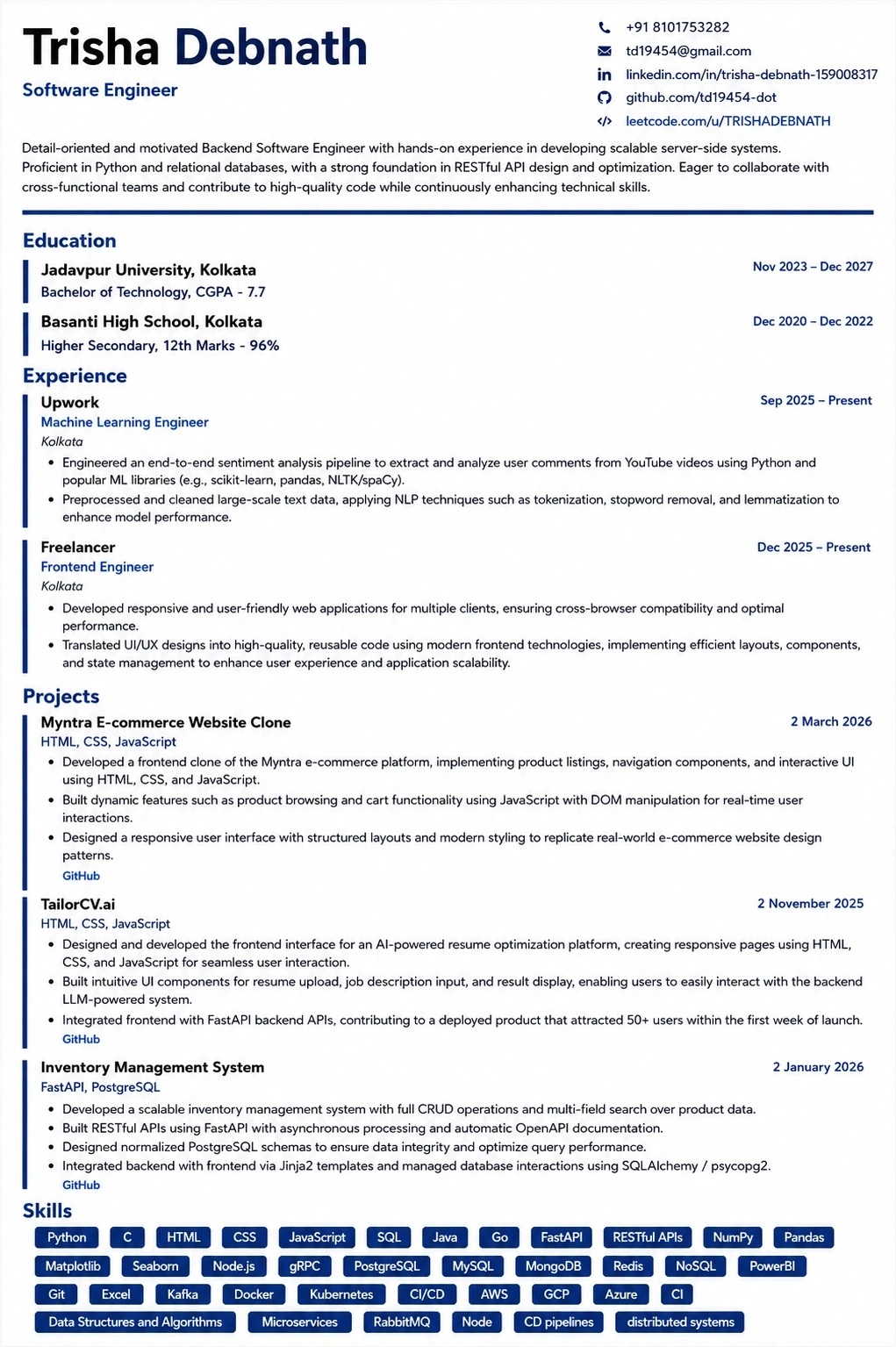
Your resume after optimization
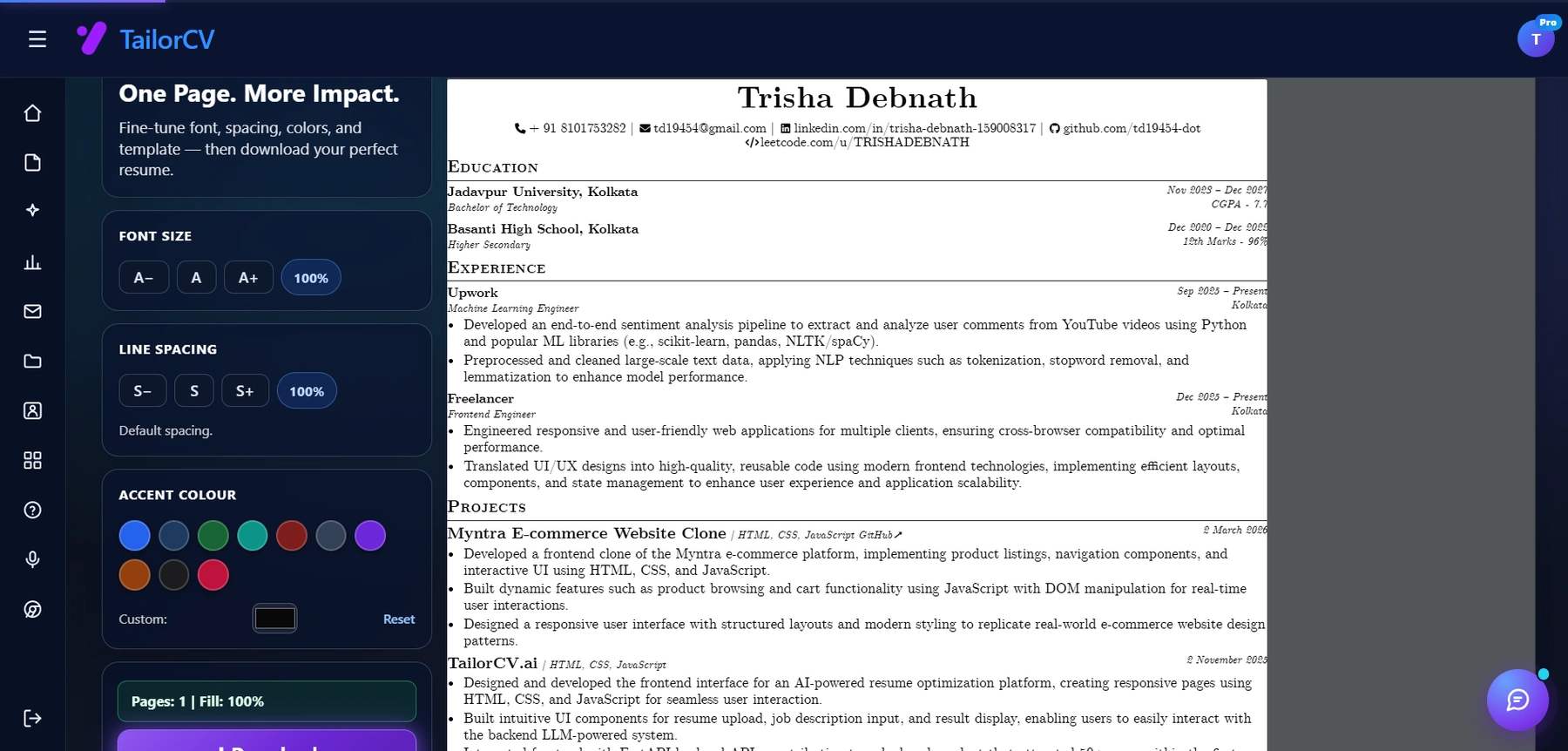
This is the resume after tailoring - the content is already matched, and these controls are how you fit it onto one page.
The Resume Builder ensures all required fields are filled. It formats your resume to meet federal standards automatically. HR specialists can review it in the system they use.
Uploaded resumes (PDF or Word) are allowed for some agencies, but the Resume Builder is safer and more complete. If you do upload a document, review ATS formatting mistakes to ensure your file parses correctly.
Go to USAJOBS.gov, create an account, and build your resume within the platform for each type of federal application.
How to Write Each Section of a Federal Resume
1. Contact Information
Include:
- Full legal name
- Address (city, state, ZIP minimum)
- Phone number
- Email address
- Citizenship status ("US Citizen" - required for most federal roles)
- Federal civilian status (if applicable - are you a current or former federal employee?)
- Veterans preference (if applicable - this matters for scoring)
2. Professional Summary (Optional but Recommended)
A 3-5 sentence summary that captures your professional identity, years of experience, and key areas of expertise relevant to the target role.
Keep it factual. Federal reviewers value substance over polish.
Read how to write a resume summary for a strong foundation - then adapt it to the more detailed, evidence-based tone federal applications require.
3. Work Experience - The Core of a Federal Resume
This section must be exhaustive.
For every role:
- Job title (exact title, not a simplified version)
- Employer name and location
- Start and end dates - Month/Year format (e.g., June 2019 - March 2022)
- Hours per week - This is critical. 40 hours/week signals full-time qualifying experience.
- Salary - Annual or hourly, in USD
- Supervisor name and contact information
- Duties, responsibilities, and accomplishments - write 200-400 words per role for mid-career positions
Your duty descriptions should mirror the language in the job vacancy announcement. USAJOBS postings are detailed. Match your experience descriptions to the duties listed in the "What You'll Do" section.
When writing your accomplishment bullets, follow the same principles as any strong resume: quantify your achievements with specific numbers, outcomes, and timelines.
4. Education
Include:
- Institution name and location
- Degree name (full title, not abbreviation)
- Major and minor
- Graduation date (month and year)
- GPA (if above 3.0 or required)
- Relevant coursework (if applying for entry-level professional positions)
- Honors and awards
Read how to list education on a resume for best practices - then adapt by including more detail than a private-sector resume would require.
For positions requiring a specific degree or field, make sure your degree's official title clearly matches or is explained.
5. KSA Statements (Knowledge, Skills, and Abilities)
This is the section that trips up most private-sector applicants.
Many federal positions - especially GS-7 and above - require KSA narratives. These are separate from your resume, submitted as attachments or entered into specific fields.
What KSAs look like:
A KSA prompt: "Skill in written communication to produce clear and accurate reports for senior leadership."
Weak response: "I have strong writing skills and have written many reports in my career."
Strong KSA response: "In my role as Program Analyst at the Department of Defense (2020-2023), I authored 40+ quarterly progress reports submitted to the Office of the Secretary of Defense. Each report synthesized data from 6 operational units into a concise executive brief used by the Assistant Secretary for Acquisition to inform budget allocation decisions totaling $120M annually. Reports required strict adherence to DoD writing guidelines and were reviewed for accuracy by three layers of leadership before final submission."
KSA responses should:
- Be specific, not general
- Include the CCAR format (Context, Challenge, Action, Result) where applicable
- Use measurable outcomes
- Reference specific dates, organizations, and stakeholder levels
- Be 200-400 words each
6. Certifications, Training, and Licenses
Federal agencies - especially defense, health, and regulatory agencies - value formal credentials.
List:
- Professional certifications (PMP, CPA, security clearances, etc.)
- Relevant training courses (federal training like OPM courses counts)
- Security clearance level and status (active clearances are highly valuable)
- Licenses (professional, state, federal)
Read how to list certifications on a resume for format and placement guidance.
7. Volunteer Work, Publications, Awards
These sections matter more in federal applications than private-sector ones.
Federal evaluators look at the whole person. Include:
- Volunteer work with civic or government organizations
- Publications or technical papers
- Awards and achievements (especially any government-specific awards)
- Professional memberships in relevant associations
How Federal Job Postings Work
Every USAJOBS posting includes:
Duties section: What you will actually do. Mirror this language in your resume. Use the hidden keywords technique to find the real priorities buried in the posting language.
Qualifications section: The exact requirements you must meet to be considered. HR specialists check your resume against these.
How You Will Be Evaluated: Often describes a self-assessment questionnaire that you must complete with your application. Your resume must support your questionnaire answers - if you say "Expert" in SQL, your resume must show SQL expertise. Inflating self-assessments is grounds for disqualification.
Required Documents: What to submit beyond the resume (transcripts, DD-214 for veterans, etc.)
Read every section. tailor your resume to the duties and qualifications sections specifically.
Tips for Getting Past the HR Specialist Review
-
Use exact phrases from the vacancy announcement. If the posting says "program management," use that phrase - not "project oversight." This is the core principle of matching keywords to a job description.
-
Never assume experience is implied. If you managed a budget, say the dollar amount. If you supervised staff, give the number. Federal HR cannot infer.
-
Repeat relevant keywords throughout your experience descriptions. Natural repetition across multiple roles reinforces your qualifications. Learn what keyword density is appropriate for federal applications.
-
Include all qualifying experience, even older roles. Federal qualification standards often allow experience from any period - older experience still counts.
-
Veterans: claim your preference. 5-point or 10-point preference affects your scoring and is a significant advantage. Document it properly with DD-214 or disability certification.
How TailorCV Can Help
The core principle of a federal resume is the same as any resume: match your experience to the job requirements with precision.
Use TailorCV's resume optimizer to check your keyword match against the vacancy announcement.
Paste the duties and qualifications section from the USAJOBS posting. Upload your draft resume. See exactly which required keywords and phrases you are missing - before you submit.
Federal applications are reviewed rigorously. Going in with a high keyword match and detailed experience descriptions dramatically improves your chances of passing the HR specialist screening.
Make This Practical
Use this guide as part of a complete job-search workflow. Check your resume with the free ATS score checker, improve targeting with the Resume Optimization Guide, and choose a clean format from the ATS-friendly resume templates.
After the resume is ready, strengthen the rest of the application. Draft a targeted letter with the AI cover letter generator, practice interviews with the AI mock interview tool, and create a project-backed proof page with the portfolio website builder if you need a stronger online presence.
FAQ
How long should a federal resume be?
3-5 pages for mid-career professionals is normal. Entry-level: 2-3 pages. Senior positions: 4-6 pages. There is no length penalty in federal applications - there is a detail deficit penalty.
Can I use my private-sector resume for government jobs?
Only if it is completely rewritten to include all required federal fields (dates, hours/week, salary, supervisor info, detailed duties). A standard private-sector resume will almost always be disqualified. For guidance on structuring your resume, check out our Resume Section Order Guide - What Comes First on a Modern Resume.
What is a GS grade?
GS stands for General Schedule - the federal pay scale. GS-5 through GS-15 cover most professional positions. The posting will specify the grade, and your qualifications must match the grade level's requirements. To better understand how to align your qualifications, read our article on How to Match Your Resume Summary to a Job Description in 2026.
Do I need a security clearance?
Many positions do not require one at the application stage. The agency will initiate clearance procedures after a job offer. However, having an active clearance is a competitive advantage for defense and intelligence positions. If you're looking to enhance your resume further, consider using our Free ATS score checker to ensure it meets the necessary standards. Additionally, you might want to explore our Chronological vs Functional Resume in 2026 - Which Format to Use for more insights on resume formats.
Related Guides
- How to Tailor Your Resume for Every Job
- Resume Matching with Job Description - Complete Guide
- How to List Certifications on a Resume
- How to Write a Resume Summary
- Resume vs CV
- Resume Keywords Guide
- How to Quantify Resume Achievements
- International Resume Tailoring Guide
- Cover Letter Guide 2026
Conclusion
A federal resume is not your private-sector resume with extra information.
It is a fundamentally different document with different rules, different length expectations, different required fields, and a different review process.
If you treat it like a normal resume, it will be disqualified at the HR specialist stage - before any hiring manager ever sees your name.
Take the time to learn the format. Build your USAJOBS profile properly. Mirror the vacancy announcement language. Write detailed duty descriptions. Complete your KSA narratives with real examples.
The federal hiring process is slow. But the jobs - stability, benefits, mission, and career progression - are worth the effort.
Optimize My Federal Resume Keywords - Free
Does your formatting survive the parser?
Upload your resume and see what an ATS actually reads back.
Drop your resume here or choose a file
PDF only. Max 2 MB.
We never share your data or use it to train AI models.

A layout that parses cleanly
Single column, standard headings, no text boxes — the formatting rules in this guide, already applied.
Was this guide useful?
Be the first to rate it.