 SS
SS
Key Takeaways
- Remote and international hiring has made multilingual candidates more valuable across nearly every field.
- The biggest mistake is vague self-assessment - use a clear, recognised proficiency scale instead of "conversational-plus".
- Where you place language skills depends on how central the language is to the role.
- Never overstate your level; many roles that value languages will test them in the interview or on the job.
- Where a language directly helped you deliver results, show it in an experience bullet rather than only in a list.
In a global job market, language skills can be a genuine differentiator — for customer-facing roles, international teams, and any company serving multiple markets. But listed vaguely, they raise more questions than they answer, and listed dishonestly they can blow up in an interview. This guide shows you how to present languages on your resume with the clarity and honesty that turns them into a real advantage.
Language ability is also a valuable keyword the ATS scans for when a role requires it, so getting this right helps you pass screening as well as impress a recruiter. Confirm your overall match with the free ATS score checker once your languages are in place.
Why language skills matter more than ever
Remote and international hiring has made multilingual candidates more valuable across nearly every field. For customer service, sales, hospitality, healthcare, and any company with global customers, a second or third language can be the deciding factor between two otherwise equal candidates. When a job description names a language as required or preferred, it becomes a top-priority keyword — put it where both the ATS and the recruiter will see it immediately.
Use recognized proficiency levels
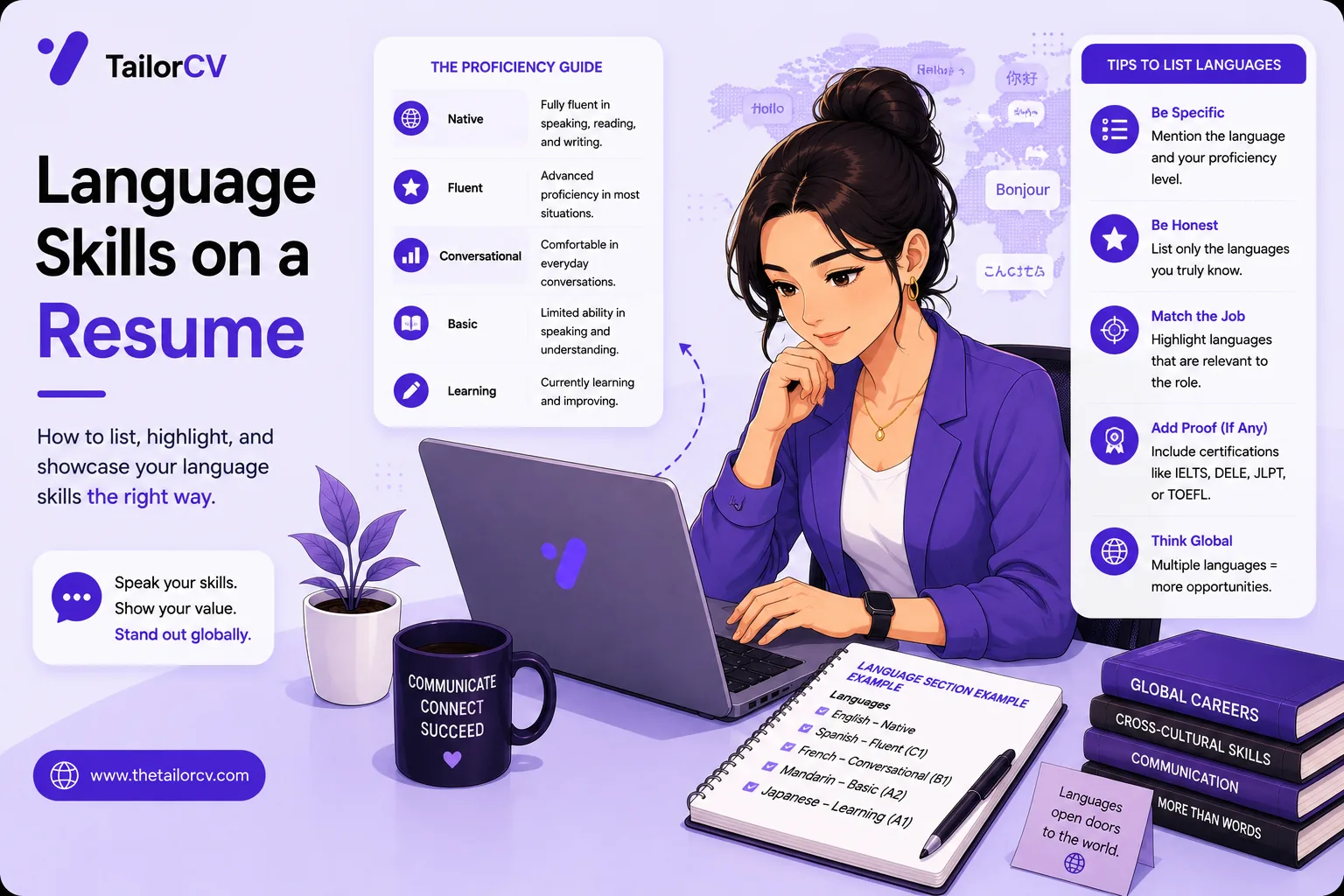
The biggest mistake is vague self-assessment. Skip "fluent-ish" or "conversational-plus" and use a clear, recognized scale:
- Native / Bilingual — your first language or equivalent fluency.
- Fluent / Professional working proficiency — you can work entirely in the language.
- Intermediate / Conversational — you can hold everyday conversations.
- Basic / Elementary — limited, simple exchanges.
For formal or international roles, frameworks like CEFR (A1–C2) or the ILR scale (0–5) add credibility because they're standardized and verifiable. Matching the level honestly matters — see should you lie on your resume for why overstating backfires.
Where to place language skills
Placement depends on how central the language is to the role:
- If a language is a job requirement, mention it in your summary and in a dedicated section — don't bury it.
- Otherwise, a clean "Languages" section near your skills section is standard and easy for the ATS to read.
Keep the formatting simple so it parses cleanly. Use an ATS-friendly template and avoid putting languages inside a graphic or a skills "bar chart" — those visual meters look nice but often break parsing, as covered in how to make your resume ATS-friendly. A simple text line — "Spanish (Fluent), French (Intermediate)" — is safest.
Be honest — you may be tested
Never overstate your level. Many roles that value languages will test them, either in the interview or on the job, and a candidate who claimed "fluent" but stumbles loses credibility instantly. "Conversational" you can defend beats "fluent" you can't. If you're actively improving a language, you can note "Intermediate (improving)" — honesty reads as confidence, not weakness. Prepare to demonstrate it calmly during a mock interview or the real thing.
Connect languages to impact
Where a language directly helped you deliver results, show it in your experience bullets, not just a list. Use the bullet point formula with a strong action verb and a quantified result:
- "Supported Spanish-speaking clients, improving retention in that segment 15%."
- "Localized marketing content for three European markets, growing regional signups 20%."
- "Interpreted between English and Mandarin teams on a cross-border project."
This turns a passive skill into evidence of value — exactly the kind of specificity that separates a strong resume from a generic one and helps you avoid a resume that gets no responses.
Tailor languages to the market
If a role serves a specific market, foreground the relevant language and connect it to the audience. Tailor each application so the language that matters to that employer is prominent — the resume optimizer helps you align your resume to the posting's requirements. If you're applying internationally, the international resume tailoring guide covers regional expectations, and how much to change your resume for every job explains the light-touch approach.
Your resume after optimization
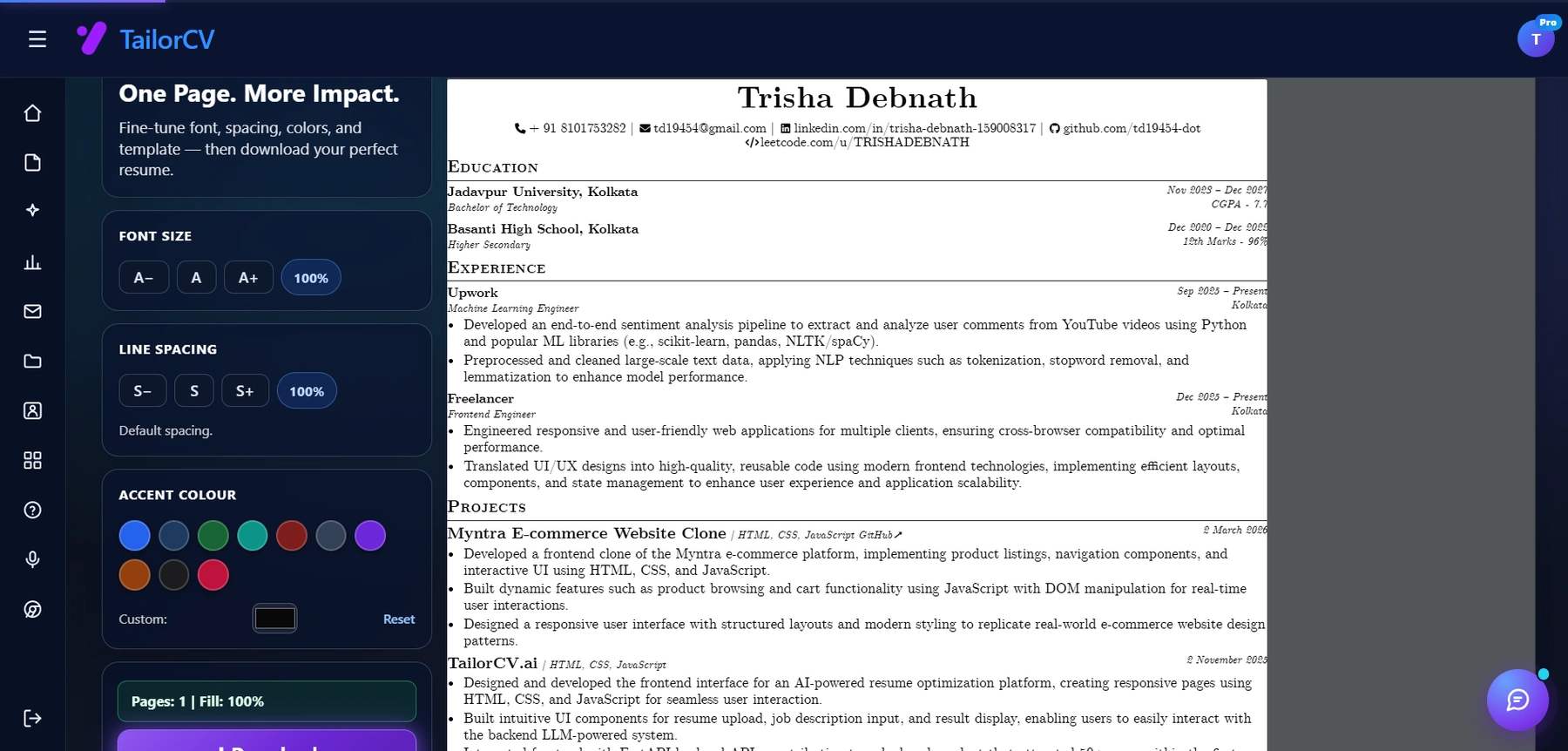
Font size, spacing, accent colour and template are all adjustable, with a live page counter.
Which languages are most in demand
While any additional language helps, some are especially valuable depending on your industry and region. Spanish is a major asset across the Americas and in US roles; Mandarin, Japanese, and Korean open doors in tech and trade; Arabic, French, and German are prized in international business, NGOs, and government. If you're targeting a specific country, research what's valued there — the how to get a job in Canada guide, how to get a job in the USA guide, and how to get a job in Singapore guide all touch on local expectations. Whatever languages you list, align them to the job description and confirm the match with the resume optimizer.
How to strengthen and prove your language skills
If a role weights languages heavily, back up your claim with evidence. Certifications — DELE for Spanish, JLPT for Japanese, DELF/DALF for French, Goethe for German, HSK for Mandarin — are concrete proof and ATS keywords; format them with how to list certifications on a resume. Study-abroad experience, roles where you used the language daily, or content you've produced in it all reinforce the skill. In interviews, be ready to switch into the language naturally — practice staying calm under that pressure with a free AI mock interview and the interview prep tool, and review interview anxiety tips if being tested makes you nervous.
Common mistakes to avoid
- Vague levels — always use a recognized scale.
| Mistake | Why it costs you |
|---|---|
| Skill "bars" or graphics | they break the ATS; use text |
| Overstating fluency | you may be tested |
| Listing a language you can barely use | basic tourist phrases don't belong |
| Hiding a required language | put it in the summary when the role demands it |
Final checklist
Your language skills are ready on your resume when they:
- unchecked: Use recognized proficiency levels (or CEFR/ILR).
- unchecked: Are placed where the role's importance dictates.
- unchecked: Are honest and defensible in an interview.
- unchecked: Connect to impact where they helped, and stay ATS-safe.
Build a clean resume in the resume builder, score it with the free ATS checker, and let your languages work as the genuine advantage they are.
What is your resume scoring right now?
Scan it against a job description and get your ATS match score in about a minute.
Drop your resume here or choose a file
PDF only. Max 2 MB.
We never share your data or use it to train AI models.

Templates that keep this structure intact
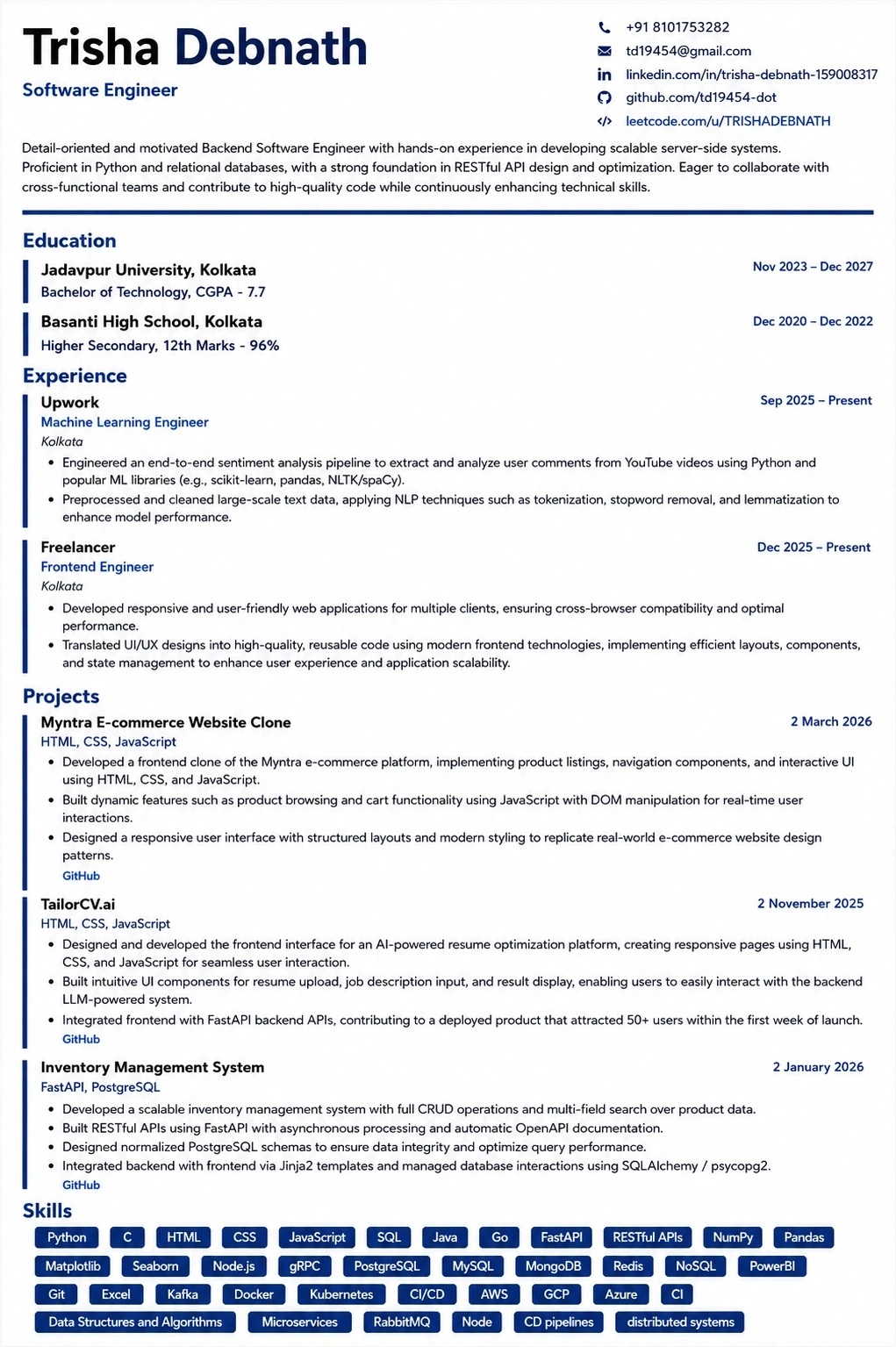
This template is ATS-tested — start from it and the formatting rules in this guide are already handled.
Was this guide useful?
Be the first to rate it.