 TD
TD
Key Takeaways
- Replace outdated objective statements with a concise professional summary that highlights relevant skills and outcomes.
- Use the exact job title from the posting as your resume headline to improve ATS alignment and recruiter categorization.
- Focus on achievements rather than responsibilities; quantify results to differentiate your impact.
- Include specific hard skills and tools in your skills section instead of generic soft skills that do not add value.
- Mirror the language of the job description in your resume to ensure ATS scoring and clear connections for recruiters.
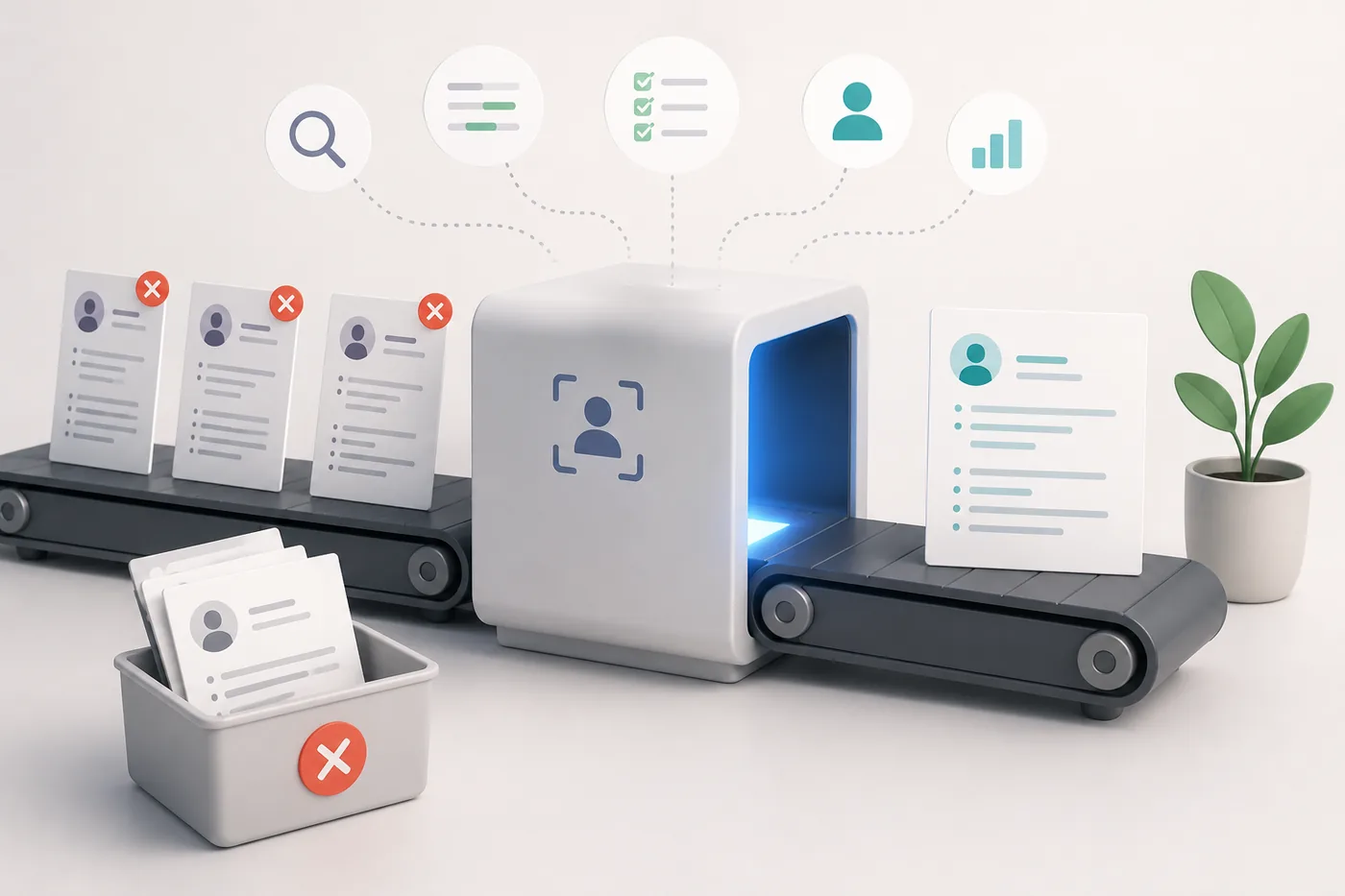
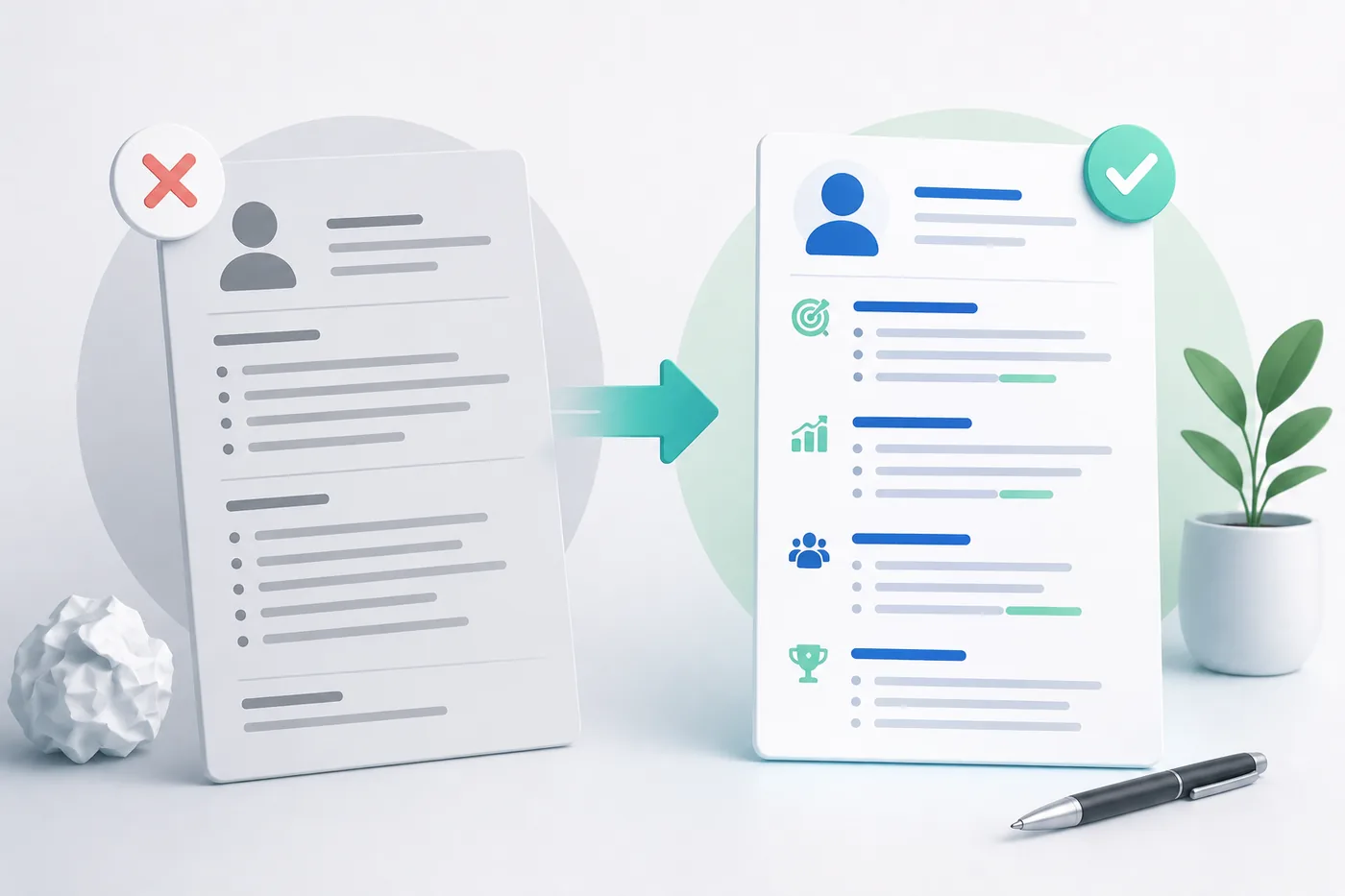
Generic resume mistakes are not obvious - that is what makes them dangerous. They look like "fine" resumes until you realize they have been filtered out by every ATS and glanced at for 6 seconds by every recruiter without triggering a callback. Here are the 10 mistakes that quietly cost you interviews, and the fix for each.
Run your resume through the free ATS checker to see your specific gaps before you apply.
Mistake 1 - Objective Statements
The objective statement - "Seeking a position where I can leverage my skills and grow professionally" - was retired a decade ago. It consumes prime resume real estate with content that is entirely about you, not about what the employer needs.
The fix: Replace it with a 3-4 sentence professional summary that names the role, 2-3 relevant skills from the posting, and a key outcome you deliver.
See how to write a resume summary for a template.
Mistake 2 - Generic Headline That Doesn't Match the Job Title
"Marketing Professional" or "Experienced Engineer" tells the ATS nothing and tells the recruiter nothing useful. The ATS checks job title alignment as a core scoring factor, and recruiters use the headline to instantly categorize whether you are relevant.
The fix: Write your headline as the exact job title from the posting. "Performance Marketing Manager" for a Performance Marketing Manager role. "Senior software engineer (Python)" for a Python-heavy engineering role.
Read how to write a resume headline.
Mistake 3 - Responsibilities Instead of Achievements
Describing your job duties instead of your impact is the most common resume mistake across all experience levels. Every person who held your job title has similar responsibilities. Achievements are what differentiate you.
| Generic (Duties) | Strong (Achievements) |
|---|---|
| "Managed social media channels" | "Grew LinkedIn engagement 87% through weekly long-form content strategy" |
| "Helped onboard new team members" | "Designed onboarding program that reduced new hire ramp time by 3 weeks" |
| "Worked with engineers to ship features" | "Partnered with a 4-person engineering team to ship 8 features in Q3, all on schedule" |
The fix: For every bullet, ask: "What was the result, and can I put a number on it?" See how to quantify resume achievements.
Mistake 4 - A Skills Section Full of Soft Skills
"Communication, teamwork, problem-solving, leadership, detail-oriented" - every resume says this. ATS doesn't weight these terms, and recruiters treat them as filler.
The fix: Your skills section should contain specific hard skills, tools, platforms, certifications, and methodologies that appear in the job posting. Soft skills can appear in your summary or embedded in achievement bullets - never as a standalone list.
See best resume keywords to beat ATS systems for a full breakdown by industry.
Mistake 5 - Not Mirroring the Job Description's Language
You may have the skill, but if you describe it differently than the posting does, ATS won't score it and the recruiter won't immediately see the connection.
- Posting says "Salesforce CRM" - your resume says "CRM tools"
- Posting says "financial modeling" - your resume says "quantitative analysis"
- Posting says "cross-functional collaboration" - your resume says "team coordination"
The fix: Before submitting, compare your resume language to the posting side by side. Wherever you describe the same thing differently, update to match. The free ATS checker at TailorCV does this automatically.
Read how to match resume keywords to job description.
Mistake 6 - Using a Creative Template That Breaks ATS
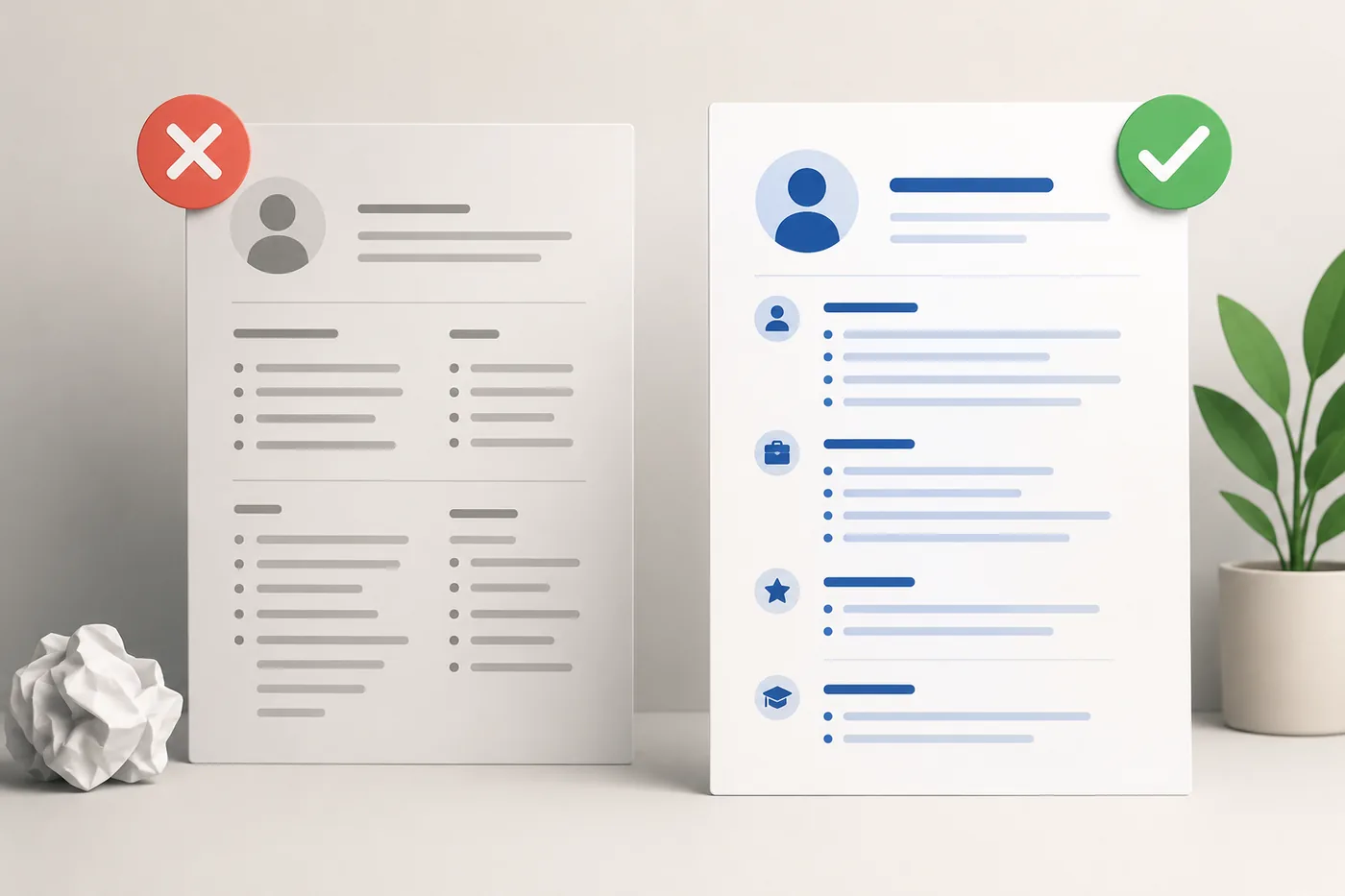
Two-column layouts, text boxes, tables for section content, icons, graphics, and unusual fonts are all visually appealing - and potentially disastrous for ATS parsing. If the parser can't read your skills section, it scores as if you have no skills.
The fix: Use a clean, single-column layout with standard section names: Summary, Experience, Skills, Education. See ATS resume formatting mistakes for the full list of format killers.
Mistake 7 - No Numbers Anywhere in the Resume
Resumes without quantified achievements score lower in ATS and perform poorly with recruiters. Numbers provide evidence, scale, and context - all three of which a generic resume lacks.
If you don't have clear metrics, estimate:
- Team size ("led a 5-person team")
- Time saved ("reduced manual process from 3 hours to 20 minutes")
- Volume ("managed $200K quarterly budget")
- Growth ("increased output by approximately 30%")
Mistake 8 - Burying Your Most Relevant Experience
A generic resume lists experience in chronological order and assumes the recruiter will read all of it. A tailored resume moves the most relevant bullets to the top of each role.
If you are a software engineer applying for a Python role and you have Python work buried in your third bullet, move it to the first. Recruiters read the top bullet of each role and often nothing else.
Mistake 9 - The Same Resume Sent to Every Job
This is the meta-mistake that causes all the others. When you send the same resume to every job, none of the above fixes are being applied. Every application is fighting a keyword mismatch, a headline mismatch, and a relevance perception problem simultaneously.
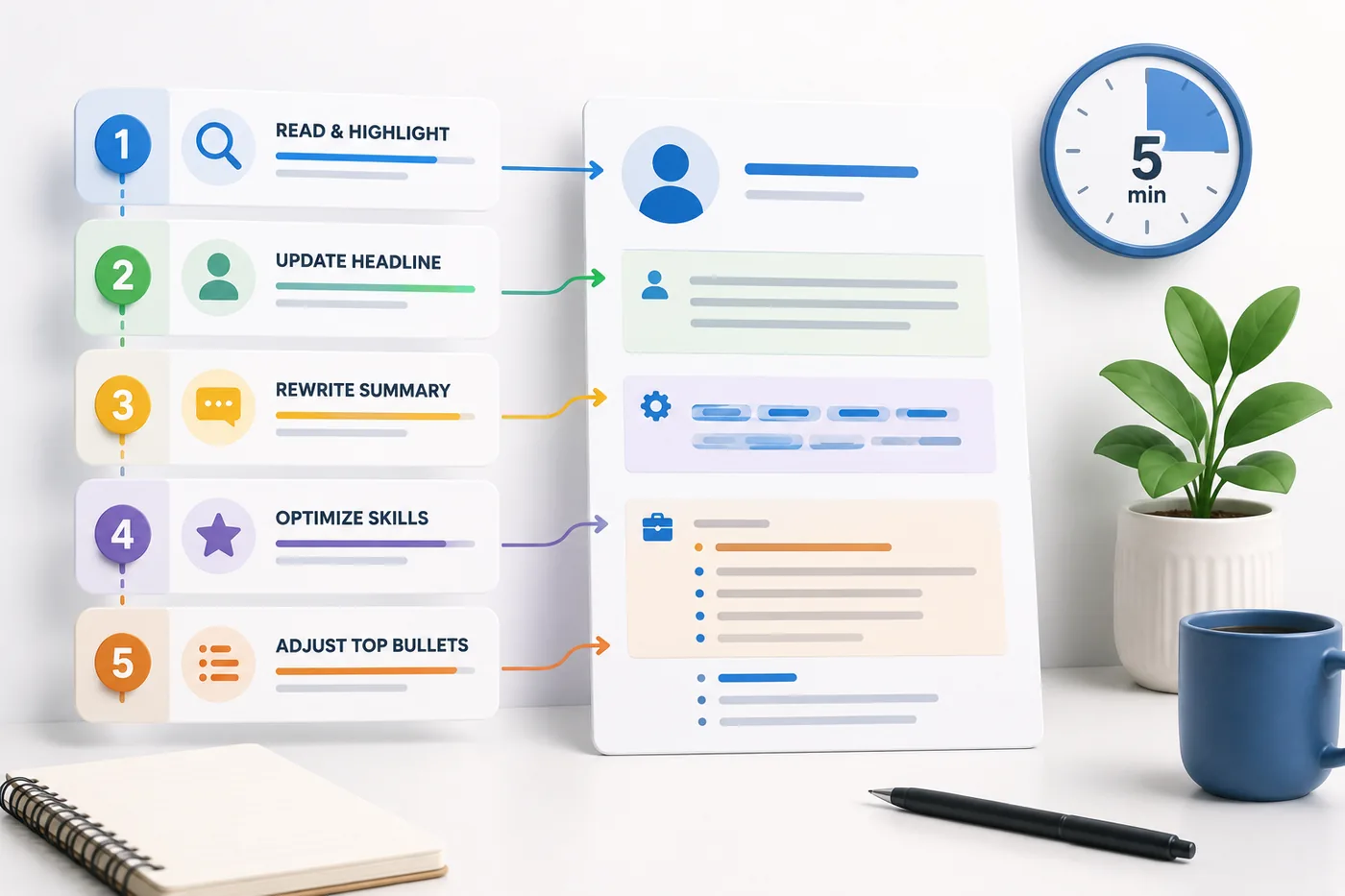
The fix: At minimum, run the 5-minute tailoring checklist before every application. It is the single highest-ROI activity in a job search.
Also read how much you should change your resume for every job for a calibrated approach.
Mistake 10 - Never Checking Your ATS Score
Most candidates don't know their ATS score exists. They apply, hear nothing, and assume the market is bad. The market is often fine - the resume is the problem, and a 60-second check would reveal exactly what to fix.
The fix: Before any application you care about, run it through TailorCV's free ATS checker. It compares your resume to the job description and shows your score, missing keywords, and specific fixes - in under a minute.
See how to check your ATS score for free and does my resume pass ATS.
Frequently Asked Questions
See it in action: a resume-based mock interview
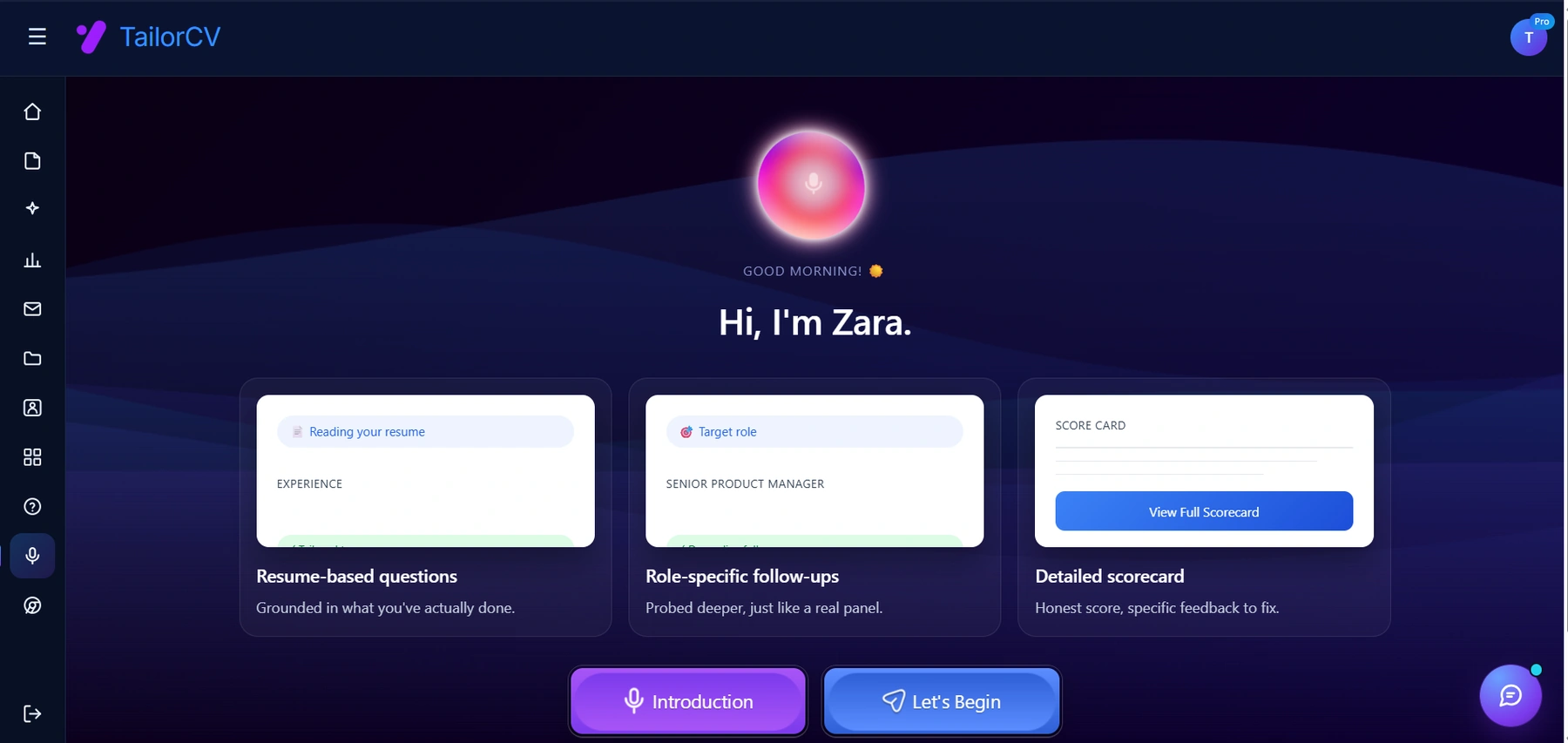
You can rehearse this before the real thing. The interviewer reads your resume first, so the questions come from your actual experience rather than a generic list.
How do I know if my resume is generic?
If it hasn't been updated for the specific job you're applying to - new headline, new summary, keyword-matched skills - it is generic by definition. Run it through TailorCV to see the score.
Can a good cover letter make up for a generic resume?
At the ATS stage, no. ATS does not typically evaluate cover letters for scoring. The resume has to pass on its own.
How long does fixing a generic resume take?
The 5-minute checklist fixes 80% of the issue for most applications. A 30-minute deep pass is warranted for your top priority roles.
Related Guides
- How Recruiters Spot Generic Resumes
- How ATS Detects a Generic Resume
- How to Tailor a Resume in 5 Minutes
- Why Your Resume Gets No Responses
- How to Quantify Resume Achievements
- ATS Resume Formatting Mistakes
- Best Resume Keywords to Beat ATS Systems
- How to Write a Resume Summary
- How to Write a Resume Headline
- How Much Should You Change Your Resume for Every Job
- Resume Mistakes Freshers Make
- ATS Mistakes Experienced Professionals Make
Make This Practical
Use this advice as interview practice, not just reading material. Start a role-specific session with the AI mock interview tool, prepare your opening with How to Answer Tell Me About Yourself, and structure evidence-heavy answers with the STAR Method Interview Answers Guide.
Before the interview, make sure the resume that earned the call is still aligned with the role. Check it with the free ATS score checker, review Common Interview Mistakes to Avoid, and use How to Follow Up After an Interview once the conversation is over.
Conclusion
generic resume mistakes are fixable - every single one of them. The common thread is that they all signal a resume that was written once and never updated for the job at hand. Swap your headline, rewrite your summary, quantify your achievements, match your keywords, and verify with a tool. Each step takes minutes and removes a filter that might have blocked you for months.
Check your resume for these mistakes - free
Was this guide useful?
Be the first to rate it.