 TD
TD
Key Takeaways
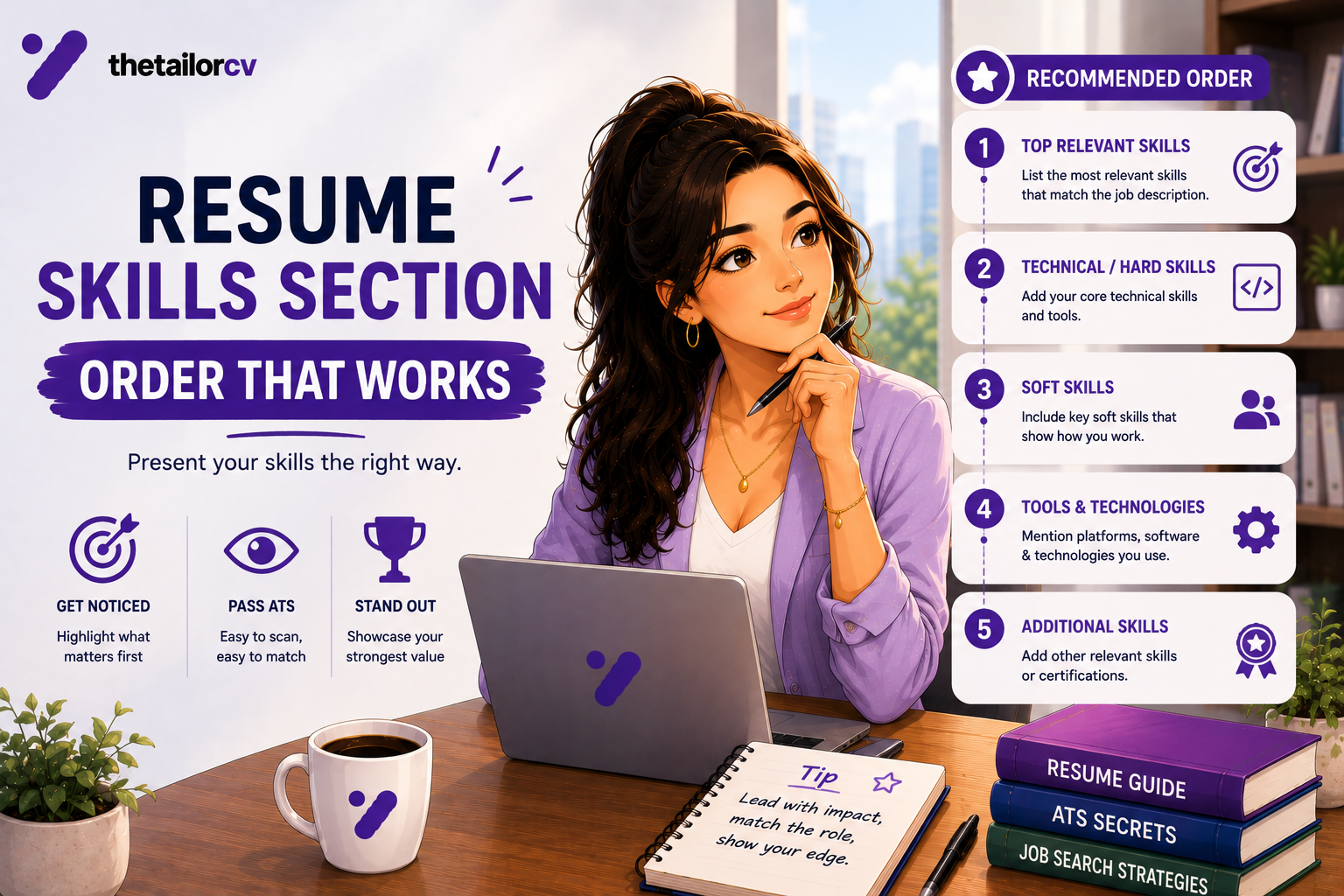
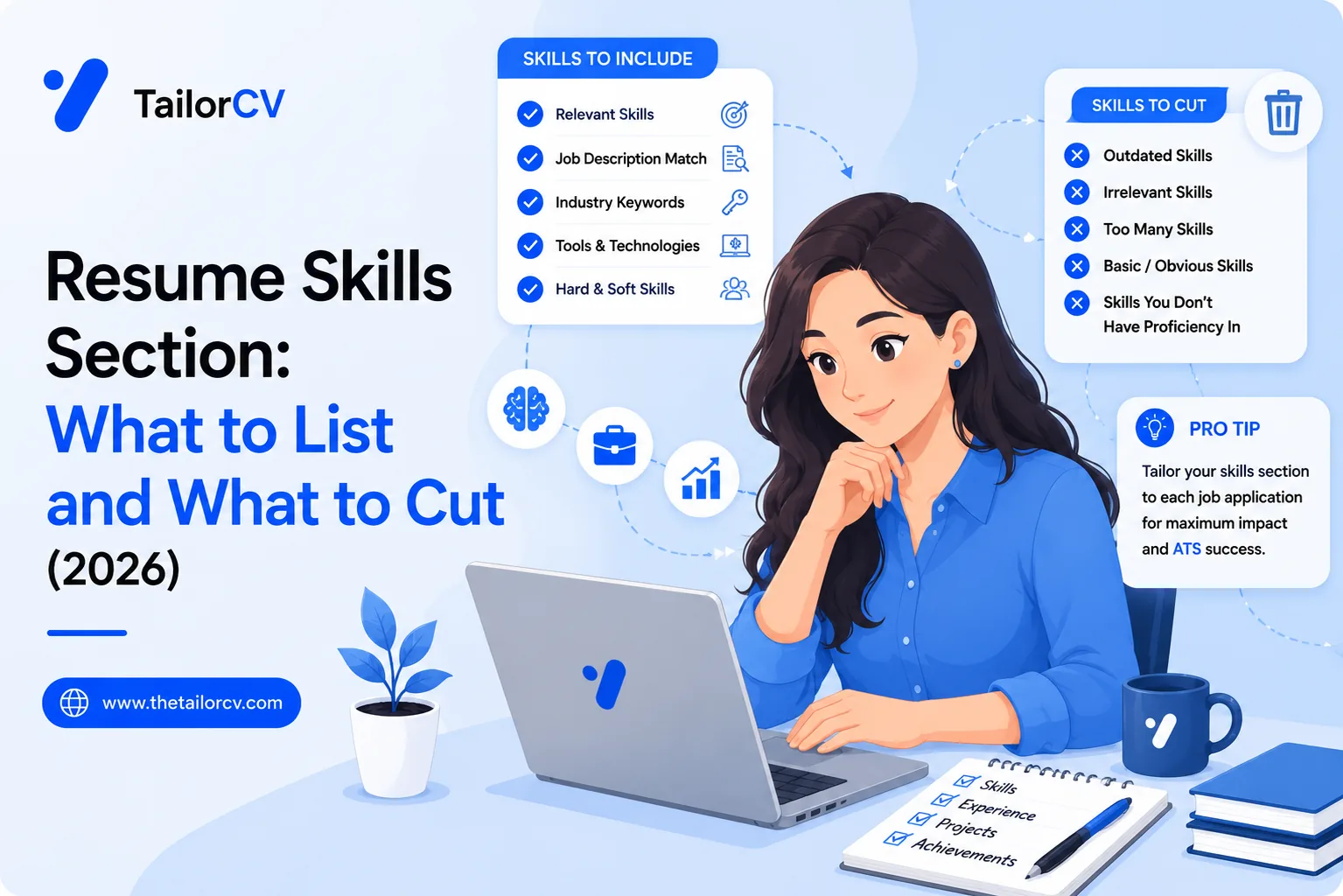
- Your skills section is for hard skills — named tools, languages, and technologies.
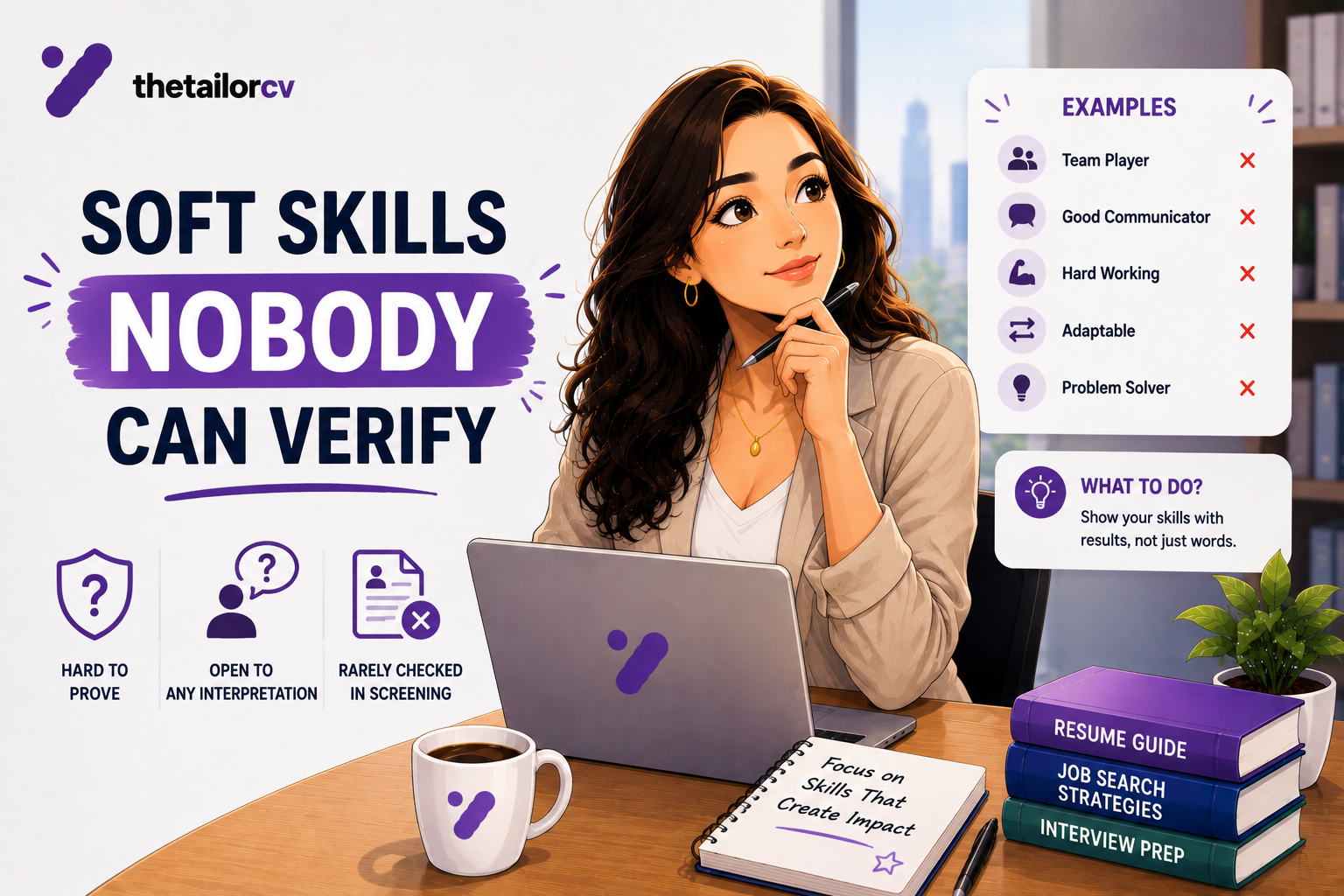
- Soft skills belong in your bullets, proven by a result, not listed as adjectives.
- Mirror the exact wording from the job description so the ATS matches you.
- Cut skills you cannot speak to for ten minutes in an interview.
Hard Skills vs Soft Skills
Hard skills are concrete and verifiable: Python, Figma, SQL, Google Analytics, French. They are things you can be tested on.
Soft skills are traits: communication, leadership, teamwork, adaptability. They are real and valuable, but listing them proves nothing — anyone can type "great communicator."
The rule: hard skills go in the skills section; soft skills get demonstrated in your experience bullets.
Why Soft Skills Don't Belong in the List
An ATS scoring a skills section against a job description looks for named technologies. A line reading "communication, teamwork, problem-solving" adds no matchable keyword and reads as filler to a human. Instead, prove the soft skill:
- Not: "Strong communicator."
- Yes: "Presented quarterly results to a 30-person leadership team and translated technical risk into plain-language recommendations."
That bullet proves communication far more convincingly than the word ever could.
Match the Job Description
The single highest-impact move is to mirror the posting's exact terms. If it says "REST APIs," write "REST APIs," not "web services." If it says "Excel," do not only write "spreadsheets." The ATS matches on keywords, and near-synonyms often do not count.
How Many Skills to List
Aim for 8–15 relevant hard skills, grouped if helpful (Languages / Frameworks / Tools). More than that dilutes focus and starts to look like keyword stuffing, which both recruiters and modern ATS filters notice.
The Ten-Minute Test
Before you list a skill, ask: could I talk about this for ten minutes in an interview? If not, cut it. A skill you cannot defend becomes a liability the moment an interviewer probes it.
How to Organize the Skills Section
Once you know what to list, structure matters. For anything beyond a handful of skills, group them into labeled categories. A wall of 20 comma-separated terms is hard to scan; grouped skills are read in a glance.
Languages: Python, JavaScript, SQL Frameworks & Libraries: React, Django, pandas Tools & Platforms: Docker, AWS, Git, PostgreSQL Practices: CI/CD, test-driven development, code review
Grouping does two things: it helps a human find what they are looking for, and it lets you present more skills without the section feeling like keyword soup. Order the groups by relevance to the target role — put the category the posting cares most about first.
Skills Sections by Role
The right skills section looks different across fields. A few patterns:
Software Engineer — heavily technical: languages, frameworks, databases, cloud, tooling. This is one of the few roles where the skills section is genuinely load-bearing and often sits near the top.
Marketer — a mix of platforms and named methods: Google Analytics, HubSpot, SEO, SEMrush, A/B testing, email automation. Avoid vague terms like "digital marketing" in favor of the specific tools.
Project / Product Manager — methodologies and tools: Agile, Scrum, Jira, roadmapping, stakeholder management (as a named competency, backed by bullets). Here the experience section carries more weight, so keep skills tight.
Designer — tools plus specializations: Figma, Adobe Creative Suite, prototyping, design systems, user research. Your portfolio does the deep proving; the skills list is a quick index.
Data Analyst — the tool stack is everything: SQL, Python or R, Excel, Tableau or Power BI, statistics. Recruiters filter hard on these exact terms.
Reading the Job Description for Skills
The posting is your keyword source. Work through it and pull out every named tool, language, framework, platform, and method. Then map them against what you genuinely have:
- Have it and used it recently? List it, and make sure a bullet shows it in action.
- Have it but rusty? List it if the posting names it; be ready to speak to it honestly.
- Do not have it? For a critical hard skill, you may still list it in the skills section for ATS matching, but never claim it in a bullet — and be honest if asked. For skills central to the role that you truly lack, the better long-term move is to build them.
The goal is a skills section that mirrors the posting's language closely enough that both the ATS and the recruiter see an obvious match.
Common Skills-Section Mistakes
- Soft skills as a list. "Communication, teamwork, leadership" adds no keyword and no proof. Move them into bullets.
- Outdated or irrelevant tools. Listing software nobody uses anymore dates you. Prune ruthlessly.
- Proficiency bars and star ratings. Self-assessed "90% Python" is subjective and invites doubt. Let experience show depth.
- Keyword stuffing. Thirty skills, half of which you have barely touched, reads as spam to modern parsers and to humans.
- Near-synonyms instead of the exact term. If the posting says "PostgreSQL," write "PostgreSQL," not just "SQL databases."
- Burying the section. For technical and early-career roles, the skills list should be easy to find near the top.
Your resume after optimization
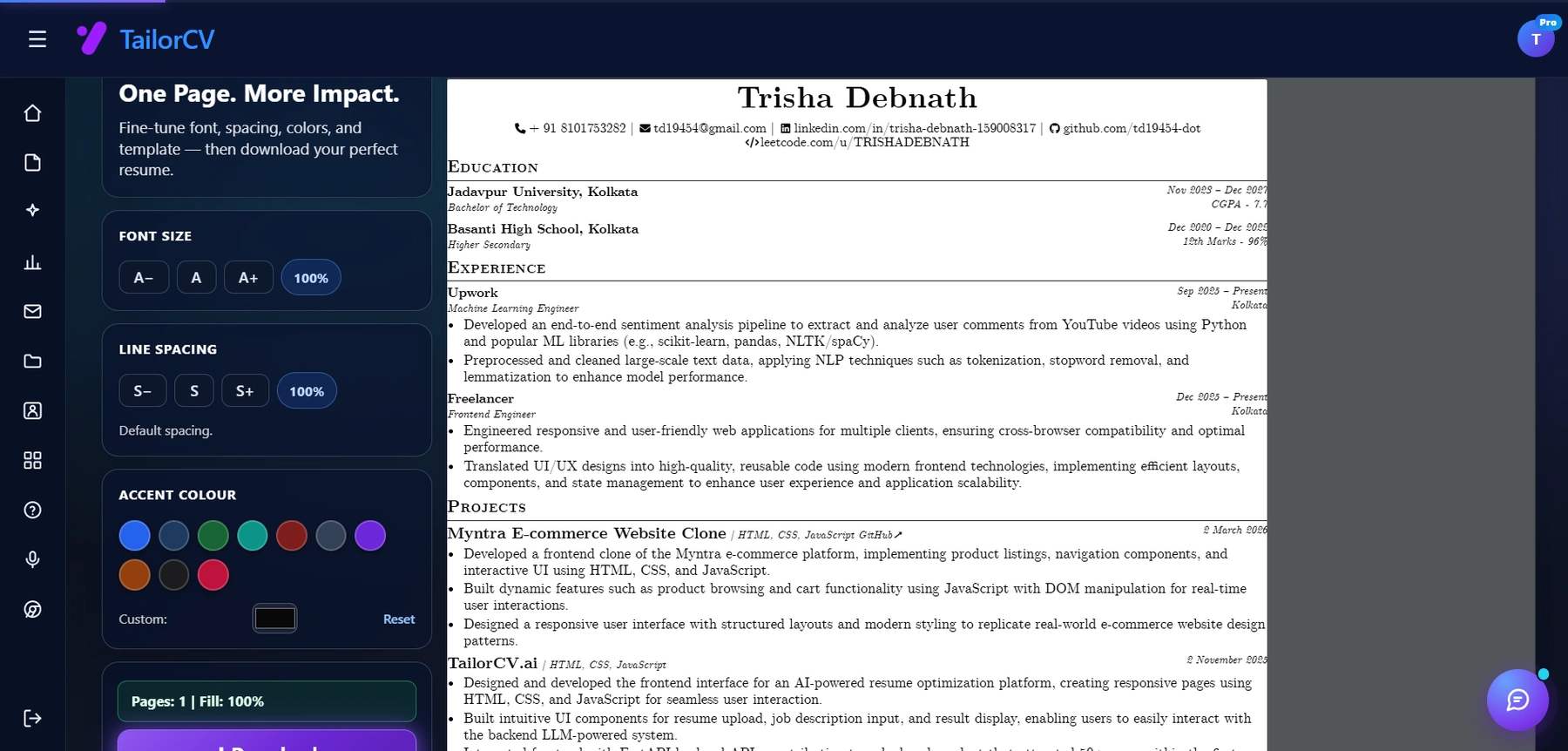
This is the resume after tailoring - the content is already matched, and these controls are how you fit it onto one page.
Hard Skills vs Soft Skills: The Full Breakdown
The single most common skills-section mistake is mixing the two types, so it is worth being precise about the line between them.
Hard skills are teachable, testable, and specific: programming languages (Python, Java), tools (Figma, Excel, Salesforce), platforms (AWS, Google Cloud), databases (PostgreSQL, MongoDB), frameworks (React, Django), certifications, and languages you speak. You can prove you have them, and an interviewer can test them. These belong in your skills section.
Soft skills are behavioral traits: communication, leadership, teamwork, adaptability, problem-solving, time management. They are genuinely valuable — often the deciding factor between two technically qualified candidates — but listing them is worthless because anyone can claim them. "Excellent communicator" in a skills list carries exactly zero evidence. These belong in your experience bullets, proven by a specific result.
The test is simple: if you could be tested on it, it is a hard skill and goes in the list. If it is a personality trait, it is a soft skill and must be shown, not stated.
Where Soft Skills Actually Belong
Since soft skills cannot be proven in a list, the strongest resumes fold them into achievement bullets where a result makes them credible:
- Communication: "Presented quarterly analytics to a 30-person leadership team, translating technical risk into plain-language recommendations."
- Leadership: "Led a team of 5 engineers through a six-month platform migration delivered on schedule."
- Problem-solving: "Diagnosed and fixed a data pipeline failure that had corrupted three months of reporting, restoring accuracy within two days."
- Adaptability: "Took over an at-risk project mid-stream and shipped it two weeks later after re-scoping with stakeholders."
Each of these proves a soft skill far more convincingly than the adjective ever could — and gives an interviewer a real story to ask about.
Keeping Your Skills Current and Honest
A skills section is a living part of your resume, not a fixed list. Two disciplines keep it effective:
- Prune the outdated. Tools nobody uses anymore quietly date you. Remove software and versions that signal you have not kept up, and add the current tools your field has moved to.
- Stay honest about depth. Only list what you can genuinely defend. The fastest way to lose credibility in an interview is to list a skill and then fumble a basic question about it. If you are still learning something, either show it through a project or leave it off until you can speak to it.
Update the section every time you tailor the resume to a new posting — reordering and adjusting so the skills the specific job cares about appear first and most prominently. A quick ATS score against the posting tells you instantly whether the keywords it wants are actually present in your skills and bullets.
Frequently Asked Questions
Should I list my proficiency level (beginner/expert)?
Usually no — self-rated levels are subjective and invite skepticism. Let your experience bullets show depth instead.
Where should the skills section go?
For technical and early-career roles, near the top so it is scanned first. For senior roles where experience leads, it can sit lower.
Can I include soft skills at all?
List one or two only if the posting explicitly names them, but always back the important ones with evidence in your bullets.
Should I list a skill I'm still learning?
Only if you can speak to it honestly. "Familiar with" or listing it without overclaiming is fine; presenting a beginner skill as expertise backfires the moment an interviewer probes. When in doubt, prove depth through a project rather than a label.
How do I handle a skill the ATS wants but I don't have?
For a genuinely critical hard skill, you can list the exact term for keyword matching, but never fabricate experience with it in your bullets, and be honest if asked. If the role centers on a skill you lack entirely, the durable fix is to build it before applying.
Do certifications go in the skills section?
Give certifications their own short section rather than mixing them into skills. It keeps the skills list clean and gives credentials the visibility they deserve.
How often should I update my skills section?
Every time you tailor the resume to a new posting, and whenever you learn a genuinely new tool. Your skills section should reflect the role you are applying for, not a frozen snapshot of everything you have ever touched.
Should I list programming languages I only used once?
Only if you can genuinely speak to them and they are relevant. Listing a language you touched once in a tutorial invites a question you cannot answer. If it matters to the role and you have real (if limited) exposure, list it honestly and be ready to describe that exposure.
Where should the skills section sit on the page?
For technical and early-career roles, near the top so it is scanned first. For senior roles where experience leads the story, it can sit lower. Either way, keep it easy to find — recruiters and parsers both look for it.
Transferable Skills When Changing Careers
Career changers face a specific skills-section challenge: your strongest hard skills may be from a field you are leaving. The move is not to hide them but to bridge them. Lead with the hard skills that transfer directly — a teacher moving into UX genuinely has research, communication, and workshop-facilitation skills; an accountant moving into data analysis genuinely has Excel, SQL-adjacent thinking, and rigor. Name the tools and methods that carry across, add the new ones you have deliberately built (a certification, a bootcamp, self-taught software), and let the combination tell the story of someone deliberately re-skilling rather than starting from zero. Mirror the target field's exact terminology, even when your experience with it is recent, so the ATS and the recruiter both see the match. The skills section is where a career change either reads as a credible pivot or a random leap — precision in which skills you surface makes the difference.
Tailoring Skills to Each Application
The single most effective habit for a skills section is to treat it as adjustable, not fixed. Different postings for the "same" role weight different tools, and the skills you list — and their order — should shift to match. Before each application, read the posting, note the hard skills it names, and reorder your section so the ones it cares about appear first and most prominently. Add any genuine skill you have that it emphasizes; drop or demote ones irrelevant to this particular job. This takes two minutes and meaningfully raises your relevance to both the parser and the human. A resume optimizer automates the matching by reading the description and surfacing the exact skills to feature, and a quick ATS score confirms the posting's key terms are actually present before you submit. A tailored skills section is one of the highest-return, lowest-effort edits in the entire job search.
Putting It All Together
Your skills section is a fast, scannable proof of relevance: list hard skills only, mirror the posting's exact terms, group them for readability, and cap the list at what you can actually defend. Push soft skills into your bullets where a result can prove them. Done right, the section takes a recruiter two seconds to read and tells both them and the ATS the same thing — this candidate has what the role needs.
What is your resume scoring right now?
Scan it against a job description and get your ATS match score in about a minute.
Drop your resume here or choose a file
PDF only. Max 2 MB.
We never share your data or use it to train AI models.

Templates that keep this structure intact
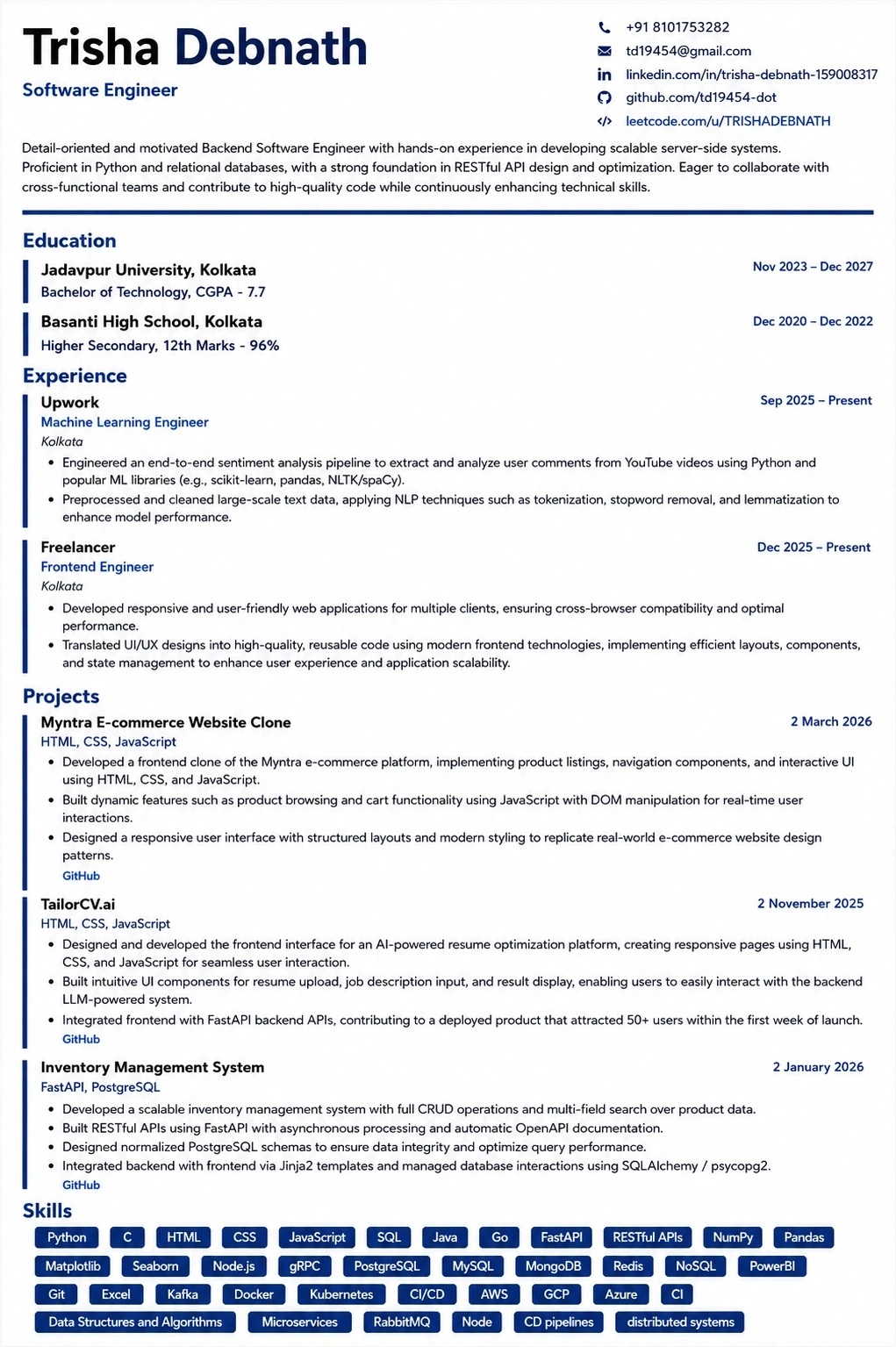
This template is ATS-tested — start from it and the formatting rules in this guide are already handled.
Was this guide useful?
Be the first to rate it.