 TD
TD
Key Takeaways
- Security clearance status is a critical, non-negotiable filter for government contractor job applications, often determining eligibility before resume review.
- Clearly state your clearance status at the top of your resume to ensure visibility for recruiters and screening software.
- Use specific keywords related to clearance levels, compliance frameworks, and relevant systems to align your resume with job descriptions.
- Tailor your experience to reflect specific compliance frameworks and contract types mentioned in the job posting to enhance your match.
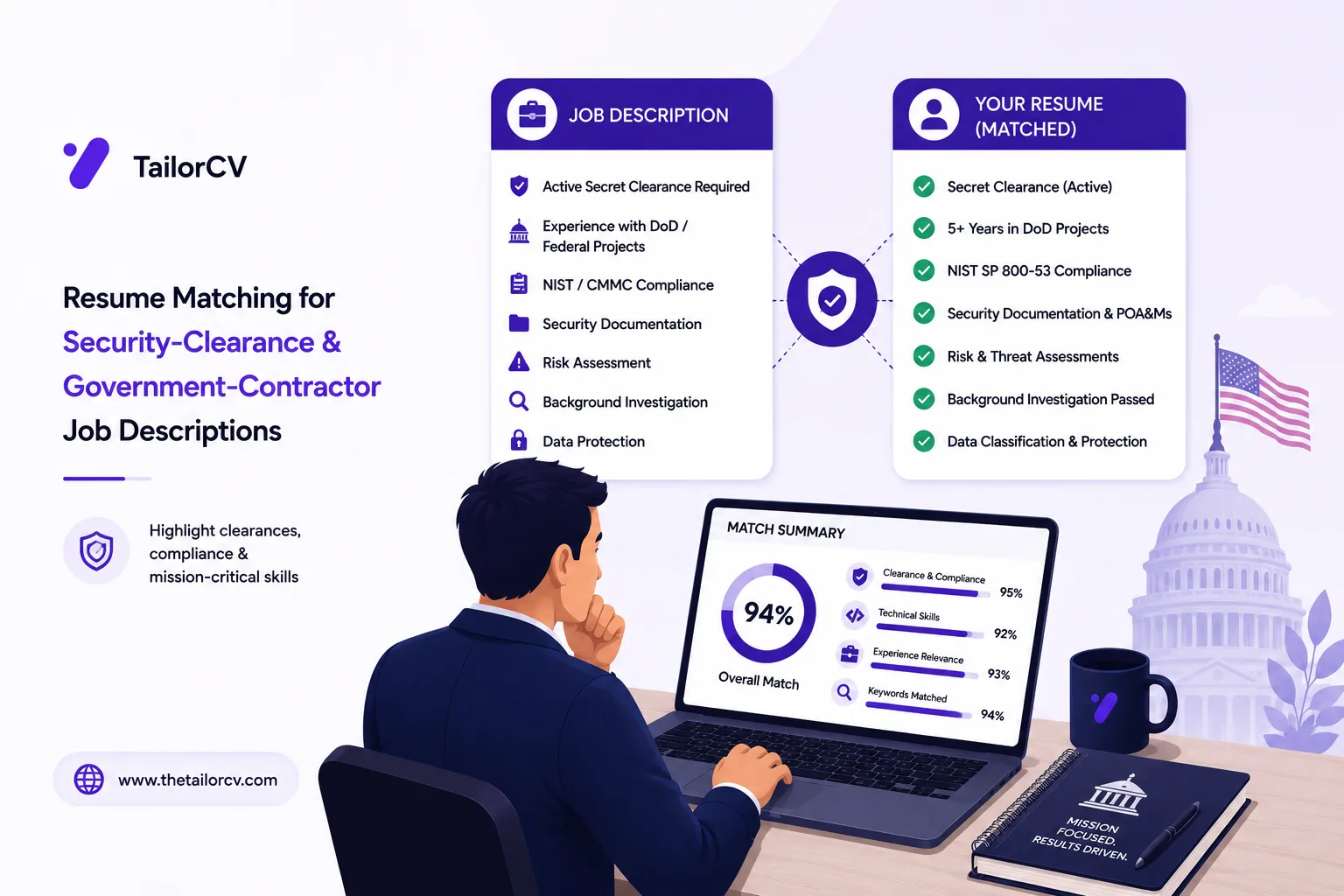
Security-clearance and government-contractor job descriptions operate under rules most other industries do not deal with. Clearance level is frequently a hard, non-negotiable filter, applied before a resume is even fully read, and the language used to describe programs, systems, and compliance frameworks is dense with acronyms that either match precisely or do not match at all.
This is different from the federal government resume guide, which covers USAJobs-style federal hiring formats. This guide focuses specifically on matching your resume to private-sector defense contractor and cleared-role job descriptions, where clearance status is the dominant filtering criterion.
Paste any cleared or contractor job posting into the TailorCV resume optimizer to see your match score and identify keyword gaps instantly.
Why Clearance Status Dominates the Matching Process
Unlike most job requirements, a security clearance cannot be earned quickly, transferred casually, or substituted with equivalent experience. This changes the matching calculus entirely:
- A posting requiring an active Top Secret clearance will typically filter out candidates without one, regardless of how strong the rest of the resume is
- Clearance status needs to be stated clearly and prominently, not buried mid-resume
- Many cleared roles cannot legally consider candidates without at least an interim clearance or clear eligibility path
Before investing time tailoring the rest of your resume, confirm whether you meet the clearance requirement, since this is functionally a hard filter in a way most other qualifications are not. Read required vs preferred qualifications for more on identifying hard filters versus flexible preferences.
How to State Your Clearance Status on Your Resume
| Status | How to State It |
|---|---|
| Active clearance | "Active TS/SCI Clearance" with the granting agency and, if relevant, polygraph status |
| Clearance eligible but inactive | "TS Clearance Eligible (Inactive, granted [Year])" |
| In the application process | "Security Clearance in Process" — only if genuinely true and verifiable |
| No clearance, but eligible to obtain one | "Eligible for Security Clearance" or state citizenship/eligibility factors directly if the posting asks |
| No clearance and not eligible | Do not apply to clearance-required roles; focus on non-cleared contractor or commercial positions instead |
Place clearance status near the top of your resume, in your summary or a dedicated header line, so it is immediately visible to both recruiters and screening software.
Keywords That Matter in Cleared and Government-Contractor Job Descriptions
| Category | Examples |
|---|---|
| Clearance levels | Secret, Top Secret, TS/SCI, Public Trust, polygraph (CI or full-scope) |
| Compliance frameworks | NIST 800-53, RMF, FedRAMP, DFARS, ITAR |
| Program and contract types | IDIQ, GWAC, prime contractor, subcontractor |
| Systems and tools | Specific government-approved software, cloud environments (GovCloud), classified systems |
| Agencies and branches | DoD, DHS, IC agencies, specific service branches |
Use the resume keywords guide to prioritize which of these terms belong in your summary versus supporting bullets, based on the specific posting.
Matching Your Experience to Contractor Job Descriptions
Government contractor postings often list specific compliance frameworks, contract vehicles, and agency experience as either required or strongly preferred:
- Name the specific compliance frameworks you have worked within (NIST 800-53, RMF, FedRAMP), not just "government compliance" generically
- Reflect the type of contract experience you have (prime vs. subcontractor) if the posting specifies it
- Match agency or branch experience directly where accurate, since many contractor roles value familiarity with a specific agency's processes
- Be precise with technical systems and tools named in the posting, since contractor environments are often highly specific
Read how to quantify resume achievements for guidance on presenting program scope and impact within security constraints (using unclassified, general descriptions where specifics cannot be disclosed).
What to Do If You Don't Have a Clearance Yet
If you are early in your career or transitioning from the commercial sector, a lack of clearance does not have to be a dead end:
- Target roles explicitly labeled as "Public Trust" or "clearance sponsorship available," which typically have a lower bar to entry
- Emphasize any factors relevant to eligibility (citizenship, clean background) if the posting requests this information
- Build experience in a non-cleared contractor role first, since many contracting companies sponsor clearances for strong employees once hired
Read resume tailoring for underqualified candidates for a broader framework on applying to roles where you do not yet meet every requirement.
Common Mistakes in Cleared-Role Resume Matching
Burying Clearance Status
If your clearance status is not immediately visible, near the top of your resume, recruiters and screening processes may pass over your application before finding it.
Overstating Clearance Status
Never claim an active clearance you do not currently hold. Clearance status is verifiable, and misrepresenting it can disqualify you immediately and damage your credibility for future opportunities.
Using Vague Compliance Language
"Familiar with government compliance requirements" is too generic. Name the specific frameworks (NIST 800-53, RMF, FedRAMP) that match the posting's exact language.
Formatting That Fails ATS Parsing
Review ATS resume formatting mistakes and use a clean, ATS-friendly template, since many contractor applications route through high-volume screening systems.
How TailorCV Helps With Cleared and Contractor Applications
Paste any cleared or government-contractor job posting into TailorCV's resume optimizer to identify missing compliance frameworks, contract-type language, and technical keywords instantly. TailorCV helps you present your clearance status and program experience clearly while checking your formatting against ATS parsing rules.
Step-by-Step Guide to Tailoring Your Resume for Security-Cleared Positions
- Analyze the Job Description: Start by thoroughly reading the job description. Highlight key phrases and requirements, especially those related to security clearance and specific skills. Use the Job Description Analysis Checklist Before You Apply to ensure you don't miss any critical elements.
Your resume after optimization
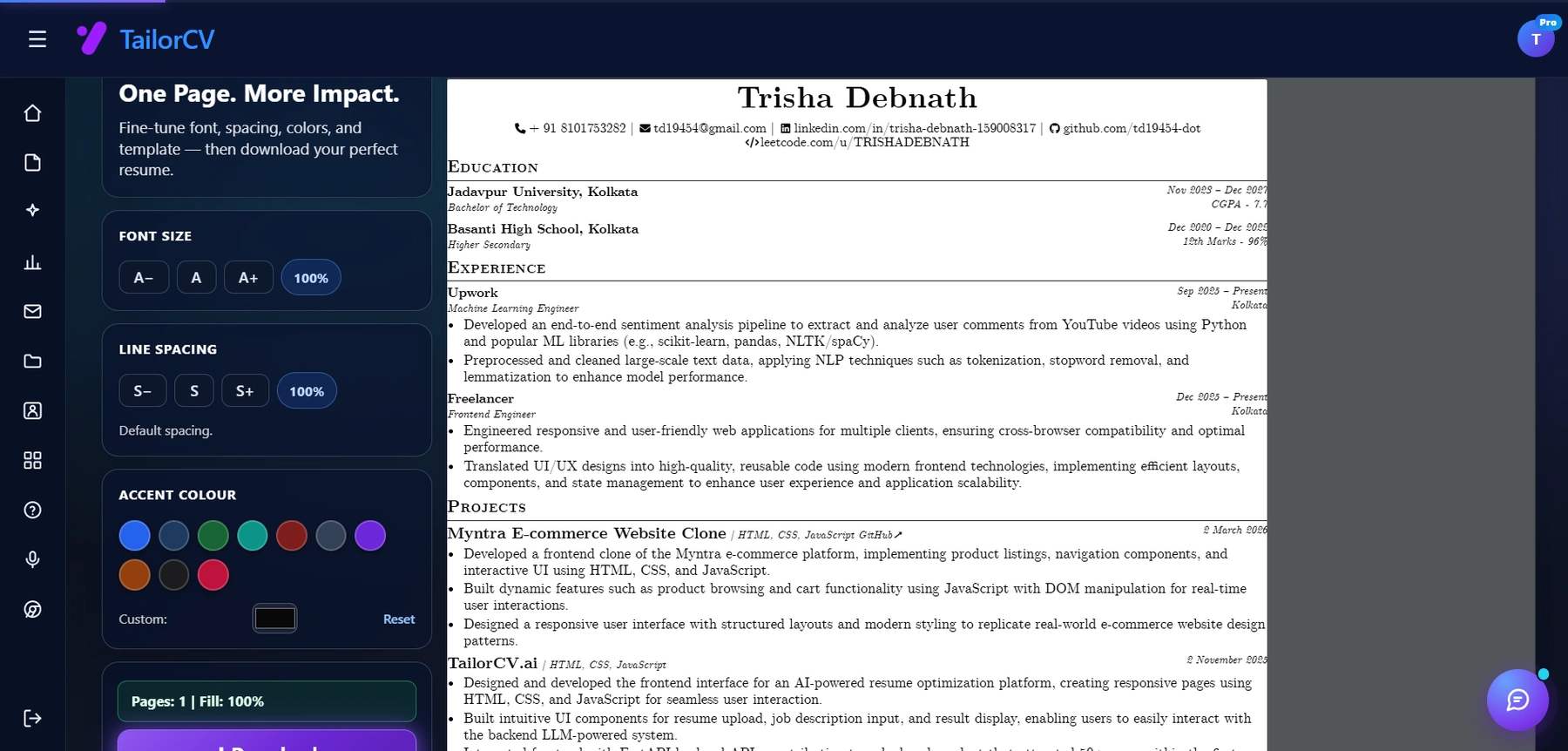
This is the resume after tailoring - the content is already matched, and these controls are how you fit it onto one page.
-
Create a Keyword Map: Once you've identified the keywords, create a keyword map. This visual representation will help you see how your experience matches the job requirements. Use our Resume Keyword Map Template - Match Your Resume to Any Job Description to efficiently organize your thoughts.
-
Match Your Experience: For each highlighted keyword, find a corresponding experience in your work history that demonstrates your qualifications. Be specific about your achievements and how they relate to the security-cleared role you’re applying for.
-
Adjust Your Resume Format: Ensure your resume is ATS-friendly. Use simple formatting, clear headings, and bullet points. Avoid images or complex designs that ATS may not read correctly.
-
Review and Edit: After tailoring your resume, take a break and return with fresh eyes. Look for clarity, conciseness, and relevance. Ensure every piece of information supports your candidacy for the security-cleared position.
Common Mistakes to Avoid When Tailoring Your Resume
-
Ignoring Soft Skills: Many job descriptions for cleared positions emphasize soft skills like teamwork and communication. Don’t overlook these; make sure to highlight relevant experiences that showcase these abilities. For tips on this, check out Matching Your Resume to the Soft Skills Buried in a Job Description.
-
Overloading with Irrelevant Information: Avoid cluttering your resume with experiences that don’t relate to the job. Each bullet point should serve a purpose—either highlighting relevant skills or demonstrating how you meet clearance requirements.
-
Failing to Customize for Each Application: Sending the same resume for multiple applications can be tempting, but it’s crucial to customize your resume for each job. Tailoring shows that you’ve put in the effort and are genuinely interested in the position.
-
Neglecting to Include Clearances: If you hold any relevant clearances, make sure they are prominently displayed. Misplacing this information can lead to missed opportunities.
-
Not Using Action Verbs: When detailing your experiences, use strong action verbs that convey your contributions effectively. Terms like "led," "developed," or "implemented" can make a significant difference in how your accomplishments are perceived.
Mini Checklist for Resume Tailoring
- unchecked: Read the Job Description Carefully: Highlight key requirements and phrases.
- unchecked: Create a Keyword Map: Identify relevant skills and experiences.
- unchecked: Use Action Verbs: Start each bullet point with a strong action verb.
- unchecked: Tailor Each Section: Ensure each part of your resume aligns with the job description.
- unchecked: Highlight Clearances: Clearly state your security clearance status.
- unchecked: Check ATS Compatibility: Ensure your resume is ATS-friendly.
- unchecked: Review Soft Skills: Incorporate relevant soft skills in your experiences.
- unchecked: Proofread: Check for spelling and grammatical errors.
Example Scenarios for Tailoring Your Resume
Scenario 1: You have experience in IT security but no direct clearance. In this case, emphasize your relevant certifications, such as CompTIA Security+, and detail your experience managing sensitive information securely. Highlight any projects that demonstrate your ability to work in a regulated environment.
Scenario 2: You are applying for a project management role with a clearance requirement. Focus on your project management experience, especially in government contracts, and include specific examples of how you’ve successfully managed teams and projects under security protocols.
Scenario 3: You are transitioning from a non-cleared role. Identify transferable skills from your previous positions, such as analytical skills, teamwork, and problem-solving abilities. Use these to demonstrate how you can apply your expertise in a cleared environment.
How to Match Your Portfolio to Security-Cleared Roles
Having a portfolio can significantly enhance your application for cleared positions. Here’s how to ensure your portfolio aligns with the job description:
-
Select Relevant Projects: Choose projects that showcase your skills required for the job. If the job emphasizes cybersecurity, include relevant case studies or work samples demonstrating your expertise.
-
Highlight Your Role: For each project, clarify your contributions and the outcomes. Use metrics where possible to quantify your results.
-
Tailor Project Descriptions: Ensure that the language used in your portfolio matches the job description. This not only shows your fit for the role but also enhances keyword optimization for ATS.
-
Include a Section on Security Practices: If applicable, provide examples of how you adhered to security protocols in your projects. This is particularly relevant for roles requiring a security clearance.
For more insights, explore How to Match Your Portfolio to the Job Description (Not Just Your Resume).
Frequently Asked Questions
Can I apply to a cleared role if my clearance has lapsed?
Often yes, especially if it lapsed recently, since many clearances can be reactivated faster than starting from scratch. State your status as "eligible for reactivation" or similar, and confirm the specific posting's requirements.
Should I list classified program details on my resume?
No. Only include unclassified, general descriptions of your work and impact. Never include classified information, program names, or details on a public-facing resume.
What if a posting requires a clearance I don't have but says "sponsorship available"?
This means the employer may sponsor your clearance process after hiring. It is worth applying, but be clear about your current eligibility status rather than implying you already hold the clearance.
Do government contractor companies use ATS software?
Yes, particularly larger defense contractors, which often receive high application volumes and use ATS or applicant management systems similar to private-sector enterprises.
How do I check my resume's match score for a cleared role?
Use the TailorCV ATS score checker to compare your resume against any cleared or contractor job posting and see your match percentage instantly. For a more detailed approach, consider using a resume keyword map template to ensure your resume aligns with the job description. Additionally, you may want to explore matching your resume to certification requirements if applicable.
Related Guides
- Resume Matching with Job Description - Complete Guide
- Federal Government Resume Guide
- Required vs Preferred Qualifications
- Matching Your Resume to Certification Requirements You Don't Have Yet
- Resume Tailoring for Underqualified Candidates
- ATS Resume Formatting Mistakes
- Cybersecurity Engineer Resume 2026
- How to Explain Resume Gaps
- ATS Score Guide 2026
- Resume Keywords Guide 2026
Conclusion
Clearance status is the single biggest filter in cleared and government-contractor hiring. State it clearly, be precise about compliance frameworks and contract types, and never misrepresent your eligibility.
Check your resume's match score against any cleared or contractor job posting with TailorCV before you apply.
Match My Resume to This Job - Free
What is your resume scoring right now?
Scan it against a job description and get your ATS match score in about a minute.
Drop your resume here or choose a file
PDF only. Max 2 MB.
We never share your data or use it to train AI models.

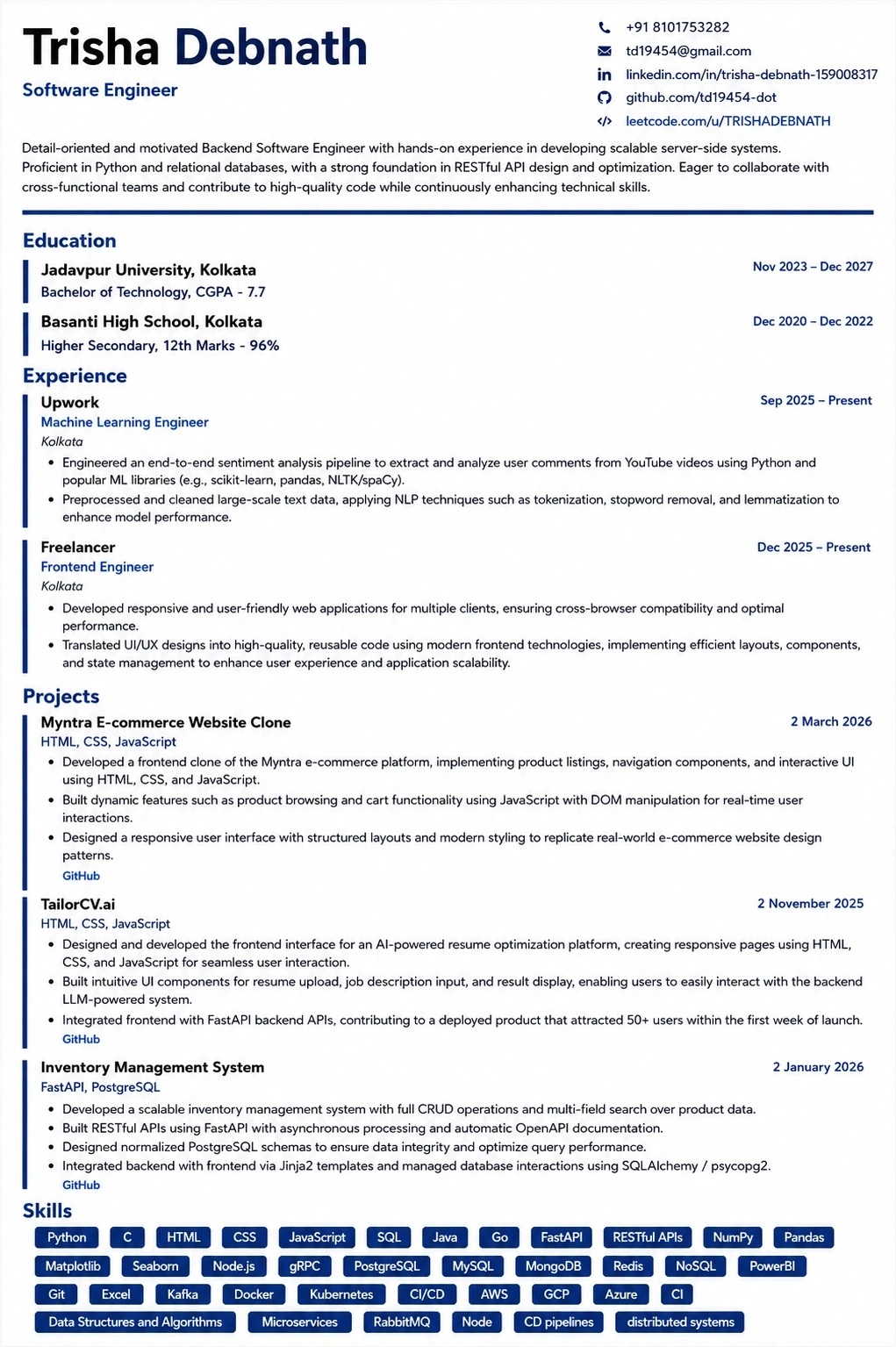
Templates that keep this structure intact
This template is ATS-tested — start from it and the formatting rules in this guide are already handled.
Was this guide useful?
Be the first to rate it.