 SS
SS

Key Takeaways
- A good ATS score is 80 or higher, indicating strong alignment with the job description and a high likelihood of passing automated filtering.
- Scores are categorized as follows: 90-100 (Excellent), 80-89 (Strong), 70-79 (Good), 60-69 (Moderate), and below 60 (At risk).
- ATS scores are relative to specific job descriptions, so always tailor your resume for each application and re-check your score.
- To improve your ATS score, mirror the job description, use ATS-friendly formatting, quantify achievements, and maintain a strong skills section.
- Common mistakes that lower ATS scores include using non-standard formatting, overlooking keywords, including irrelevant information, and ignoring job titles.
You ran your resume through a checker and got a number - but what does it actually mean? Is 65 good enough? Do you need a perfect 100? This guide explains what a good ATS score is, what each range means, and how to hit a competitive target.
Want your number first? Run your resume through the free ATS score checker, then come back to interpret it.
The Short Answer
A good ATS score is 80 or higher. At that level, your resume strongly matches the job description and is very likely to pass automated filtering and reach a recruiter.
Below is the full breakdown.
| ATS Score | Rating | What to Do |
|---|---|---|
| 90-100 | Excellent | Apply now - your resume is highly aligned |
| 80-89 | Strong | Apply; minor polish optional |
| 70-79 | Good | A few tweaks will push you over 80 |
| 60-69 | Moderate | Optimize keywords and formatting first |
| Below 60 | At risk | Likely filtered out - needs real work |
Why 80 Is the Target
ATS software ranks every applicant. Recruiters often review only the top-ranked resumes for a role that may have hundreds of applicants. A score of 80+ generally means:
- Your skills and keywords closely match the posting
- Your formatting parses cleanly
- Your job titles and experience align with the role
A score in the 60s might still be qualified on paper, but it risks being ranked below other candidates and never reviewed.
How ATS Scores Are Calculated
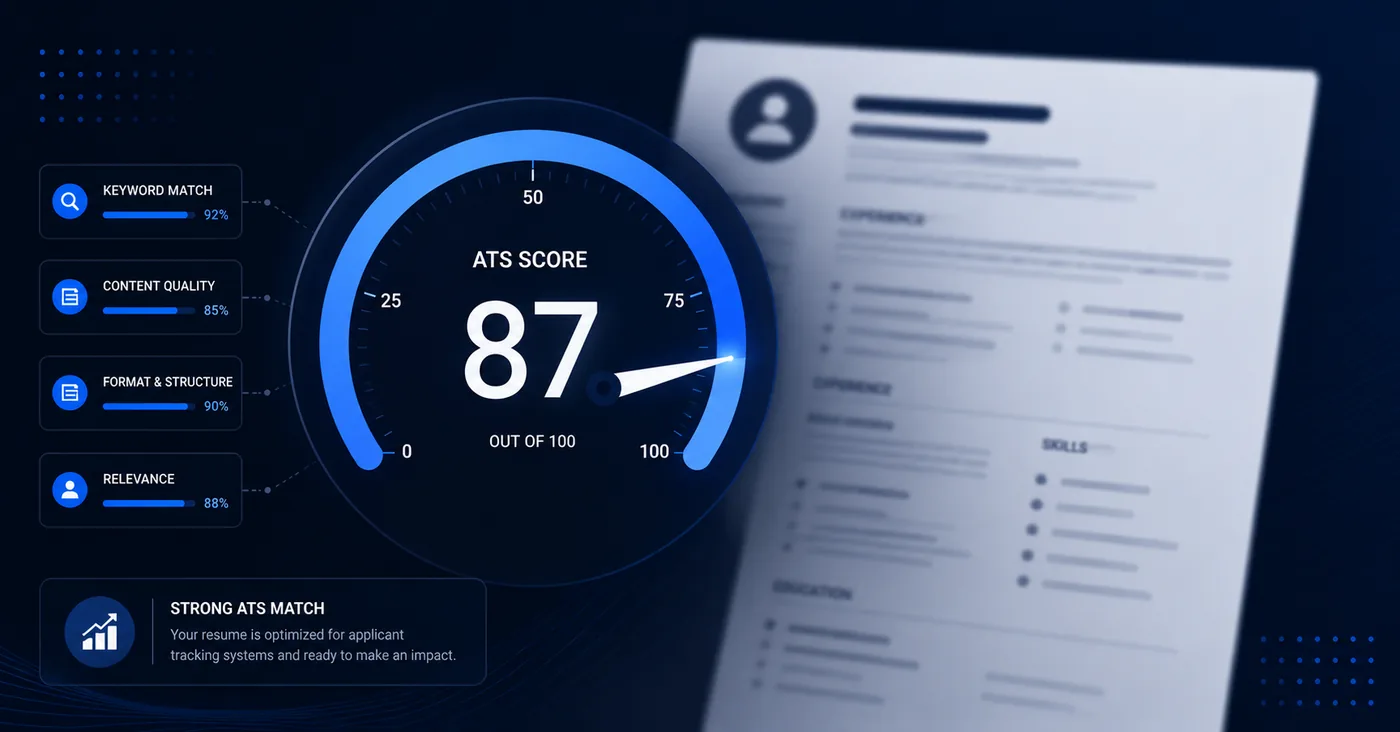
Different tools weight factors slightly differently, but the core components are consistent:
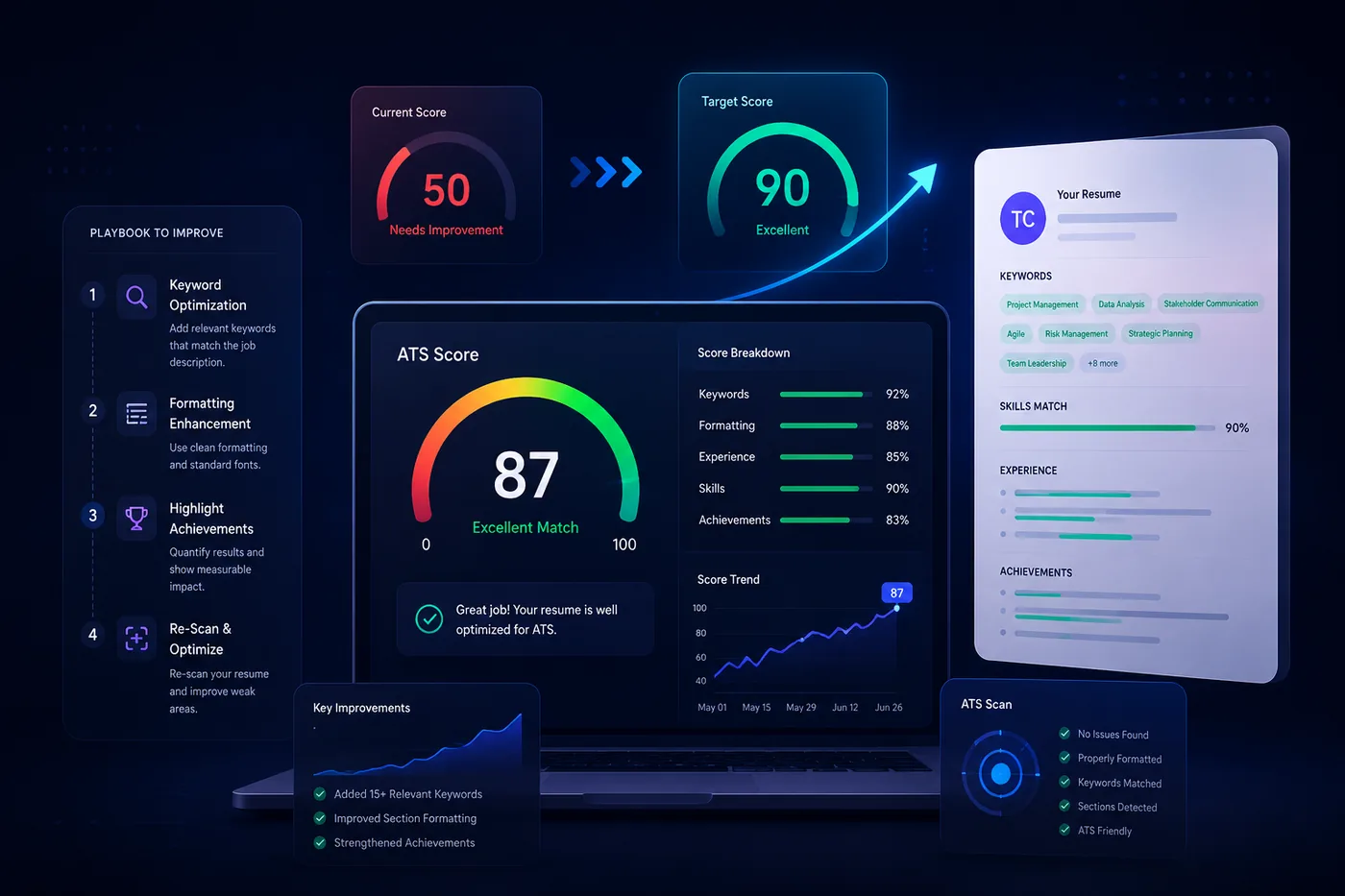
What an ATS score report actually shows you

Here is what that looks like in practice. The headline number (51/100 above) matters far less than the breakdown beside it: every check tells you what passed, what failed, and why it matters - a missing LinkedIn profile, a ten-skill gap against the posting, formatting the parser cannot read. That per-check list is what you actually work through, and it is the difference between knowing your score and knowing what to do about it.
| Factor | Approximate Weight |
|---|---|
| Keyword & skills match | 30-40% |
| Skills alignment | 20-25% |
| Formatting & parseability | 10-15% |
| Job title relevance | 10-15% |
| Experience quality | 10-20% |
| Education & certifications | 5-10% |
This is why a generic resume rarely scores well - it is not tailored to the specific keywords and titles in the job description. Learn how to fix that in how to tailor your resume for every job.
A "Good" Score Is Relative to the Job
There is no universal ATS score. The same resume can score 90 for one role and 55 for another, because the score measures the match between your resume and a specific job description.
That means:
- Always check your score against the exact job you are applying to
- Re-tailor and re-check for each application
- Do not assume one strong score covers every job
How to Reach a Good ATS Score
- Mirror the job description. Use the exact skills, tools, and titles listed. See the resume keywords guide.
- Use ATS-friendly formatting. Single column, standard headings, no tables or graphics. Start from an ATS-friendly template.
- Quantify your achievements. Numbers signal impact - see how to quantify resume achievements.
- Add a strong skills section with both technical and soft skills.
- Re-scan until you hit 80+. Use the ATS score checker after each edit.
For a full walkthrough, read how to increase your ATS score.
Common Mistakes That Lower Your ATS Score
When optimizing your resume for Applicant Tracking Systems (ATS), it's crucial to avoid common pitfalls that can negatively impact your score. Here are some frequent mistakes to steer clear of:
-
Using Non-Standard Formatting: ATS may struggle to read resumes with unusual fonts, graphics, or complex layouts. Stick to traditional formats like .docx or .pdf and use standard fonts like Arial or Times New Roman.
-
Overlooking Keywords: Failing to include relevant keywords from the job description can lead to a low score. Analyze the job posting and incorporate those terms naturally throughout your resume.
-
Including Irrelevant Information: Adding unrelated work experience or skills can dilute your ATS score. Focus on what is pertinent to the job you’re applying for.
-
Ignoring Job Titles: If your previous job titles were unique to your company, consider using standard titles that align with industry norms to ensure the ATS recognizes your experience.
-
Neglecting to Tailor Your Resume: Sending out a generic resume can significantly reduce your chances of passing the ATS filter. Customize your resume for each application, focusing on the specific requirements listed in the job description.
For a deeper understanding of how to avoid these pitfalls, check out our guide on How ATS Detects a Generic Resume - And Why It Filters You Out.
Step-by-Step: How to Tailor Your Resume for Better ATS Performance
To ensure your resume meets ATS requirements and achieves a good score, follow this step-by-step guide:
-
Analyze the Job Description: Highlight keywords and phrases that are repeated or emphasized. This includes required skills, qualifications, and specific job titles.
-
Choose the Right Format: Use a simple, clean format. Avoid tables and text boxes that ATS might misinterpret. A chronological or combination format is often best.
-
Incorporate Keywords: Integrate the identified keywords into your resume. Use them in your summary, work experience, and skills sections, maintaining a natural flow.
-
Use Standard Headings: Stick to conventional section titles like "Work Experience," "Education," and "Skills." This helps ATS easily categorize your information.
-
Edit for Clarity: Proofread your resume to remove any typos or errors. ATS can misread misspelled words, which could cost you points.
-
Test Your Resume: Before submitting, use an ATS Resume Checker - How It Works and How to Pass to evaluate your score and make necessary adjustments.
Do's and Don'ts for ATS Optimization
Do's
- Do Use Relevant Keywords: Tailor your resume to match the specific terminology used in the job description.
- Do Keep It Simple: Use a straightforward layout and avoid complicated graphics and fonts.
- Do Include Action Verbs: Start bullet points with strong action verbs to convey your achievements effectively.
- Do Save in the Right Format: Save your resume in a .docx or .pdf format unless otherwise specified.
Don'ts
| Type | What it involves |
|---|---|
| Don’t Stuff Keywords | Avoid overloading your resume with keywords; this can come off as unnatural and may even lead to disqualification |
| Don’t Use Uncommon Abbreviations | Always spell out acronyms the first time you use them to ensure clarity |
| Don’t Include Personal Information | Avoid putting sensitive information like your age, gender, or marital status, as these can lead to bias |
| Don’t Submit Without Testing | Always check your ATS score before sending your resume out to potential employers |
Scenario: A Real-Life Example of ATS Optimization
Let’s consider a scenario involving a marketing professional named Sarah. She applied for a digital marketing manager position but received a low ATS score.
Initial Resume Issues:
- Generic Keywords: Sarah's resume used phrases like "managed projects" instead of specific terms like "digital marketing campaigns."
- Complex Formatting: She included a colorful header that ATS couldn't read.
Optimization Steps:
- Keyword Analysis: Sarah highlighted terms like "SEO," "content marketing," and "social media strategy" from the job description.
- Format Change: She switched to a simple, clean format and removed the header.
- Tailoring Content: Sarah adjusted her bullet points to include the targeted keywords naturally.
Result:
After making these changes and testing her resume with an ATS checker, Sarah improved her score from 55 to 85, significantly increasing her chances of being noticed by hiring managers.
For more tips on how to enhance your ATS score, explore our article on How to Increase Your ATS Score From 50 to 90.
Mini Checklist for ATS Optimization
To help streamline your resume optimization process, use this mini checklist:
- unchecked: Have you analyzed the job description for keywords?
- unchecked: Is your resume formatted simply and clearly?
- unchecked: Are relevant keywords included throughout your resume?
- unchecked: Have you used standard headings for sections?
- unchecked: Did you proofread for errors and clarity?
- unchecked: Have you tested your resume with an ATS checker?
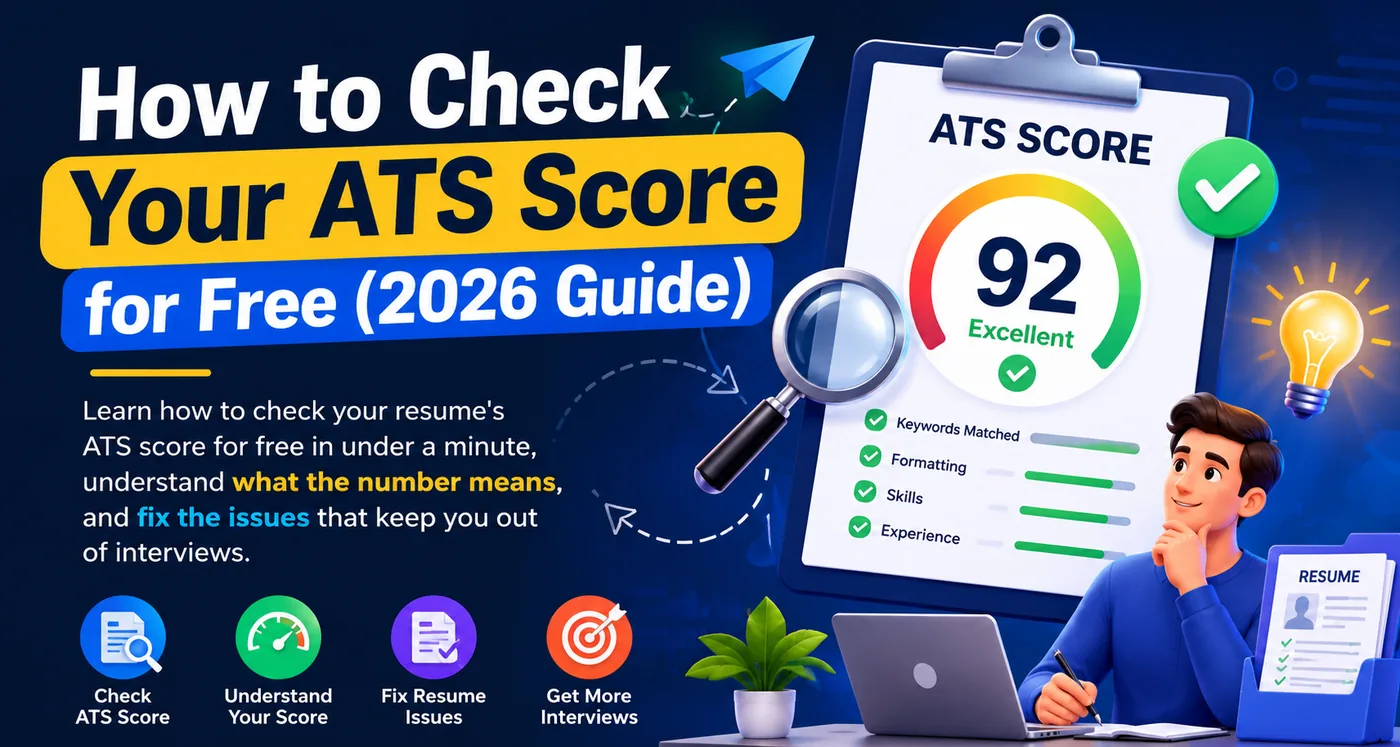
By following this checklist and the strategies outlined, you'll be well on your way to achieving a good ATS score, improving your job application success. For further insights, visit our guide on How to Check Your ATS Score for Free (2026 Guide).
Frequently Asked Questions
Is 70 a good ATS score?
70 is decent but not ideal. It usually means a few keywords or formatting issues are holding you back. With small tweaks you can reach 80+. For more insights, check out How to Increase Your ATS Score From 50 to 90 (2026).
Do I need a 100 ATS score?
No. A perfect score is not necessary. Anything 80 and above is competitive. Chasing 100 often leads to unnatural keyword stuffing, which can hurt you with human reviewers. To understand more about ATS scores, read What is an ATS Score and Why Does It Decide Your Job Application Before Any Human Reads It.
Why did my ATS score drop for a different job?
Because the score is calculated against that job's specific requirements. A different role means different keywords and a different match. Re-tailor for each application. For tips on tailoring your resume, see How ATS Detects a Generic Resume - And Why It Filters You Out.
What is a good ATS score for freshers?
The same target - 80+. Freshers can reach it by emphasizing projects, internships, and skills. See ATS score for freshers.
Related Guides
- How to Check Your ATS Score for Free
- Why Is My ATS Score So Low?
- How to Increase Your ATS Score
- ATS Score Guide for 2026
- How to Make Your Resume ATS-Friendly
- ATS Resume Checker - How It Works and How to Pass (2026)
- ATS Score vs Resume Score - What's the Difference? (2026)
- Does My Resume Pass ATS? A 12-Point Checklist (2026)
- Free ATS Resume Scan - Test Your Resume in 60 Seconds (2026)
- What is an ATS Score and Why Does It Decide Your Job Application Before Any Human Reads It
Make This Practical
Do not guess whether the resume is ready. Upload it to the free ATS score checker, compare the result with the ATS Score Guide, and fix formatting issues using ATS Resume Formatting Mistakes and ATS Resume Parser Friendly Format.
After the technical cleanup, improve relevance. Use Resume Matching With Job Description, strengthen keyword coverage with the Resume Keywords Guide, and avoid overdoing it by checking ATS Keyword Mistakes. If the layout itself is weak, rebuild with an ATS-friendly resume template.
Conclusion
A good ATS score is 80 or higher, measured against the specific job you want. Anything lower means there is room to improve your keywords, formatting, or achievements before you apply.
Check where you stand right now, then optimize until you are confidently in the 80+ range.
What is your resume scoring right now?
Scan it against a job description and get your ATS match score in about a minute.
Drop your resume here or choose a file
PDF only. Max 2 MB.
We never share your data or use it to train AI models.
Templates that keep this structure intact
This template is ATS-tested — start from it and the formatting rules in this guide are already handled.
Was this guide useful?
Be the first to rate it.