 TD
TD

Key Takeaways
- HR interviews focus on communication, self-awareness, and team fit, rather than tricking candidates.
- Understanding the category of a question can help tailor responses effectively, avoiding generic answers.
- Opening questions set the tone; use the Present → Past → Future framework for structured responses.
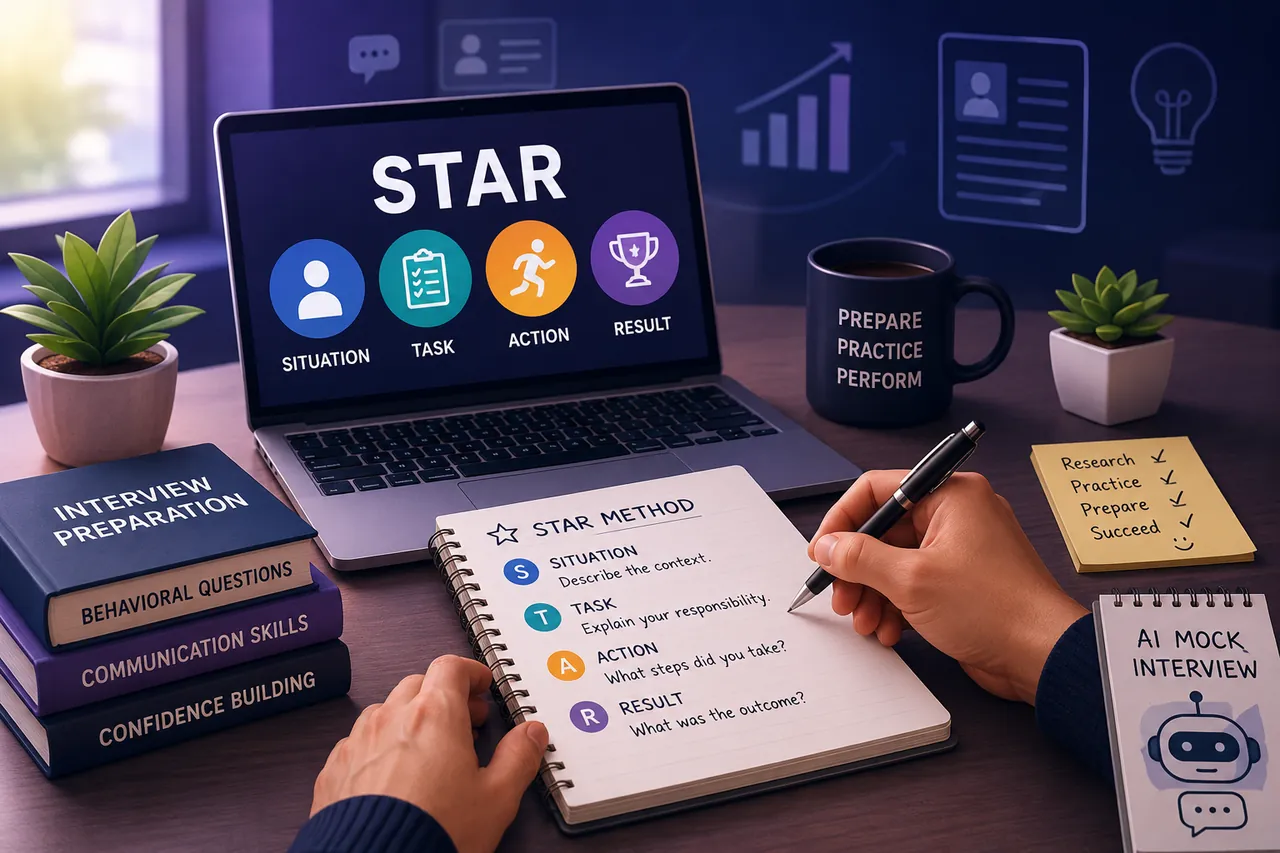
- Behavioral questions require real-life examples; use the STAR method (Situation, Task, Action, Result) to frame answers.
- Practicing with resume-based mock interviews is more effective than rehearsing generic responses.
Every job search eventually comes down to the same room, the same laptop screen, or the same phone call — and the same handful of questions asked in a hundred different orders.
HR rounds are not designed to trick you. They are designed to check three things: can you communicate clearly, do you actually understand your own resume, and will you fit the team. Most candidates lose points not because they lack the experience, but because they never rehearsed saying it out loud. That is exactly the gap free mock interview practice is built to close.
This guide walks through the top 50 HR interview questions asked in 2026, organized by category, with a framework for answering each type — not just a script to memorize.
Why HR Interview Questions Feel Repetitive (and Why That's Useful)
HR interviewers reuse the same core question set across industries and levels because the underlying signals never change: communication, self-awareness, motivation, and reliability. Once you understand the category a question belongs to, you can answer almost any variation of it.
See it in action: a resume-based mock interview
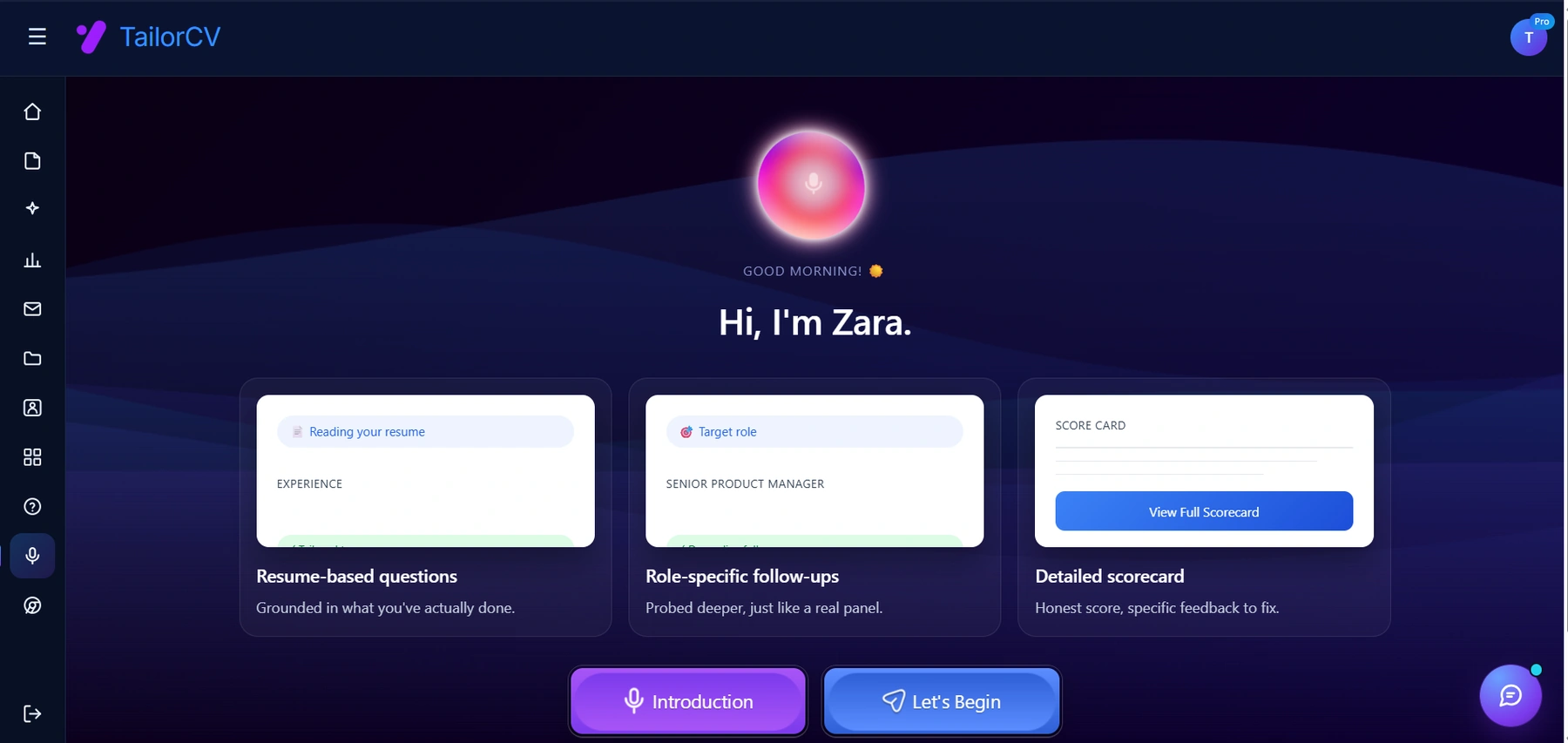
The useful part is the scorecard at the end - an honest score plus concrete feedback, which is what turns practice into an actual improvement.
That is also why generic answers cost interviews — the questions are predictable, but a good answer is not generic. It should be built from your actual resume, not a template. If your resume itself is vague, your answers will be too, so it is worth checking your ATS score and tailoring your resume before you start rehearsing.
Category 1: Opening & Icebreaker Questions
These set the tone. The interviewer is listening for structure and confidence, not just content.
- Tell me about yourself.
- Walk me through your resume.
- How did you hear about this role?
- What do you know about our company?
- Why do you want to work here?
- What are you currently doing?
- Why are you looking for a change?
- What does a typical day in your current role look like?
Framework: Present → Past → Future. Start with who you are today, briefly explain the path that got you here, and end with why this role is the logical next step. Full breakdown here: how to answer "tell me about yourself".
Sample answer to Q1:
"I'm a data analyst with four years of experience turning messy operational data into decisions leadership actually uses. Most recently, I built a churn-prediction dashboard that helped my team cut customer attrition by 12%. I'm looking for a role where I can work closer to product strategy, which is what drew me to this position."
Notice this answer only works because it is built from a real resume bullet — which is exactly why resume-based mock interview practice is more useful than rehearsing generic answers: it asks you about your dashboard, not a hypothetical one.
For "why do you want to work here," always tie it back to something specific about the company — see how to research a company before an interview for a repeatable method.
Category 2: Behavioral Questions (STAR Method)
Behavioral questions ask you to prove a claim with a real story. These are the hardest to improvise and the easiest to prepare for.
- Tell me about a time you faced a conflict at work.
- Describe a situation where you missed a deadline.
- Tell me about a time you failed.
- Describe a time you had to persuade someone.
- Tell me about a time you worked under pressure.
- Give an example of a time you took initiative.
- Tell me about a time you disagreed with your manager.
- Describe a time you had to learn something quickly.
- Tell me about a mistake you made and how you fixed it.
- Give an example of a time you went above and beyond.
Framework: Situation, Task, Action, Result (STAR). Keep the Situation and Task brief — most candidates over-explain context and run out of time before the Result, which is the part that actually matters. A full walkthrough with more examples is here: behavioral interview questions and answers.
Sample answer to Q11 (failure question):
"Early in a product launch, I underestimated how long QA would take and promised a date I couldn't hit. I flagged it to my manager as soon as I saw the risk instead of waiting, we renegotiated the timeline with stakeholders, and I built a buffer into every estimate since. That habit has kept every project after it on schedule."
The failure question is not really about the failure — it is about ownership and what changed afterward. Interviewers are listening for whether you learned something, not whether you are perfect.
Category 3: Strengths, Weaknesses & Self-Awareness
- What is your greatest strength?
- What is your greatest weakness?
- How would your manager describe you?
- How would your colleagues describe you?
- What motivates you at work?
- What is your biggest professional achievement?
- What do you do when you don't know the answer to something?
- How do you handle criticism?
Framework: For weaknesses, pick something real but not disqualifying for the role, and always end on the corrective action — the growth matters more than the flaw. For strengths, choose one that is directly relevant to the job description, not the most impressive-sounding one.
If you're unsure which strengths to lead with, they should mirror the language already in your resume — see soft skills for resume and make sure your resume summary matches the job description before the interview, so your spoken answers and written resume tell the same story.
Category 4: Motivation, Career Goals & Fit
- Where do you see yourself in five years?
- Why should we hire you?
- Why are you leaving your current job?
- What are you looking for in your next role?
- What type of work environment do you thrive in?
- Are you interviewing elsewhere?
- What is your ideal manager like?
- How do you define success?
Framework: These questions test alignment, not ambition. "Why should we hire you" is really asking "what is the business case for choosing you over the other candidates" — the same question an executive resume has to answer in writing, just spoken out loud.
For "why are you leaving," always frame it forward — toward what you're moving to, not what you're moving away from. If there's a gap or a difficult exit involved, prepare that separately; see how to explain resume gaps so the written and spoken versions of your story match.
Category 5: Situational & Problem-Solving Questions
- How would you handle a disagreement with a teammate?
- What would you do if you disagreed with a decision from leadership?
- How do you prioritize when everything feels urgent?
- What would you do in your first 90 days in this role?
- How do you handle ambiguity?
- What would you do if you realized you made an error after a project shipped?
Framework: These are hypothetical, but treat them like behavioral questions — ground your answer in a real instinct or past pattern rather than a purely theoretical process. Question 38 in particular is worth preparing properly; see first 90 days at a new job for a credible structure (listen and learn, quick wins, longer-term contributions).
Category 6: Team, Culture & Collaboration
- How do you handle working with a difficult colleague?
- Do you prefer working independently or in a team?
- How do you build relationships with new teammates?
- Tell me about a time you gave difficult feedback to a peer.
- What does good teamwork look like to you?
Framework: Interviewers are checking for maturity and self-regulation here, not conflict-avoidance. A good answer names the friction honestly, then shows a repeatable, respectful process for resolving it.
Category 7: Logistics & Closing Questions
- What are your salary expectations?
- When can you start?
- Do you have any questions for us?
- Is there anything else you'd like us to know?
- What would make you accept an offer from us over another company?
Framework: For salary, give a researched range rather than a single number or an evasive non-answer — see how to negotiate a salary offer for how to set that range and when to hold it.
Question 48 is not optional — showing up with no questions signals low genuine interest. Always have two or three ready; see questions to ask in an interview for strong options by round.
If this is a later round, the questions get sharper and more specific to your candidacy — see resume tailoring for a second interview and final round interview tips for what changes.
Sample Answers to All 50 Questions
Use these as starting frameworks, not scripts — swap in your own numbers, projects, and language so the answer sounds like you, not a template. If you want answers generated directly from your own resume instead of generic ones, that's exactly what a free AI mock interview is built to do.
Opening & Icebreaker
- Tell me about yourself. "I'm a [role] with [X] years in [field]. Most recently, I [key achievement with a number]. I'm looking for a role where I can [specific growth area], which is why this position caught my eye."
- Walk me through your resume. "I started in [first relevant role], where I learned [core skill]. From there I moved to [next role] to take on more [responsibility], and most recently at [current company] I've focused on [current focus]. Each move added a layer of responsibility toward the kind of work I'd be doing here."
- How did you hear about this role? "A former colleague who works on your [team name] mentioned the opening, and after reading the job description I realized it lines up closely with the [specific work] I've been doing."
- What do you know about our company? "You recently [specific initiative, product launch, or news item], and your focus on [company value or market position] stood out to me because it aligns with how I like to work."
- Why do you want to work here? "I've followed your work in [specific area] for a while, and the chance to apply my [skill] to [specific company challenge] is exactly the kind of problem I want to be solving next."
- What are you currently doing? "I'm currently a [title] at [company], where I own [specific responsibility] and recently delivered [result]."
- Why are you looking for a change? "I've grown a lot in my current role, but I've reached the point where the next step in my growth — [specific skill or scope] — isn't available there, which is what's drawing me to this position."
- What does a typical day in your current role look like? "My day usually starts with [priority-setting activity], followed by [core work], and I typically close the day with [collaboration or review step] to keep things moving for the team."
Behavioral (STAR)
- Tell me about a time you faced a conflict at work. "Two teammates disagreed on [approach] for a project I was leading. I set up a short meeting where each explained their reasoning, we identified the shared goal, and combined the strongest parts of both approaches — the project shipped on time and both teammates felt heard."
- Describe a situation where you missed a deadline. "I underestimated the scope of a [project type] and realized midway I'd miss the date. I flagged it immediately with a revised timeline and a plan to protect the most critical piece, and since then I build a buffer into every estimate."
- Tell me about a time you failed. "Early in a launch, I promised a date QA couldn't hit. I owned it as soon as I saw the risk, we renegotiated with stakeholders, and I've built buffer time into every estimate since — every project after it has stayed on schedule."
- Describe a time you had to persuade someone. "My manager wanted to launch a feature without user testing. I put together a quick data summary showing the risk, proposed a one-week test that wouldn't delay the timeline much, and we ran it — it caught an issue that would have cost far more to fix post-launch."
- Tell me about a time you worked under pressure. "During a product outage, I was responsible for coordinating the fix across three teams within a two-hour SLA. I triaged by impact, delegated clearly, and we resolved it in 90 minutes with a clean postmortem afterward."
- Give an example of a time you took initiative. "I noticed our onboarding process had no documentation, so I built a step-by-step guide on my own time. It's now used to onboard every new hire on the team and cut ramp-up time by roughly two weeks."
- Tell me about a time you disagreed with your manager. "My manager wanted to cut a testing phase to hit a deadline. I laid out the specific risk and a lower-cost alternative that kept most of the timeline intact — they agreed to the compromise, and it avoided a bug that would have affected customers."
- Describe a time you had to learn something quickly. "I was asked to take over a project built in a tool I'd never used. I spent a weekend in documentation and tutorials, paired with a teammate for the first few days, and was contributing independently within a week."
- Tell me about a mistake you made and how you fixed it. "I sent a report with an outdated dataset to leadership. I corrected it within the hour, flagged exactly what changed and why, and added a version-check step to my process so it hasn't recurred."
- Give an example of a time you went above and beyond. "A client needed a deliverable moved up by a week due to a change on their end. I reprioritized my other work, coordinated with two teammates to split the load, and we delivered two days early — the client renewed their contract shortly after."
Strengths, Weaknesses & Self-Awareness
- What is your greatest strength? "I'm good at breaking ambiguous problems into a clear plan — on my last project, that meant turning a vague 'improve retention' goal into three testable initiatives, one of which cut churn by 12%."
- What is your greatest weakness? "I used to take on too much myself instead of delegating. I've gotten better by explicitly blocking out delegation points at the start of a project, which has also freed me up for more strategic work."
- How would your manager describe you? "Reliable and low-drama — someone who flags problems early rather than letting them surface as surprises."
- How would your colleagues describe you? "Someone who's easy to bring a half-formed idea to, because I'll help shape it rather than just critique it."
- What motivates you at work? "I get the most energy from solving problems where I can see a direct link between my work and a real outcome — a metric moving, a process getting faster."
- What is your biggest professional achievement? "Leading a project that reduced onboarding time by 30% — it required buy-in from three teams, and seeing it become the new default process was the most satisfying part."
- What do you do when you don't know the answer to something? "I say so directly, then either find the answer myself or find the person who has it — I've found that's far more trusted than guessing."
- How do you handle criticism? "I try to separate the feedback from my ego in the moment, ask a clarifying question if needed, and look for the one actionable thing in it — even when it's delivered bluntly."
Motivation, Career Goals & Fit
- Where do you see yourself in five years? "I'd like to have grown into a [target role/scope], having built deep expertise in [specific area] — this role's focus on [relevant aspect] is a strong step in that direction."
- Why should we hire you? "I bring [specific, relevant experience] directly to the challenge you described in this role — [specific example] — and I'm someone who ramps quickly and takes ownership without needing much oversight."
- Why are you leaving your current job? "I've grown as much as I can in my current scope, and I'm looking for a role with more [ownership/scope/specific challenge], which is what drew me here."
- What are you looking for in your next role? "I'm looking for more ownership over [specific area], a team that values [specific value], and a chance to work on [specific type of problem]."
- What type of work environment do you thrive in? "I do my best work with clear goals and autonomy on how to reach them, alongside a team I can check in with when something's ambiguous."
- Are you interviewing elsewhere? "I'm in early conversations with a couple of companies, but this role is the one I'm most excited about given [specific reason]."
- What is your ideal manager like? "Someone who sets clear expectations, gives direct feedback, and trusts me to figure out the how once the what is clear."
- How do you define success? "For me it's the combination of a measurable result and a team that's better off — a good outcome that burns people out isn't really a win."
Situational & Problem-Solving
- How would you handle a disagreement with a teammate? "I'd raise it directly and privately, focus on the shared goal rather than who's right, and if we couldn't align, bring in a manager for a tiebreak rather than letting it fester."
- What would you do if you disagreed with a decision from leadership? "I'd voice my concern once, clearly and with data if I have it, and then commit fully to the decision once it's made — repeated relitigating isn't useful."
- How do you prioritize when everything feels urgent? "I sort by actual business impact and deadline rigidity rather than who's asking loudest, and I communicate the tradeoffs clearly so stakeholders aren't surprised."
- What would you do in your first 90 days in this role? "The first month I'd focus on listening — understanding the team, the systems, and where the real friction is. The second month I'd target one or two quick wins. By month three I'd be contributing to a longer-term initiative."
- How do you handle ambiguity? "I start by defining what I do know, make a reasonable assumption for what I don't, state that assumption out loud to the team, and adjust as more information comes in rather than waiting for perfect clarity."
- What would you do if you realized you made an error after a project shipped? "Flag it immediately, propose a fix and a timeline, and communicate proactively rather than waiting for someone else to catch it."
Team, Culture & Collaboration
- How do you handle working with a difficult colleague? "I try to understand what's driving the friction first — often it's a difference in working style rather than intent — and adjust how I communicate with them accordingly."
- Do you prefer working independently or in a team? "I like a mix — independent focus time for deep work, with regular touchpoints to stay aligned, since the best outcomes usually combine both."
- How do you build relationships with new teammates? "I make a point of having a low-stakes one-on-one early on to understand how they like to work, not just what they work on."
- Tell me about a time you gave difficult feedback to a peer. "A teammate's work was consistently missing a step in our process. I raised it privately and specifically, focused on the impact rather than the person, and we agreed on a checklist that solved it going forward."
- What does good teamwork look like to you? "Clear ownership, honest communication when something's off track, and people who help each other without being asked."
Logistics & Closing
- What are your salary expectations? "Based on my research for this role and level, I'm targeting a range of [X to Y], though I'm open to discussing the full package."
- When can you start? "I'd need to give [standard notice period] to my current employer, so I could start on [specific date]."
- Do you have any questions for us? "Yes — what does success look like in this role after the first six months, and what's the biggest challenge the team is facing right now?"
- Is there anything else you'd like us to know? "Just that I'm genuinely excited about this specific role — the focus on [specific aspect] is exactly the kind of work I want to be doing next."
- What would make you accept an offer from us over another company? "Honestly, the scope of ownership in this role and what I've heard about the team culture — that matters as much to me as the title or comp."
How to Actually Prepare These 50 Answers
Reading this list is step one. Saying the answers out loud, under time pressure, is what actually builds recall under stress. A simple routine:
- Tailor your resume first. Your answers should echo the language of your resume, not contradict it — check your resume against the job description before you rehearse.
- Pick 4–5 stories from your career that can flex across multiple behavioral questions (a conflict story, a failure story, an initiative story, a pressure story).
- Practice out loud, not silently. Use a free AI mock interview that asks questions generated from your actual resume, so you're rehearsing the exact follow-ups a real interviewer would ask.
- Adapt for format. A phone interview and a virtual interview reward different things — pacing and clarity on the phone, eye contact and framing on video.
- Prepare for technical or panel rounds separately if your role includes them — see the technical interview preparation guide, coding interview preparation guide, or system design interview guide depending on the role.
- Avoid the common traps. Rambling, vague answers, and no questions at the end are the most frequent reasons candidates lose an HR round — see common interview mistakes to avoid.
- Follow up afterward. How you close the loop matters almost as much as how you answered — see how to follow up after an interview.
What If You Get Rejected Anyway?
Even a well-prepared HR round doesn't guarantee an offer — sometimes it's fit, budget, or an internal candidate, not your answers. If that happens, it's worth understanding why you might be getting rejected and how to handle job rejection constructively so the next round goes better. Before your next application, double check your LinkedIn profile is aligned with your resume — recruiters check both, and a mismatch raises questions before you even get to the interview.
FAQ
What are the most commonly asked HR interview questions?
"Tell me about yourself," "why should we hire you," "what is your greatest weakness," and "where do you see yourself in five years" appear in almost every HR round, across industries and experience levels.
How do I answer "tell me about yourself" for an HR interview?
Use a Present → Past → Future structure: what you do now, the relevant path that led here, and why this specific role is the next logical step. See the full guide for examples.
Should I memorize answers to these 50 questions?
No — memorize your stories, not your sentences. Prepare 4–5 flexible stories from your resume and adapt them to whichever specific question is asked, so your answers sound natural instead of recited.
How can I practice these questions realistically?
The most effective method is speaking answers out loud to questions generated from your own resume, followed by feedback on structure and clarity — which is what a free AI mock interview is designed for.
Do HR interview questions differ by industry or seniority?
The core categories stay the same, but the depth changes. Senior and executive candidates get more strategic and leadership-focused variations — see the executive resume tailoring guide for how expectations shift at that level. For more insights on behavioral questions, check out the STAR Method Interview Guide and learn how to effectively use the STAR Method for Interview Answers.
Related Guides
- Behavioral Interview Questions and Answers
- How to Prepare for a Job Interview in 2026
- Common Interview Mistakes to Avoid
- How to Answer "Tell Me About Yourself"
- Questions to Ask in an Interview
- Phone Interview Tips
- Virtual Interview Tips
- Final Round Interview Tips
- How to Follow Up After an Interview
- How to Negotiate a Salary Offer
- Free Mock Interview Practice
Final Thoughts
Fifty questions sound like a lot to prepare — but they collapse into about seven categories, each with a predictable framework. Once your resume is sharp and your stories are ready, most HR rounds stop feeling unpredictable and start feeling like a conversation you've already had once, in practice.
Start by making sure your resume tells the same story you're about to tell out loud — check and tailor it here — then run a free AI mock interview built from your own experience to rehearse the exact version of these 50 questions you're most likely to be asked.
Practice My Interview Answers — Free
Was this guide useful?
Be the first to rate it.