 SS
SS

Key Takeaways
- System design interviews assess your ability to architect scalable and reliable systems, focusing on reasoning and trade-off analysis rather than a single correct answer.
- Follow a structured framework: clarify requirements, estimate scale, define the API, create a high-level design, deep dive into components, and address bottlenecks and trade-offs.
- Understand core concepts such as scalability (vertical vs. horizontal), load balancing, caching strategies, and database types (SQL vs. NoSQL).
- Familiarize yourself with the CAP theorem, which states that in a distributed system, you can only achieve two of consistency, availability, and partition tolerance.
- Practice designing systems with real-world examples, such as a URL shortener, to solidify your understanding of requirements, scaling, and caching strategies.
The system design interview evaluates your ability to architect scalable, reliable systems. Unlike coding interviews with a single correct answer, system design interviews assess your reasoning, trade-off analysis, and breadth of architectural knowledge. They are standard for mid-level and senior engineering roles.
This guide gives you a repeatable framework and walks through the concepts and common questions you need to master.
This pairs with the broader technical interview preparation guide and coding interview guide. Before interviews, optimize your resume with the TailorCV ATS score checker and practice with the mock interview tool.
The System Design Framework (Use This Every Time)
Step 1: Clarify Requirements (5 minutes)
Never start designing immediately. Ask questions:
Functional requirements: What features must the system support? Non-functional requirements: How many users? How much data? Read-heavy or write-heavy? Latency requirements? Availability requirements?
Example for a URL shortener:
- Functional: shorten a URL, redirect to original, custom aliases, analytics
- Non-functional: 100M URLs/day, read:write ratio of 100:1, low-latency redirects
Step 2: Estimate Scale (3 minutes)
Do back-of-envelope calculations:
- Requests per second (RPS)
- Storage requirements
- Bandwidth
- Cache size
This shows the interviewer you think about scale concretely.
Step 3: Define the API (3 minutes)
Sketch the core API endpoints:
- POST /shorten {long_url} -> {short_url}
- GET /{short_code} -> 302 redirect
Step 4: High-Level Design (10 minutes)
Draw the major components:
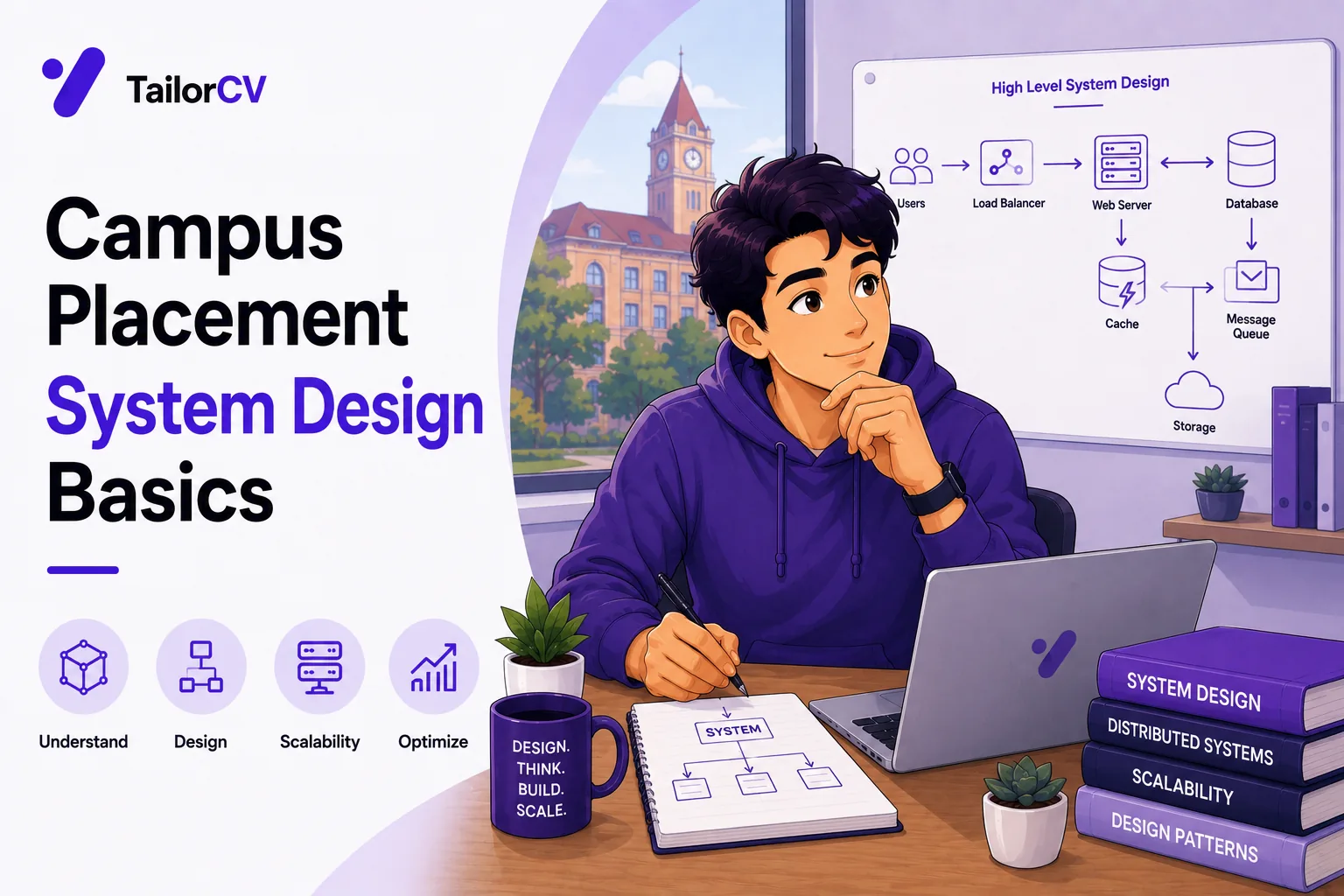
- Client -> Load Balancer -> Application Servers -> Database
- Add caching, CDN, message queues as needed
Step 5: Deep Dive (10 minutes)
Go deep on the most interesting components:
- Database schema and choice (SQL vs NoSQL)
- How to generate unique short codes
- Caching strategy
- Handling hot URLs
Step 6: Address Bottlenecks & Trade-offs (5 minutes)
- What happens at 10x scale?
- Single points of failure?
- Consistency vs availability trade-offs?
Core Concepts You Must Understand
Scalability
- Vertical scaling: bigger machine (limited, single point of failure)
- Horizontal scaling: more machines (preferred for large scale)
Load Balancing
Distributes traffic across servers. Know round-robin, least-connections, and consistent hashing.
Caching
- Application cache: Redis, Memcached
- CDN: caches static content close to users
- Cache strategies: cache-aside, write-through, write-back
- Eviction policies: LRU, LFU, TTL
Databases
- SQL: strong consistency, ACID, relational (PostgreSQL, MySQL)
- NoSQL: scalability, flexible schema (MongoDB, Cassandra, DynamoDB)
- Sharding: horizontal partitioning of data
- Replication: copies for read scaling and failover
- Indexing: speeds up reads, slows down writes
CAP Theorem
In a distributed system, you can have only 2 of: Consistency, Availability, Partition tolerance. Understand the trade-offs.
Message Queues
Kafka, RabbitMQ, SQS - decouple services, handle async processing, smooth traffic spikes.
Consistency Models
- Strong consistency: every read gets the latest write
- Eventual consistency: reads may be stale temporarily, but converge
Walkthrough: Design a URL Shortener
Requirements: Shorten URLs, redirect, 100M new URLs/day, read-heavy.
Scale: 100M writes/day ≈ 1,160 writes/sec. Reads at 100:1 ≈ 116K reads/sec.
API:
- POST /shorten -> returns short code
- GET /{code} -> 302 redirect
Short code generation: Base62 encoding of an auto-incrementing ID, or a hash with collision handling. 7 characters of Base62 gives 62^7 ≈ 3.5 trillion URLs.
Database: Key-value store (DynamoDB or Redis) mapping short code -> long URL. Read-heavy workload suits a NoSQL store with heavy caching.
Caching: Cache hot URLs in Redis. With 100:1 read ratio, caching dramatically reduces database load.
Scaling: Load balancer + multiple app servers (stateless). Database sharding by short code. CDN for the redirect service.
Walkthrough: Design a Chat System (WhatsApp)
Requirements: 1-on-1 messaging, group chat, online status, message delivery receipts, 500M users.
Key components:
- WebSocket connections for real-time messaging
- Message queue for delivery
- Database for message persistence (Cassandra for write-heavy, time-series messages)
- Presence service for online status
- Notification service for offline users (push notifications)
Deep dive: How to handle a user who is offline (store and forward), how to deliver to all group members (fan-out), how to scale WebSocket connections (connection servers + a pub/sub layer like Redis).
Common System Design Questions
- Design a URL shortener (TinyURL)
- Design a social media feed (Twitter, Instagram)
- Design a chat application (WhatsApp, Slack)
- Design a ride-sharing service (Uber, Lyft)
- Design a video streaming platform (YouTube, Netflix)
- Design a rate limiter
- Design a notification system
- Design a distributed cache
- Design an e-commerce system (Amazon)
- Design a search autocomplete system
See it in action: a resume-based mock interview
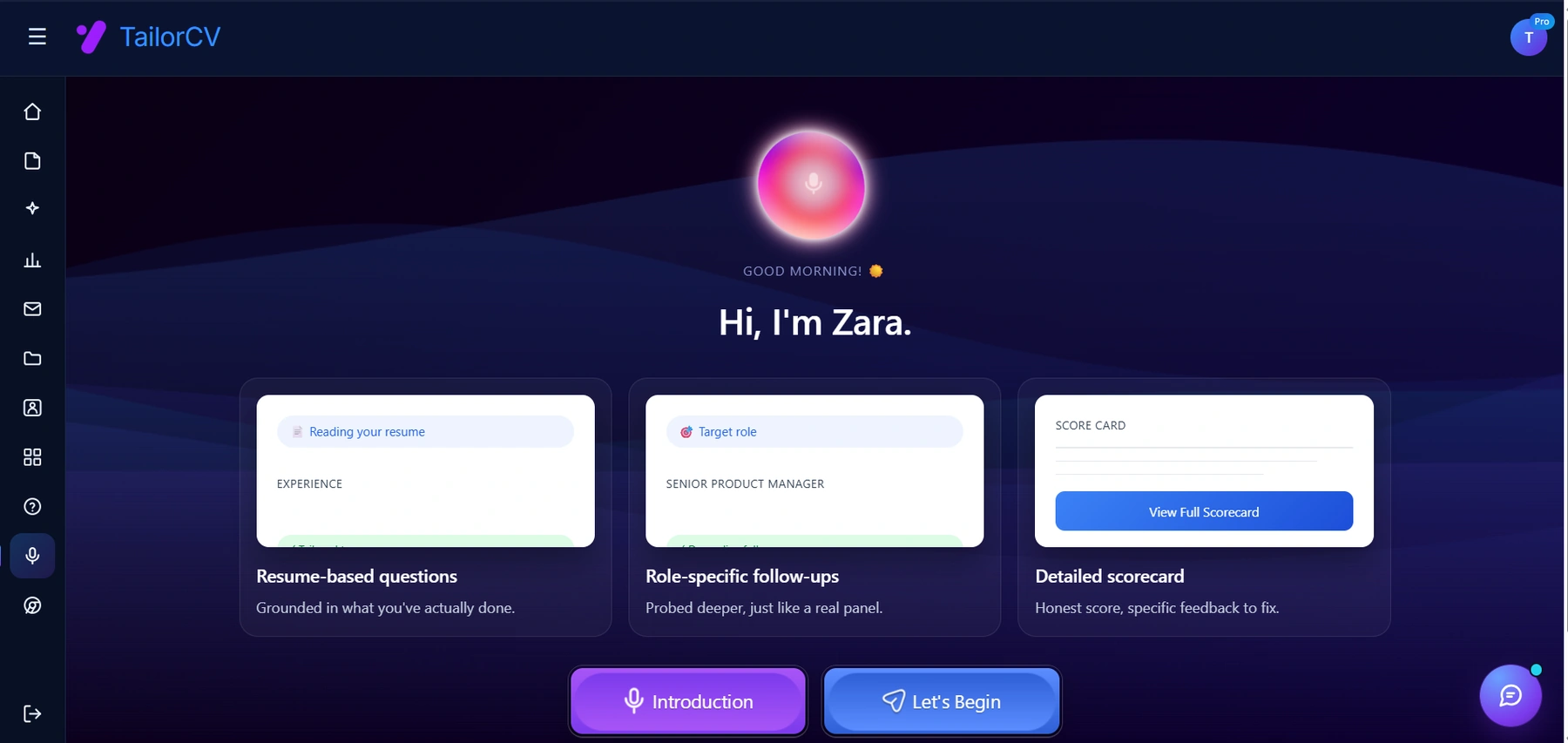
You can rehearse this before the real thing. The interviewer reads your resume first, so the questions come from your actual experience rather than a generic list.
Common System Design Mistakes
Mistake 1: Jumping to design without clarifying
Always clarify requirements and estimate scale first. Designing before understanding is a red flag.
Mistake 2: Not discussing trade-offs
There is no perfect design. Interviewers want to hear you weigh SQL vs NoSQL, consistency vs availability, etc.
Mistake 3: Staying too high-level
After the high-level design, you must go deep on at least one or two components. Surface-level answers do not demonstrate depth.
Mistake 4: Ignoring bottlenecks
Always discuss what breaks at scale and how you would handle single points of failure.
Related Guides
- Technical Interview Preparation Guide
- Coding Interview Preparation Guide
- How to Practice Mock Interviews Online for Free Using AI
- Phone Interview Tips
- Behavioral Interview Questions and Answers
- 20 Common Interview Mistakes to Avoid
- Final Round Interview Tips
- Group Discussion Tips
- How to Answer "Tell Me About Yourself"
- How to Prepare for a Job Interview
- How to Research a Company Before Your Job Interview
- Best Questions to Ask in a Job Interview
- How to Prepare for Campus Placement in 2026 - Complete Guide
- Why Am I Not Getting Interviews for Jobs I'm Qualified For?
Make This Practical
Use this advice as interview practice, not just reading material. Start a role-specific session with the AI mock interview tool, prepare your opening with How to Answer Tell Me About Yourself, and structure evidence-heavy answers with the STAR Method Interview Answers Guide.
Before the interview, make sure the resume that earned the call is still aligned with the role. Check it with the free ATS score checker, review Common Interview Mistakes to Avoid, and use How to Follow Up After an Interview once the conversation is over.
Conclusion
system design interviews reward structured thinking, scale awareness, and trade-off analysis. Use the 6-step framework every time: clarify, estimate, API, high-level design, deep dive, bottlenecks.
Combine this with the technical interview preparation guide and coding interview guide. Optimize your resume with the TailorCV ATS score checker and practice with the mock interview tool.
Frequently Asked Questions
What are the key components of a system design interview?
The key components of a system design interview include understanding functional and non-functional requirements, estimating scale, defining APIs, and considering trade-offs in architectural decisions. By following a structured approach, you can effectively showcase your ability to design scalable systems, which is a crucial skill for mid-level and senior engineering roles. For more comprehensive insights, check out our Technical Interview Preparation Guide 2026 - Complete Roadmap.
How do I clarify requirements during a system design interview?
To clarify requirements, start by asking targeted questions about both functional and non-functional aspects of the system. This includes understanding the features needed, the expected user load, and any latency or availability requirements. Clarifying these details ensures that your design aligns with what the interviewer expects, which is critical for a successful outcome. For more tips on interview preparation, view our Software Engineer Interview Preparation – The Complete 2026 Guide.
What is the importance of estimating scale in system design?
Estimating scale is essential as it helps you determine the system's capacity and performance needs. By performing back-of-envelope calculations, you can showcase your understanding of requests per second, storage requirements, and bandwidth considerations, which are crucial for designing systems that can handle real-world traffic. This analysis demonstrates your ability to think critically about scalability, a key aspect of system design interviews.
Can you provide examples of common system design questions?
Common system design questions include designing a URL shortener, a chat application, or a file storage system. These scenarios allow you to demonstrate your architectural knowledge and problem-solving skills. Practicing these types of questions will prepare you for the variety of topics you may encounter in interviews. For more practice, consider using our AI mock interview tool.
How can I improve my system design interview skills?
Improving your system design interview skills involves studying architectural patterns, practicing with common design questions, and seeking feedback on your design approach. Engaging with resources such as the System Design Interview Guide and participating in mock interviews can significantly enhance your readiness. Additionally, utilizing tools like the Free ATS score checker can help you refine your overall interview preparation strategy.
Was this guide useful?
Be the first to rate it.