 TD
TD

Key Takeaways
- British cover letters - often called covering letters - stay on one page and follow a more formal structure than American ones.
- The salutation rule still matters: "Dear Mr Smith" closes with "Yours sincerely", "Dear Sir or Madam" closes with "Yours faithfully".
- Tone is understated. Evidence should carry the claim, because overselling reads as arrogance rather than confidence.
- Non-UK applicants should state right-to-work status in one clause rather than leaving it to surface at offer stage.
- The letter must add to the CV, not summarise it - explaining fit, gaps, and motivation is its actual job.
Cover letters are requested less often than they used to be, but in the UK they still appear regularly - particularly in the public sector, academia, law, charities, and at smaller employers. When one is requested and you send a generic paragraph, it counts against you.
The British version differs from the American in two ways that matter: it is more formal in structure, and considerably more restrained in tone. A letter that would read as appropriately confident in the US can read as boastful in London.
This guide covers the format, the tone, and what to do about visa status.
Before you write it, make sure the CV it accompanies parses cleanly - run it through the free ATS score checker.
The Format
One page. Three or four paragraphs. Business letter conventions.
Structure:
- Your contact details
- The date
- The recipient's name and the organisation
- Salutation
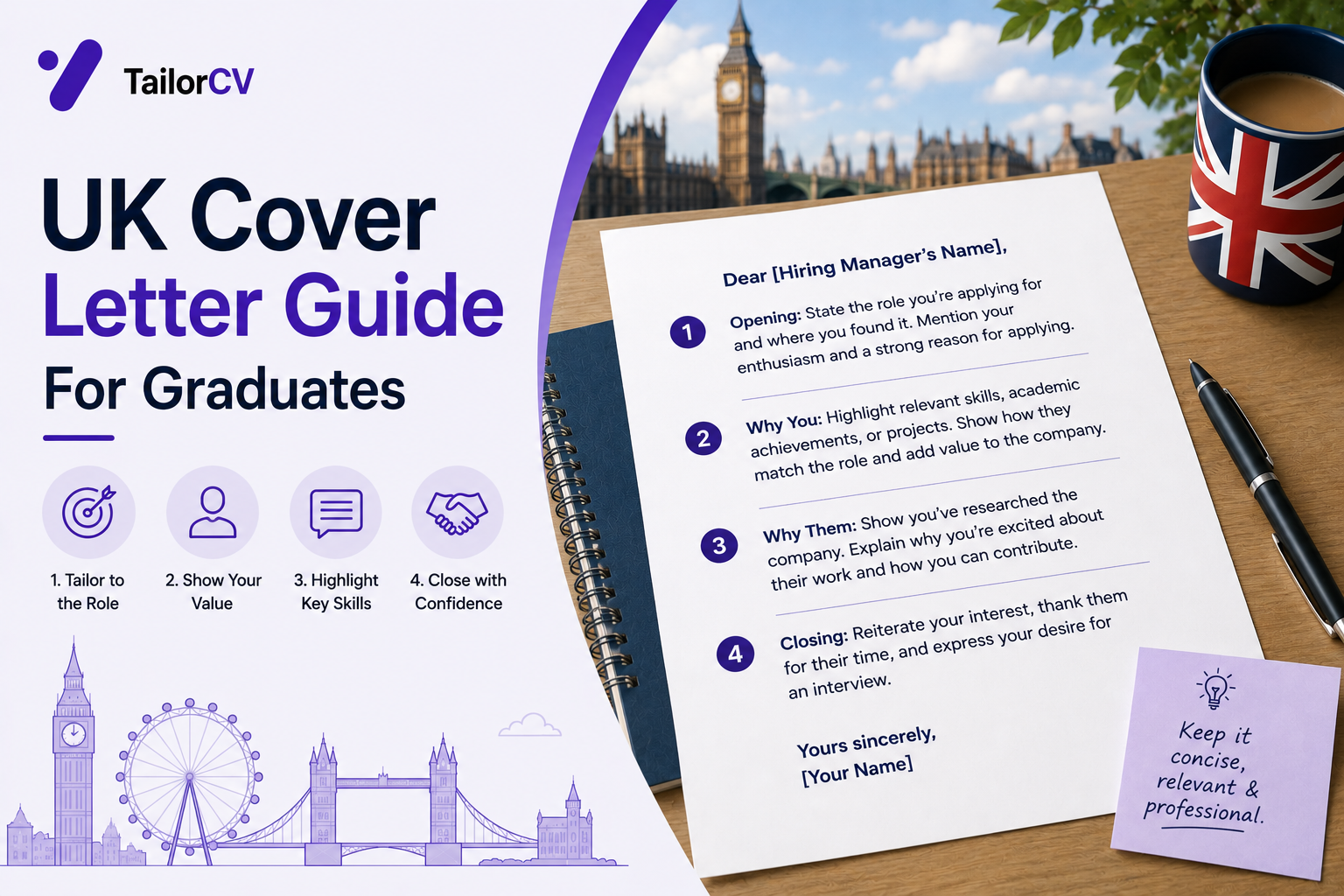
- Opening paragraph - the role, and why you
- Middle paragraphs - evidence
- Closing paragraph - availability and next step
- Sign-off
The salutation rule
This trips people up and British readers do notice:
- Named recipient - "Dear Ms Patel" closes with "Yours sincerely"
- Unnamed - "Dear Sir or Madam" closes with "Yours faithfully"
Find the name if you can. The job advert, the company website, or LinkedIn will usually yield it, and addressing a person is better than addressing nobody.
"Dear Hiring Manager" is increasingly accepted and sits somewhere between the two - pair it with "Yours sincerely".
The Opening
Most cover letters open with a sentence that says nothing:
I am writing to apply for the position of Marketing Executive as advertised on your website.
It is not wrong, but it wastes the strongest line on the page. Better openings state the role and immediately give a reason to keep reading:
I am writing to apply for the Marketing Executive role advertised on Reed. I spent the last two years running paid acquisition for a DTC brand, where I cut cost per acquisition by 34% while doubling monthly spend - which is the combination your posting describes.
Avoid the clichés entirely: "I am a hard-working and passionate individual", "I believe I would be a perfect fit", "your esteemed organisation". More on this in cover letter opening lines that work.
The Middle: Evidence, Not Summary
The letter's job is to explain what the CV lists. If a hiring manager could delete your letter and lose nothing, it has failed.
Pick two or three requirements from the posting and match each with specific evidence. Not all of them - the two or three that matter most.
Quantify. The same discipline as the CV, covered in how to quantify achievements on your resume.
Explain anything the CV cannot. A career change, a gap, a relocation, a sideways move. This is the right place for it, in one sentence without apology - see how to explain an employment gap and, for a change of field, career change cover letter.
Say something specific about the organisation. Not "a leader in the industry" - something you could only write about them.
Tone: Understatement Works
British professional writing rewards restraint. The claim should come from the evidence, not the adjective.
Too much: "I am an exceptional communicator with an outstanding track record of transformational results."
Right: "I rewrote the onboarding documentation, which reduced first-week support tickets by around 40%."
The second is a stronger claim because it is checkable. Overstatement invites scepticism; specificity invites a conversation.
Related conventions:
- UK spelling throughout - organised, specialised, programme
- No exclamation marks
- Avoid superlatives about yourself
- Formal but not archaic - "I would welcome the opportunity to discuss" is fine; "I remain, sir, your obedient servant" is not
The same register applies in interview, as covered in UK interview tips.
Right to Work
If you are not a UK citizen or settled resident, address this in the letter. One clause, placed near the end.
I hold a Graduate visa valid until September 2027 and do not require sponsorship.
or
I would require Skilled Worker sponsorship, and I note that [Company] holds a sponsor licence.
That second version does something useful: it shows you checked the register, which signals you understand the process rather than hoping it will not come up. The mechanics are in the UK Skilled Worker visa guide.
Leaving it unstated does not help. Recruiters ask early, and silence reads as avoidance.
Full Template
[Your name] [City, postcode area] [Phone] | [Email] | [LinkedIn]
12 August 2026
Ms Sarah Whitfield Head of Analytics Northgate Retail Group Manchester
Dear Ms Whitfield,
I am writing to apply for the Senior Data Analyst role advertised on your careers page. I have spent four years in retail analytics, most recently at a £40m-revenue e-commerce business where I built the demand forecasting model that cut stock-outs by 18% across our top 200 lines.
Your posting emphasises pricing analysis and stakeholder communication. On pricing, I ran the quarterly elasticity review that informed markdown strategy for two seasons, working directly with the buying team. On communication, I presented monthly to a commercial board with no analytics background - which taught me more about clear reporting than any technical training did.
I was drawn to this role by Northgate's move to bring analytics in-house rather than outsourcing it. Having worked on both sides of that arrangement, I think the in-house model produces considerably better decisions, and I would like to be part of building it.
I am available for interview at short notice and could start within one month. I hold indefinite leave to remain and do not require sponsorship.
Thank you for considering my application. I would welcome the opportunity to discuss the role further.
Yours sincerely,
[Your name]
Note what it does: names the role and one quantified result up front, addresses two specific requirements from the posting, says something only true of this employer, and resolves availability and right to work in one line each.
Common Mistakes
Summarising the CV. Adds nothing. Explain instead.
The wrong sign-off. "Dear Ms Whitfield … Yours faithfully" is a visible error.
Clichés. "Hard-working team player with a passion for excellence" describes nobody.
American spelling. Noticed immediately.
Running to two pages. One page.
Generic company praise. Says you did not look.
No name when one is findable. A minute of searching improves the letter.
Ignoring visa status when you are a non-UK applicant.
Sending the same letter everywhere. Tailoring is the whole point - see how to tailor your resume for every job.
Frequently Asked Questions
Do UK employers still read cover letters?
It varies. Public sector, academia, law, charities, and smaller employers frequently do. Large corporates using application forms often do not. When one is requested, a weak letter counts against you, so write it properly or the effort is wasted.
How long should a UK cover letter be?
One page - typically three or four paragraphs, around 250 to 400 words.
Should I say "Yours sincerely" or "Yours faithfully"?
"Yours sincerely" when you have named the recipient, "Yours faithfully" when you have used "Dear Sir or Madam". The distinction is still observed in the UK.
Should I attach it or put it in the email body?
Follow the instructions in the advert. If there are none, attaching a PDF and including a short version in the email body covers both.
Do I need a cover letter for an online application form?
Usually not if the form has its own supporting-statement fields - but the same principles apply to those fields, and public sector forms in particular expect competency-based written answers.
Should I mention salary expectations?
Only if the advert asks. If it does, give a researched range and mark it negotiable - see UK salary negotiation.
Make sure the CV attached to it holds up too. Check your ATS score free.
Make This Practical
Start by finding the recipient's name and picking two requirements from the posting. Those two decisions shape the whole letter and take ten minutes.
Then write the evidence paragraphs, matching each requirement with a quantified result rather than an adjective, and add one sentence that is specifically true of this employer. Resolve availability and right-to-work status in a single line each near the end.
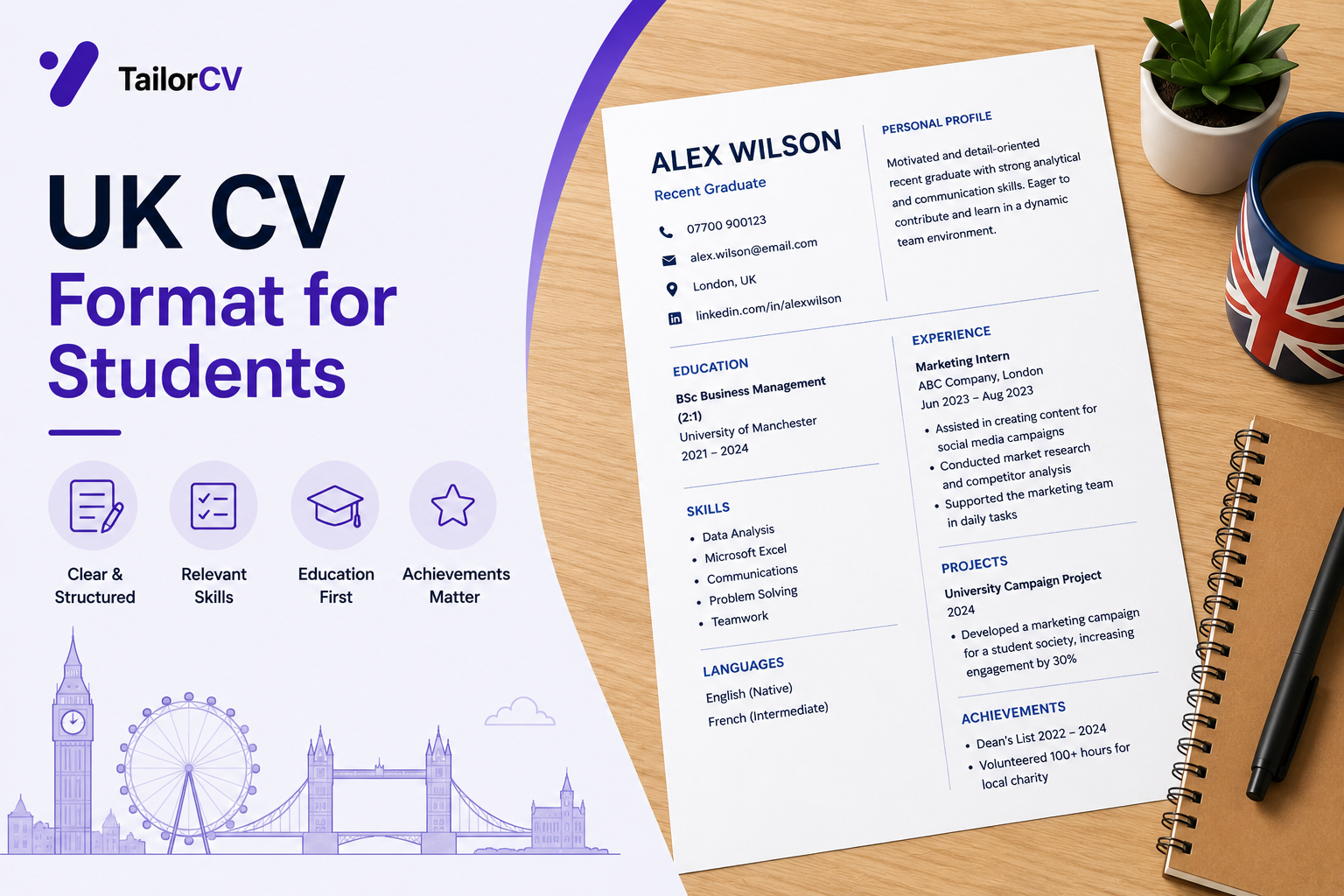
Finally, check the pair works together. The letter should explain what the CV lists rather than repeat it - build the CV to UK convention with the UK CV format guide, verify it parses with the free ATS score checker, and apply through the channels in the best job sites in the UK.
Was this guide useful?
Be the first to rate it.