SS
SS
Key Takeaways
- Coding interviews often revolve around a limited set of recognizable patterns, which can simplify problem-solving.
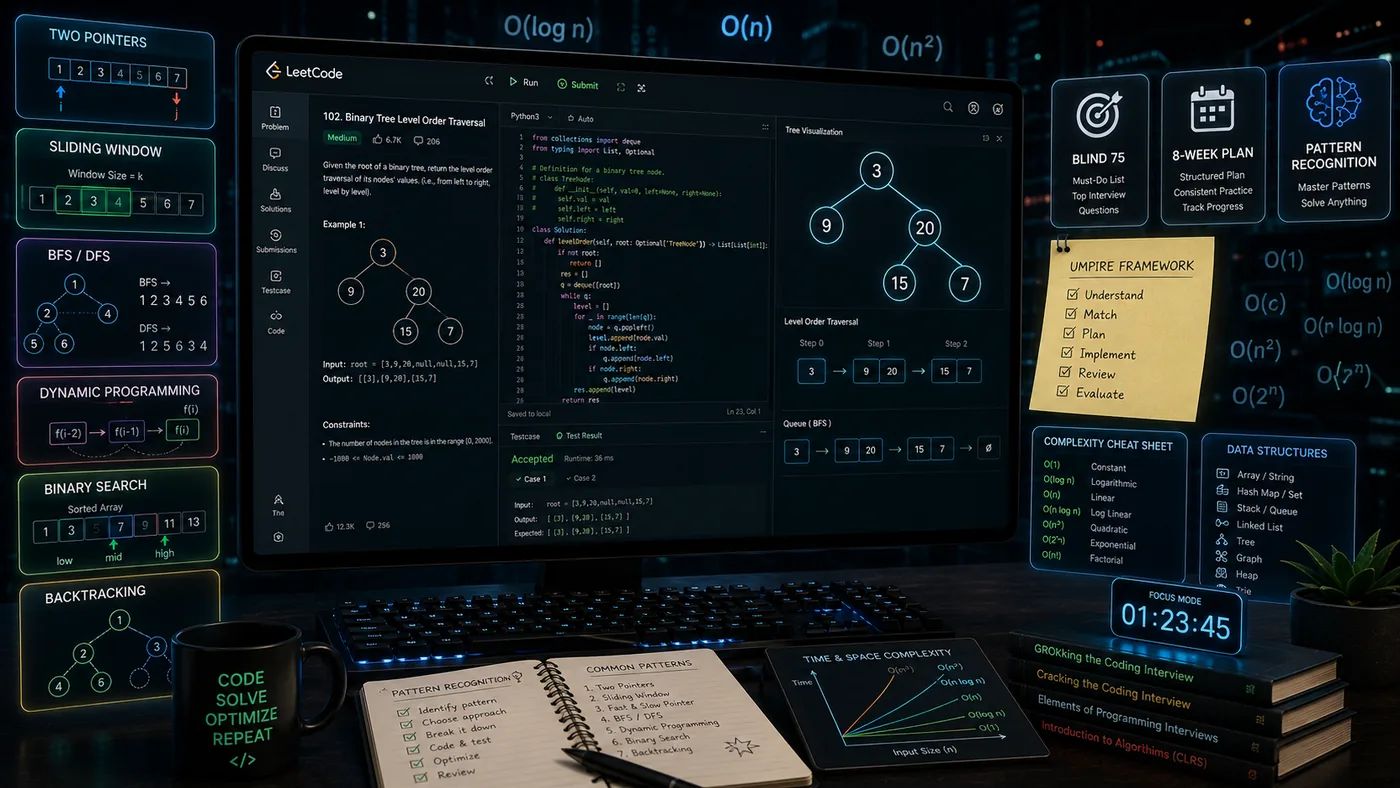
- Essential data structure and algorithm patterns include Two Pointers, Sliding Window, BFS, DFS, and Dynamic Programming, among others.
- Use the UMPIRE framework (Understand, Match, Plan, Implement, Review, Evaluate) to tackle coding problems systematically.
- Focus on quality practice by deeply understanding a smaller number of problems rather than mindlessly solving many.
- Follow a structured 8-week practice plan to cover various topics and enhance problem-solving skills effectively.
Coding interviews test your problem-solving ability under time pressure using data structures and algorithms. The good news: the vast majority of coding interview problems fall into a limited set of recognizable patterns. Once you learn the patterns, most problems become variations you can solve systematically.
This guide gives you the essential patterns, a problem-solving framework, and a structured practice plan.
This is part of the broader technical interview preparation guide. For senior roles, also study the system design interview guide. Before interviews, optimize your resume with the TailorCV ATS score checker.
The Essential DSA Patterns
1. Two Pointers
Use two pointers moving toward each other or in the same direction. Common in sorted arrays, palindromes, and pair-sum problems.
2. Sliding Window
Maintain a window over a contiguous subarray or substring. Common in "longest/shortest substring" and "maximum sum subarray" problems.
3. Fast and Slow Pointers
Two pointers at different speeds. Used for cycle detection in linked lists and finding the middle element.
4. Hash Map / Hash Set
Trade space for time. Common for "find duplicates," "two sum," and frequency counting problems.
5. Binary Search
Search a sorted space in O(log n). Also applies to "search in rotated array" and "find peak element."
6. BFS (Breadth-First Search)
Level-by-level traversal using a queue. Used for shortest path in unweighted graphs and level-order tree traversal.
7. DFS (Depth-First Search)
Deep traversal using recursion or a stack. Used for tree/graph traversal, connected components, and path finding.
8. Backtracking
Build solutions incrementally and abandon paths that fail. Used for permutations, combinations, subsets, and N-Queens.
9. Dynamic Programming
Break problems into overlapping subproblems. Used for "minimum/maximum," "count ways," and optimization problems.
10. Heap / Priority Queue
Maintain the largest or smallest elements efficiently. Used for "top K elements" and "merge K sorted lists."
11. Topological Sort
Order tasks with dependencies. Used for scheduling and course-prerequisite problems.
12. Union Find (Disjoint Set)
Track connected components efficiently. Used for graph connectivity and cycle detection in undirected graphs.
The Problem-Solving Framework (UMPIRE)
When you receive a problem, follow this:
U - Understand: Restate the problem. Ask about edge cases, input size, and constraints. M - Match: Which pattern does this resemble? (sliding window? DFS? DP?) P - Plan: Outline your approach in plain English before coding. I - Implement: Write clean code while explaining as you go. R - Review: Trace through your code with an example. Check edge cases. E - Evaluate: State the time and space complexity. Discuss optimizations.
How to Practice Effectively
See it in action: a resume-based mock interview
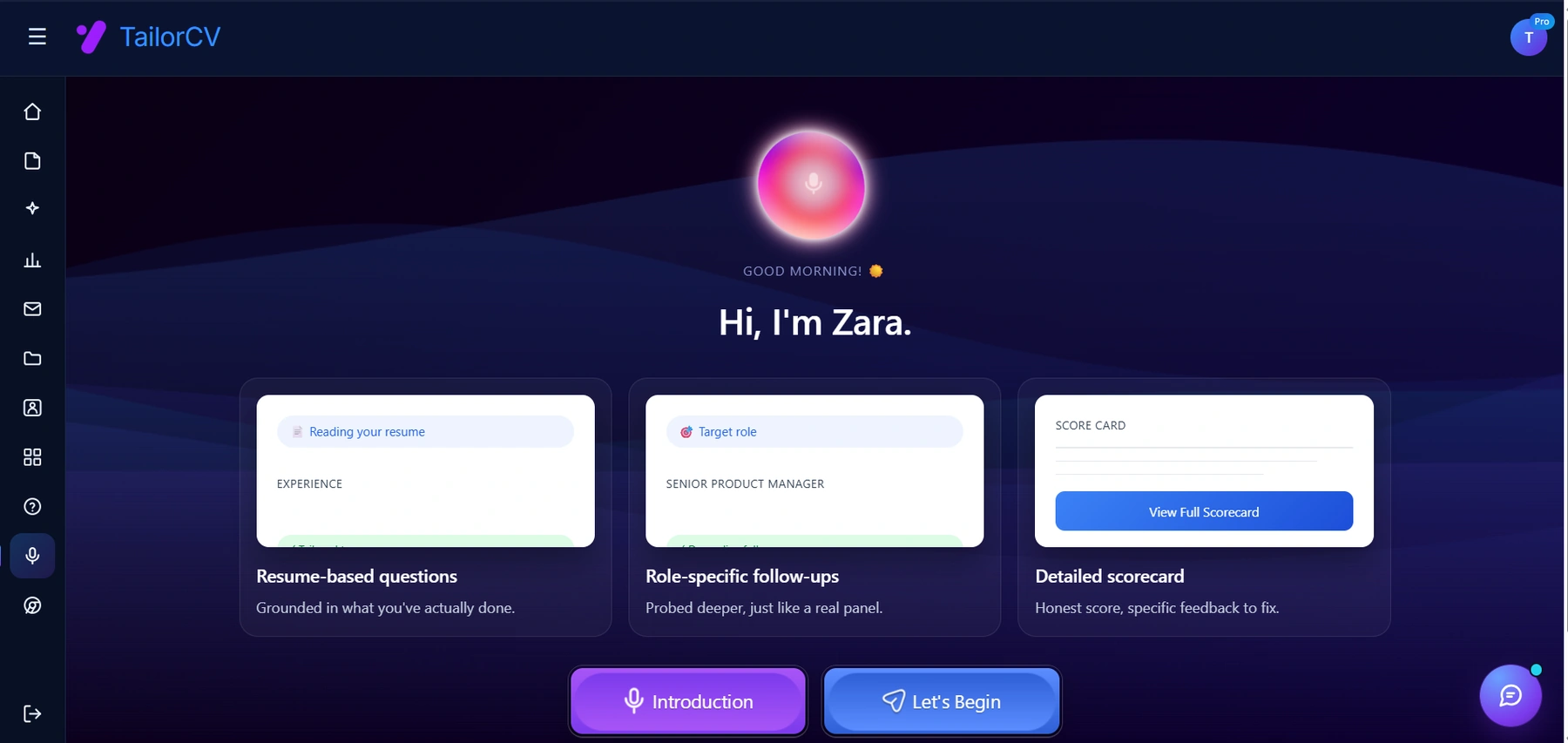
The useful part is the scorecard at the end - an honest score plus concrete feedback, which is what turns practice into an actual improvement.
Quality Over Quantity
Solving 500 problems mindlessly is less effective than solving 150 problems while truly understanding each pattern.
The Right Practice Loop
- Attempt the problem for 20-30 minutes
- If stuck, look at hints (not the full solution)
- If still stuck after 40 minutes, study the solution
- Understand the pattern, not just the specific solution
- Re-solve the problem from scratch a week later
Talk Out Loud
In real interviews, you must think aloud. Practice this from day one - explain your reasoning as you solve, even when practicing alone. Use the mock interview tool to practice verbal problem-solving.
Recommended Problem Lists
- Blind 75 - The classic starting list (75 essential problems)
- NeetCode 150 - Expanded, well-organized by pattern
- Grind 75 - Customizable by time available
- LeetCode company tags - Practice problems asked at your target companies
8-Week Practice Plan
Week 1: Arrays, two pointers, hash maps (15 problems) Week 2: Sliding window, strings (15 problems) Week 3: Linked lists, fast/slow pointers, stacks (15 problems) Week 4: Trees, BST, BFS, DFS (20 problems) Week 5: Graphs, topological sort, union find (15 problems) Week 6: Backtracking, recursion (15 problems) Week 7: Dynamic programming (20 problems) Week 8: Heaps, binary search, mixed review, mock interviews (15 problems)
Total: ~130 problems across all patterns.
Time and Space Complexity
You must be able to state Big O for every solution:
- O(1) - constant
- O(log n) - logarithmic (binary search)
- O(n) - linear (single loop)
- O(n log n) - sorting
- O(n²) - nested loops
- O(2^n) - exponential (some recursion/backtracking)
Always know the complexity of your solution and whether it can be improved.
Interview Day Coding Tips
- Clarify before coding - never assume
- Start with brute force, then optimize
- Write clean, readable code with good variable names
- Talk through every decision
- Test with examples, including edge cases (empty input, single element, duplicates)
- If you finish early, discuss optimizations or follow-up variations
Common Coding Interview Mistakes
Mistake 1: Coding before understanding
Jumping straight to code without clarifying the problem leads to wrong solutions. Spend the first few minutes understanding.
Mistake 2: Silent solving
Interviewers evaluate your reasoning. Silence makes them unable to assess you or help you when stuck.
Mistake 3: Not testing your code
Always trace through your solution with an example before declaring it done. Catching your own bug is far better than the interviewer catching it.
Mistake 4: Memorizing instead of understanding
Memorized solutions break when the problem varies slightly. Understand the underlying pattern instead.
Related Guides
- Technical Interview Preparation Guide
- How to Prepare for a Job Interview
- How to Research a Company Before Your Job Interview
- How to Practice Mock Interviews Online for Free Using AI
- Phone Interview Tips
- System Design Interview Guide
- Behavioral Interview Questions and Answers
- 20 Common Interview Mistakes to Avoid
- Final Round Interview Tips
- Group Discussion Tips
- How to Answer "Tell Me About Yourself"
- Best Questions to Ask in a Job Interview
- How to Prepare for Campus Placement in 2026 - Complete Guide
- Why Am I Not Getting Interviews for Jobs I'm Qualified For?
- How to Reschedule an Interview (Without Losing the Offer)
Make This Practical
Use this advice as interview practice, not just reading material. Start a role-specific session with the AI mock interview tool, prepare your opening with How to Answer Tell Me About Yourself, and structure evidence-heavy answers with the STAR Method Interview Answers Guide.
Before the interview, make sure the resume that earned the call is still aligned with the role. Check it with the free ATS score checker, review Common Interview Mistakes to Avoid, and use How to Follow Up After an Interview once the conversation is over.
Conclusion
Coding interview success comes from pattern recognition, a structured problem-solving framework, and consistent practice with verbal reasoning. Learn the 12 core patterns, practice 130+ problems with the UMPIRE framework, and always think aloud.
Combine this with the technical interview guide and system design guide. Optimize your resume with the TailorCV ATS score checker and practice with the free AI mock interview tool.
Frequently Asked Questions
What are the essential data structures and algorithms (DSA) patterns I should learn for coding interviews in 2026?
The essential DSA patterns include Two Pointers, Sliding Window, Fast and Slow Pointers, Hash Map/Hash Set, Binary Search, BFS, and DFS. Mastering these patterns will help you recognize and solve a wide variety of coding problems more efficiently. For a comprehensive overview, check out our Technical Interview Preparation Guide 2026.
How can I effectively practice coding problems to prepare for interviews?
To effectively practice coding problems, follow a structured practice plan that incorporates the essential DSA patterns discussed in this guide. Utilize platforms like LeetCode to find problems categorized by these patterns, and aim to solve a mix of easy, medium, and hard questions. You can also explore our Software Engineer Interview Preparation Guide for additional insights.
What is the role of problem-solving frameworks in coding interviews?
A problem-solving framework helps you systematically approach coding questions, breaking them down into manageable components. This structured approach not only improves your speed but also enhances your accuracy during interviews. For more strategies on tackling technical interviews, refer to our Technical Interview Preparation Guide.
How can I optimize my resume before a coding interview?
Optimizing your resume is crucial for making a strong first impression. Use tools like the Free ATS score checker to ensure your resume is tailored for Applicant Tracking Systems, highlighting your relevant skills and experiences clearly. A well-crafted resume can significantly increase your chances of getting noticed by recruiters.
What common mistakes should I avoid during coding interviews?
Some common mistakes to avoid include not communicating your thought process clearly, neglecting edge cases, and failing to ask clarifying questions. Being aware of these pitfalls can help you present yourself as a more competent candidate. For a deeper understanding of interview etiquette, check out our article on 20 Common Interview Mistakes to Avoid in 2026.
Was this guide useful?
Be the first to rate it.