SS
SS
Key Takeaways
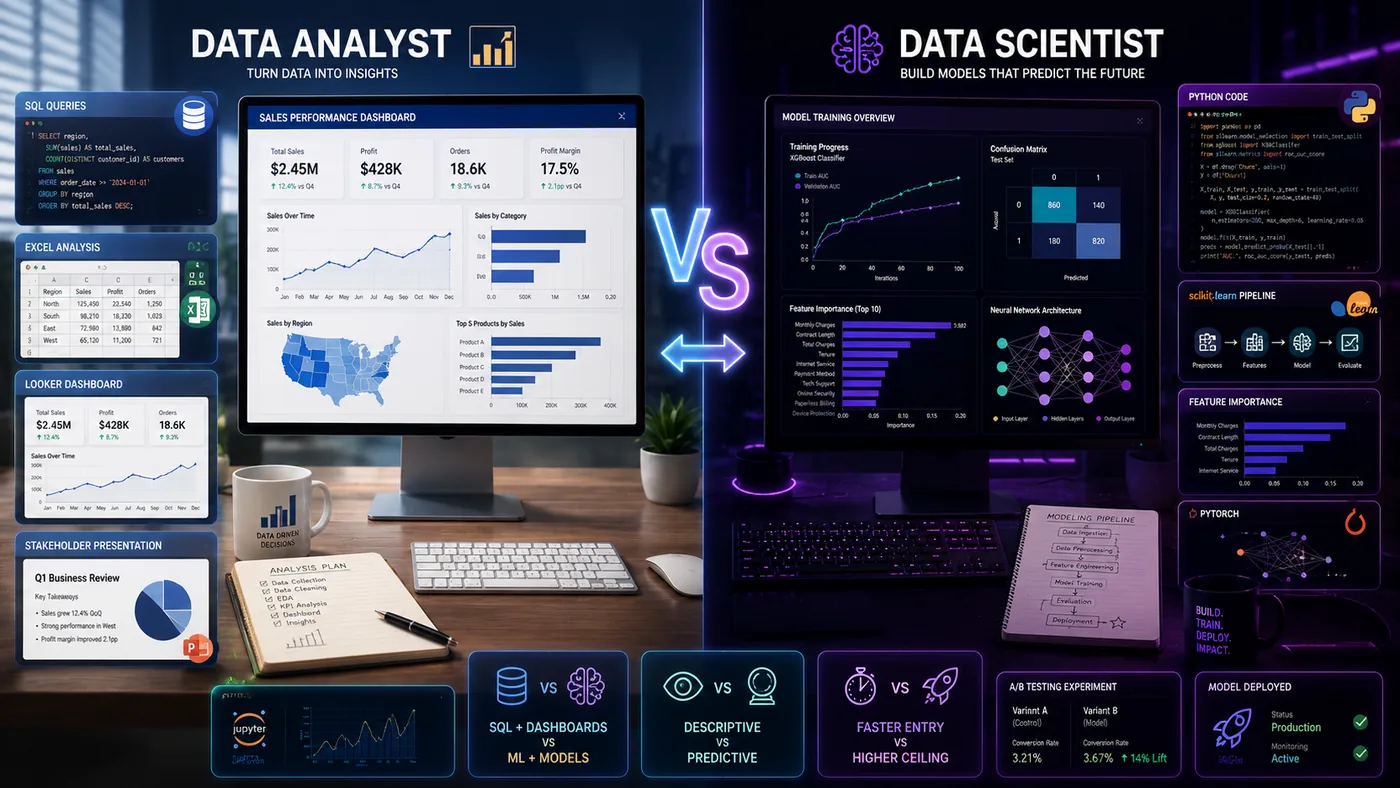
- Data analysts focus on understanding past data and answering business questions using SQL, dashboards, and reporting, while data scientists predict future outcomes using machine learning and statistical modeling.
- The day-to-day work of data analysts includes creating reports and dashboards, whereas data scientists build and deploy predictive models and work with complex datasets.
- Data analyst roles are more accessible, often requiring only a bachelor's degree or certifications, while data scientist positions typically demand advanced degrees and a strong math background.
- Data scientists generally earn higher salaries than data analysts due to their specialized skills, though salary ranges can overlap significantly based on experience and location.
"Should I become a data analyst or a data scientist?" is one of the most common questions for people entering the data field. The roles overlap but differ significantly in skills, day-to-day work, salary, and career trajectory. Choosing the right one depends on your interests, math comfort, and career goals.
This guide compares the two roles honestly across every dimension that matters.
For each role, we have detailed resume guides: the data analyst resume guide and data scientist resume guide. Whichever you choose, optimize your resume with the TailorCV ATS score checker.
The Core Difference
data analyst: Focuses on understanding what happened and why, using existing data. Answers business questions through SQL, dashboards, and reporting. Descriptive and diagnostic analytics.
data scientist: Focuses on predicting what will happen and building models. Uses statistics, machine learning, and programming to create predictive systems. Predictive and prescriptive analytics.
Simply put: analysts explain the past and present; scientists predict and model the future.
Day-to-Day Work
Data Analyst
- Writing SQL queries to extract and analyze data
- Building dashboards in Power BI, Tableau, or Looker
- Creating reports for business stakeholders
- A/B test analysis
- Identifying trends and answering business questions
- Presenting insights to non-technical audiences
Data Scientist
- Building and training machine learning models
- Feature engineering and data preprocessing
- Statistical analysis and experimentation
- Deploying models to production
- Working with large, messy datasets
- Research and prototyping new approaches
Skills Comparison
Data Analyst Skills
- SQL (essential)
- Excel / Google Sheets
- Power BI / Tableau / Looker
- Python or R (basic to intermediate)
- Statistics (descriptive)
- Data visualization
- Business acumen
Data Scientist Skills
- Python (advanced)
- machine learning (scikit-learn, PyTorch, TensorFlow)
- Statistics and probability (advanced)
- SQL
- Data engineering basics
- Model deployment (MLOps)
- Mathematics (linear algebra, calculus)
The data scientist role requires significantly more math, programming, and machine learning depth.
Education and Entry Barrier
Data Analyst
- More accessible entry point
- Can enter with a bachelor's degree in any analytical field
- Bootcamps and certifications (Google Data Analytics) can be sufficient
- Career changers can transition in 3-9 months of focused learning
Data Scientist
- Higher entry barrier
- Often requires a master's or PhD (though not always)
- Strong math and statistics background expected
- career change is possible but takes longer (12-24 months)
Salary Comparison
Generally, data scientists earn more than data analysts due to the higher skill barrier and specialization. However, ranges overlap significantly, and senior analysts can out-earn junior scientists.
- data analyst: solid mid-range salary, growing with experience and specialization
- data scientist: higher ceiling, especially with ML engineering or specialized domains
Salaries vary widely by location, company, and experience. Research specific numbers on Levels.fyi, Glassdoor, and LinkedIn Salary for your market. Read the salary negotiation guide when you get an offer.
Career Path and Progression
Data Analyst Path
data analyst -> Senior data analyst -> Analytics Lead / Analytics Manager -> Director of Analytics OR: data analyst -> Data Scientist (with upskilling) -> Senior Data Scientist
Data Scientist Path
data scientist -> Senior data scientist -> Staff/Principal data scientist -> ML Engineering or Data Science Management
Many data scientists start as analysts and transition up. The analyst role is an excellent entry point even if your goal is data science.
Which Should You Choose?
Choose Data Analyst If You:
- Enjoy answering business questions and finding insights
- Like building dashboards and communicating with stakeholders
- Prefer SQL and visualization over heavy programming
- Want a faster, more accessible entry into data
- Are not deeply interested in advanced math and ML
- Are a career changer wanting a quicker transition
Choose Data Scientist If You:
- Love math, statistics, and machine learning
- Enjoy building predictive models and research
- Are comfortable with advanced programming
- Want to work on cutting-edge ML and AI problems
- Have or are willing to build strong quantitative foundations
- Are patient with a longer learning curve
The Smart Strategy: Start as an Analyst
For many people, especially career changers, starting as a data analyst is the smart move even if your ultimate goal is data science:
- The analyst role is more accessible to break into
- You build SQL, data, and business skills that data scientists also need
- You can transition to data science from within (internal moves are easier)
- You earn while you upskill toward data science
Read the how to get your first tech job guide and career change to tech guide for transition strategies.
Related Roles to Consider
The data field has more than two roles:
| Role | What it involves |
|---|---|
| Data Engineer | Builds the data infrastructure and pipelines. Read the data engineer resume guide |
| ML Engineer | Productionizes ML models. Read the ML engineer resume guide |
| Analytics Engineer | Bridges analyst and engineer (dbt, modeling) |
| BI Developer | Specializes in business intelligence and dashboards |
Related Guides
- Freelancing vs Full-Time Employment
- Cover Letter Guide
- How to Build a Professional Portfolio
- How to Decline a Job Offer Professionally
- How to Get a Job With No Experience
- How to Handle Job Rejection
- How to Negotiate a Salary Offer
- How to Quit Your Job Professionally
- How to Use LinkedIn for Job Search
- How to Write a Cold Email to a Recruiter
- How to Write a Two Weeks Notice
- LinkedIn Profile Optimization Guide
Make This Practical
Turn the career advice into a stronger application system. Start by checking your resume with the free ATS score checker, align it with the role using How to Tailor Your Resume for Every Job, and keep your profile consistent with LinkedIn Resume Tailoring Sync.
When you are ready to apply, build the supporting pieces around the resume. Use the AI cover letter generator for targeted outreach, practice with the AI mock interview tool, and review Why Your Resume Gets No Responses if applications are not converting.
Conclusion
data analyst and data scientist are both excellent careers with strong demand in 2026. Choose analyst if you enjoy business insights, SQL, and visualization with a faster entry. Choose data scientist if you love math, ML, and predictive modeling and are ready for a steeper learning curve. For many, starting as an analyst and growing into data science is the smartest path.
Whichever you choose, build the right resume with the data analyst resume guide or data scientist resume guide, and optimize it with the TailorCV ATS score checker.
Frequently Asked Questions
What are the main skills needed for a Data Analyst in 2026?
A Data Analyst in 2026 should be proficient in SQL for data extraction, data visualization tools like Power BI or Tableau, and statistical analysis. Strong communication skills are essential for presenting insights to non-technical stakeholders. To enhance your skills, consider checking out our data analyst resume guide for tips on how to effectively showcase your abilities.
How does the salary of a Data Scientist compare to that of a Data Analyst?
In 2026, Data Scientists typically earn higher salaries than Data Analysts due to the advanced skills required for predictive modeling and machine learning. While a Data Analyst may earn a competitive salary, Data Scientists can command premium compensation because of their expertise in statistical analysis and programming. For more insights into high-paying careers, refer to our article on highest-paying jobs without a degree.
What kind of career growth can I expect as a Data Analyst versus a Data Scientist?
Career growth for both Data Analysts and Data Scientists is promising, but they differ in trajectory. Data Analysts often advance to senior analyst or managerial roles, while Data Scientists may transition into roles like machine learning engineer or data architect. Exploring both career paths can help you decide which aligns with your ambitions; our guide on data engineer resumes outlines another potential career path in the data field.
How should I tailor my resume for a Data Scientist position?
To tailor your resume for a Data Scientist role, focus on showcasing your experience with machine learning models, programming languages like Python or R, and your ability to handle large datasets. Highlight any projects or portfolios that demonstrate your skills, as detailed in our Data Scientist Portfolio Guide. Additionally, consider using our free ATS score checker to optimize your resume for applicant tracking systems.
What are some common misconceptions about Data Analysts and Data Scientists?
A common misconception is that Data Analysts and Data Scientists perform the same tasks. While both roles work with data, Analysts focus on understanding historical data and generating reports, whereas Scientists emphasize predictive modeling and advanced analytics. It's crucial to understand these differences to determine which career suits your interests and skills. For more clarity on career paths, check out our post on AI-proof jobs.
What is your resume scoring right now?
Scan it against a job description and get your ATS match score in about a minute.
Drop your resume here or choose a file
PDF only. Max 2 MB.
We never share your data or use it to train AI models.

Was this guide useful?
Be the first to rate it.