 TD
TD

Key Takeaways
- Decline promptly and in writing so they can move to their next candidate.
- Be gracious and brief; you may cross paths with these people again.
- You do not owe a detailed reason — a warm, general one is enough.
- Keep the door open when the company was a genuine near-miss.
Why Declining Well Is Worth the Effort
The person you turn down today may be your hiring manager, client, or colleague in three years. Industries are small, recruiters move between companies, and reputations travel. A graceful decline costs you five minutes and can preserve a relationship worth far more later. Ghosting an offer, by contrast, is remembered.
Decline Quickly
Once you have decided, tell them soon. They are holding a spot and often keeping a runner-up waiting. A prompt, kind no lets everyone move on and leaves a professional impression.
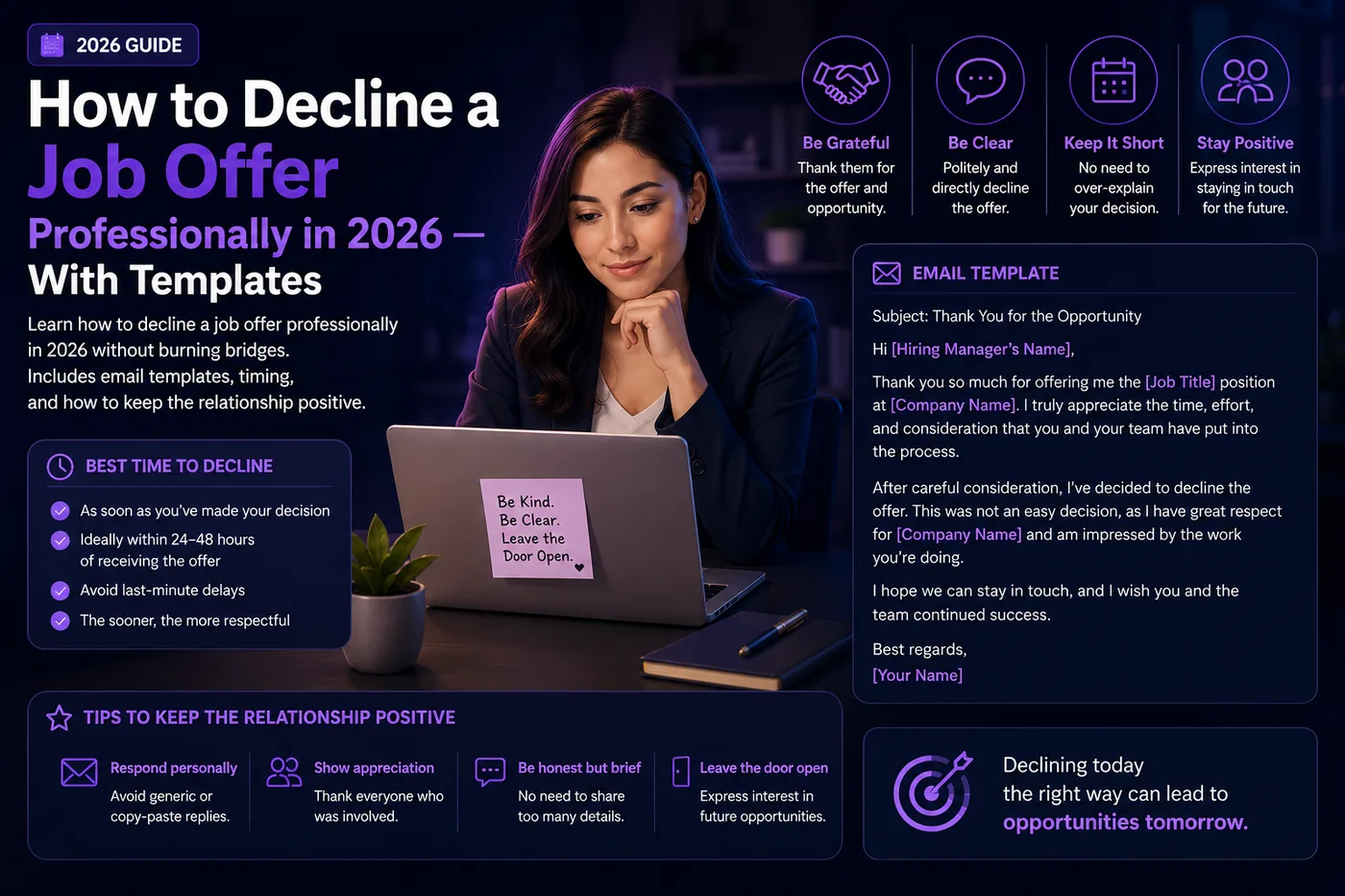
Template: Accepted Another Offer
Hi [Name],
Thank you so much for the offer to join [Company] as [Role]. After careful thought, I've decided to accept another opportunity that's a closer fit for my goals right now.
I really enjoyed meeting the team, and it was a genuinely hard decision. I hope our paths cross again, and I wish you and the team all the best.
Warm regards, [Your Name]
Template: Declining on Fit
Hi [Name],
I'm grateful for the offer and for the time everyone spent with me. After reflecting, I've concluded this isn't the right move for me at this stage, so I'll be respectfully declining.
Thank you again — I have a lot of respect for what you're building, and I hope to stay in touch.
Best, [Your Name]
What Never to Say
- Do not trash the offer, pay, or team. Even if pay drove your decision, "another role was a better overall fit" is enough.
- Do not over-explain. A paragraph is plenty; a detailed critique helps no one.
- Do not leave the door slammed unless you mean it. "I hope our paths cross again" keeps future options open.
If You Used Them as Leverage
If a competing offer improved because of this one, do not gloat or mention it. Simply decline warmly. The recruiter will connect the dots without you rubbing it in, and your grace is what they will remember.
More Templates for Common Situations
Declining after accepting, because a much better offer arrived late:
"This is an awkward message to send, and I'm sorry for it. After I accepted, an opportunity came up that I can't pass on, and I need to withdraw. I'm genuinely sorry for the timing and any disruption — I know it's not ideal, and I hope you understand."
Reneging on an accepted offer is not something to do lightly; it can burn a bridge. But when it is the right decision, honesty and a sincere apology are the only way through.
Declining a role that pays too little:
"Thank you so much for the offer. After careful thought, the overall package isn't the right fit for where I am right now, so I'll be respectfully declining. I really appreciated the process and the team, and I hope we cross paths again."
Notice it says "overall package," not "the pay is too low." Keep it gracious even when money drove the decision.
Declining an internal or referred role:
"Thank you for thinking of me and for putting this forward. After reflecting, I've decided it isn't the right move for me at the moment. I really appreciate your support and want to make sure this doesn't affect our working relationship at all."
When a colleague referred you, protect that relationship explicitly — they spent social capital on you.
The Etiquette of Declining Well
- Respond promptly. The company is holding a spot and often a runner-up. A fast, kind no lets everyone move on.
- Decline to a person, warmly. Address the recruiter or hiring manager by name; do not just ignore the offer.
- Keep it short. A paragraph is plenty. Over-explaining helps no one.
- Never negotiate through a decline. If you actually want more money, negotiate honestly; do not use a fake decline as a tactic.
- Stay reachable. "I hope our paths cross again" is not just polite — it keeps a real door open.
Why This Matters More Than It Seems
The person you decline today may be your hiring manager, client, or colleague in three years. Recruiters move between companies and remember how they were treated. Industries are smaller than they feel, and reputations travel through back channels you never see. A gracious decline costs you five minutes; a ghosted offer or a smug one can quietly cost you an opportunity years later. Treat every decline as an investment in a relationship you may need again — because often, you will.
What Comes Next
Declining one offer usually means you are accepting another — which means it is also time to negotiate the offer you are taking if you have not already, and to give notice at your current role gracefully. Handle all three the same way — promptly, warmly, and in writing — and you close this chapter with every bridge intact.
Deciding Whether to Decline in the First Place
Before you write the decline, make sure it is the right call — a graceful no to the wrong offer is only valuable if it is genuinely the wrong offer. Weigh the decision against the things that actually predict job satisfaction: the work itself, the manager and team, growth opportunity, compensation, and life fit like location and flexibility. Money is real but rarely the whole story; a slightly higher offer with a bad manager often turns out worse than the alternative. If your hesitation is really about compensation, the right move may be to negotiate rather than decline — many offers have room, and asking is far cheaper than walking away. Decline when the role is genuinely wrong for you; negotiate when it is close but the terms are off.
Timing and Sequence Matter
The order in which you handle competing offers protects your relationships. Never decline one offer until the one you are accepting is fully confirmed in writing — verbal offers occasionally fall through, and you do not want to be left with neither. Once your chosen offer is documented, decline the others promptly, because each company you turn down is likely holding a spot and possibly a runner-up. A fast, gracious no lets them move immediately to their next candidate, which is itself a professional courtesy they will remember. Then, and only then, give notice at your current role. Handled in this sequence — confirm, decline, resign — you close every door gently and leave no one waiting on you longer than necessary.
The Long Game of a Graceful No
It is worth restating why any of this matters, because in the moment a decline feels like a formality you want to rush. The person reading your no today may resurface as your future manager, a client, a colleague, or the connector who mentions your name for a role you would love. Recruiters move between companies and carry their impressions with them. A warm, prompt, specific decline plants a seed: "this person handled themselves well." A ghosted or graceless one plants the opposite. You are not just closing a door — you are deciding what these people say about you when your name comes up in a room you are not in. Five minutes of genuine warmth is one of the highest-return investments in a career, precisely because you can never predict which relationship will matter later.
Frequently Asked Questions
Do I have to give a reason for declining?
No. A warm, general reason ("a closer fit for my goals") is completely acceptable and standard.
Is it okay to decline by email rather than a call?
Yes. Email is professional, gives you time to word it well, and creates a clear record. A call is a nice touch for a role you were very close on.
Can I reapply to a company I declined?
Usually yes, if you declined graciously. That is exactly why the tone of your no matters.
Is it ever okay to back out after accepting?
It is a last resort and can damage a relationship, but sometimes the right call — a dramatically better offer, or a change in your circumstances. If you must, do it fast, apologize sincerely, and accept that this particular bridge may be strained.
Do I need to give a reason for declining?
No. A warm, general reason ("a closer fit for my goals right now") is standard and completely acceptable. You are not obligated to explain your decision in detail.
Should I tell them which company I chose instead?
You do not have to, and usually should not volunteer it. If asked directly and you are comfortable sharing, a brief answer is fine — but keep the focus on gratitude, not comparison.
How quickly should I decline once I've decided?
As soon as you have confirmed the offer you are accepting, in writing. The company you are declining is holding a spot and often a runner-up, so a prompt no is a professional courtesy that lets everyone move forward.
Is it okay to decline by email, or should I call?
Email is professional, standard, and gives you a clear record — it is completely acceptable. A brief call is a thoughtful touch for a role you were very close on or where you built a real rapport, but it is never required.
What if they counter my decline with a better offer?
It happens. Take it seriously if the improved offer genuinely changes your decision, but be honest with yourself about why you were declining. If the original issue was fit or direction rather than money, a higher number may not fix it — and reversing course requires real conviction, not just flattery.
What to Do If You Have Second Thoughts After Declining
Occasionally you decline an offer and then wonder if you made a mistake — the role you chose sours, or the one you turned down starts to look better in hindsight. Because you declined graciously, you have options. A warm, honest note can sometimes reopen a door: "I know I withdrew, and I completely understand if the moment has passed, but my circumstances have changed and I remain genuinely excited about the role — is there any chance it's still open?" This works precisely because your original decline was respectful; a company remembers a gracious candidate fondly and may welcome you back, especially if their search is still ongoing. It will not always succeed — the role may be filled — but the fact that it is even possible is the dividend of declining well. A burned bridge offers no path back; a well-tended one sometimes does.
Declining Recruiter Outreach You're Not Interested In
Not every decline is about a formal offer — recruiters will approach you about roles you do not want, and how you handle those messages also shapes your reputation. Rather than ignoring them, a brief, warm reply pays off: "Thanks for reaching out! I'm happy where I am right now and not exploring, but I appreciate you thinking of me — feel free to keep me in mind down the road." This takes fifteen seconds, keeps the recruiter in your corner, and means that when you are looking, you have a warm contact instead of a cold inbox. Recruiters have long memories and move between companies; the ones who feel treated respectfully when you said no are the ones who champion you when you eventually say yes. Treat every decline, from a full offer to a casual message, as an investment in a network you will draw on for the rest of your career.
Putting It All Together
Declining an offer well is a small act with a long shadow. Respond promptly and in writing, address a real person warmly, keep it brief, and never trash the offer or the team — even when pay drove your decision. Keep the door open with a genuine "I hope our paths cross again," because the industry is smaller than it looks and today's decline can be tomorrow's opportunity. Five gracious minutes now protects relationships worth far more later.
Does your formatting survive the parser?
Upload your resume and see what an ATS actually reads back.
Drop your resume here or choose a file
PDF only. Max 2 MB.
We never share your data or use it to train AI models.

Was this guide useful?
Be the first to rate it.