 SS
SS
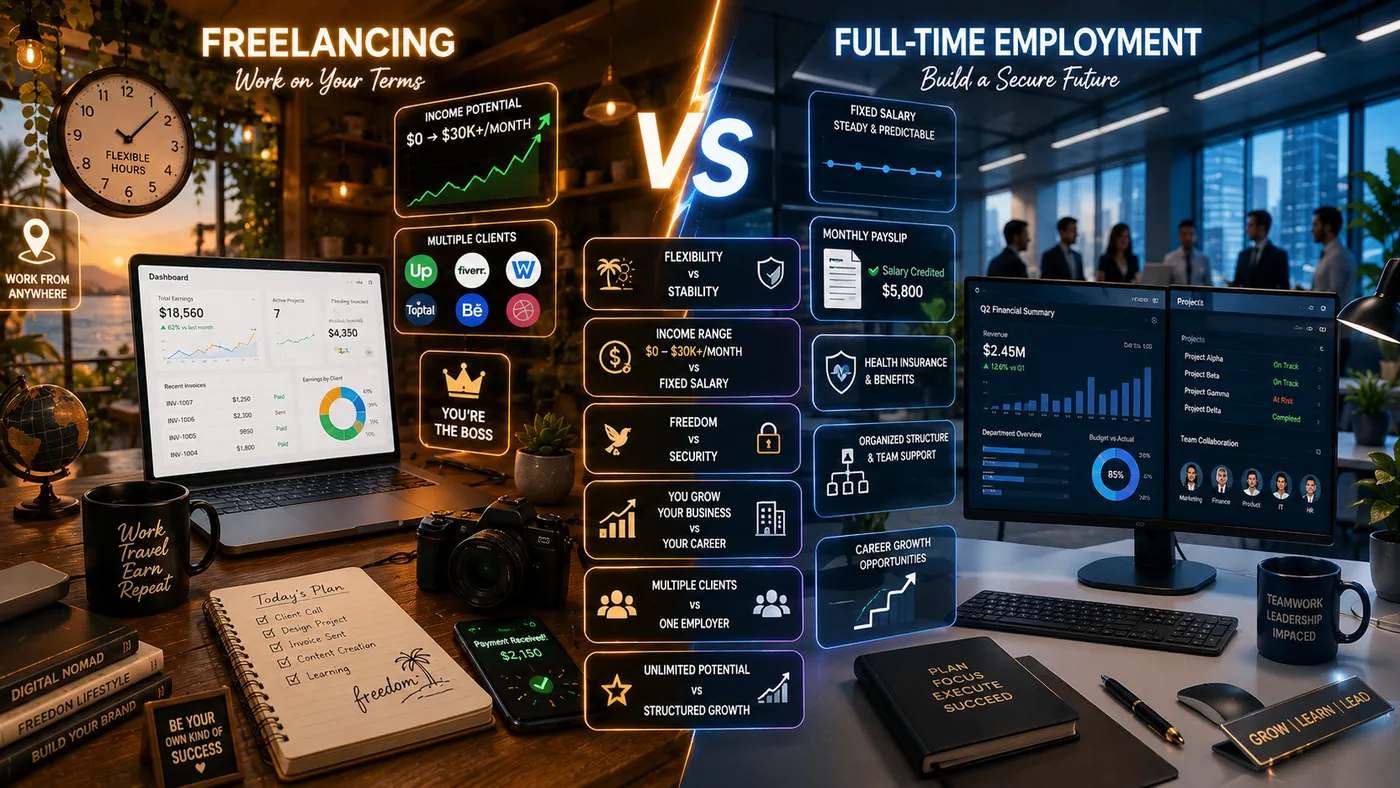
Key Takeaways
- Freelancing offers higher income potential but comes with significant income variability, while full-time employment provides predictable salaries with regular benefits.
- Full-time jobs typically include health insurance, retirement contributions, and job security, whereas freelancers must manage their own benefits and face potential income gaps.
- Career growth in full-time roles is often structured with mentorship and training opportunities, while freelancers gain diverse experiences but lack formal support and progression paths.
- Freelancers need to charge 1.5-2 times their full-time hourly rate to account for benefits and downtime, making financial planning crucial for success.
- Building a stable freelance career can take years of client development, whereas full-time employment offers immediate stability and organizational support.
The question of freelancing versus full-time employment is one of the most personal career decisions you will make - and the right answer depends entirely on your financial situation, personality, career stage, and goals. Both paths have genuine advantages and real disadvantages. Anyone who tells you one is universally better is selling something.
This guide gives you an honest comparison across every dimension that actually matters when making this decision in 2026.
Before considering either path, make sure your skills and resume are strong. Use the TailorCV ATS score checker to optimize your resume for full-time applications, or read the how to build a professional portfolio guide to strengthen your freelance pitch. For understanding your market value, read the salary negotiation guide.
The Income Question - Which Actually Pays More?
The honest answer: freelancing has higher income ceilings but higher income variance. Full-time has lower ceilings but much more predictability.
Full-Time Employment Income Structure
- Base salary (fixed, paid regularly)
- Benefits: health insurance, PF/pension, paid leave, stock options (at some companies)
- Annual reviews with increments (typically 5-15%)
- Predictable income - you know exactly what you earn each month
A mid-level software engineer at a product company earns $60-120K USD depending on location. A senior engineer earns $100-180K+. The ceiling is clear and usually tied to promotions that require time.
Freelance Income Structure
- Hourly or project-based rates - no guaranteed monthly income
- No employer benefits - health insurance, taxes, retirement contributions all come from you
- Income can be $0 in a slow month or $30K+ in a busy one
- Top freelancers in tech earn $150K-300K+ annually, but most earn significantly less
The catch: Freelancers must set aside 25-35% of income for taxes (in most countries), pay for their own health insurance and software tools, and factor in unpaid time (client hunting, admin, gaps between projects). A freelancer charging $100/hour is not earning $100/hour net.
Rule of thumb: A successful freelancer should charge 1.5-2x their equivalent full-time hourly rate to break even on benefits and downtime. A developer earning $90K FTE ($45/hr) should charge $80-100/hr as a freelancer to be economically equivalent.
Stability and Security
Full-Time Employment
- Predictable monthly income
- Employment benefits (health, retirement, paid leave)
- Job security (varies by company and economy - layoffs happen, but they come with notice and often severance)
- Clear career ladder and growth path
- Colleagues, team structure, organizational support
Freelancing
- No guaranteed income - client gaps can mean $0 months
- No employee benefits (unless you create them yourself)
- Effectively unemployed between contracts - no severance, no safety net
- No career ladder - you build your own progression
- Isolation - no built-in team or community unless you actively create it
The verdict on stability: Full-time is significantly more stable. Freelancers with strong networks and long-term client relationships can build income stability - but it takes 2-5 years of active client development to achieve reliably.
Career Growth and Learning
Full-Time Employment
- Clear mentorship structure (if at a good company)
- Company-funded training and conference budgets
- Complex, large-scale projects often only accessible at established companies
- Promotion path with objective milestones
- Exposure to cross-functional teams, enterprise processes, and advanced problems
Freelancing
- Breadth of exposure - you work across multiple industries and problem types
- Forced business skills - client management, negotiation, sales, invoicing
- Speed of learning varies wildly - you might do the same type of project repeatedly
- No formal mentorship unless you seek it actively
- Hard to get "FAANG-level" engineering experience as a freelancer - those complex distributed systems problems only exist inside those companies
The verdict on growth: Full-time employment at a strong company typically offers faster technical depth. Freelancing offers faster business breadth and client management skills. If deep technical expertise is your goal, full-time usually wins. If diverse skills and client-facing experience is your goal, freelancing wins.
Work-Life Balance and Flexibility
Full-Time Employment
- Set hours (though many tech companies expect overtime during crunch)
- Dedicated paid time off (typically 15-25 days per year)
- Geographic flexibility is improving - hybrid and remote options are common
- Less control over when and how you work
Freelancing
- Complete control over your schedule - you decide when to start, stop, and take breaks
- You can take an unpaid month off whenever you can afford to
- But: poor boundaries can mean working more than a full-time employee
- Client deadlines can create intense pressure with no organizational buffer
The verdict on work-life balance: Freelancing offers better flexibility if you are disciplined. Many freelancers work more hours than they planned because finding the next client takes significant time.
Taxes and Financial Complexity
Full-Time Employment
- Employer handles most tax administration (TDS in India, PAYE in UK, withholding in US)
- PF, gratuity, ESI contributions made by employer
- Simple financial management
Freelancing
- You handle all taxes - quarterly estimated payments (US), self-assessment (UK), advance tax (India)
- No employer retirement contributions - you fund your own retirement
- Business expenses can be deducted but require meticulous bookkeeping
- GST registration required above certain thresholds in India
- Financial complexity is significantly higher
The verdict: Freelancers need an accountant and a clear financial management system. Many freelancers underestimate their tax liability and face unexpected bills.
How to Decide - 5 Key Questions
1. Do you have 6-12 months of expenses saved? Freelancing without a financial runway is extremely stressful. You need money to weather slow months while building your client base.
2. Do you have an existing client network? Successful freelancers usually have relationships before going freelance. Starting freelance with zero contacts is the hardest path.
3. Are you comfortable with selling yourself? Freelancing requires constantly pitching, networking, and closing new work. If this is deeply uncomfortable, freelancing will be miserable.
4. Do you want deep technical expertise or broad client experience? If you want to be the world's best at a specific technical skill, full-time at a leading company is often better. If you want variety and business skills, freelance.
5. What does your personal life require right now? If you have dependents, a mortgage, or medical needs requiring stable insurance, full-time is usually the safer choice. If you are young, mobile, and have low financial obligations, freelancing is lower risk.
The Hybrid Path
Many professionals do not choose one or the other - they:
- Work full-time while freelancing on the side (check employment contract for restrictions)
- Freelance for 1-2 years to build skills and savings, then return to full-time at a higher level
- Freelance as a transition between full-time roles
- Build a full-time employment career while running a small consultancy on the side
This hybrid approach is increasingly viable in 2026 with remote work normalizing asynchronous schedules.
Related Guides
- Work-Life Balance Tips for Professionals
- Data Analyst vs Data Scientist
- How to Explain Resume Gaps
- How to Get a Job With No Experience
- How to Negotiate a Salary Offer
- Remote Job Search Guide
- Cover Letter Guide
- How to Build a Professional Portfolio
- How to Decline a Job Offer Professionally
- How to Get a Promotion
- How to Handle Job Rejection
- How to Quit Your Job Professionally
- First 90 Days at a New Job in 2026 - How to Succeed and Stand Out
- How to Ask for a Raise in 2026 - Scripts, Timing, and Strategy
- Personal Branding for Professionals in 2026 - Complete Guide
Make This Practical
Turn the career advice into a stronger application system. Start by checking your resume with the free ATS score checker, align it with the role using How to Tailor Your Resume for Every Job, and keep your profile consistent with LinkedIn Resume Tailoring Sync.
When you are ready to apply, build the supporting pieces around the resume. Use the AI cover letter generator for targeted outreach, practice with the AI mock interview tool, and review Why Your Resume Gets No Responses if applications are not converting.
Conclusion
Freelancing vs full-time employment is not a permanent decision. Most people do both at different life stages. The right choice depends on your financial situation, personality, career goals, and what you want your daily life to look like.
If you are choosing full-time: optimize your resume with the TailorCV ATS score checker, prepare for interviews with the behavioral interview guide, and negotiate your offer with the salary negotiation guide.
If you are building a freelance career: develop your portfolio with the portfolio building guide, network through LinkedIn, and master client outreach with the cold email guide.
Frequently Asked Questions
What are the main income differences between freelancing and full-time employment in 2026?
Freelancing often offers higher income ceilings due to the potential for charging premium rates, but it also comes with significant income variability. In contrast, full-time employment provides a more predictable income structure, including a base salary and benefits such as health insurance and retirement contributions. For a deeper understanding of managing your income effectively, consider reading our guide on how to ask for a raise.
How do benefits compare between freelancers and full-time employees?
Full-time employees typically enjoy a range of employer-sponsored benefits, including health insurance, paid leave, and retirement plans, which can significantly enhance their overall compensation package. Freelancers, however, must independently secure their own benefits, which can be costly and variable. To build a strong case for your freelance work, check out our virtual assistant and freelancer portfolio guide.
What factors should I consider when deciding between freelancing and full-time employment?
When deciding between these two paths, consider your financial stability, career goals, and personal preferences. Freelancing may suit those seeking flexibility and higher earning potential, while full-time employment is often better for individuals who value stability and structured career growth. For tips on succeeding in a new job, refer to our article on the first 90 days at a new job.
Is freelancing a viable long-term career choice?
Freelancing can be a sustainable long-term career if you can effectively manage your finances, market your skills, and maintain a steady flow of clients. However, it requires strong self-discipline and the ability to adapt to changing market conditions. To build a strong personal brand that attracts clients, explore our guide on personal branding for professionals.
How can I ensure my resume is competitive for both freelancing and full-time roles?
To make your resume stand out for both freelancing and full-time employment, focus on showcasing your skills, experience, and accomplishments that are relevant to your desired roles. Utilize tools like the free ATS score checker to optimize your resume for applicant tracking systems, ensuring it gets noticed by potential employers or clients.
What is your resume scoring right now?
Scan it against a job description and get your ATS match score in about a minute.
Drop your resume here or choose a file
PDF only. Max 2 MB.
We never share your data or use it to train AI models.

Was this guide useful?
Be the first to rate it.