SS
SS

Key Takeaways
- Many candidates miss out on better salaries due to discomfort with negotiation rather than asking for too much.
- Researching salary benchmarks, total compensation packages, and personal leverage is crucial for confident negotiation.
- Timing is important; negotiate after receiving a written offer, during annual reviews, or after promotions for the best results.
- When making your ask, express enthusiasm for the role and provide a specific, research-backed number to facilitate the conversation.
Most people leave money on the table not because they asked for too much, but because they never asked at all. Research consistently shows that candidates who negotiate — even modestly — end up with meaningfully better outcomes than those who accept the first number, yet a large share of candidates skip the conversation entirely out of discomfort or fear of losing the offer.
This guide covers the full picture: how to research a fair number, when and how to raise it, what to say, and the mistakes that quietly undercut candidates who otherwise negotiate well.
Why So Many People Don't Negotiate
The most common reasons candidates skip negotiation are rarely about the number itself — they're about discomfort with the conversation. A few patterns show up repeatedly:
- Fear the offer will be withdrawn. In practice, a reasonable, well-researched counter almost never causes a company to rescind an offer — that risk is far smaller than most candidates assume.
- Not knowing what "fair" actually looks like. Without a researched number, candidates default to accepting whatever is offered, because they have nothing concrete to counter with.
- Discomfort with the conversation itself, especially early in a career or after a long job search that already felt exhausting.
- Gratitude bias — feeling so relieved to get an offer that negotiating feels ungrateful, rather than a normal part of the process.
Every one of these is solvable with preparation, which is the whole purpose of this guide.
Step 1: Research Before You Negotiate Anything
You cannot negotiate confidently without a number to negotiate from. Before any conversation:
What optimizing actually does to your resume
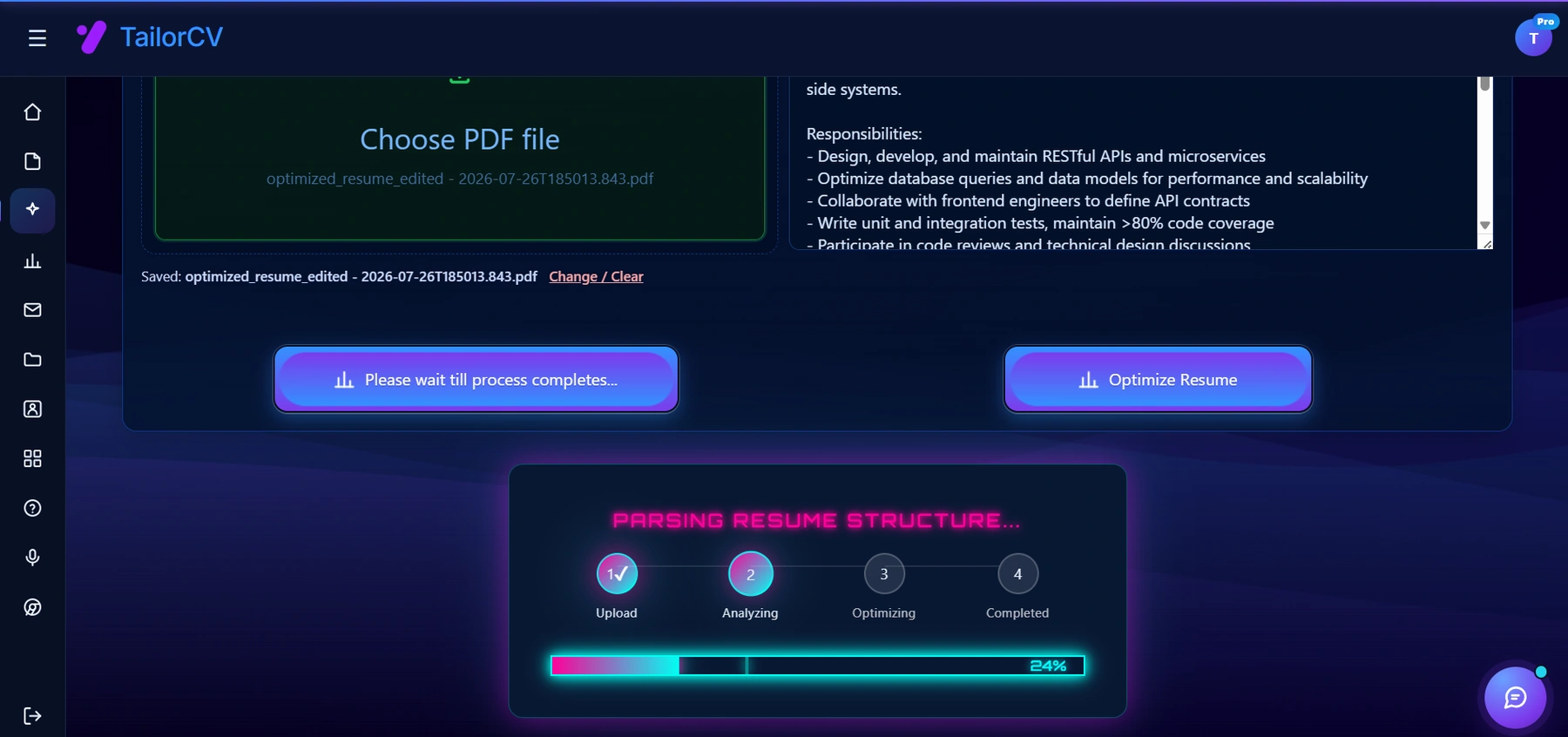
Optimising runs against the specific job description you paste in, not in the abstract.
- Benchmark the role, level, and location using multiple sources — aggregated salary data, industry reports, and if possible, direct conversations with people in similar roles.
- Understand the full compensation package, not just base salary — bonus structure, equity, benefits, and remote/hybrid flexibility all factor into total value. If you're comparing a remote offer to an in-office one, note that compensation and tailoring both shift for remote roles.
- Account for your specific leverage — competing offers, scarce skills, or a strong track record all shift what's reasonable to ask for.
- Factor in company stage and type. A Series A startup and a public enterprise negotiate differently — equity matters more at one, stability and structured bands matter more at the other.
This research step is the single biggest predictor of a successful negotiation — going in with a specific, defensible number changes the entire tone of the conversation.
Step 2: Timing — When to Bring Up Salary
Timing shapes how a negotiation lands as much as the number itself.
- During the interview process, let the employer raise compensation first where possible. If asked for your expectations early, giving a researched range rather than a single number keeps you from underselling or over-anchoring — see how to negotiate a salary offer for exact phrasing.
- After receiving a written offer, this is the strongest point to negotiate — you have leverage because the company has already decided they want you.
- During annual reviews or after a major achievement, is the natural time to ask for a raise at your current job, ideally tied to specific, recent contributions rather than tenure alone.
- Immediately after a promotion is also a reasonable moment to discuss compensation, since scope has changed — see how to get a promotion for how to build the case before that conversation happens.
Step 3: What to Actually Say
Negotiating a new job offer
Once you have a written offer, respond with enthusiasm about the role first, then make your ask specific and grounded in research:
"Thank you so much for the offer — I'm genuinely excited about the team and the role. Based on my research for this level and the scope we discussed, I was hoping we could get closer to [specific number]. Is there flexibility there?"
Notice this does three things: confirms genuine interest (so the ask doesn't read as a threat to walk), gives a specific number (not a vague "more"), and frames it as a question rather than an ultimatum.
Negotiating a raise
"I wanted to talk about my compensation. Over the past [timeframe], I've [specific achievement with a number], and I'd like to discuss adjusting my salary to reflect that. Based on my research, I think [specific number] would be appropriate for my current scope."
The strength of this ask depends entirely on how well you can quantify your contribution — see how to quantify resume achievements for the same skill applied to writing your case down, since a raise conversation is really a spoken version of a resume bullet.
Handling pushback
If the employer says the number isn't possible:
"I understand there may be constraints on base salary. Is there flexibility in other areas — signing bonus, additional PTO, or an earlier compensation review?"
Negotiation isn't only about the base number — total package flexibility often exists even when the base figure genuinely can't move.
Step 4: What to Do If You Don't Get What You Asked For
Sometimes the answer is a firm no, or a smaller adjustment than hoped. A few paths forward:
- Accept if the overall package still meets your needs — a negotiation that doesn't move the number can still succeed if it secures something else valuable (start date flexibility, an earlier review, remote flexibility).
- Ask for a defined timeline for a follow-up conversation — e.g., a compensation review in six months tied to specific goals.
- Decline professionally if the gap is too large — see how to decline a job offer for how to do this without burning the relationship, since the same recruiter or hiring manager may resurface at a future point in your career.
If the rejection is about the role itself rather than compensation, it's worth understanding why you might be getting rejected more broadly, and how to handle job rejection without it affecting your approach to the next opportunity.
Common Salary Negotiation Mistakes
- Giving a number with no research behind it. An arbitrary figure is easy to dismiss; a benchmarked one is not.
- Negotiating before there's a written offer. Compensation conversations that happen too early can anchor expectations before the employer has fully decided they want you.
- Accepting the first offer out of relief or gratitude. Most initial offers have room built in — declining to ask leaves that room unclaimed.
- Treating negotiation as adversarial. Framing it as a collaborative conversation about fair value, rather than a confrontation, produces better outcomes and preserves the relationship.
- Not knowing your walk-away point in advance. Deciding your minimum acceptable number before the conversation prevents an emotional decision in the moment.
- Focusing only on base salary. Bonus structure, equity, benefits, and flexibility (especially relevant for remote or hybrid roles) are all negotiable levers beyond the headline number.
Negotiating in Different Career Situations
- Early career / first job: Leverage is lower, but a modest, well-researched ask is still reasonable and rarely backfires — see how to get your first tech job for context on entry-level expectations specifically.
- Career changers: If you're moving industries, your negotiating leverage often comes from transferable achievements rather than direct experience — see career change resume guidance for how to frame that value before the negotiation even starts.
- Freelance or contract work: Rate negotiation works differently than salary negotiation — project scope, timeline, and revisions all factor in alongside the number itself. See freelancing vs. full-time employment and resume tailoring for freelance and contract roles for how positioning shifts.
- Later-round or executive negotiations: By the time you're deep into a final round or a second interview, the company has invested real time in you — which is exactly when your negotiating leverage is highest.
Preparing for the Conversation Itself
Knowing what to say is different from being able to say it comfortably out loud, under mild pressure, in real time. A short prep routine:
- Write your target number and your walk-away number down before the conversation, so you're not deciding under pressure.
- Practice saying your ask out loud, ideally multiple times, until it doesn't feel awkward leaving your mouth.
- Anticipate the employer's likely response and prepare your follow-up for each — acceptance, partial flexibility, or a firm no.
- Rehearse with realistic pushback, not just a friendly run-through — a free AI mock interview can simulate tougher, more realistic negotiation conversations so the real one feels familiar rather than high-stakes.
FAQ
Is it risky to negotiate a job offer?
Rarely. A reasonable, well-researched counter almost never results in an offer being withdrawn — most companies expect some degree of negotiation and build room into their initial number.
How much more should I ask for than the initial offer?
There's no universal percentage — it depends on your research into the specific role, level, and location. A well-benchmarked number is more persuasive than an arbitrary percentage increase.
What if the employer says the salary is fixed with no flexibility?
Ask about flexibility in other areas — signing bonus, additional PTO, remote flexibility, or an earlier compensation review — since total package value often has room even when base salary genuinely doesn't. Consider looking into negotiating multiple job offers for strategies that can help you maximize your overall compensation.
Should I negotiate for a raise the same way I negotiate a job offer?
The principles are similar — research, specific numbers, and quantified achievements — but a raise conversation depends more heavily on documented recent contributions than market benchmarking alone. For more insights, check out our salary negotiation after a job interview guide.
How do I know if I should just accept the offer instead of negotiating?
If the total package already meets your researched target and there's little room in the specific number, accepting is reasonable — negotiation is about securing fair value, not extracting the maximum possible in every situation. If you're unsure, consider using our free ATS score checker to evaluate your overall application strategy.
Related Guides
- How to Negotiate a Salary Offer
- How to Ask for a Raise
- How to Get a Promotion
- How to Decline a Job Offer
- How to Quit Your Job Professionally
- How to Write a Two Weeks' Notice
- First 90 Days at a New Job
- Freelancing vs. Full-Time Employment
- Final Round Interview Tips
- Free Mock Interview Practice
Final Thoughts
salary negotiation is a skill, not a personality trait — the discomfort fades with preparation and repetition, and the research step matters more than the script. A specific, benchmarked number delivered with genuine enthusiasm for the role will outperform an emotional, unprepared ask almost every time.
Before you get to the negotiation stage, make sure your resume and interview performance have earned you the strongest possible offer to negotiate from — check and tailor your resume here — and run a free AI mock interview to rehearse the conversation itself before it counts.
Prepare My Interview and Negotiation — Free
What is your resume scoring right now?
Scan it against a job description and get your ATS match score in about a minute.
Drop your resume here or choose a file
PDF only. Max 2 MB.
We never share your data or use it to train AI models.

Was this guide useful?
Average 5.00 / 5.00 · 1 rating