 SS
SS

Key Takeaways
- Recruiters spend an average of 6-7 seconds on an initial resume scan, focusing on specific patterns of information.
- The top third of the resume is crucial; include your name, current job title, and a concise professional summary prominently.
- Use a single-column layout to ensure all key information is easily visible, as the right side of the resume is often ignored.
- Ensure job titles and company names are clear and left-aligned, with consistent date formatting to avoid confusion about employment history.
- A resume that passes the initial scan can earn a longer review, where bullet point quality and relevance to the job description become critical.
Eye-tracking studies of recruiters reviewing resumes show something uncomfortable: most resumes are read in under 10 seconds before a decision is made. Not because recruiters are lazy - but because they review hundreds of resumes per role, and pattern recognition is faster than reading.
Understanding how recruiters scan resumes lets you put the right information in the right places - so your resume gets through the initial cut and earns a proper read.
Before optimizing your layout, make sure your content passes ATS first with the TailorCV ATS score checker. Then use an ATS-friendly template that is designed for the scan pattern described in this guide.
What Eye-Tracking Research Shows
TheLadders' eye-tracking study - one of the most widely cited in recruiting - found that recruiters spend an average of 6-7 seconds on an initial resume review. Their gaze follows a predictable pattern:
The F-pattern: Recruiters scan across the top, then down the left side, then across at key points that catch their eye. Most of a resume's right side is never read on the first pass.
What they look at first (in order):
- Your name
- Current job title and company
- Previous job title and company
- Start and end dates
- education
That's it. In the first scan, the recruiter is answering one question: "Does this person have the right background for this role?"
The 10-Second Test - What Passes
A resume passes the 10-second test if the recruiter can immediately see:
- Who you are - your name and current title
- Where you have worked - company names that register
- What level you are - seniority, career progression
- Whether you match - role relevance at a glance
A resume fails the test when:
- The name/title area is cluttered or hard to find
- Job titles are buried in wall-of-text descriptions
- Companies are not prominent
- Dates are inconsistent or hard to parse
- The layout is a two-column design that breaks the scan pattern
Where Recruiters Look - Section by Section
Top Third: The Most Critical Zone
The top third of your resume receives the most attention in the first scan. This means:
- Your name should be the largest text on the page
- Your current or most recent job title should appear immediately below
- Your professional summary (2-4 lines) should be tight and role-specific
Read how to write a resume summary - this is the highest-leverage section you can improve.
Left Column: The Primary Reading Line
Recruiters scan the left side before reading across. This means:
- Job titles should be left-aligned and easy to find
- Company names should be prominent
- Section headers should be clear (Experience, education, Skills - not creative alternatives)
Dates: The Timeline Check
Recruiters look at dates to check for employment gaps, job-hopping, and career progression. Make dates clear and consistent. Use a consistent format (Jan 2023 - Present) throughout. Gaps raise flags - read how to explain resume gaps for the right approach.
Right Side: Often Skipped
On the first pass, the right side of a single-column resume is rarely read. This is a critical argument against two-column resume layouts - the second column may never be seen. Use a single-column layout and confirm it with the ATS score checker.
What Earns a Longer Read
A resume that passes the 10-second test earns 30-60 seconds of real reading. At this stage, the recruiter is looking at:
- Bullet point quality - Are achievements quantified? Are they relevant?
- Company/role relevance - Does the experience match the job?
- Skills match - Do the skills listed align with the job description?
- Career trajectory - Is there logical progression?
This is where your bullet points and keywords carry the weight. Read how to write resume bullet points that get results and best action verbs for resume to make these count.
The ATS Layer Before the Human
Before a human recruiter ever sees your resume, an ATS system filters it. ATS does not scan like a human - it parses for keywords, dates, and section structure. A resume that looks beautiful can fail ATS and never reach a human at all.
This means your resume needs to win two reviews: the ATS scan and the human scan. Read how to make your resume ATS-friendly for the formatting rules that satisfy both. Then check your ATS score with the TailorCV checker.
7 Things Recruiters Say Immediately End a Resume Review
1. A Messy or Cluttered Header
If your name and contact info are hard to find, the first impression is already damaged.
2. Irrelevant Experience at the Top
Your most recent and relevant role should be first. An unrelated job at the top of your experience section signals poor tailoring.
3. Dense Paragraphs Instead of Bullets
Paragraphs do not scan. Bullets do. Recruiters skip paragraphs on the first pass.
4. No Quantified Achievements
"Responsible for managing social media" tells a recruiter nothing. "Grew Instagram following from 5K to 50K in 6 months" is memorable. Read how to quantify resume achievements.
5. A Two-Column Layout
Two-column resumes break both the recruiter's natural scan pattern and ATS parsing. Read ATS resume formatting mistakes for why this is consistently problematic.
6. Obvious Generic Content
A summary that says "passionate professional seeking growth opportunities" signals the resume was not tailored. Recruiters immediately sense a generic application.
7. Typos and Formatting Inconsistencies
A single typo can end a review. Inconsistent date formats, varying font sizes, and misaligned bullets all signal carelessness. Read the resume proofreading checklist before you submit.
How to Optimize Your Resume for the Recruiter Scan
- Lead with impact - Your name, title, and summary should immediately communicate who you are
- Use left-aligned job titles - They catch the eye on the scan line
- Bold company names - Make them easy to spot
- Keep bullets short - 1-2 lines each, starting with an action verb
- Use standard section headers - Experience, education, Skills
- Single-column layout only - Two-column breaks the scan and ATS
- White space matters - A dense, cramped resume is harder to scan than one with breathing room
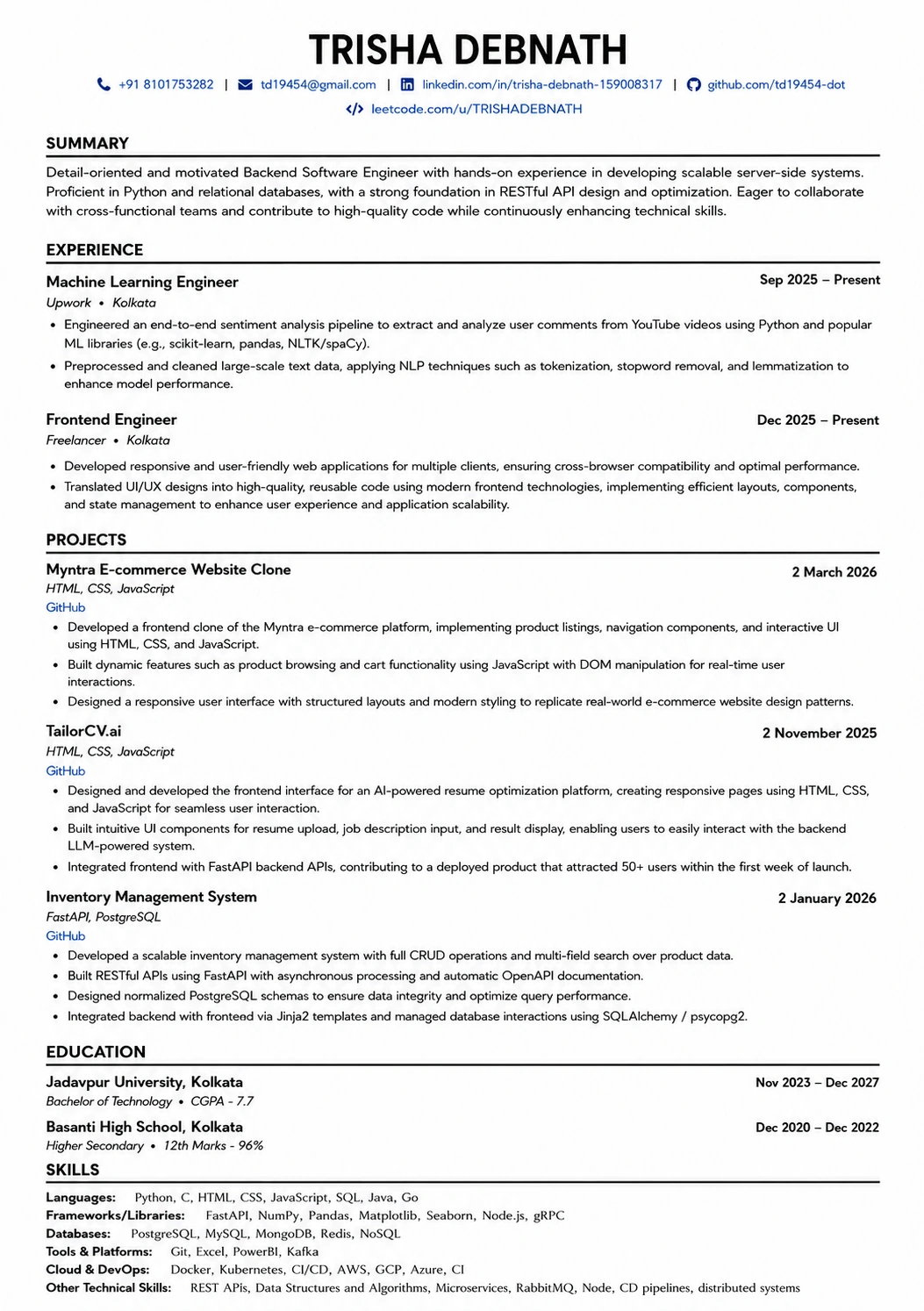
Your resume after optimization
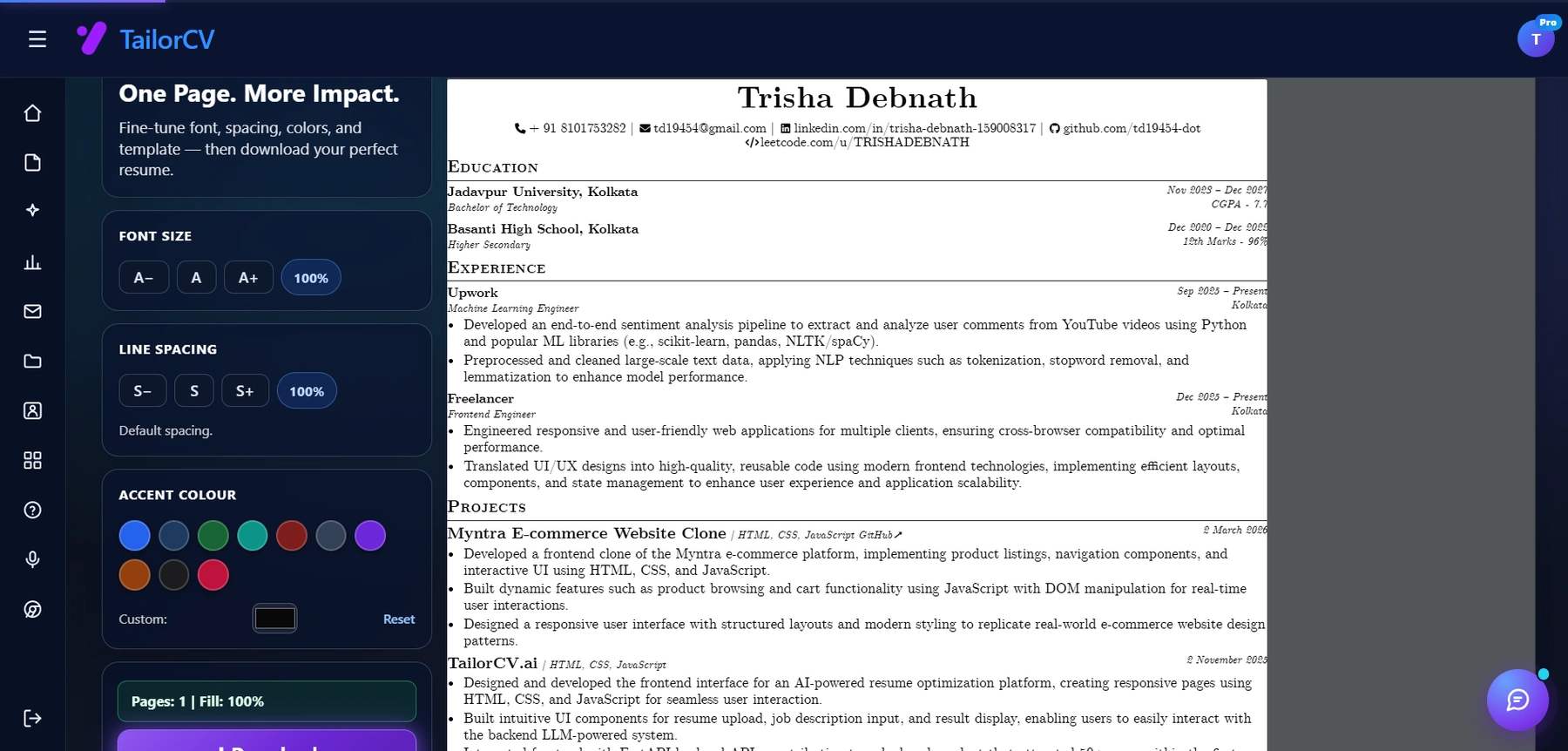
Font size, spacing, accent colour and template are all adjustable, with a live page counter.
The 10-Second Test: Do It Yourself
Before submitting your resume, do this test: set a 10-second timer, look at your resume, and ask:
- Can I immediately see my name and current role?
- Can I see 2-3 companies I've worked at?
- Can I see 1-2 clear accomplishments?
- Does it look clean and easy to scan?
If the answer to any of these is no, your resume needs work. Use an ATS-friendly template as a starting point and run it through the TailorCV ATS checker before submitting.
Related Guides
- What Is a Resume and Why Does It Matter?
- The Anatomy of a Perfect Resume
- How to Write a Resume Summary
- How to Write Resume Bullet Points That Get Results
- Best Action Verbs for Resume
- How to Quantify Resume Achievements
- How to Make Your Resume ATS-Friendly
- ATS Resume Formatting Mistakes
- How to Explain Resume Gaps
- Resume Proofreading Checklist
- Resume Design and Color Guide
- Resume Margins, Spacing and Layout
Make This Practical
Use this guide as part of a complete job-search workflow. Check your resume with the free ATS score checker, improve targeting with the Resume Optimization Guide, and choose a clean format from the ATS-friendly resume templates.
After the resume is ready, strengthen the rest of the application. Draft a targeted letter with the AI cover letter generator, practice interviews with the AI mock interview tool, and create a project-backed proof page with the portfolio website builder if you need a stronger online presence.
Conclusion
Recruiters read resumes in under 10 seconds on the first pass, scanning the top, the left column, and the key landmarks of your career history. Optimize for this by putting your strongest, most relevant content in the highest-visibility positions, using clean formatting, quantified bullets, and a single-column layout.
Use an ATS-friendly template as your foundation, verify with the TailorCV ATS checker, and once your resume starts landing you interviews, prepare with the mock interview tool.
Frequently Asked Questions
How can I optimize my resume to pass the 10-second scan?
To optimize your resume for the 10-second scan, focus on placing key information where recruiters look first, such as your name, current job title, and previous job titles. Use clear headings and bullet points to enhance readability. Additionally, ensure your resume is ATS-friendly by using a free ATS score checker before finalizing your layout.
What should I include in the contact section of my resume?
In your resume contact section, include your full name, phone number, email address, and LinkedIn profile link if applicable. Avoid unnecessary details like your full address or personal information that can lead to bias. For more guidance on formatting this section, check out our article on the resume contact section.
Why is the F-pattern important for resume writing?
The F-pattern is crucial because it reflects how recruiters visually scan resumes, starting from the top and moving down the left side. By structuring your resume to align with this pattern, you increase the chances that essential details will catch the recruiter's eye. Learn more about effective resume layouts in our post on the anatomy of a perfect resume.
How do I make my resume stand out from generic ones?
To make your resume stand out, customize it for each job application by using specific keywords from the job description and highlighting relevant experiences. Avoid generic phrases and ensure each section reflects your unique qualifications. For tips on avoiding generic resumes, read our article on how recruiters spot generic resumes.
What role does education play in the 10-second scan?
Education is one of the key components recruiters look for during the initial scan, usually appearing after job titles and companies. Clearly list your degrees, institutions, and graduation dates in a concise format to ensure it is easily visible. For more details on how to present your education effectively, visit our guide on how to list education on resume.
What is your resume scoring right now?
Scan it against a job description and get your ATS match score in about a minute.
Drop your resume here or choose a file
PDF only. Max 2 MB.
We never share your data or use it to train AI models.

Templates that keep this structure intact
This template is ATS-tested — start from it and the formatting rules in this guide are already handled.
Was this guide useful?
Be the first to rate it.