 TD
TD
Key Takeaways
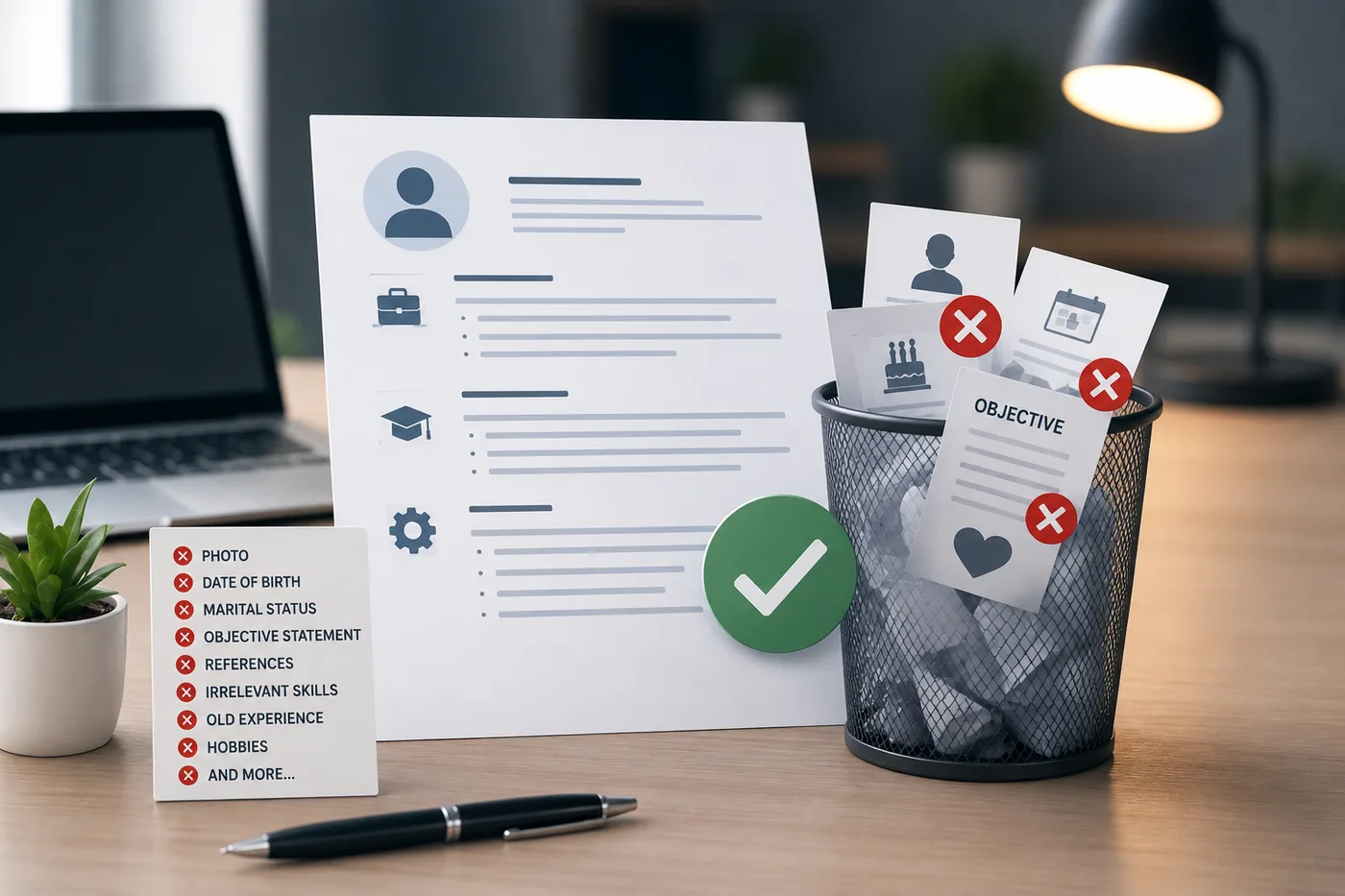
- Remove personal information such as photos, date of birth, marital status, and full home addresses to avoid bias and protect privacy.
- Avoid generic objective statements; instead, provide a specific summary that highlights your skills and goals.
- Do not list basic skills like Microsoft Office; focus on advanced competencies relevant to the job.
- Eliminate vague personality traits and instead demonstrate your abilities through specific examples or achievements.
- Only include hobbies if they are directly relevant to the role or showcase unique accomplishments.
Most resume advice tells you what to add. This guide tells you what to remove. Knowing what does not belong on a resume is just as important as knowing what does - because many candidates actively hurt their chances with information that is irrelevant, outdated, or counterproductive.
If your resume has any of the following 25 things, remove them before your next application.
Start with the right foundation. Use the ATS score checker to see if your resume is well-matched to the job description, use an ATS-friendly template, and read the resume optimization guide for the complete picture. For the opposite view - what to add - read the guide to best action verbs for resume and how to quantify resume achievements.
Personal Information to Remove
Your resume after optimization
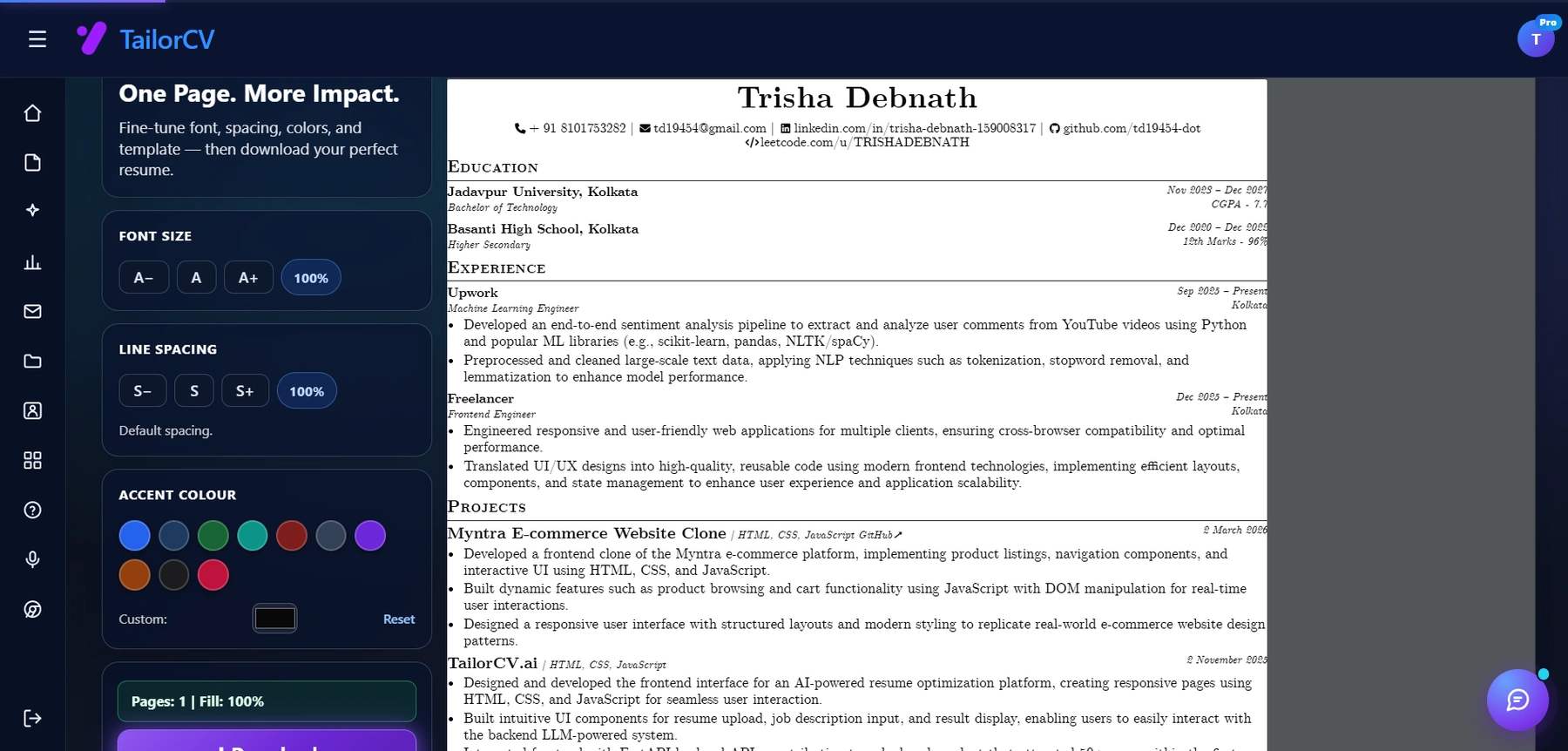
This is the resume after tailoring - the content is already matched, and these controls are how you fit it onto one page.
1. Photo (unless specifically required)
In the US, UK, Canada, Australia, and most Western countries, including a photo creates unconscious bias and can actually get your resume rejected to protect the company from discrimination claims. Check norms for your specific country. If not required, remove it.
2. Date of birth or age
Age discrimination is illegal in most countries and pervasive in practice. Never include your birth date or year on a resume unless legally required for a specific role type.
3. Marital status or family information
"Married with 2 children" - this is completely irrelevant to your ability to do the job. Remove it.
4. Full home address
City and country/state is sufficient. Your full street address is unnecessary, a privacy risk, and takes up space. Replace "123 MG Road, Apartment 4B, Bengaluru, Karnataka 560001" with "Bengaluru, India."
5. Social security number, passport number, or national ID
Never include sensitive personal identifiers on a resume. This information is submitted only when formally required during background check processes.
6. Religious or political affiliations
Unless the role or organization is specifically related to your religion or political beliefs, these should not appear on a resume.
Objective Statements That Are Too Generic
7. The classic "looking for an opportunity" statement
"Seeking a challenging position in a dynamic organization where I can utilize my skills and grow professionally" - this sentence appears on millions of resumes and adds zero information. Replace with a specific, targeted summary of what you bring and what you are looking for.
If you write a summary, make it specific: your domain, your stack, your most impressive result, and your target role. Read the resume summary guide for examples.
Skills and Experience to Remove
8. Microsoft Office (basic)
In 2026, knowing how to open Word and Excel is assumed for every white-collar role. Listing "Microsoft Office" as a skill wastes space. Only list advanced skills: "Excel (VBA, Power Query, PivotTables)" or remove it entirely.
9. Skills you cannot discuss in an interview
If you list "Machine Learning," "Kubernetes," or "SAP" because you watched a YouTube video once, remove it. Interviewers will ask about anything on your resume. Getting caught exaggerating is a red flag that can end an interview immediately.
10. Generic personality traits
"Team player," "hard worker," "fast learner," "detail-oriented," "passionate" - these are claims without evidence. Everyone says this. Show teamwork through a collaboration example. Show fast learning through a specific case. Show passion through projects. Remove the traits and replace with proof.
11. Hobbies and interests (most of the time)
Reading, traveling, cooking, music - these are universal and say nothing. Remove them unless:
- The hobby is directly relevant to the role (e.g., coding side projects for a tech role)
- The hobby shows unusual achievement (e.g., national-level athlete)
- The company culture explicitly values personality fit and you have strong unique interests
12. References
"References available upon request" - this is obvious and outdated. Remove it. If references are needed, employers will ask. The line wastes one or two resume lines you could use for a bullet point.
13. High school information (if you have a university degree)
Once you have a bachelor's degree, your high school entry should be removed. Exceptions: if the high school is exceptionally prestigious, or if you are currently a high school student.
14. Old or irrelevant work experience
A 10-year-experienced software engineer does not need to list their call center job from 2011. Include only the last 10 years of relevant experience. For more recent candidates, remove roles shorter than 3 months that contributed nothing relevant.
15. Experience from 15+ years ago (unless directly relevant)
Older experience dates you, takes space, and is rarely relevant. A senior engineer's 2004 junior dev role at a company that no longer exists is not relevant to a 2026 application.
Format and Design Elements to Remove
16. Tables and text boxes
Many ATS systems cannot read text inside tables or text boxes. The content disappears - only the empty box is parsed. Use simple paragraph and list formatting instead.
17. Headers and footers in Word
Text placed in the header or footer section of a Word document is often not extracted by ATS parsers. Put your name and contact information in the main body.
18. Columns (two-column layouts)
Some ATS systems read columns left-to-right row-by-row rather than top-to-bottom per column, resulting in garbled text. A single-column resume is the safest format for ATS parsing. Use ATS-friendly templates designed for clean parsing.
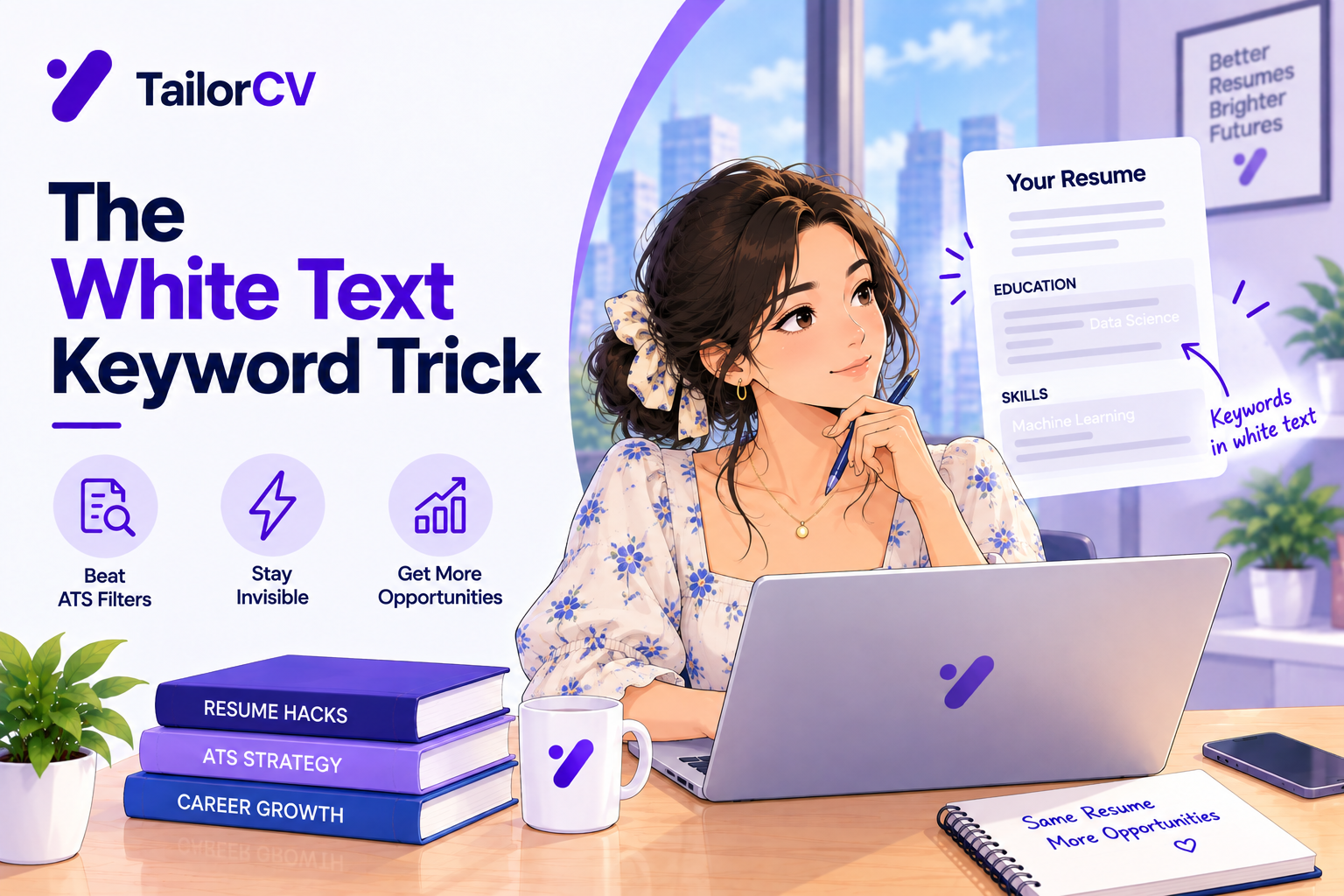
19. Graphics, icons, and charts
Skill bar charts (the horizontal bars showing "JavaScript: 80%") cannot be read by ATS. Icons next to contact information are often not parseable. Remove all graphics and represent everything in clean text.
20. Decorative fonts or very small text
Use standard fonts (Arial, Calibri, Garamond, Georgia) at 10-12pt for body text. Decorative fonts often do not parse correctly. Very small fonts (8-9pt) are hard to read and signal poor design judgment.
Content That Creates Legal or Professional Risk
21. Confidential client or company information
Do not include proprietary financial figures, client names under NDA, unreleased product information, or internal system names that are confidential. Describe your work without revealing confidential specifics.
22. Compensation information
Never include your current salary, expected salary range, or compensation history on your resume unless specifically asked by the application system. This weakens your negotiating position.
23. Negative information about former employers
"Left due to toxic management" or "company went bankrupt due to leadership failure" - never. Your resume should be entirely positive and forward-looking.
24. Exaggerated or false credentials
Inflating your GPA, claiming a certification you have not completed, or listing a job title that was not official - these are discovered in background checks and instantly eliminate you from consideration. Honesty is non-negotiable.
25. Unprofessional email addresses
"coolboy2000@gmail.com" or "partyanimal@hotmail.com" - these signal immaturity. Create a professional email: firstname.lastname@gmail.com or similar before applying.
Quick Checklist: Scan Your Resume Now
Before sending your next application:
- Photo removed (unless required)?
- Date of birth removed?
- Objective replaced with a specific summary?
- "Team player / hard worker / fast learner" removed?
- "References available on request" removed?
- "Microsoft Office" removed or upgraded?
- High school removed (if you have a degree)?
- No tables, text boxes, or two-column layout?
- No skill bars or graphics?
- Professional email address?
- No confidential information?
- No exaggerated credentials?
Related Guides
- How to List Certifications on a Resume
- How to List Education on a Resume
- Soft Skills for Resume
- 200 Best Action Verbs for Resume
- How to Quantify Resume Achievements
- How to Write a Resume Headline
- How to Write a Resume Summary
- Top Skills to Add to Your Resume
- 20 Common Interview Mistakes to Avoid
- How to Explain Resume Gaps
- Ideal Resume Length
- First Time Resume With No Experience: Complete Guide for Freshers & College Students
- Cover Letter Guide 2026 - How to Write a Cover Letter That Gets Read
- Why Your Resume Never Gets a Response - 12 Hidden ATS Mistakes Killing Your Job Search in 2026
- Why Am I Not Getting Interviews for Jobs I'm Qualified For?
- ATS Mistakes Experienced Professionals Make (And Why Your Resume Stops Working After 5+ Years)
Make This Practical
Use this guide as part of a complete job-search workflow. Check your resume with the free ATS score checker, improve targeting with the Resume Optimization Guide, and choose a clean format from the ATS-friendly resume templates.
After the resume is ready, strengthen the rest of the application. Draft a targeted letter with the AI cover letter generator, practice interviews with the AI mock interview tool, and create a project-backed proof page with the portfolio website builder if you need a stronger online presence.
Conclusion
What you remove from your resume is as important as what you add. A clean, focused resume that removes noise lets your strongest achievements stand out.
Once you have removed the wrong things, run your resume through the TailorCV ATS score checker to verify your keywords match the job description. Use an ATS-friendly template and then strengthen your bullets with the action verbs guide and achievement quantification guide.
Frequently Asked Questions
What are some common resume red flags to avoid in 2026?
In 2026, certain resume elements can raise red flags for employers, such as including outdated skills or irrelevant work experiences. To ensure your resume stands out positively, familiarize yourself with the 15 resume red flags that get you rejected before an interview and eliminate any elements that may harm your chances.
Should I include my photo on my resume?
Generally, it's best to avoid including a photo on your resume unless specifically requested, as it can lead to unconscious bias and potential discrimination claims. In most Western countries, omitting your photo helps keep the focus on your qualifications and skills. Instead, concentrate on crafting a strong resume using ATS-friendly templates.
What personal information should I exclude from my resume?
You should avoid including personal information such as your date of birth, marital status, and full home address. This information is often irrelevant to your job qualifications and can even lead to privacy concerns. Instead, provide only necessary details like your city and country, and focus on showcasing your skills and achievements.
How can I effectively quantify my resume achievements?
Quantifying your achievements is key to demonstrating your impact in previous roles. Use specific numbers, percentages, or outcomes to illustrate your contributions. For guidance on how to do this effectively, check out our post on how to quantify resume achievements for practical examples and tips.
What should I focus on adding to my resume instead?
While knowing what to remove is crucial, it's equally important to know what to add. Focus on including relevant skills, accomplishments, and action verbs that resonate with the job description. For a comprehensive list of impactful terms, refer to our guide on the 200 best action verbs for resume in 2026.
What is your resume scoring right now?
Scan it against a job description and get your ATS match score in about a minute.
Drop your resume here or choose a file
PDF only. Max 2 MB.
We never share your data or use it to train AI models.

Templates that keep this structure intact
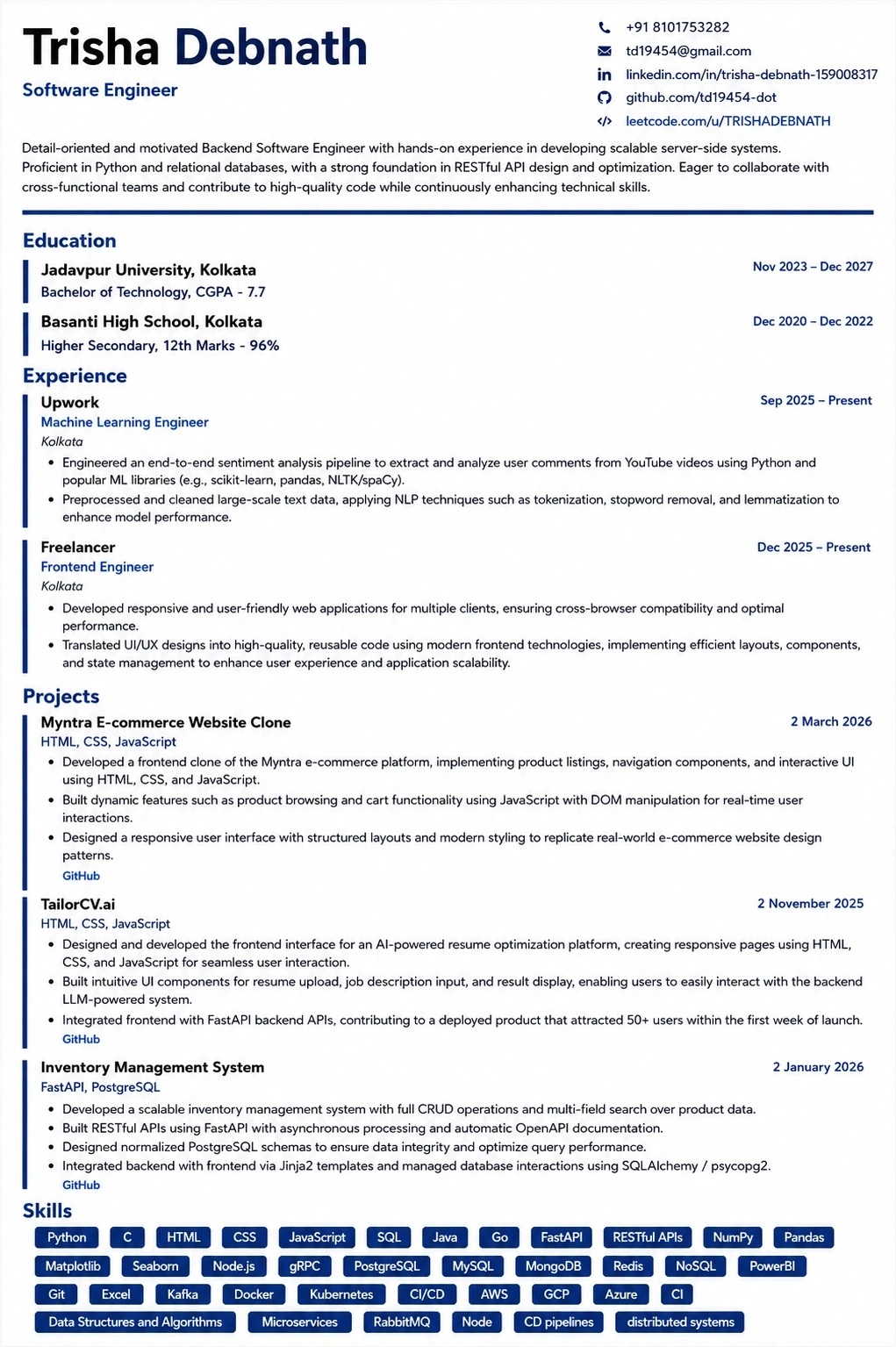
This template is ATS-tested — start from it and the formatting rules in this guide are already handled.
Was this guide useful?
Be the first to rate it.