 SS
SS
Key Takeaways
- In 2026, do not include references on your resume as they take up space and are assumed by employers.
- Only include references on your resume if explicitly requested in the job posting, for academic CVs, or for internships at small organizations.
- When preparing a reference list, create a separate document with details such as name, title, relationship, email, and phone number.
- Aim for 3 references for standard roles and 4-5 for senior positions, and have them ready before applying.
- Choose credible references like former managers or peers, and avoid family or friends unless exceptional. Always ask for permission before listing someone as a reference.
"References available upon request" was standard resume advice for decades. Today it is outdated, wastes space, and signals that you are using advice from 20 years ago. This guide tells you exactly what to do with references in 2026 - when to include them, what format to use, how to prepare them, and what common mistakes to avoid.
Once your references are sorted, focus on making your resume content exceptional. Use an ATS-friendly template and check your score with the TailorCV ATS checker.
The Short Answer: Do Not Put References on Your Resume
In 2026, references do not belong on your resume for these reasons:
-
They take up valuable space. A line saying "References available upon request" wastes space that could hold an achievement or skill.
-
It is assumed. Every employer knows you have references. Stating "references available" communicates nothing - it is like writing "Can attend interviews if asked."
-
References are a later-stage activity. Employers ask for references after they have decided you are a serious candidate, usually between final-round interview and offer. Adding them to your resume puts the cart before the horse.
-
Privacy concerns. Listing reference contact information on a resume that may be uploaded to multiple job boards exposes your references to unsolicited contact.
When References Are Appropriate on a Resume
There are a few exceptions:
When the Job Posting Explicitly Requests References
Some job postings (often in government, education, nonprofit, or certain European markets) explicitly ask for references with the application. Follow the posting's instructions - if they ask for references on the resume, include them.
Academic CVs
An academic CV (different from a resume - see resume vs CV) typically includes professional references as a standard section. For faculty, postdoc, or research applications, references are expected.
Internships at Small Organizations
Some small companies and startups with informal hiring processes do expect references from the start, especially for internship or entry-level roles where reference checks substitute for work history.
How to Prepare a References List (For When It's Requested)
When an employer requests references, you provide a separate document - never embedded in your resume.
Format for a Reference List
Create a separate document titled "References - [Your Name]" with the following for each reference:
[Full Name]
[Title], [Company]
[Relationship to you - e.g., "Direct Manager, 2021-2023"]
[Email Address]
[Phone Number]
Example:
Sarah Chen
VP of Engineering, TechCorp Inc.
Direct Manager, Jan 2021 - Dec 2023
sarah.chen@techcorp.com | +1 (555) 234-5678
How Many References to Prepare
Standard: 3 references
For senior roles: 4-5 references
Have references prepared and ready before you begin applying. Do not wait until an employer requests them.
Who to Choose as References
Strongest Reference Types
Former direct managers - The most credible and most asked-for reference. A manager who can speak to your work quality, reliability, and impact is gold.
Former peers who can speak to your work - Especially senior peers or leads who observed your work closely.
Former clients or stakeholders - Particularly valuable for consulting, sales, and client-facing roles.
Professors or academic advisors - Valid for recent graduates and early-career professionals.
Mentors with professional standing - Particularly relevant for first jobs and career changers.
Avoid
- Family members or personal friends (never, unless truly exceptional and business-related)
- References who may not remember you clearly
- Former managers who you know are skeptical of your work
- References who work at your current employer without their knowledge
How to Ask Someone to Be a Reference
Always ask permission before listing anyone as a reference. A reference who is surprised by a call gives a weak or awkward endorsement.
When asking:
- Give them context on the role(s) you are applying for
- Share your updated resume so they can speak to your current positioning
- Ask if they are comfortable speaking positively on your behalf
- Give them a heads-up when you provide their name to an employer
Keep the relationship warm. Reconnect with potential references before you need them - a call asking "how are you?" is far better than one saying "can I list you immediately for a job I'm applying for today?"
What Makes a Strong Reference
A strong reference can:
- Speak specifically to your work (not vague praise)
- Recall concrete projects, achievements, or examples
- Confirm your technical and soft skills with direct evidence
- Say with confidence that they would hire you again
A weak reference gives generic answers: "She was great. Very hard-working. I'd recommend her." Without specifics, this does little to move your candidacy forward.
Brief your references before they receive a call:
- What role you are applying for
- What the employer is most likely to ask about
- One or two key stories they could reference about your work
The "References Available Upon Request" Line: Remove It
If your resume currently includes this line, delete it. It:
- Wastes valuable resume space
- Is assumed by all employers
- Makes your resume look dated
Replace that space with a strong bullet point, certification, or achievement. Read what not to put on a resume for more things to remove.
Reference Checks in the Hiring Process
Reference checks typically happen:
- After the final interview - When the employer is deciding between top candidates
- Before an official offer is extended - As part of background verification
- Occasionally before a final interview - For senior or sensitive roles
Reference checks are a formality in some industries and a critical decision factor in others. In government, healthcare, finance, and education, a weak reference can reverse a hiring decision.
What Employers Ask References
Common reference check questions:
- How long did you work with this person and in what capacity?
- What were their greatest strengths?
- What were their areas for improvement?
- Would you hire them again?
- Can you describe a time they handled a difficult challenge?
- Were there any performance concerns during their time with you?
Prepare your references to answer these questions with specific examples - not just general praise.
Related Guides
- The Anatomy of a Perfect Resume
- What Not to Put on a Resume
- Resume Proofreading Checklist
- How to Write a Resume from Scratch
- Resume vs CV: What's the Difference?
- How to Follow Up After an Interview
- Mock Interview Practice
Make This Practical
Use this guide as part of a complete job-search workflow. Check your resume with the free ATS score checker, improve targeting with the Resume Optimization Guide, and choose a clean format from the ATS-friendly resume templates.
After the resume is ready, strengthen the rest of the application. Draft a targeted letter with the AI cover letter generator, practice interviews with the AI mock interview tool, and create a project-backed proof page with the portfolio website builder if you need a stronger online presence.
Conclusion
Do not include references on your resume - remove "references available upon request" if it's there. Instead, maintain a separate, prepared reference list ready to send when requested. Choose 3-5 strong references, ask permission in advance, keep relationships warm, and brief references before any employer call.
Focus your resume space on your achievements and skills. Use an ATS-friendly template, optimize your content with the TailorCV ATS checker, and prepare for the interview itself with the mock interview tool.
Frequently Asked Questions
Should I include references on my resume in 2026?
No, you should not include references on your resume in 2026. This practice is outdated and takes up valuable space that could be better used to showcase your skills or achievements. Employers already assume you have references and typically request them later in the hiring process, after you've made it through initial rounds of interviews.
What should I do if a job posting asks for references?
If a job posting explicitly requests references, you can include a separate document with your references instead of listing them on your resume. Make sure this document is professional and includes the necessary contact information and context for each reference. For tips on formatting your resume, check out our guide on the resume section order.
How can I prepare my references for a job application?
Preparing your references involves informing them about the positions you are applying for and providing them with context about your skills and experiences. This way, they can tailor their recommendations to align with the job requirements. To ensure your resume is polished, consider using our resume templates for a professional look.
What are some common mistakes to avoid regarding resume references?
Common mistakes include listing references directly on your resume, using outdated phrases like "references available upon request," and not notifying your references beforehand. Instead, focus on crafting an exceptional resume that highlights your qualifications. You can also use our free ATS score checker to ensure your resume meets modern standards.
When is it appropriate to use a video resume?
A video resume can be appropriate in creative fields or when specifically requested by the employer. It allows you to showcase your personality and communication skills in a unique way. For more details on when and how to use a video resume, read our video resume guide.
What is your resume scoring right now?
Scan it against a job description and get your ATS match score in about a minute.
Drop your resume here or choose a file
PDF only. Max 2 MB.
We never share your data or use it to train AI models.

Templates that keep this structure intact
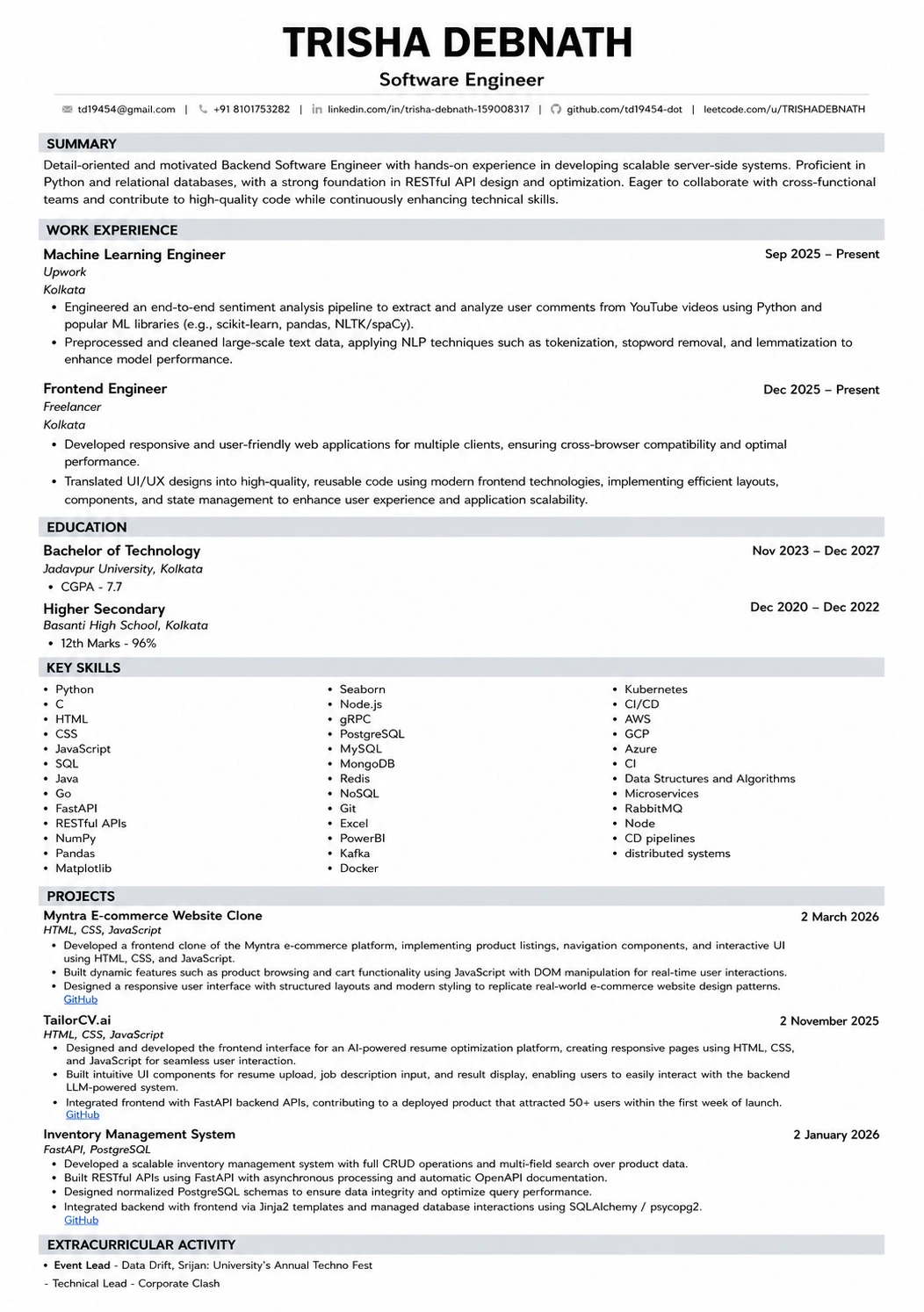
This template is ATS-tested — start from it and the formatting rules in this guide are already handled.
Was this guide useful?
Be the first to rate it.