 TD
TD

Key Takeaways
- Job descriptions contain three layers: explicit requirements, priority signals, and subtext, which provide deeper insights into the role.
- Priority signals, such as the position of requirements and repetition of key terms, indicate what the employer values most.
- The "Required vs. Preferred" sections reveal essential qualifications and differentiators that can set candidates apart.
- Understanding the subtext, including the problems the company is facing, helps tailor applications more effectively.
- Candidates who analyze all three layers of a job description are more likely to stand out in the hiring process.
You read the job description.
You see: "Python, SQL, machine learning, cross-functional collaboration, communication skills."
You add them to your resume. You apply. You do not hear back.
Another candidate - who used almost the same keywords - got the interview.
What did they see that you missed?
They read between the lines.
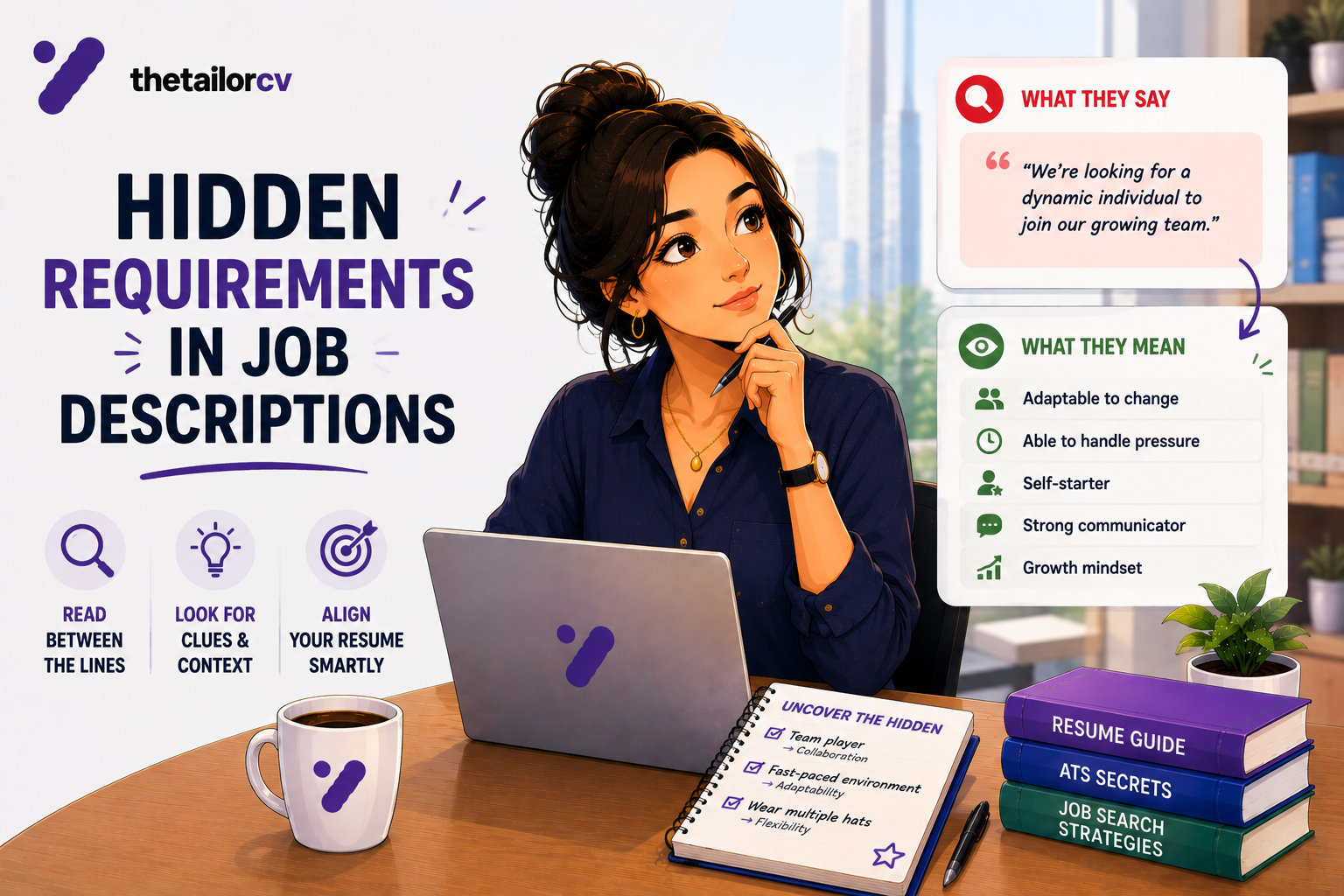
A job description is never just a list of requirements. It is a window into what the team is actually dealing with right now. The problems they are trying to solve. The frustrations they have with the current state. The type of person who will fit into the culture.
All of that is encoded in the language - if you know how to read it.
This guide teaches you how. It goes deeper than the standard job description keyword extraction guide - that covers finding the obvious terms. This guide covers finding the ones that are not obvious.
The Three Layers of a Job Description
Most candidates only read the first layer.
Layer 1: The Explicit Requirements These are the obvious bullets: skills, tools, years of experience, education. Everyone reads these. These are important - but they are just the baseline.
Layer 2: The Priority Signals The way requirements are ordered, repeated, and described tells you what actually matters most. "Python, SQL" at the top of requirements is different from "Python, SQL" buried in a nice-to-have list.
Layer 3: The Subtext The company's real pain points, culture, and expectations are hidden in how they describe the role - in the tone, the word choices, the problems they reference, and what they conspicuously avoid mentioning.
Most tailoring advice covers Layer 1. The candidates who stand out work all three layers.
Reading Layer 2: Priority Signals
Signal 1: Position in the Description
Job descriptions are not randomly ordered. What appears first is usually what matters most.
A posting that opens "We are looking for a data engineer who can build reliable pipelines at scale" is telling you the #1 priority before the requirements list even begins.
A posting that leads with "We are a fast-moving startup in the health space" is flagging that speed and healthcare context are core requirements - even if they appear nowhere in the bullet list.
Read the first paragraph of the job description like a headline. It tells you more than anything else.
Understanding how recruiters read resumes also helps you understand the reverse - what they are looking for in those first few lines before deciding whether to read further.
Signal 2: Repetition
If a word or concept appears more than twice in a job description, it is not an accident. It is an obsession.
If "data-driven" appears in the intro, the responsibilities section, and the culture description - the company is telling you that data fluency is non-negotiable, even if it is not in the required qualifications list.
Count repetitions. What appears three or more times? That is what they really care about.
Signal 3: The "Required vs. Preferred" Balance
Read both sections - but read them strategically.
Everything in "Required" is a filter. You must have these (or convincingly demonstrate you can grow into them quickly).
Everything in "Preferred" is a differentiator. Candidates who check off preferred qualifications stand out from those who only check off required ones.
Most candidates stop after confirming they meet the required section. The candidate who quietly covers 4 out of 6 preferred qualifications - and shows it on their resume - wins.
Reading Layer 3: The Subtext
This is where the real tailoring advantage lives.
Subtext Signal 1: The Problems They Are Trying to Solve
Job descriptions often reveal the team's current pain points - sometimes explicitly, sometimes through implication.
"We are looking for someone to help us scale our data infrastructure as we prepare for Series B" tells you:
- The team is currently under-scaled
- There is a fundraising event on the horizon
- Speed and growth-readiness are the real criteria
- Keywords to add: scale, infrastructure, growth-stage, high-availability, distributed systems
"We need someone who can bring structure to our analytics function" tells you:
- There is currently no structure
- Your ability to build processes from scratch is what they actually need
- Keywords: process-building, analytics frameworks, documentation, stakeholder alignment, governance
Find the problem statement hidden in the "about this role" section. Then tailor your bullet points to show you have solved that exact type of problem before.
Subtext Signal 2: The Culture Language
How a company describes itself reveals what kind of person they will actually hire.
"Fast-paced and high-growth" -> They want scrappiness, speed, and comfort with ambiguity. Do not lead with bureaucratic processes. See startup vs enterprise resume tailoring for how to adjust your language accordingly.
"Collaborative and inclusive environment" -> They value team players over individual heroes. Adjust your bullets to show teamwork alongside personal accomplishment. Soft skills deserve more prominence here.
"Data-driven culture" -> Every claim needs a number. Adjust your bullets to be heavily metric-led. Read how to quantify resume achievements for the framework.
"Customer-obsessed" -> Add customer-facing impact to your bullets even if the role is internal.
"Mission-driven" -> They want genuine alignment with the cause. If the company works in sustainability, healthcare, or education - and you have any connection to that mission - make it visible in your summary.
Subtext Signal 3: What They Did Not List
The absence of certain keywords is also information.
If a software engineering role does not mention agile, scrum, or sprints - they may not be a process-heavy team. Do not lead with your Scrum Master experience.
If a data role does not mention any visualization tools - they may not value dashboards right now. Do not put Tableau front and center.
If a marketing role does not mention SEO or content - the role is probably paid or brand-focused, not organic. Do not lead with your content marketing work.
The missing items tell you what to de-emphasize as much as the present items tell you what to emphasize.
Practical Technique: The Three-Pass Read
Before you tailor your resume, read the job description three times.
Pass 1 - What (10 minutes) Read it straight through for overall comprehension. What does this role actually do day-to-day? What is the team's mission?
Pass 2 - Why (10 minutes) Read for subtext. Why is this role open? (New headcount, replacement, expansion?) What problem is this hire solving? What is the company's biggest challenge right now?
Pass 3 - Who (10 minutes) Read for cultural fit. What kind of person succeeds in this environment? What language signals what values the team holds?
After all three passes, write down:
- The top 5 explicit required keywords
- The top 3 priority signals (what is repeated and emphasized)
- The one-sentence problem statement ("they need someone to...")
- The one-word culture signal ("fast-moving" / "collaborative" / "data-driven" / "customer-first")
Now tailor your resume to address all four. Use the resume matching checklist to confirm you have covered every layer before submitting.
Examples: Before and After Subtext Reading
Job Description Opening:
"We are rebuilding our analytics foundation after a period of hypergrowth and need a data engineer who can bring reliability and trust back to our data pipelines. Our current setup is fragile - you will own the migration to a more scalable architecture."
What most candidates read: Data engineering, pipelines, scalable architecture.
What the subtext tells you:
- The current state is broken ("fragile")
- They want reliability, not just functionality
- "Trust" in data is the emotional priority
- The word "own" signals they want an autonomous contributor, not someone who needs direction
tailored resume language: "Rebuilt fragile ETL pipeline at [Company] - reduced data incidents from 15/month to 0 over 6 months and established data quality monitoring that gave the business its first reliable daily metrics."
You addressed the real problem. Not just the listed requirement.
Use TailorCV to Find Explicit Keywords - Then Add the Subtext Yourself
TailorCV's keyword analyzer handles the Layer 1 and Layer 2 work efficiently.
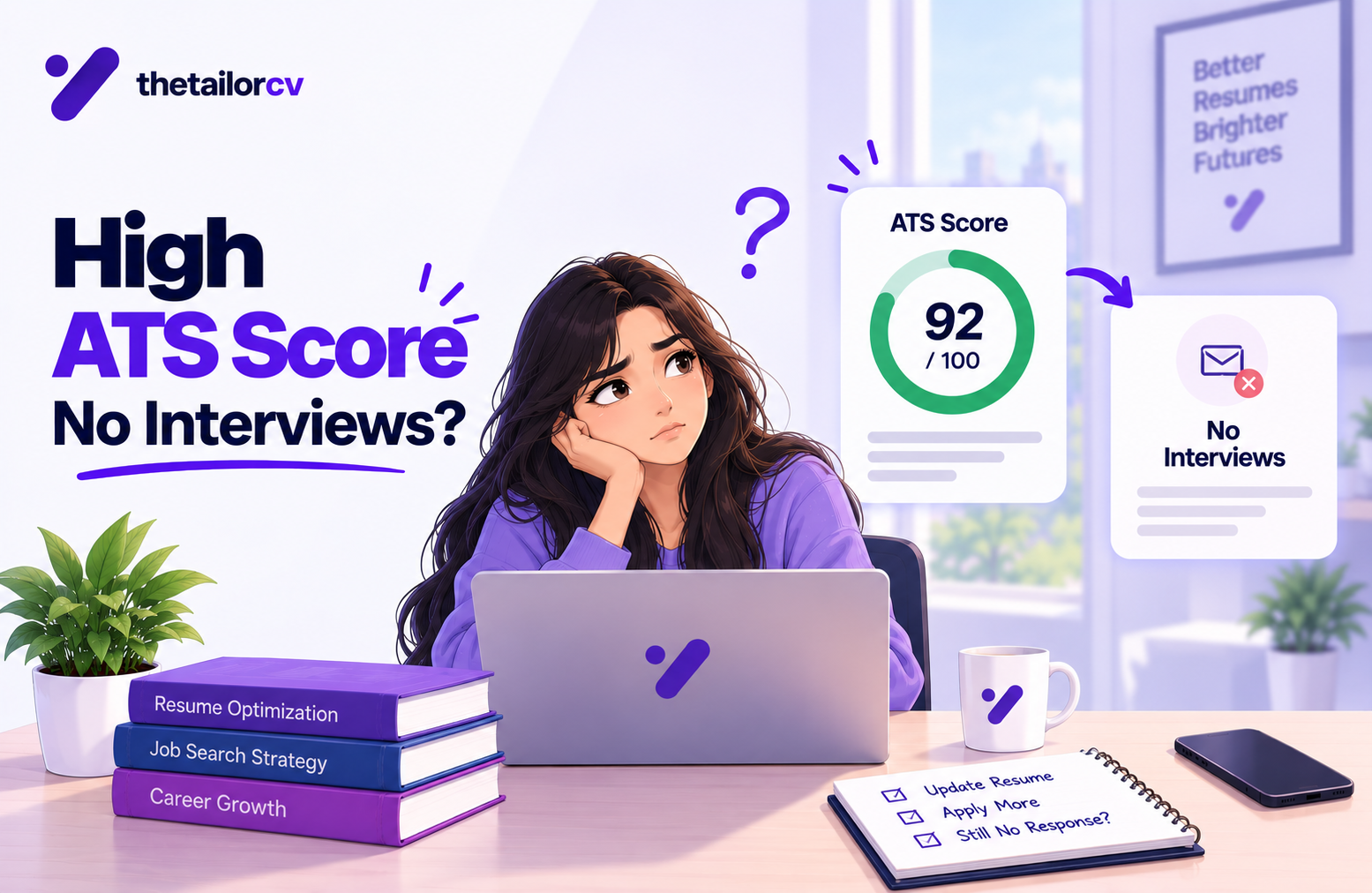
What an ATS score report actually shows you

The score matters less than the breakdown beside it - each check names what passed, what failed and why, which is the list you actually work through.
Paste the job description. Upload your resume. Get an instant gap analysis: which required and preferred keywords are missing from your resume, and where to add them.
This saves the time-consuming explicit keyword matching work.
Then - using the subtext reading techniques in this guide - you add the Layer 3 tailoring: the problem-statement language, the culture signals, the priority emphasis.
The combination of AI-powered keyword matching and human-level subtext reading is what produces a resume that passes ATS and resonates with the human on the other side.
Make This Practical
Do not guess whether the resume is ready. Upload it to the free ATS score checker, compare the result with the ATS Score Guide, and fix formatting issues using ATS Resume Formatting Mistakes and ATS Resume Parser Friendly Format.
After the technical cleanup, improve relevance. Use Resume Matching With Job Description, strengthen keyword coverage with the Resume Keywords Guide, and avoid overdoing it by checking ATS Keyword Mistakes. If the layout itself is weak, rebuild with an ATS-friendly resume template.
FAQ
Do ATS systems pick up subtext and context?
Modern ATS systems are increasingly semantic - they understand context, not just exact keyword matches. A bullet that describes the relevant work in the employer's own language scores better than a keyword forced into an unrelated sentence. Subtext reading helps you write naturally in the right language - which ATS rewards. Check ATS score guidance to understand how semantic scoring works.
How do I know if I am reading too much into a job description?
If your interpretation requires significant inference and the job description doesn't support it clearly, you are probably over-reading. Stick to signals that appear at least twice or that are explicitly stated in the role description or culture sections.
Should I use the exact phrases from the company's culture section?
Use the concepts, adapted naturally. If the company says "customer-obsessed," you do not have to use that exact phrase - but your resume should show customer outcomes and customer focus clearly.
How long should this three-pass reading take?
For a priority application: 30 minutes. For a volume application where you are using a base resume: 10 minutes is enough for a quick pass 1. Invest time proportional to how much you want the role. Consider using resume templates to streamline your process.
Related Guides
- Job Description Keyword Extraction Guide
- How to Match Resume Keywords to Job Description
- Resume Keyword Density Guide
- How to Tailor Your Resume for Every Job
- ATS Keyword Mistakes That Cost Interviews
- How to Stop Sounding Generic on Your Resume
- Tailored vs Generic Resume
- How to Write Resume Bullet Points
- Resume Matching with Job Description - Complete Guide
- How Recruiters Read Resumes
Conclusion
Every job description has three layers.
Most candidates only read one.
The explicit keywords are just the entrance fee. The priority signals tell you what to emphasize. The subtext tells you what the team is actually living through - and whether your experience is the answer to their real problem.
Read the JD three times. Find the hidden keywords. Identify the real problem statement. Match your resume to the culture language.
Then check your explicit keyword match with TailorCV.
The candidates who do all of this consistently do not just pass ATS. They make recruiters feel like the search is over.
Analyze My Resume Against This JD - Free
See which keywords you are missing
Scan your resume against the posting and get the exact terms it did not find.
Drop your resume here or choose a file
PDF only. Max 2 MB.
We never share your data or use it to train AI models.
Where those keywords actually go
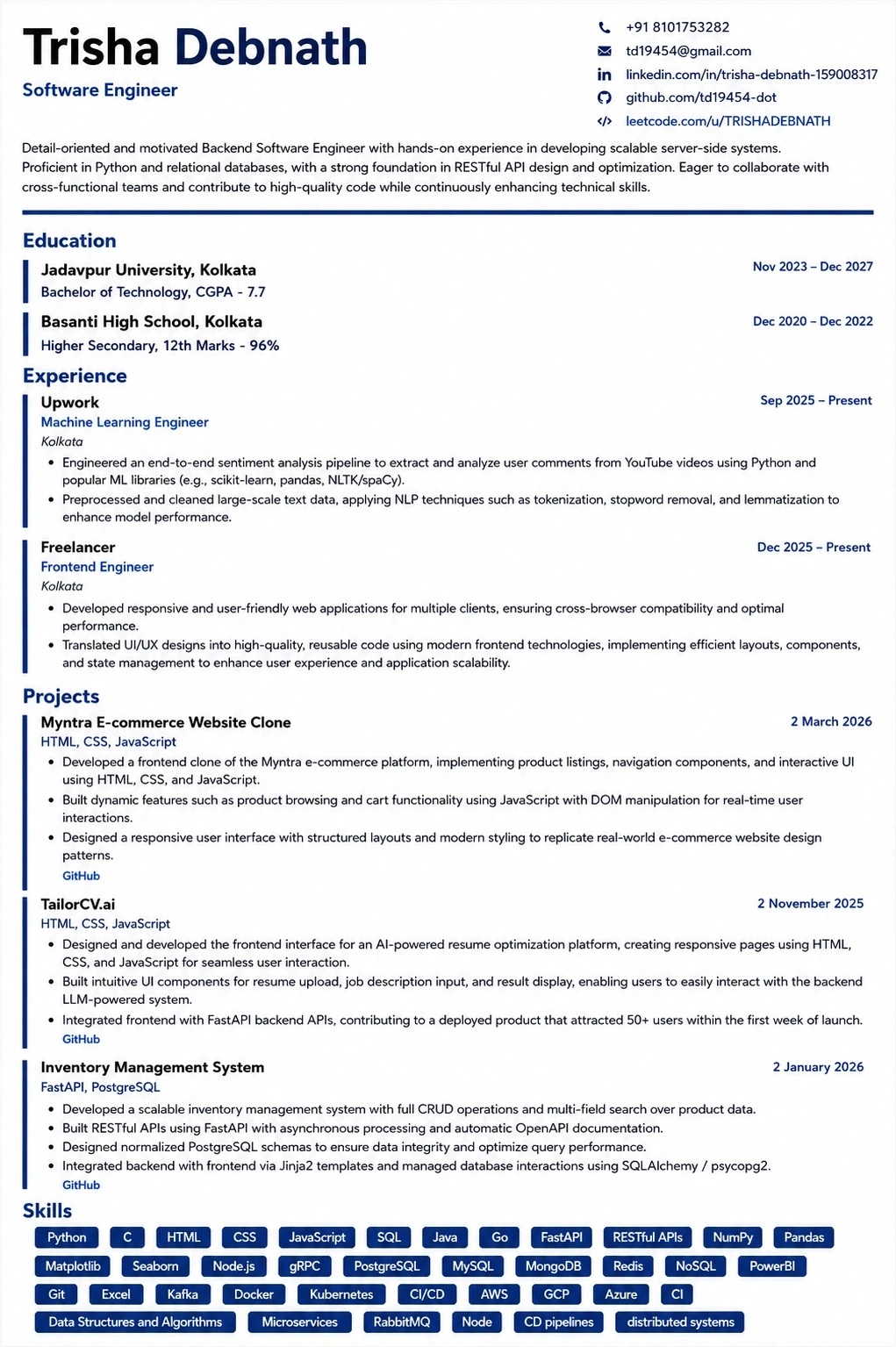
A layout with a real skills section gives the parser somewhere clean to find every term you just added.
Was this guide useful?
Be the first to rate it.