SS
SS
Key Takeaways
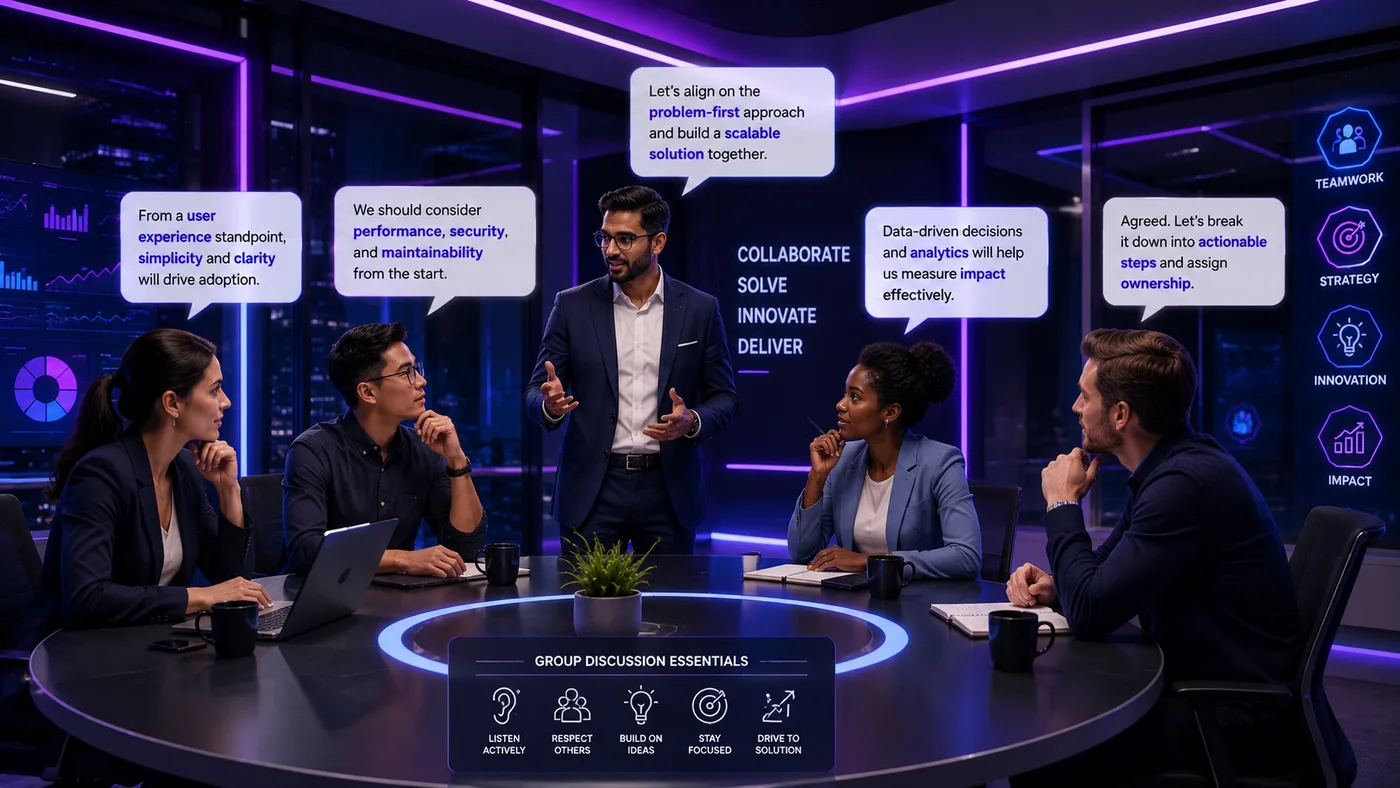
- Evaluators in group discussions assess communication, leadership, teamwork, and logical reasoning, valuing quality contributions over quantity.
- Strong openings should define the topic, outline key dimensions, and present an initial perspective to establish leadership.
- Use structured thinking and data to enhance contributions, while actively listening and building on others' points to demonstrate collaboration.
- Handle difficult situations by asserting your point politely, bringing order to chaos, and respectfully disagreeing with reasoning.
- Conclude discussions with a concise summary that reflects the group's consensus and acknowledges differing viewpoints to showcase leadership.
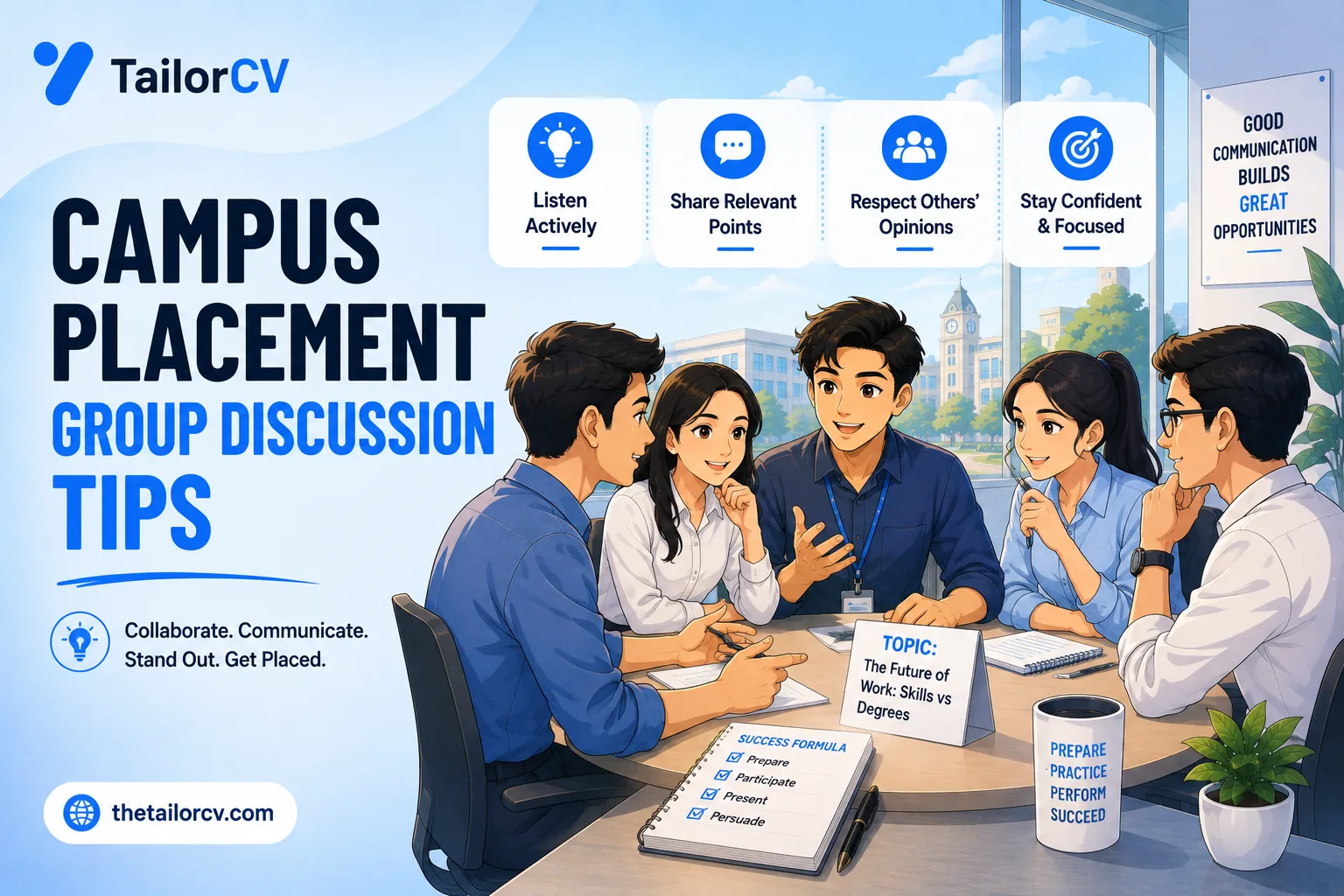
The group discussion (GD) round is a common screening stage in campus placements, MBA admissions, and some corporate hiring processes - especially in India and parts of Asia. In a GD, 6-12 candidates discuss a topic for 10-20 minutes while evaluators assess communication, leadership, teamwork, and thinking under pressure.
The challenge: standing out positively without dominating, and contributing meaningfully without staying silent. This guide gives you proven strategies.
A GD is one stage of a larger process. Make sure your resume gets you there with the TailorCV ATS score checker, and prepare for the interview rounds with the interview preparation guide.
What Evaluators Look For in a GD
GD evaluators assess:
- Communication skills (clarity, articulation, listening)
- Leadership and initiative
- Content quality and knowledge
- Teamwork and collaboration
- Logical reasoning and structured thinking
- Confidence and body language
- Ability to handle conflict gracefully
They are not just looking for who talks most - they are looking for who contributes most valuably.
Types of GD Topics
Factual / Current Affairs
Topics based on current events, economy, technology, society. Example: "The impact of AI on employment."
Abstract
Open-ended topics requiring creative interpretation. Example: "Black or White."
Case-Based
A business or social scenario requiring analysis and a recommendation. Example: "A company must lay off 20% of staff - how should it decide?"
Opinion-Based
Topics with clear for/against positions. Example: "Should social media be regulated?"
How to Open a GD (High Impact)
Initiating a GD well makes a strong impression - but only if you have something substantial to say. A weak opening hurts more than staying quiet.
Strong opening approach:
- Briefly define or frame the topic
- State the key dimensions to discuss
- Offer your initial perspective
"Before we dive in, let me frame the topic. The question of [topic] really has three dimensions - economic, social, and ethical. I'd like to start with the economic angle..."
Only initiate if you are confident and have structure. A confident, structured opening can position you as a leader.
How to Contribute Throughout
Quality Over Quantity
2-3 substantial, well-reasoned contributions beat 10 shallow interruptions. Each contribution should add a new point, perspective, data, or structure.
Use Structure
Bring frameworks: "There are three factors to consider..." Structured thinking stands out.
Bring Data and Examples
Specific facts, statistics, and real examples elevate your contributions above generic opinions.
Build on Others
"Building on what [name] said about X, I'd add that..." This shows listening and collaboration, which evaluators value highly.
Bring In Quiet Participants
"I'd love to hear [name]'s view on this." This demonstrates leadership and inclusivity - a strong positive signal.
How to Handle Difficult Situations
When Someone Dominates
Do not fight aggressively. Wait for a pause, then assertively but politely make your point: "That's a good point, and I'd like to add another perspective..."
When the Discussion Gets Chaotic
Be the one who brings order: "We seem to have several points on the table. Can we structure this around the key themes?" Bringing structure to chaos is a leadership signal.
When You Disagree
Disagree respectfully with reasoning, never personally: "I see it differently - here's why..." Never attack the person.
When You Can't Get a Word In
Use body language (lean forward, raise your hand slightly), wait for a natural pause, and speak with confidence. If needed: "I'd like to add a point here..."
How to Conclude a GD
If the group is asked to summarize, or if you sense the discussion ending, offering a concise summary is a strong leadership move:
"To summarize the key points we've discussed: [main points from multiple participants]. The consensus seems to be [conclusion], while [name] raised a valid counterpoint about [X]."
A good summary that fairly represents the whole discussion (not just your views) is impressive.
Body Language in a GD
- Sit upright and confident
- Make eye contact with all participants, not just one
- Use natural hand gestures
- Nod when others speak (shows active listening)
- Stay calm and composed even when others are aggressive
- Smile appropriately
GD Preparation
- Stay current with news, business, and technology trends
- Practice structuring arguments quickly
- Practice mock GDs with peers
- Build a habit of seeing multiple perspectives on issues
- Develop frameworks for common topic types
Common GD Mistakes
Mistake 1: Staying silent
Not contributing means you cannot be evaluated positively. You must speak.
Mistake 2: Dominating aggressively
Talking over others, interrupting, or being aggressive is a major negative. Collaboration matters.
Mistake 3: Shallow contributions
Repeating points or making vague statements adds no value. Bring substance.
Mistake 4: Getting personal in disagreements
Attacking people instead of ideas is heavily penalized.
Mistake 5: Poor listening
Not building on others or ignoring the discussion flow signals weak teamwork.
Related Guides
- 20 Common Interview Mistakes to Avoid
- How to Answer "Tell Me About Yourself"
- How to Prepare for a Job Interview
- How to Research a Company Before Your Job Interview
- Behavioral Interview Questions and Answers
- Final Round Interview Tips
- How to Follow Up After a Job Interview
- How to Prepare for Campus Placement
- Best Questions to Ask in a Job Interview
- Virtual Interview Tips
- Coding Interview Preparation Guide
- First 90 Days at a New Job
- Why Am I Not Getting Interviews for Jobs I'm Qualified For?
- Phone Interview Tips 2026 - How to Ace the Phone Screen
- How to Explain Resume Gaps in 2026 - Honest Strategies That Work
- How to Get a Job With No Experience - 10 Strategies That Actually Work in 2026
- Networking Tips for Job Search in 2026 - Even If You Hate Networking
- System Design Interview Guide 2026 - Framework and Examples
Make This Practical
Use this advice as interview practice, not just reading material. Start a role-specific session with the AI mock interview tool, prepare your opening with How to Answer Tell Me About Yourself, and structure evidence-heavy answers with the STAR Method Interview Answers Guide.
Before the interview, make sure the resume that earned the call is still aligned with the role. Check it with the free ATS score checker, review Common Interview Mistakes to Avoid, and use How to Follow Up After an Interview once the conversation is over.
Related Guides to Strengthen This Topic
Use these internal guides to connect this topic with interviews, communication, and placement preparation:
- How to Prepare for a Job Interview in 2026
- Behavioral Interview Questions and Answers
- STAR Method Interview Guide
- Common Interview Mistakes to Avoid
- Interview Body Language and Communication Tips
- How to Prepare for Campus Placement
- Questions to Ask in an Interview
- Mock Interview Practice Online Free AI
Conclusion
To stand out in a group discussion, contribute substantial and well-structured points, listen actively and build on others, handle conflict gracefully, and demonstrate leadership through inclusivity and structure - not domination. Quality contributions beat quantity every time.
A GD is one step in the hiring process. Make sure your resume gets you there with the TailorCV ATS score checker, and prepare for the interview rounds with the behavioral interview guide and interview preparation guide.
Frequently Asked Questions
What are the key skills evaluated during a group discussion (GD)?
Evaluators in a group discussion primarily assess communication skills, leadership qualities, teamwork, and logical reasoning. They look for candidates who can articulate their thoughts clearly while also listening and engaging with others. To prepare effectively for GDs, consider reviewing our guide on how to prepare for campus placement.
How can I make a strong opening statement in a GD?
A strong opening statement can set the tone for the entire discussion. You should present a clear, relevant point that showcases your knowledge of the topic. Avoid generic statements; instead, aim to provide a unique perspective or insight. For more tips on presenting yourself well, check out our article on how to answer "Tell Me About Yourself".
What types of topics are commonly used in GDs?
Group discussion topics can be categorized into factual, abstract, case-based, and opinion-based themes. Each type requires a different approach, from discussing current affairs to analyzing hypothetical scenarios. Familiarizing yourself with these categories can improve your confidence; you might find our post on group interview tips and strategies helpful.
How should I handle aggressive participants in a GD?
When faced with aggressive participants, it's important to remain calm and composed. Focus on listening and responding thoughtfully rather than reacting emotionally. Demonstrating grace under pressure can highlight your leadership skills and conflict resolution abilities. For more strategies on managing stress in interviews, visit our guide on overcoming interview anxiety.
What should I do if I feel nervous during a GD?
Feeling nervous is common, especially during high-stakes discussions like GDs. To manage your nerves, practice deep breathing techniques and remind yourself of your preparation. Engaging with others in the discussion can also distract you from anxiety. For additional tips on managing nerves, check our article on common interview mistakes to avoid.
Was this guide useful?
Be the first to rate it.