TD
TD

Key Takeaways
- Emerging job titles like "AI Engineer" and "Prompt Engineer" lack standardized job descriptions and skill sets, making resume tailoring challenging.
- To tailor your resume effectively, analyze 10-15 job descriptions to identify common skills and responsibilities across postings.
- Research LinkedIn profiles of individuals in your target roles to understand their backgrounds, emphasized skills, and daily work descriptions.
- Investigate the specific AI stack used by companies before applying, as context is crucial for emerging roles.
Three years ago, "Prompt Engineer" did not exist as a job title.
Two years ago, a handful of companies listed it. Today, it is a category on major job boards - and it pays six figures.
The same is true for:
- AI Engineer
- machine learning Engineer (with LLM focus)
- GenAI product manager
- AI Safety Researcher
- Climate Tech Analyst
- Digital Health Strategist
- Growth Engineer
- Revenue Operations (RevOps) Manager
These roles are real. They are growing. They pay well.
And they are almost impossible to tailor a resume for using traditional advice - because the job descriptions are inconsistent, the required skills are debated, and the role itself is still being defined.
This guide gives you the strategy for breaking into emerging roles before the market catches up to them. For context on what makes these roles challenging to apply for, see also how to tailor your resume when you're underqualified - the same principles of reframing transferable experience apply here.
The Challenge With Emerging Roles
When a role is brand new, several problems arise simultaneously:
No standard job description: Two companies might post "AI Engineer" roles with completely different expectations. One wants a backend engineer who can integrate LLMs into products. Another wants a researcher who can fine-tune foundational models.
No canonical skill set: There is no agreed-upon list of what an "AI Engineer" must know. Each company's JD reflects their current technical stack and priorities.
No resume benchmarks: You cannot Google "AI Engineer resume example" and get something reliable. Most examples are outdated or fabricated.
Low supply of qualified candidates: The field is new. Hiring managers are learning what they need as they hire. This is actually good news.
High employer confusion: Some job descriptions are written by HR generalists who do not fully understand the technical requirements. The posted qualifications may not match what the actual team needs.
The Strategy: Reverse-Engineer the Role
When a role is not standardized, you have to build your own picture of what it requires - across multiple data sources.
Step 1: Read 10-15 Job Descriptions for This Role
Go to LinkedIn, Indeed, and company career pages. Search for every variant of the role title.
For "Prompt Engineer," search:
- Prompt Engineer
- Prompt Designer
- LLM Engineer
- AI Content Engineer
- Conversational AI Engineer
- AI Application Engineer
Read every job description you can find.
Identify the skills, tools, and responsibilities that appear across most of them - these are the emerging standards.
For AI/prompt engineering roles in 2026, you will likely find:
- Python (almost universal)
- LLM frameworks: LangChain, LlamaIndex, OpenAI API, Anthropic API
- Prompt design and evaluation
- RAG (Retrieval-Augmented Generation) pipelines
- Vector databases: Pinecone, Weaviate, Chroma
- Fine-tuning (for senior roles)
- Technical writing / documentation
- Product thinking (for roles bridging AI and product)
This cross-JD analysis is essentially the job description keyword extraction technique applied to 15 postings at once.
Step 2: Find LinkedIn Profiles of People in These Roles
Use LinkedIn for your job search as a research tool here. Search for people with the emerging title you are targeting. Look at their "About" sections, their listed skills, their previous experience.
This tells you:
- What backgrounds people actually come from (often software engineering, data science, NLP research, or surprisingly, writing and content)
- What skills they emphasize on their profiles
- How they describe their day-to-day work
This is your real-world benchmark - people who already have the job you want.
Step 3: Research the Company's AI Stack
For emerging roles, company-specific context matters more than standard role expectations.
Before applying:
- Check the company's engineering blog (most tech companies have one)
- Look at recent tech talks or conference presentations by the team
- Check GitHub for open-source contributions or tools the team has built
- Look at job postings for adjacent roles (ML Engineer, data scientist) to understand the tech stack
This research tells you which specific tools and frameworks this company actually uses - and those are the keywords your resume needs. The hidden keywords guide helps you decode the subtext of what each company's JD is actually asking for.
How to Tailor Your Resume for an Emerging Role
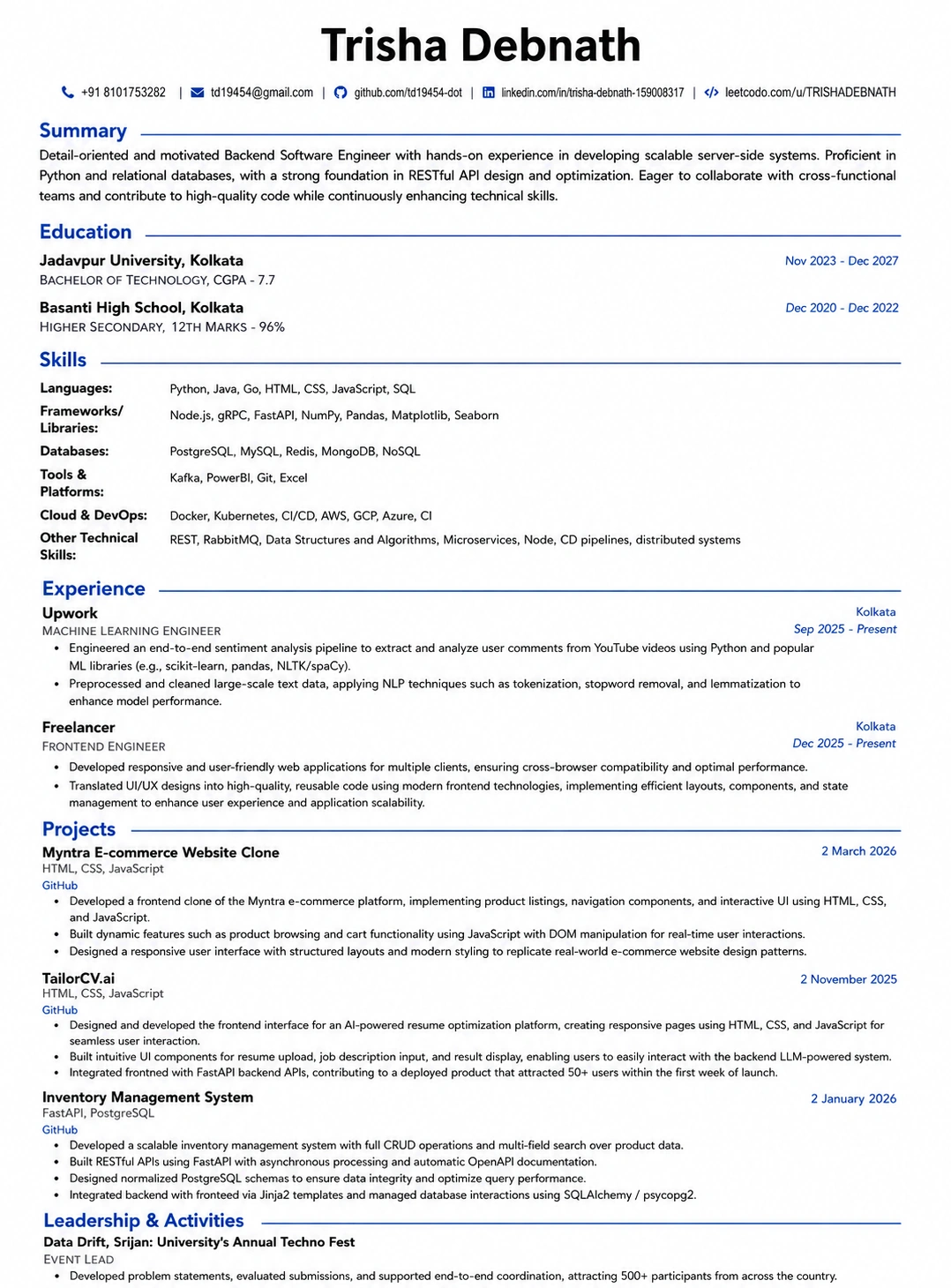
Your resume after optimization
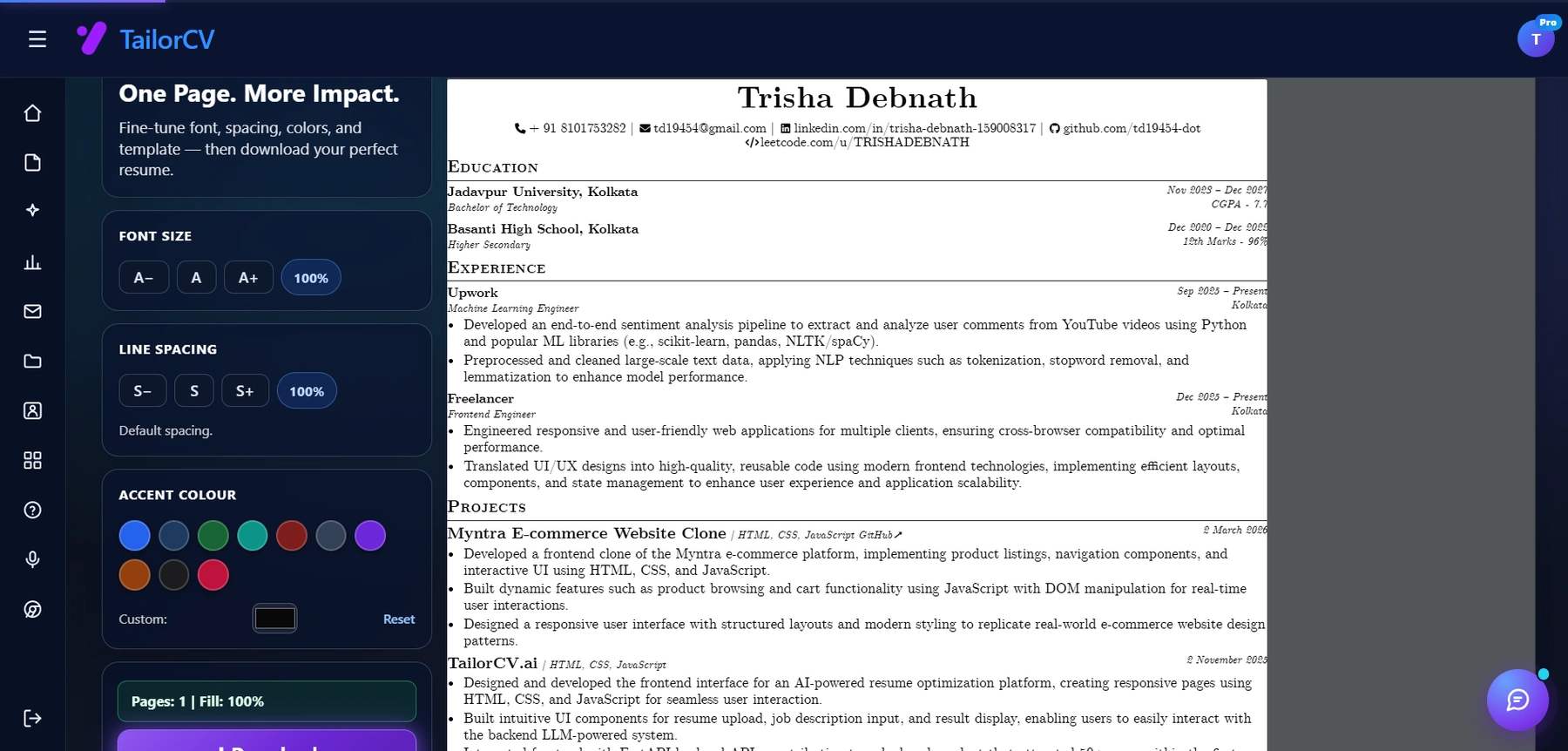
This is the optimized result, and it is usually how a spilling two-page draft gets back onto one page without deleting anything worth keeping.
1. Build a Bridge From Your Past to Their Future
You probably do not have 3 years of "Prompt Engineering" experience. Nobody does.
Your job is to show how your existing background makes you uniquely suited for this emerging role.
If you are a software engineer: Show Python proficiency, API integration experience, and any LLM or ML project work - even hobby projects.
If you are a data scientist: Show NLP work, text processing, and any generative AI experimentation.
If you are a content writer or technical writer: Show your understanding of language quality, tone calibration, and iterative refinement - the core of prompt engineering.
If you are a product manager: Show your understanding of user needs, AI product design, and cross-functional coordination with engineering.
Every background has a path to emerging AI roles. The tailoring challenge is drawing that path clearly.
For a deeper framework on this kind of bridging, see the career change resume guide.
2. Show Projects More Prominently Than Job History
For emerging roles, personal and side projects often carry more weight than prior job titles.
If you have:
- Built a RAG pipeline as a side project
- Fine-tuned a model on a custom dataset
- Built a GPT-powered tool that is live and used
- Contributed to an open-source AI library
-
Published a blog post or write-up about your LLM experiments
-
these belong in a prominent section on your resume.
Read how to list projects in a resume for the best format and placement.
For emerging roles, what you have built matters more than where you worked. Pair this with a strong portfolio where you can showcase live work.
3. Match the Specific Company's Language
"AI Engineer" at Anthropic means something very different from "AI Engineer" at a retail analytics company.
After researching the company's tech stack and approach, use their specific language:
- If they use LangChain - mention LangChain explicitly
- If they use RAG architectures - mention RAG
- If they focus on evaluation frameworks - mention evals
- If they build multi-agent systems - mention agents
Generic AI language will not stand out. Company-specific language will.
Use TailorCV's keyword optimizer to check your match against the specific job description. Paste the JD - even an unusual one for an emerging role - and get a keyword gap analysis.
4. Address the "What Have You Actually Done With AI" Question
Hiring managers for emerging roles almost always ask this directly in interviews. Your resume should pre-answer it.
Do not just list skills. Include at least one bullet that describes a real AI project with a real outcome.
Weak: "Experienced in prompt engineering and LLM frameworks."
Strong: "Designed and tested 40+ prompt variants for a customer support LLM at [Company], improving resolution accuracy from 61% to 84% and reducing human escalation rate by 35%."
That is a real result with real numbers. That is what gets you the interview.
Learn how to write resume bullet points for the structure that makes these results land.
Emerging Roles Cheat Sheet: What Each One Actually Wants
AI Engineer (2026)
Core skills: Python, LangChain or LlamaIndex, OpenAI/Anthropic API, vector databases, API integration, system design
Background: Software engineering + AI curiosity
Key resume signals: Live AI projects, API integrations, production deployments
Prompt Engineer
Core skills: Prompt design, evaluation frameworks, LLM behavior understanding, Python (often), technical writing
Background: NLP, content, technical writing, software - varies widely
Key resume signals: Measurable prompt improvement results, systematic evaluation approach
GenAI Product Manager
Core skills: AI product design, understanding of LLM capabilities and limitations, user research, roadmapping
Background: Product management with AI familiarity
Key resume signals: AI product shipped, cross-functional AI project leadership, user impact metrics
RevOps Manager
Core skills: CRM (Salesforce, HubSpot), data analytics, sales process optimization, pipeline management
Background: Sales ops, marketing ops, or finance
Key resume signals: Revenue impact, sales cycle reduction, CRM implementation
Climate Tech Analyst
Core skills: ESG frameworks, carbon accounting, sustainability metrics, data analysis, policy understanding
Background: Finance, engineering, or environmental science
Key resume signals: ESG reporting, sustainability initiative outcomes, industry certifications (SASB, GRI)
The Application Timing Advantage
Emerging roles are easier to get into before they become mainstream.
When a field is new:
- There are fewer "perfect" candidates
- Hiring managers are more open to adjacent backgrounds
- Showing curiosity and initiative carries disproportionate weight
- Early movers build credibility that later candidates cannot easily match
If you are interested in an emerging field, start building your experience and applying now - not after the role has been standardized and competition intensifies.
Consider using AI to tailor your resume for these roles - keeping your authentic voice while optimizing for the emerging keyword landscape.
Make This Practical
Do not guess whether the resume is ready. Upload it to the free ATS score checker, compare the result with the ATS Score Guide, and fix formatting issues using ATS Resume Formatting Mistakes and ATS Resume Parser Friendly Format.
After the technical cleanup, improve relevance. Use Resume Matching With Job Description, strengthen keyword coverage with the Resume Keywords Guide, and avoid overdoing it by checking ATS Keyword Mistakes. If the layout itself is weak, rebuild with an ATS-friendly resume template.
FAQ
Do I need a certification for emerging AI roles?
Formal certifications are less important than demonstrated project work in AI. A completed Coursera ML course plus a live project on GitHub beats a certification with no applied work.
What if I apply and get rejected for lacking "required" experience?
Expected for emerging roles. Apply to multiple companies. The requirements are inconsistent - you may be underqualified for one company's definition and overqualified for another's. Volume + tailoring wins.
Should I include my AI projects even if they are personal/side projects?
Absolutely. For emerging roles, personal projects are primary evidence. They show initiative, curiosity, and actual ability - three things that matter more than years of experience in a field that barely existed. Consider using resume templates to effectively showcase these projects.
Related Guides
- How to Tailor Your Resume for Every Job
- Projects in Resume for Freshers
- Machine Learning Engineer Resume 2026
- Data Scientist Resume 2026
- Resume Tailoring When Underqualified
- How to Write a Resume with AI
- Skills to Add to Your Resume in 2026
- How to Build a Professional Portfolio
- Career Change to Tech Guide
- AI Resume Tailoring - Human Voice Guide
Conclusion
Emerging roles do not come with a template. That is what makes them hard - and what makes them worth targeting.
The candidates who win these roles are not the ones waiting for the field to be defined. They are the ones who research what each company actually needs, show specific work that demonstrates capability, and apply before the competition catches up.
Reverse-engineer the role from 15 job descriptions. Study people who already have the title. Build and show relevant projects. Match the specific company's language. Check your keyword match before applying.
The field is early. Your window is now.
Tailor My Resume for an Emerging Role - Free
See what tailoring is worth on your resume
Score your current resume against a real job description before you change a word.
Drop your resume here or choose a file
PDF only. Max 2 MB.
We never share your data or use it to train AI models.

Start from a template that tailors well
Clean structure means swapping keywords per job takes minutes, not a re-layout every time.
Was this guide useful?
Be the first to rate it.