 TD
TD
Key Takeaways
- Recruiter ghosting often stems from internal processes and circumstances unrelated to your interview performance, such as budget cuts or internal candidates being preferred.
- It's normal to wait 3-5 business days after an interview before interpreting silence, as various internal discussions take time.
- If given a specific timeline for feedback, wait until one business day after that date to follow up, as delays are common.
- After two polite follow-ups with no response over 2-3 weeks, it's reasonable to consider the process closed, even without formal rejection.
You had a great interview, felt genuine momentum, and then - silence. No email, no LinkedIn reply, no answer to the voicemail you left three days ago. Recruiter ghosting after an interview is one of the more disorienting parts of a modern job search, partly because the silence itself gives you nothing to work with - no rejection to process, no offer to celebrate, just an open loop your brain keeps returning to. This guide walks through why it happens, how long is genuinely normal to wait, exactly what to send and when, and how to keep your search moving instead of stalling out on one company's inbox. If you also want to check whether your resume made it past the first screen at all, the free ATS score checker is a useful gut check while you wait.
Why Recruiters Go Silent (It's Rarely About You)
It helps to understand the mechanism behind ghosting, because most of it happens for reasons that have nothing to do with your interview performance. Recruiters are not usually choosing to be cruel - they're operating inside systems that make silence the path of least resistance.
- The role gets frozen or cancelled mid-process. Budgets get cut, reorgs happen, or a VP decides headcount is on hold - often with zero notice given to the recruiter, let alone the candidates already in the pipeline.
- An internal candidate quietly surfaces. Many companies are legally or politically required to post roles externally even when someone internal is the front-runner. When that person accepts, external candidates are simply left hanging because there's no clean way to explain it.
- The hiring manager changes or leaves. A new hiring manager frequently wants to restart the search from scratch, review candidates fresh, or re-scope the role entirely - and nobody tells you that's what happened.
- Legal caution about giving reasons. Many companies instruct recruiters not to give specific feedback on why a candidate wasn't selected, to avoid discrimination claims. Silence, unfortunately, becomes the "safe" default over an honest but vague rejection.
- Sheer volume and understaffing. A single recruiter at a high-volume company can be juggling dozens of open reqs at once. Following up with every candidate at every stage simply doesn't happen, even with good intentions.
- Approval chains that stall. Offers and rejections often need sign-off from a hiring manager, a director, and sometimes HR or finance. Any one of those people being slow, on leave, or distracted delays everyone downstream.
None of this makes the silence feel better in the moment, but it does matter for how you interpret it. Ghosting is very often a symptom of a broken internal process, not a verdict on your qualifications. If you're also wondering whether the problem is upstream of the interview - i.e., your resume isn't landing interviews in the first place - that's a separate diagnosis covered in why your resume gets no responses.
The Realistic Timeline: Normal Delay vs. Actual Ghosting
One of the biggest sources of anxiety is not knowing whether you're still "in normal range" or whether you've actually been ghosted. Here's a rough framework for calibrating that, broken out by stage.
Right after the interview, before any timeline was given: Give it at least 3-5 business days before reading anything into silence. Interview debriefs, panel scheduling conflicts, and internal scoring calls take time even when a process is healthy.
When the recruiter gave you a specific timeline ("we'll have an update by Friday," "expect to hear back next week"): Treat that date as a soft target, not a hard promise. It's reasonable to wait until one business day after the stated date before you follow up - internal timelines slip constantly, and a single day of overrun is not yet a red flag.
After your first follow-up email: Give it 5-7 business days for a response before you consider a second, much shorter follow-up. Recruiters juggling many candidates often batch their outreach, so a gap here doesn't necessarily mean they're avoiding you.
Beyond 2-3 weeks with zero response to two polite follow-ups: At this point, it's fair to treat the process as functionally closed, even if no formal rejection ever arrives. This isn't a legal deadline - it's a practical one, meant to protect your time and attention.
A useful mental model: every day of silence within the "normal" windows above is process. Silence that persists well past two follow-ups, especially after a stated decision date, is ghosting - and the right response to ghosting is to redirect your energy, not to escalate. For a broader look at pacing your outreach across an entire process (not just after ghosting), see how to follow up after an interview.
A Follow-Up Cadence That Doesn't Feel Needy
The goal of a follow-up isn't to pressure anyone into responding faster - it's to give the recruiter an easy, low-friction way to update you, while signaling that you're still interested without sounding anxious about it. A good cadence looks like this:
- First check-in - sent per the timeline guidance above (3-5 business days with no stated date, or one day after a missed stated date).
- Second and final check-in - sent only if the first gets no response, roughly 5-7 business days later. Keep it shorter than the first.
- A closing-the-loop message (optional but useful) - sent weeks later if you've accepted another offer or moved on, so you exit the relationship gracefully instead of just vanishing yourself.
Each message should do three things: reaffirm interest, ask a direct but polite question, and make it easy to say no. Avoid guilt-tripping language ("I was really hoping to hear back by now"), ultimatums ("I need an answer by Friday or I'll withdraw"), or over-explaining why you're following up. Recruiters respond better to brevity than to justification.
First check-in email
Subject: Following up - [Role] interview
Hi [Name],
I hope things are going well on your end. I wanted to check in on the status of the [Role] position - I remain very interested in the opportunity and happy to provide any additional information that would help with your decision.
Thanks again for your time, and I look forward to hearing from you.
Best, [Your Name]
Second, shorter check-in (only if the first got no reply)
Subject: Re: Following up - [Role] interview
Hi [Name],
Just circling back briefly in case my last note got buried. No pressure at all - I know these processes take time. If there's any update on the [Role] search, I'd appreciate hearing where things stand, even if it's not the outcome I'm hoping for.
Best, [Your Name]
Closing the loop (if you've moved on)
Subject: Update on my end - [Role] position
Hi [Name],
Wanted to let you know I've accepted another offer and am withdrawing my candidacy for the [Role] position. I enjoyed learning about the team and would welcome staying in touch for future opportunities.
Thanks again for the time and consideration.
Best, [Your Name]
That last template does something useful beyond politeness: it occasionally jolts a genuinely interested but overwhelmed recruiter into responding fast, because "I'm about to take another offer" changes the urgency calculus on their end. Use it honestly, though - not as a manufactured bluff. For the exact wording and timing conventions recruiters expect at the very first outreach stage (before an interview has even happened), see follow-up email after application.
What to Do While You Wait (Instead of Refreshing Your Inbox)
The waiting period is where most of the emotional damage happens, not because the silence itself is so severe, but because of what people do with it: checking email compulsively, mentally rehearsing the interview for flaws, or pausing everything else because "this one felt like it was going to work out." None of that helps, and some of it actively hurts your search.
- Keep applying as if this process doesn't exist. Treat every open application as independent. A promising interview is not a reason to slow down outreach elsewhere - it's a reason to keep your pipeline just as full, because you genuinely don't know the outcome yet.
- Treat verbal enthusiasm as informational, not binding. "We really liked you" or "I think this is going to move fast" from an interviewer is a data point, not a commitment. Recruiters and hiring managers say encouraging things in good faith all the time, and internal reality frequently overrides that enthusiasm.
- Don't decline other interviews or offers to "wait and see." Until an offer is signed, it isn't real. If a second company wants to move forward, let that process run in parallel rather than stalling it out of loyalty to a company that hasn't committed to you.
- Use downtime productively, not anxiously. Instead of refreshing your inbox, use the time to prep for other interviews with the AI mock interview tool, tighten your materials with the AI cover letter generator, or review pacing guidance in how many jobs should you apply to per day.
- Log the follow-up dates somewhere outside your head. Uncertainty feels worse when you're trying to remember "did I already follow up, and when" from memory. A simple tracker removes that mental overhead entirely.
Protecting Yourself Emotionally and Practically
Ghosting has a way of feeling personal even when you intellectually know it probably isn't. It's worth naming that directly, because the emotional toll is real and it compounds across a long search.
A few things worth holding onto:
- A strong interview does not guarantee a strong outcome. Interviews are only one input into a hiring decision that also depends on budget, internal politics, timing, and factors you will never see. Feeling like it "went well" is a real signal, but it isn't the whole picture.
- Ghosting is unfortunately common enough that it says more about hiring practices than about you. It happens to strong, well-qualified candidates constantly. Internalizing it as a referendum on your skills or your resume is understandable but usually inaccurate.
- Give yourself a real but bounded window to feel frustrated, then redirect. Suppressing the frustration entirely isn't necessary or realistic - but letting it bleed into every subsequent application (through hesitance, over-explaining, or defensiveness in future interviews) is worth actively guarding against.
- Resist comparing your timeline to other people's stories. Someone else hearing back in two days doesn't mean your three-week silence is uniquely bad - hiring timelines vary enormously by company size, industry, and even the specific team.
If the emotional weight of this particular process is compounding with rejections elsewhere, how to handle job rejection covers the broader mindset shift for staying resilient across a longer search - this post is deliberately scoped to the silence itself, not the full emotional arc of job hunting.
Patterns Worth Tracking for Next Time
One silent recruiter is just an unfortunate data point. But if you notice a pattern - the same company ghosting you across multiple roles, or a particular type of company (large-volume tech, agencies, certain industries) consistently going quiet - that's information worth acting on.
Keeping every tailored resume with its job
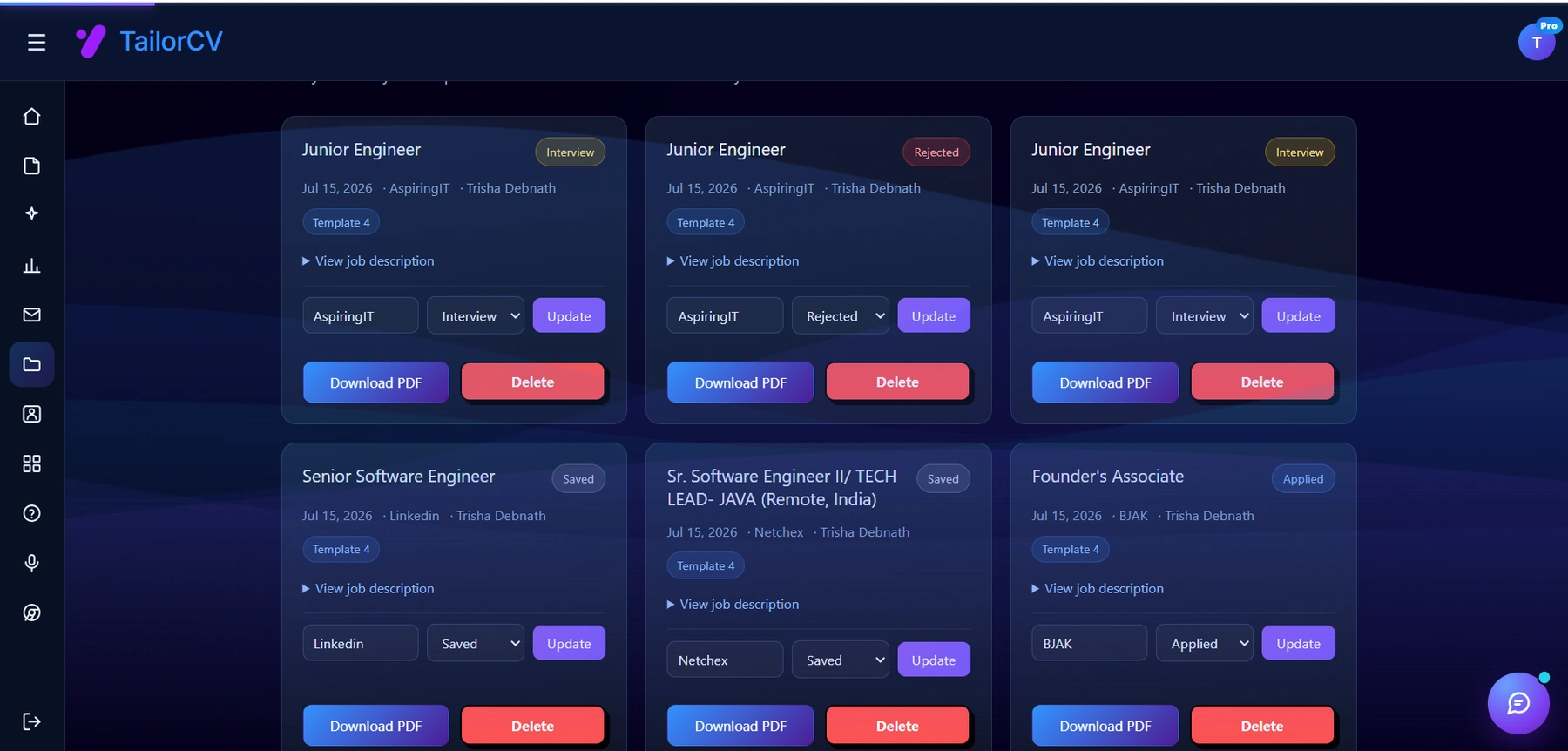
Every resume you tailor is saved against the job it was written for, with the company, the job description and a status you can move from Saved to Applied to Interview. That is the part a spreadsheet usually gets wrong - the tracker and the actual document drift apart, and you end up guessing which version you sent.
- Note company-specific behavior. If a company ghosted you after a strong interview once, factor that into whether it's worth reapplying there later, or at minimum, set your expectations accordingly the second time around.
- Watch for patterns in your own process, not just theirs. If ghosting seems to cluster after a specific interview stage (say, always after the panel round but before an offer), that might be worth examining alongside your interview performance, separate from the ghosting itself - the final round interview tips guide is useful if that stage keeps being where things stall.
- Use a structured tracker instead of relying on memory. A spreadsheet or dedicated tool makes patterns visible that are easy to miss when each application feels like an isolated event. The job application tracker template is built for exactly this - logging stage, dates, and follow-up cadence per application so you can spot trends across your whole search.
- Feed what you learn back into networking, not just applications. If a company's recruiting process is consistently unreliable, a warm introduction through your network can sometimes route around it entirely next time. See networking tips for job search for how to build those connections proactively.
When It's Not Just Disorganization: Spotting Real Red Flags
Most ghosting is exactly what this post describes - disorganized, under-resourced, or overly cautious hiring processes, not malice. But it's worth briefly distinguishing ordinary slow hiring from something more concerning.
Ordinary disorganization looks like: vague timelines, slow responses, a recruiter who takes a week to reply to simple questions, or a process that clearly involves multiple busy stakeholders. Frustrating, but normal.
Worth a second look: a "recruiter" who never gets on a call, asks for sensitive personal or financial information early, pushes you toward buying equipment or software before starting, offers a role with no real interview process at all, or communicates only through unofficial channels like text or personal email addresses with no matching corporate presence. Those patterns point toward something other than an overwhelmed recruiter, and they warrant a different level of caution than the garden-variety silence covered here. If any of that sounds familiar, how to spot a job scam covers the specific warning signs in depth.
Make This Practical
Silence from one recruiter should never be the reason your whole search loses momentum. Keep your resume sharp and ready for the next opportunity with the free ATS score checker, log every application and follow-up date with the job application tracker template, and keep your interview skills warm between processes with the AI mock interview tool. If you're mid-search across multiple companies at once, how to follow up after an interview and how to handle job rejection are the natural next reads for keeping your pipeline healthy while you wait on any single outcome.
FAQ
Is it rude to follow up more than once?
No - one polite follow-up is standard and expected, and a brief second one after a longer gap is generally acceptable too. Beyond two follow-ups, additional messages rarely change the outcome and can start to read as pressure rather than genuine interest.
Does ghosting mean I definitely didn't get the job?
Not necessarily. Silence usually means the process is delayed, stuck in an approval chain, or the recruiter simply hasn't been given a final answer to pass along yet. Treat it as "unresolved" rather than assuming rejection until you've given it a fair amount of time and at least one follow-up.
Should I contact the hiring manager directly if the recruiter goes silent?
If you have a direct, appropriate contact and enough time has genuinely passed, a single brief, polite note to the hiring manager is acceptable. Avoid bypassing the recruiter aggressively or contacting multiple people on the team at once, which can come across as pushy rather than persistent.
How many follow-ups is too many?
Two is generally the practical ceiling: one initial check-in, and one shorter follow-up if that gets no response. A third unsolicited message, especially within a short window, tends to signal anxiety more than professionalism.
Should I keep interviewing elsewhere if this role feels like a strong match?
Yes, always. Until you have a signed offer, no process - no matter how promising it felt - is guaranteed. Keeping other interviews and applications moving protects you regardless of how this particular one resolves.
Is it ever appropriate to mention that I have another offer to speed things up?
Yes, if it's true. Letting a recruiter know you have a competing offer with a deadline is normal and often genuinely speeds up a stalled process, since it forces internal urgency. Don't fabricate one, though - recruiters compare notes and a bluff that unravels can damage your reputation with that company.
How do I stay motivated when this keeps happening across multiple applications?
Treat every application as one entry in a larger pipeline rather than a single make-or-break event, since no individual outcome should carry the full weight of your search. Reviewing why your resume gets no responses and how to handle job rejection can help build a more sustainable mindset for the stretches where responses slow down.
At what point should I stop reapplying to a company that ghosted me before?
There's no fixed rule, but if a company ghosted you after a strong interview once, it's reasonable to wait at least a full hiring cycle (often six months to a year) before trying again, and to go in with tempered expectations about their process. A pattern across multiple attempts is a stronger signal than a single instance and may be worth deprioritizing that employer going forward.
Next Step
Don't let one recruiter's silence determine the pace of your whole search - run your resume through the free ATS score checker so you're ready to move fast the moment your next opportunity responds.
Was this guide useful?
Be the first to rate it.