SS
SS
Key Takeaways
- Companies hiring freshers expect little to no professional experience; they focus on your ability to learn and communicate effectively.
- Preparation is crucial; your resume should clearly highlight projects, internships, and relevant skills to support your interview responses.
- Understand the typical interview process, which includes a screening call, aptitude test, HR round, and technical round, to better prepare for each stage.
- Practice with mock interviews to build confidence and improve your communication skills before the actual interview.
Your first job interview is a milestone - and it feels overwhelming because everything is new. You do not have years of experience to draw from, you do not know what the room (or the video call) will actually feel like, and you are competing against hundreds of other freshers who look similar on paper. That anxiety is normal, and it is also fixable with the right kind of preparation.
The good news: companies that hire freshers already expect you to have zero professional experience - that is the whole point of a fresher role. What they are actually evaluating is whether you can learn fast, communicate clearly, and talk honestly about what you have done so far. Preparation matters more than experience. This guide walks through exactly what a first interview looks like, what to say when you feel like you have "nothing to talk about," and how to walk in calmer than you thought possible.
Practice before the real thing with TailorCV's AI mock interview. Also read campus placement preparation, first resume with no experience, and the complete interview guide.
Before the Interview: Resume and Application
Your interview actually starts with your resume, because every question in the room will trace back to it. If the interviewer asks about a line on your resume and you cannot explain it clearly, that is a bigger problem than any "trick question" they might ask. For freshers:
- Highlight projects, internships, and coursework - projects in resume guide
- List technical skills clearly, and only list what you can actually discuss - technical skills guide
- Use ATS-friendly formatting so your resume is not filtered out before a human sees it - ATS-friendly resume guide
- Avoid fresher mistakes like generic objectives and unverifiable claims - resume mistakes every fresher makes
- Check your score before you apply - TailorCV ATS checker
Print or save a copy of the exact resume version you applied with. Interviewers often have it open in front of them, and if your "updated" version has different project details, that mismatch creates confusion you do not need.
What Actually Happens in a First Interview: A Realistic Walkthrough
Nobody explains this clearly enough, so here is what a typical fresher hiring process actually looks like, stage by stage. Not every company runs all of these, and the order can shift, but this is the general shape.
1. Screening call (10-20 minutes). Usually a recruiter or HR coordinator, not the hiring manager. They confirm your basic details, availability, notice period (if any), salary expectations, and willingness to relocate or work specific shifts. They are checking for fit and logistics, not depth - do not over-prepare technical answers for this stage, just be clear and consistent with what is on your resume.
2. Aptitude or written test (30-60 minutes). Common in mass campus hiring. Covers quantitative aptitude, logical reasoning, English, and sometimes basic coding. This is a filter, not a conversation - practice sample papers in the days before rather than trying to cram theory the night before.
3. HR or behavioral round (20-30 minutes). This is where most of your "Tell me about yourself" and personality-fit questions live. The interviewer is evaluating communication, confidence, and whether you would work well with a team. See the HR round guide for a deeper breakdown.
4. Technical or functional round (30-45 minutes). For technical roles, this is a deep dive into your projects, fundamentals, and problem-solving process. For non-technical roles, it is a deep dive into domain knowledge and how you approach real scenarios. The interviewer often cares more about how you think through a problem than whether you get the exact right answer instantly.
5. Final round (15-30 minutes). Only a subset of candidates reach this stage. It is often with a senior manager and is less about testing knowledge and more about confirming culture fit, motivation, and whether they can picture you on the team long-term.
Knowing this sequence in advance removes a lot of the fear of the unknown. You are not walking into one giant unpredictable event - you are walking into a series of shorter, specific conversations, each with a fairly narrow purpose.
You Have More to Talk About Than You Think
The single biggest source of fresher anxiety is the belief that you have "nothing real" to say because you have never held a full-time job. That belief is wrong, and it is worth correcting before you walk in, not during the interview when you are already nervous.
Interviewers hiring freshers do not expect work history. They expect evidence that you can do things and learn things. That evidence can come from far more sources than a job title:
- Class projects and capstone work. Any project where you built, analyzed, designed, or presented something is fair game. Talk about your specific role, the decisions you made, and what went wrong along the way - that last part is often more interesting to an interviewer than a clean success story.
- Internships, even short or unpaid ones. A two-week internship where you shadowed a team and completed one small task is still real exposure to how a workplace runs. Describe what you actually did, not what the internship was supposed to be about.
- Part-time work of any kind. Tutoring, retail, freelancing, food delivery, running a small online shop - all of it demonstrates responsibility, customer interaction, time management, or handling pressure. Do not dismiss it just because it is unrelated to your target industry.
- College clubs, fests, and leadership roles. Organizing an event, managing a budget, leading a small team of volunteers, or running a college society's social media are all legitimate examples of initiative and coordination.
- Personal or open-source projects. Something you built on your own time, without anyone requiring it, often says more about your motivation than a mandatory assignment does.
- Competitions, hackathons, and certifications. Even if you did not win, describe what you built under time pressure and what you learned from the team dynamic.
The skill here is not inventing experience you do not have - it is reframing the experience you already have so it answers the question being asked. The same project can support an answer about teamwork, about problem-solving, about handling failure, or about technical depth, depending on which angle you pull out. For a deeper framework on structuring these stories, use the STAR Method Interview Answers Guide.
Common Fresher Interview Questions (With Example Answers)
These questions come up in almost every fresher interview in some form. Below are realistic example answers built from typical student material - use them as a structure to adapt, not a script to memorize word for word.
See it in action: a resume-based mock interview
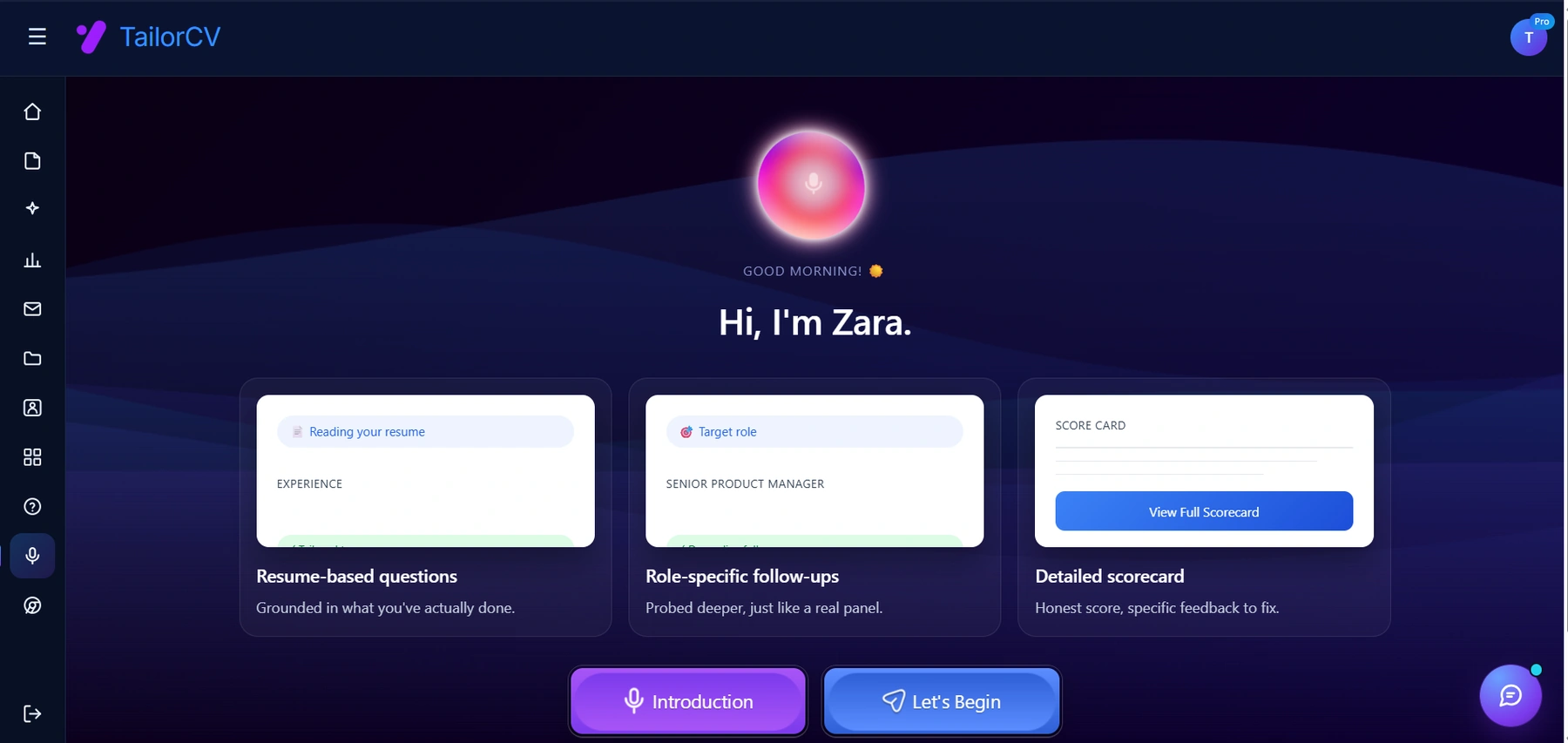
You can rehearse this before the real thing. The interviewer reads your resume first, so the questions come from your actual experience rather than a generic list.
1. Tell me about yourself
Keep it under two minutes. Focus on education, one or two standout projects, and what you are looking for next - not your entire life story. Full guide.
"I am a final-year computer science student at [college], and I have spent the last two years focused on web development, both through coursework and personal projects. My biggest project was a college event management app that I built with two classmates - I handled the backend and database design, and we ended up presenting it at our department's tech fest. I also did a six-week internship at a local startup where I helped fix bugs in their customer dashboard, which taught me a lot about working in an existing codebase rather than building from scratch. I am now looking for a role where I can keep growing as a developer while contributing to real products from day one."
2. Why should we hire you as a fresher with no experience?
Do not apologize for being a fresher - reframe it as an advantage. Emphasize learning speed, adaptability, and the specific proof points from your projects. Answer guide.
"I know I do not have years of professional experience, but I have spent my degree deliberately building practical skills instead of just studying theory - three of my four major projects were built end-to-end by me, not assigned templates. Because I have not developed fixed habits from a previous job, I can adapt quickly to how your team works. I am also someone who follows through - I taught myself the framework this internship required in about a week because I was motivated to contribute quickly, not just complete tasks."
3. Tell me about your final year project
Use the STAR method: your specific role, the technologies involved, a real challenge you hit, and the outcome. Avoid describing the project like a brochure - describe one decision or problem in detail instead.
4. What are your strengths and weaknesses?
Give a real strength backed by a specific example, and a real weakness paired with what you are actively doing about it. Weakness guide.
5. Where do you see yourself in five years?
Show ambition that is realistic and aligned with growth inside the company you are interviewing with - not a vague dream job or, worse, your own startup idea.
"In five years, I would like to have grown from an individual contributor into someone who can mentor newer freshers the way I hope to be mentored here. Right now my focus is on becoming genuinely strong at the fundamentals of this role, and over time I would like to take on more ownership of a specific product area rather than jumping between many different things."
6. Are you willing to relocate or work in shifts?
Answer honestly based on your actual situation - a wishy-washy answer here reads worse than a clear "no" with a reason.
7. Do you have any questions for us?
Always say yes. Prepare two or three specific questions in advance. Questions to ask guide.
Fresher Interview Rounds
| Round | What to expect |
|---|---|
| Aptitude / written test | Math, logic, English - practice sample papers |
| HR round | Communication, fit, basic questions |
| Technical round | Domain questions, project deep-dive - technical prep |
| Group interview | Common in mass hiring |
| Final round | Senior leadership for select candidates |
For tech roles, add coding interview prep.
How Freshers Should Prepare
- Research the company - even ten minutes on their website and recent news changes how you sound. Company research guide.
- Prepare five STAR stories from projects and internships that you can adapt to multiple questions - behavioral guide
- Practice with AI mock interviews so your first time answering out loud is not during the real interview - practice at home guide
- Dress professionally - even for virtual interviews, where it still affects how seriously you come across on camera
- Manage nerves deliberately rather than hoping they disappear on their own - interview anxiety tips
- Arrive early - 15 minutes for in-person, 5 minutes early for video, logged in and tested, not scrambling to fix your webcam
Nerves Are Normal - Here Is How to Actually Manage Them
Telling a nervous person to "just relax" has never once worked, so here are concrete things you can do instead.
- Reframe the interview as a conversation, not an interrogation. The interviewer is not trying to trap you - they usually want you to do well, because hiring is slow and expensive for them too. You are also evaluating whether this is a team you want to join, which shifts you from a powerless position to an equal one.
- Prepare your opening lines word for word. Nerves hit hardest in the first sixty seconds. If your first answer ("Tell me about yourself") is well-rehearsed, you get a confidence boost early that carries into the rest of the conversation.
- Slow your breathing before you join the call or walk in. A slower exhale than inhale (for example, four seconds in, six seconds out) for even thirty seconds measurably lowers physical anxiety symptoms like a racing heart or shaky voice.
- Keep a glass of water nearby. Taking a sip while you think buys you two or three seconds to organize an answer, and it looks like composure rather than hesitation.
- Write down three bullet points, not a full script. A full script increases panic when you forget a line. Three keywords per likely question are easier to glance at and recover from than a paragraph you were trying to memorize.
- Accept that a little nervousness is not visible to the interviewer the way it feels to you. Your racing heart is rarely as obvious externally as it feels internally - interviewers are used to talking to nervous freshers and mentally discount it.
- Do one full practice run out loud before the real thing. Thinking through an answer silently and saying it out loud are completely different skills. A mock session with the AI mock interview tool closes that gap in a low-stakes setting.
Interview Day Logistics and Etiquette
A lot of fresher mistakes are not about knowledge at all - they are about not knowing the unwritten rules of how interview days work.
- What to wear: When in doubt, dress one level more formal than the company's everyday culture. Business casual (collared shirt or blouse, neat trousers) is a safe default for most fresher interviews, in-person or virtual.
- Timing: Log in to a video interview five minutes early so you are not troubleshooting audio while the interviewer waits. For in-person interviews, arrive 15 minutes early - not 45, which can be as awkward as arriving late.
- Test your setup. For virtual interviews, check your camera, microphone, lighting, and internet connection the night before, not five minutes before. Sit somewhere quiet with a plain background.
- If you do not know an answer, say so honestly. Guessing wildly or bluffing through a technical question is far more damaging than a calm "I have not worked with that specifically, but here is how I would approach figuring it out." Interviewers generally respect honesty over false confidence.
- Ask clarifying questions when a question is ambiguous. If you are asked to solve a problem with missing details, asking "should I assume X or Y?" shows structured thinking rather than confusion.
- Take a beat before answering. A two-second pause to organize your thoughts reads as composure, not weakness. Rushing into an unstructured answer is far more noticeable than a short pause.
- Follow up afterward. A short, specific thank-you note within 24 hours keeps you top of mind and shows basic professionalism. See the follow-up guide for exact wording.
Fresher Interview Mistakes to Avoid
Some mistakes are specific to first-timers who have never done this before:
- Over-apologizing for lack of experience. Saying "I know I don't have much experience, but..." repeatedly plants doubt that was not there before. State what you do have and move on.
- Rambling without structure. Freshers often try to include everything they have ever done in one answer. Pick the one or two most relevant points and stop.
- Not researching the company at all. Being unable to name what the company does, beyond the job title you applied for, is one of the fastest ways to lose a fresher role to someone equally qualified who did five minutes of homework.
- Forgetting to ask any questions at the end. Saying "no, I think you covered everything" wastes a genuine opportunity to show interest and gather information that helps you decide too.
- Not knowing your own resume and project details. If it is on your resume, you must be able to explain it in detail - vague answers about your own work are an immediate red flag.
- Badmouthing college, professors, or a previous internship. Even valid frustration reads as a lack of professionalism to someone who has not seen that context.
- Overclaiming skills you cannot demonstrate. Listing a technology you used once in a tutorial as a core skill invites a follow-up question you cannot answer.
- Not practicing out loud at all. Reading advice like this is necessary but not sufficient - see the common interview mistakes guide for a broader list, and pair it with actual spoken practice.
After Your First Interview
- Send a thank-you email within a day - follow-up guide
- If rejected, treat it as data, not a verdict on your worth - handling job rejection
- Keep practicing for the next one - AI mock interview guide
- Build a portfolio that backs up what you talked about - professional portfolio guide
For your first tech role specifically, read how to get your first tech job. Your first interview will almost never be your best one - most freshers notice a real jump in comfort by their second or third real interview, which is exactly why practice interviews before the real ones matter so much.
Make This Practical
Use this advice as interview practice, not just reading material. Start a role-specific session with the AI mock interview tool, prepare your opening with How to Answer Tell Me About Yourself, and structure evidence-heavy answers with the STAR Method Interview Answers Guide.
Before the interview, make sure the resume that earned the call is still aligned with the role. Check it with the free ATS score checker, review Common Interview Mistakes to Avoid, and use How to Follow Up After an Interview once the conversation is over. If your resume itself needs a rebuild first, browse resume templates or pair it with a tailored cover letter for the specific role.
FAQ
How do I prepare for a fresher interview with no internship?
Use academic projects, personal projects, open source contributions, and hackathons as your experience base - interviewers evaluate what you have built and learned, not your job title. See the projects in resume guide for how to describe them clearly.
Can AI mock interviews actually help freshers?
Yes - they are ideal for building confidence before your first real interview because they let you make mistakes in a low-stakes setting instead of during the real thing. Start free.
What salary should freshers expect?
Research market rates for your specific role, industry, and city before the conversation comes up, so you are not answering from guesswork. Read the salary negotiation guide once you actually receive an offer.
What if I freeze up or forget my answer mid-interview?
Pause, take a sip of water, and say something like "let me gather my thoughts for a second" - interviewers see this often and it reads as composure, not failure. Trying to push through a jumbled answer is worse than a short, visible pause.
Should I bring printed copies of my resume to an in-person interview?
Yes, bring two or three clean printed copies even if you already applied online - not every interviewer will have it pulled up, and it signals preparedness.
How long should my answers be in a fresher interview?
Most answers should land between 60 and 90 seconds - long enough to give real detail, short enough that you do not lose the interviewer's attention or wander off the actual question.
Is it okay to say I don't know the answer to a technical question?
Yes, and it is far better than guessing incorrectly with false confidence. Say what you do know, explain how you would find the answer, and move on - interviewers weigh problem-solving approach heavily for freshers.
How many interviews does it usually take to get a first offer?
It varies a lot by industry, role, and how many companies you are applying to, but it is completely normal for freshers to go through several interviews before landing an offer. Each one is practice for the next - see handling job rejection if earlier ones did not work out.
Next Step
Do not walk into your first real interview cold - run a practice round first with TailorCV's free AI mock interview so your actual interview is not the first time you have said your answers out loud.
Was this guide useful?
Be the first to rate it.