 SS
SS

Key Takeaways
- Hiring managers prioritize clear communication, initiative, and the ability to learn over extensive work history on a first resume.
- A one-page resume is preferred; focus on clarity and avoid padding with unnecessary information.
- Include relevant projects, coursework, and experiences that demonstrate skills, regardless of whether they were paid positions.
- Use a concise skills section listing only tools and platforms you are genuinely comfortable with, and provide a specific summary instead of a vague objective.
- Structure your experience descriptions with action verbs, measurable results, and specific details to effectively showcase your capabilities.
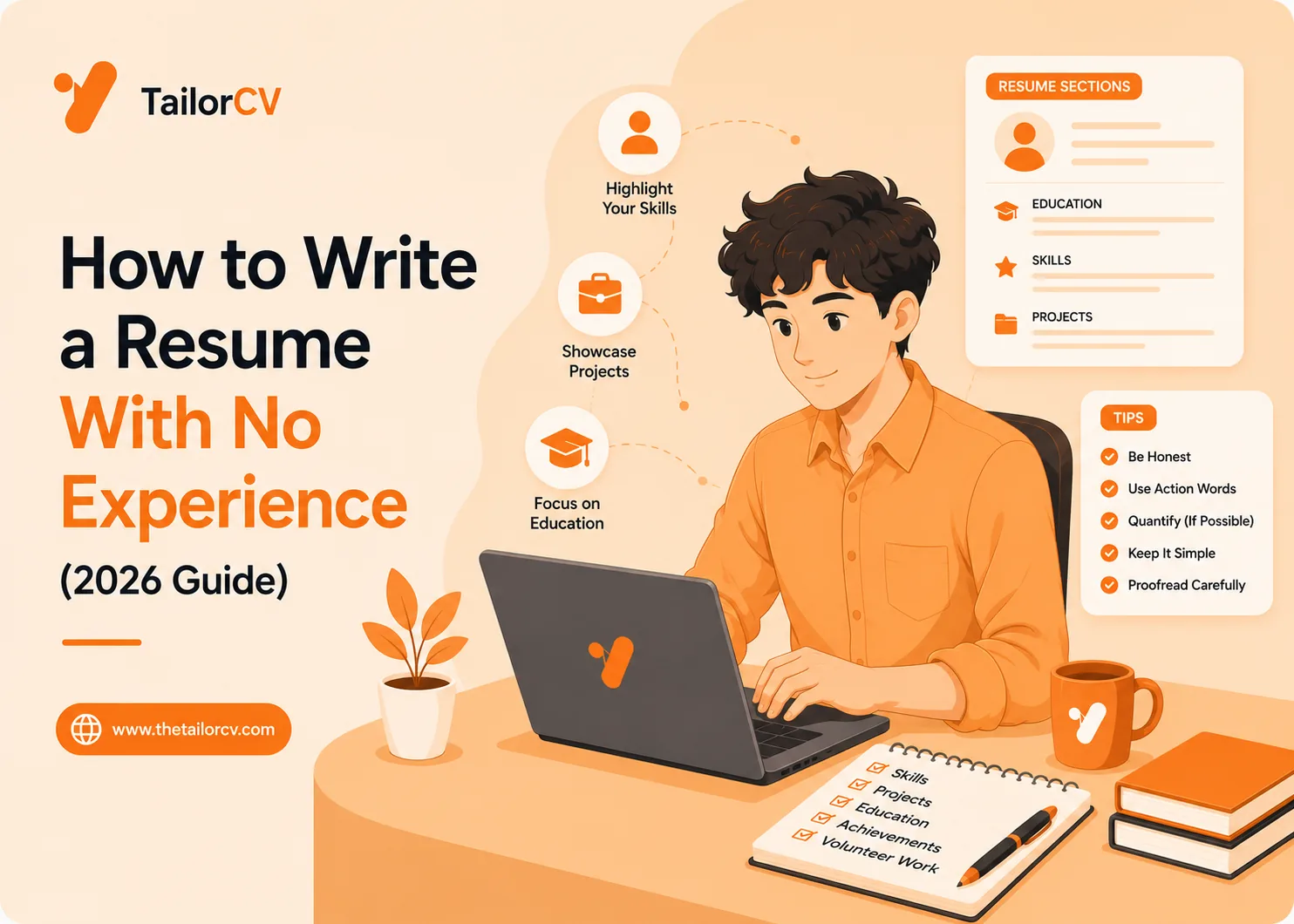
If you're writing your first resume in 2026, the good news is that hiring managers already know you don't have a decade of work history - what they're actually screening for is whether you can communicate clearly, show initiative, and prove you can learn fast. The resume just needs to make that easy to see. Most of what feels like "nothing to put on the page" right now - the class project you led, the shifts you worked at a part-time job, the club you helped run - is more resume material than you think, and how to get a job with no experience walks through the bigger job-search picture this resume fits into.
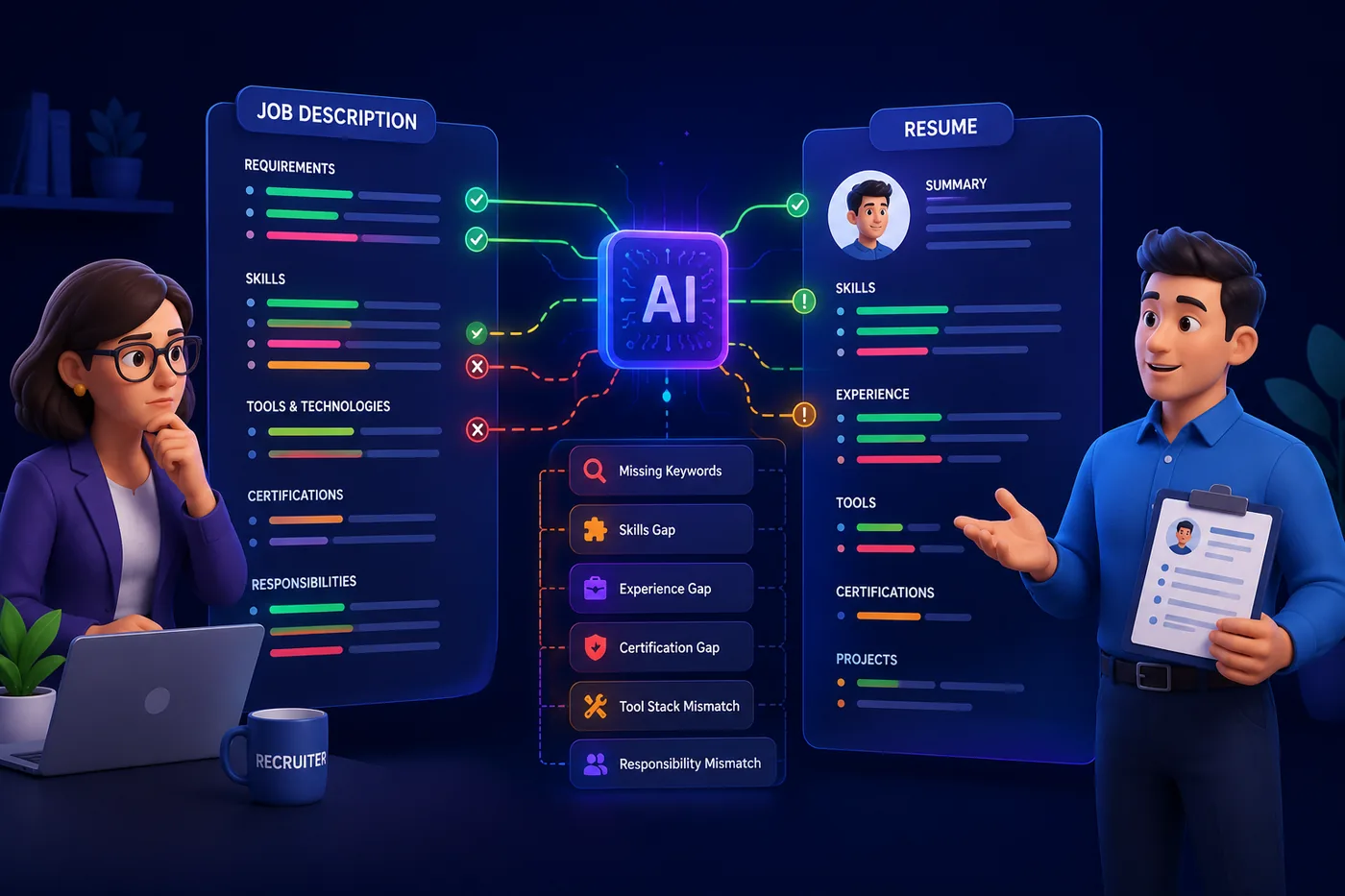
Before you finalize it, run it through the free ATS score checker against a real job posting to see exactly what's missing.
What Actually Matters on a First Resume
- Clarity over length - one clean page beats two padded ones every time. See ideal resume length guide.
- Projects and coursework in place of formal jobs - see projects in resume and fresher resume projects that get interviews
- A tight skills section listing tools and platforms you're actually comfortable with, not aspirational ones - see skills to add to resume 2026
- A short, specific summary instead of a vague objective - see resume objective vs summary
- An ATS-friendly format that survives automated screening on your first try - see ATS-friendly resume builder
None of this requires a job title. It requires specifics - what you did, what changed because you did it, and what tools or skills you used to do it. That's true whether the "role" was a summer job, a student club, or a class project.
Redefining What Counts as "Experience"
The biggest block most first-time resume writers hit is thinking "experience" only means paid, full-time work. It doesn't. Hiring managers reading entry-level resumes expect to see a mix of the following, and they read all of it the same way: as evidence of what you can do.
| Rule | What it means |
|---|---|
| Class and group projects | a semester-long project, a capstone, a case competition, a research assignment done with a team |
| Part-time and hourly jobs | retail, food service, tutoring, campus jobs, babysitting or lifeguarding |
| Gig and freelance work | freelance design, writing, social media management, selling on Etsy or Depop, running a small side hustle |
| Volunteering | fundraising, event organizing, mentoring, community service hours; see volunteer work on resume for how to phrase it |
| Student organizations and clubs | a role in student government, a cultural club, a hobby club, a Greek organization |
| Sports and leadership roles | team captain, section leader in band, club officer |
| Personal projects | a website you built, a small app, a blog with a real readership, a YouTube channel you grew, a portfolio piece |
The structure for writing about any of these is identical to writing about a job: start with an action verb, describe what you actually did, and end with the result or impact where you can measure it. A resume reader doesn't care whether the paycheck existed - they care whether the skill did. If you led a project team as a volunteer, that's team leadership. If you managed a budget for a club, that's budget management. Write it that way.
Turning Everyday Experience Into Strong Resume Bullets
The gap between a weak first resume and a strong one usually isn't the underlying experience - it's how specifically that experience gets written down. Vague summaries of "helped with" or "was involved in" don't tell a hiring manager anything. Specific, structured bullets do.
Example 1: Club treasurer
Weak: "Was treasurer for the business club and handled money stuff."
Strong: "Managed a $2,400 annual budget for a 40-member business club, tracked spending across 6 events, and cut catering costs by switching vendors, freeing up funds for a guest speaker series."
Example 2: Group class project
Weak: "Worked on a group project for marketing class."
Strong: "Led a 4-person team to design a go-to-market plan for a fictional product, presented findings to 30 classmates and the professor, and received the highest grade in the section for strategic clarity."
Example 3: Part-time retail job
Weak: "Worked as a cashier at a clothing store."
Strong: "Handled an average of 80 customer transactions per shift, trained 3 new hires on the point-of-sale system, and was recognized twice for having the store's highest customer satisfaction scores."
Example 4: Volunteer work
Weak: "Volunteered at a local food bank."
Strong: "Coordinated weekend volunteer shifts for a team of 12 at a local food bank, streamlined the intake process for donated goods, and helped the location serve roughly 200 families per month."
Notice the pattern: each strong version names a number, a scope, or a concrete outcome instead of just a task. You don't need to inflate anything to do this - you need to sit down and actually remember the specifics, then write them the way a resume expects them written. A good way to test a bullet is to ask yourself "would a stranger reading only this line understand what I actually did and why it mattered?" If the answer is no, it needs another pass. For more worked examples across different situations, see how to quantify resume achievements.
Section-by-Section Guide
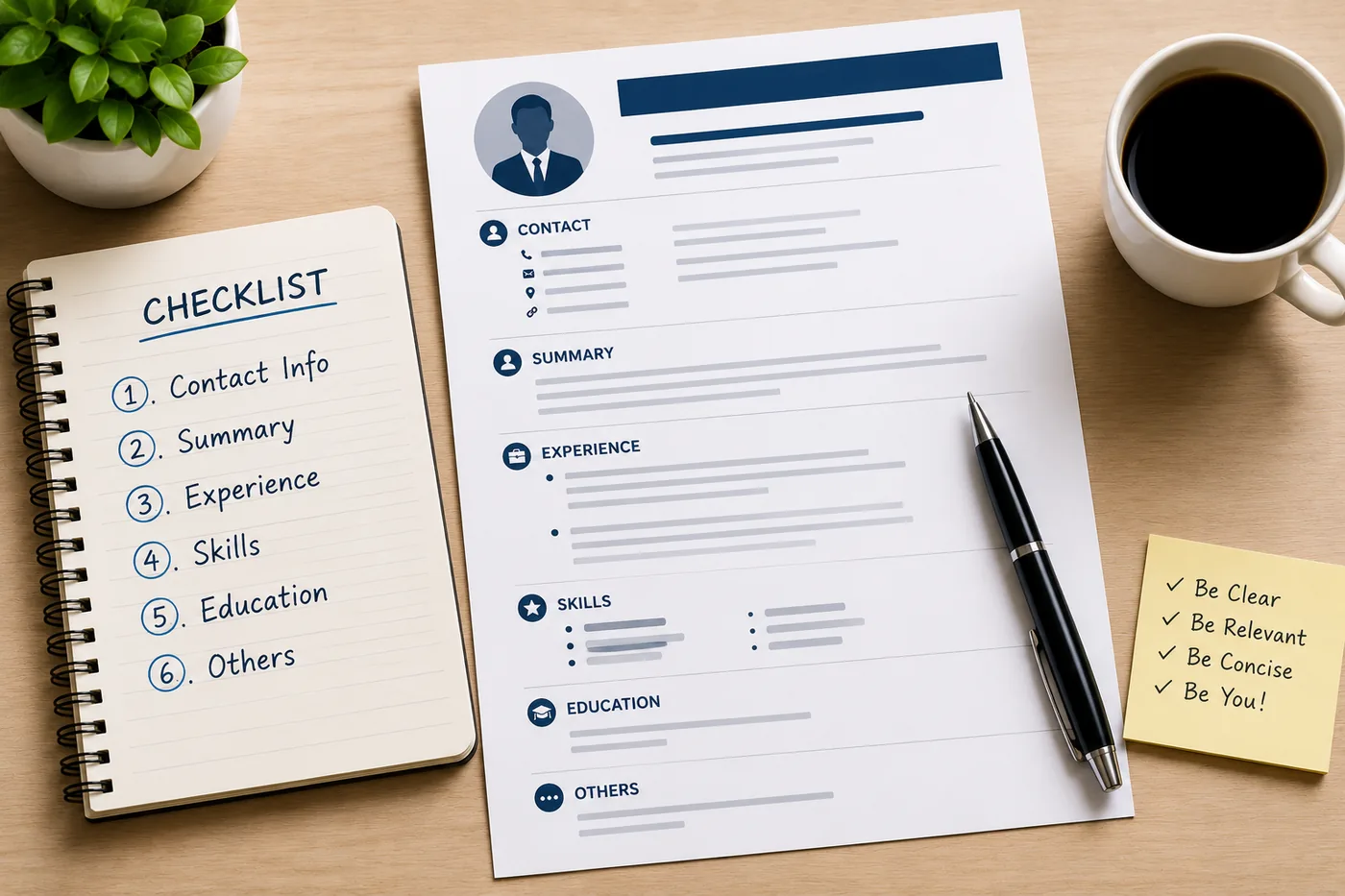
Contact and links
Keep it simple: name, email, phone, city/state, and links to LinkedIn or a portfolio if relevant. See resume contact section. Skip the objective-style tagline under your name and skip a full mailing address - city and state is enough.
Summary
Two to three lines connecting your background to the type of role you want - not a generic "hardworking recent graduate" line. See how to write a resume summary and resume summary with no experience.
Education
List your school, expected/actual graduation date, and relevant coursework if your major connects to the role. See how to list education on resume. Include GPA only if it's a strong number and the employer or industry norm expects it; otherwise leave it off.
Projects and experience
This is where most of your resume's value lives. Include class projects, internships, part-time work, and volunteer roles with specific, quantified outcomes - see how to quantify resume achievements. If you've done any internship-style work already, resume for internship with no experience has more detail on framing it.
Skills
List tools, languages, and platforms honestly - see technical skills guidance for freshers and avoid vague buzzwords with no proof behind them.
How to Structure a Resume When You Don't Have Work History Yet
The order of sections on your resume isn't fixed - it should reflect where your strongest material actually is. For most first-time resume writers, that means flipping the usual order.
- Put education first. Once you have a few years of relevant work history, education moves toward the bottom. Until then, it belongs near the top, right under your summary, because it's currently one of your strongest credentials.
- Add a dedicated Projects or Activities section if you have three or more pieces of project, club, or volunteer work that don't fit neatly into a "work experience" header. Calling it "Projects" or "Leadership & Activities" is more accurate than forcing it into "Experience" and more honest than hiding it in a skills list.
- Keep it to one page. With limited history, there is rarely enough substantive material to justify a second page, and a half-empty page reads worse than a full, tight one. If you're unsure whether you have enough to fill a page, that's usually a sign to add more detail to existing bullets rather than stretch the layout. See how to write a resume from scratch if you're starting completely blank.
- Group similar things together. If you have both a part-time job and a class project relevant to the same skill, put them near each other so a reader can quickly see the pattern rather than hunting across the page.
- Order within each section by relevance, not recency. Your most job-relevant project can sit above a more recent but less relevant one.
Writing a Summary Line That Signals Direction
A summary at the top of a first resume has one job: give the reader a fast, specific sense of who you are and what you're aiming for. The failure mode is writing something so generic it could sit on top of anyone's resume.
Weak: "Hardworking recent graduate seeking an entry-level opportunity to grow and learn."
Strong: "Marketing graduate with hands-on experience running social campaigns for a student organization and a part-time retail role, looking to bring content and analytics skills to a brand marketing team."
The strong version names a field, references real experience, and states a direction - all in one sentence. It doesn't claim skills you haven't demonstrated elsewhere on the resume, and it doesn't rely on adjectives like "hardworking" or "passionate" to do the work that specifics should be doing. If you're stuck on wording, look at resume objective vs summary for the difference between the two, and resume summary with no experience for more first-resume examples.
Skills Worth Listing on a First Resume
A skills section is meant to be scannable proof, not a wish list. Two categories are worth including:
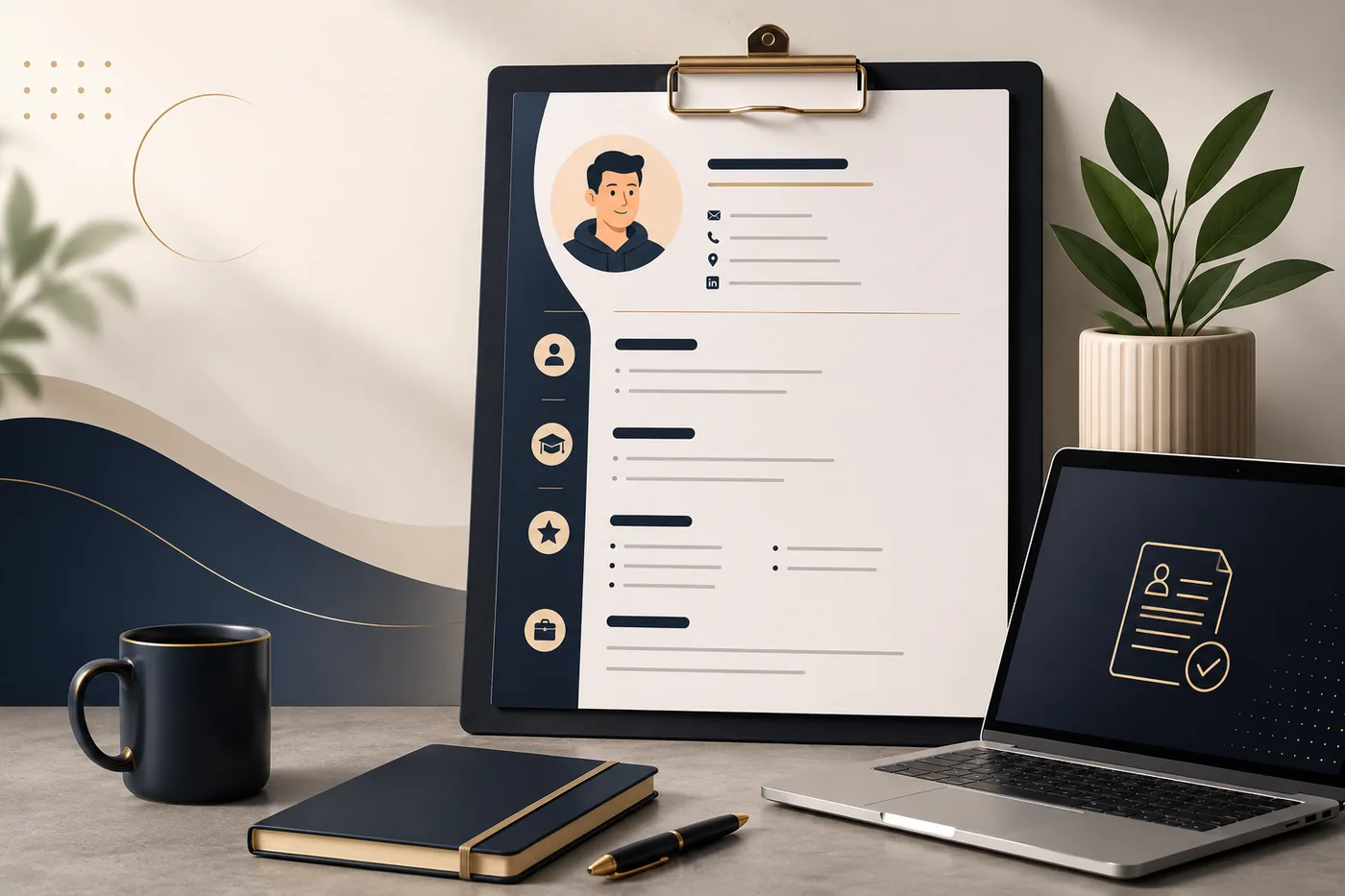
Your resume after optimization
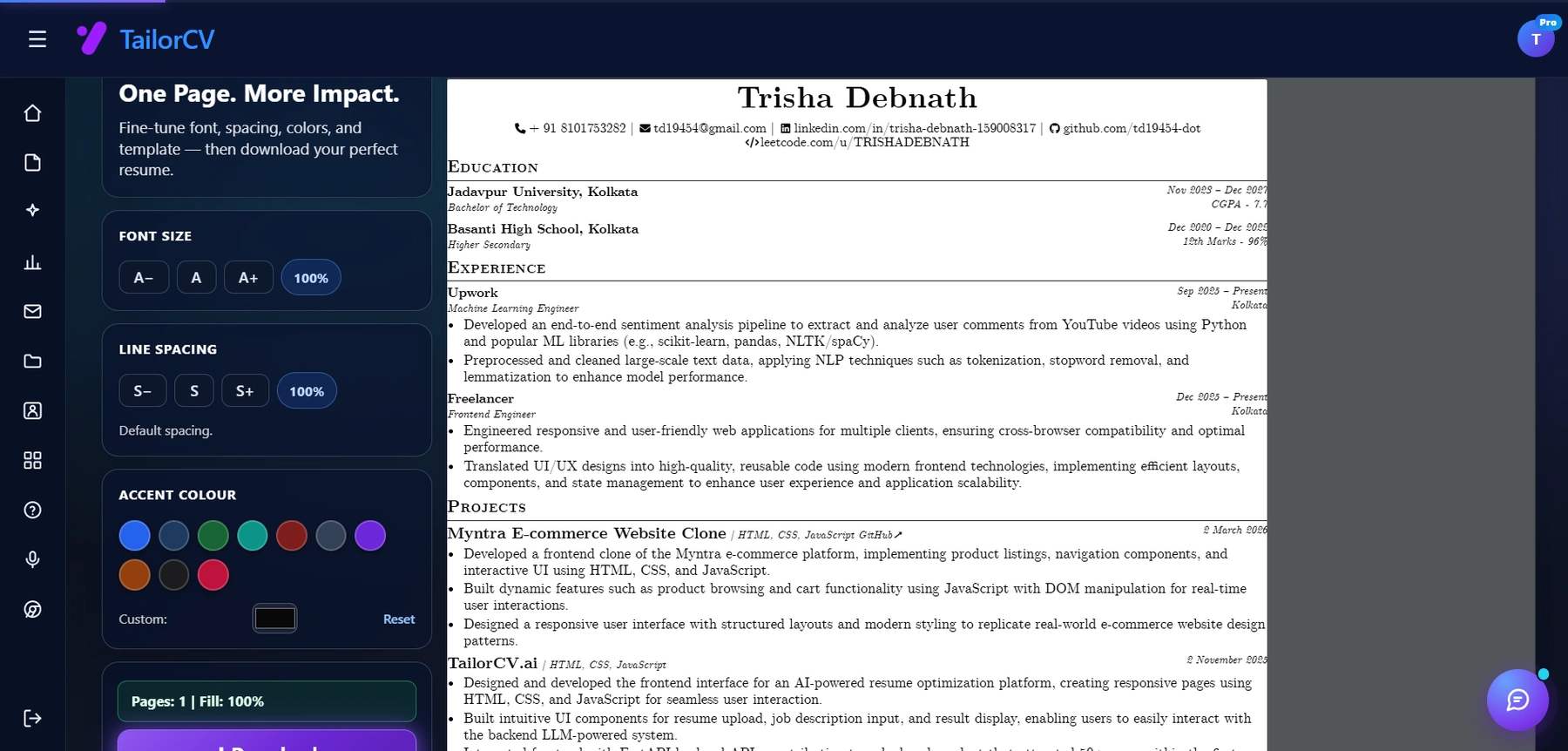
Font size, spacing, accent colour and template are all adjustable, with a live page counter.
- Technical or hard skills - software, tools, platforms, or languages you can actually use without help: spreadsheet tools, design software, coding languages, specific platforms relevant to the role (CRM tools, analytics dashboards, POS systems).
- Transferable skills with backup elsewhere on the page - things like project coordination, public speaking, or customer service, but only if a bullet somewhere in your experience or projects section actually demonstrates them. A skill with zero supporting evidence anywhere on the resume reads as filler.
The common mistake is padding this section to look fuller: adding "Microsoft Word," "communication," and "teamwork" alongside actually relevant tools dilutes the list and makes it harder for a hiring manager - or an ATS keyword scan - to see what you're genuinely strong at. Keep the list focused on what the specific role asks for, and check it against the job posting with the free ATS score checker before you submit.
Common First-Resume Mistakes
- Using a generic objective statement instead of a targeted summary
- Padding with irrelevant high school details once you're in college or graduated - once you have a semester or two of college or any part-time work, high school clubs and awards can usually come off
- Formatting with tables, columns, or graphics that break ATS parsing
- Listing skills with zero supporting evidence anywhere on the resume
- Sending the exact same resume to every application instead of tailoring it
- Listing hobbies that don't connect to the role or say anything about you as a candidate - "reading" and "watching movies" rarely add value; a hobby is worth including only if it demonstrates a relevant skill or genuinely differentiates you
- Writing job duties instead of outcomes - "responsible for helping customers" says less than "resolved an average of 25 customer issues per shift with a 95%+ satisfaction rating"
- Leaving obvious formatting inconsistencies - mismatched date formats, inconsistent bullet punctuation, or fonts that change between sections all signal a rushed draft
Using AI Tools the Right Way at This Stage
AI writing tools are genuinely useful for a first resume - they can help you structure sections, suggest stronger action verbs, and tighten wording that feels clunky. Used well, a tool like TailorCV's resume builder can take you from a blank page to a formatted, ATS-friendly draft in minutes.
Where it goes wrong is when AI output replaces the substance instead of shaping it. A tool can't know that you actually managed a $2,400 club budget or trained three new hires - only you know that. If you ask an AI tool to "write bullet points for a retail job" without feeding it your real details, you'll get generic, forgettable lines that any other applicant's resume could also have. The reliable process is:
- Write down the raw, specific details of what you did first - numbers, scope, outcomes, tools used.
- Use AI tools to help phrase, structure, and tighten those details, not invent new ones.
- Read every generated line back and confirm it's true and specific to you before it goes on the resume.
A hiring manager who asks a follow-up question in an interview should get an answer that matches what's on the page. Keep the facts yours; let the tools handle the polish.
Make This Practical
Turn your draft into an application-ready package. Check your resume's ATS fit with the free ATS score checker, start from a clean layout with TailorCV's resume templates, pair it with a cover letter built for no experience, and practice your first interviews with the AI mock interview tool. If your field supports it, a simple portfolio can back up your resume with real work samples - see the student portfolio guide for how to put one together fast.
FAQ
Should my first resume be one page?
Yes, almost always - one page is standard for entry-level resumes. See the ideal resume length guide for exceptions.
What if I have literally no work experience at all?
Lean fully on projects, coursework, and extracurriculars - see resume with no experience and technical skills for freshers. Every section can still work; you're just filling "Experience" with a different mix of material.
Do I need a cover letter too?
Yes - pair your resume with a cover letter with no work experience, which often carries even more weight than the resume for entry-level roles. It's where you can explain your direction in a way a bullet-point resume can't.
Should I build a portfolio even if I'm not in a design or dev field?
Yes, if your field allows it - a simple portfolio website built from your resume can make you stand out even in non-technical fields. See student portfolio guide.
How do I know which class projects are worth including?
Include projects where you can point to a specific role you played, a skill you used, and something measurable or demonstrable that came out of it. A project you barely contributed to, or one with nothing specific to say about it, is better left off in favor of something you can describe in real detail.
Is it okay to include a part-time job that has nothing to do with the career I want?
Yes - the job itself doesn't need to match your target field for it to be worth including. What matters is pulling out the transferable pieces: handling responsibility, working with people, solving problems under time pressure. A retail or food service job can still demonstrate reliability and customer-facing skills that any employer values.
How many bullet points should each entry have?
Two to four bullets per entry is typical. More than that usually means you're listing minor tasks instead of your strongest, most specific outcomes - trim down to the points that say the most.
Should I list a GPA on my first resume?
Only if it's strong (generally 3.5 or above, though norms vary by field) or if a specific employer explicitly asks for it. If your GPA doesn't add to the picture, leave it off and let your projects and experience carry the page instead.
Next Step
The fastest way to know if your first resume is actually ready is to test it against a real job posting rather than guessing - run it through the free ATS score checker and fix what it flags before you hit submit.
What is your resume scoring right now?
Scan it against a job description and get your ATS match score in about a minute.
Drop your resume here or choose a file
PDF only. Max 2 MB.
We never share your data or use it to train AI models.

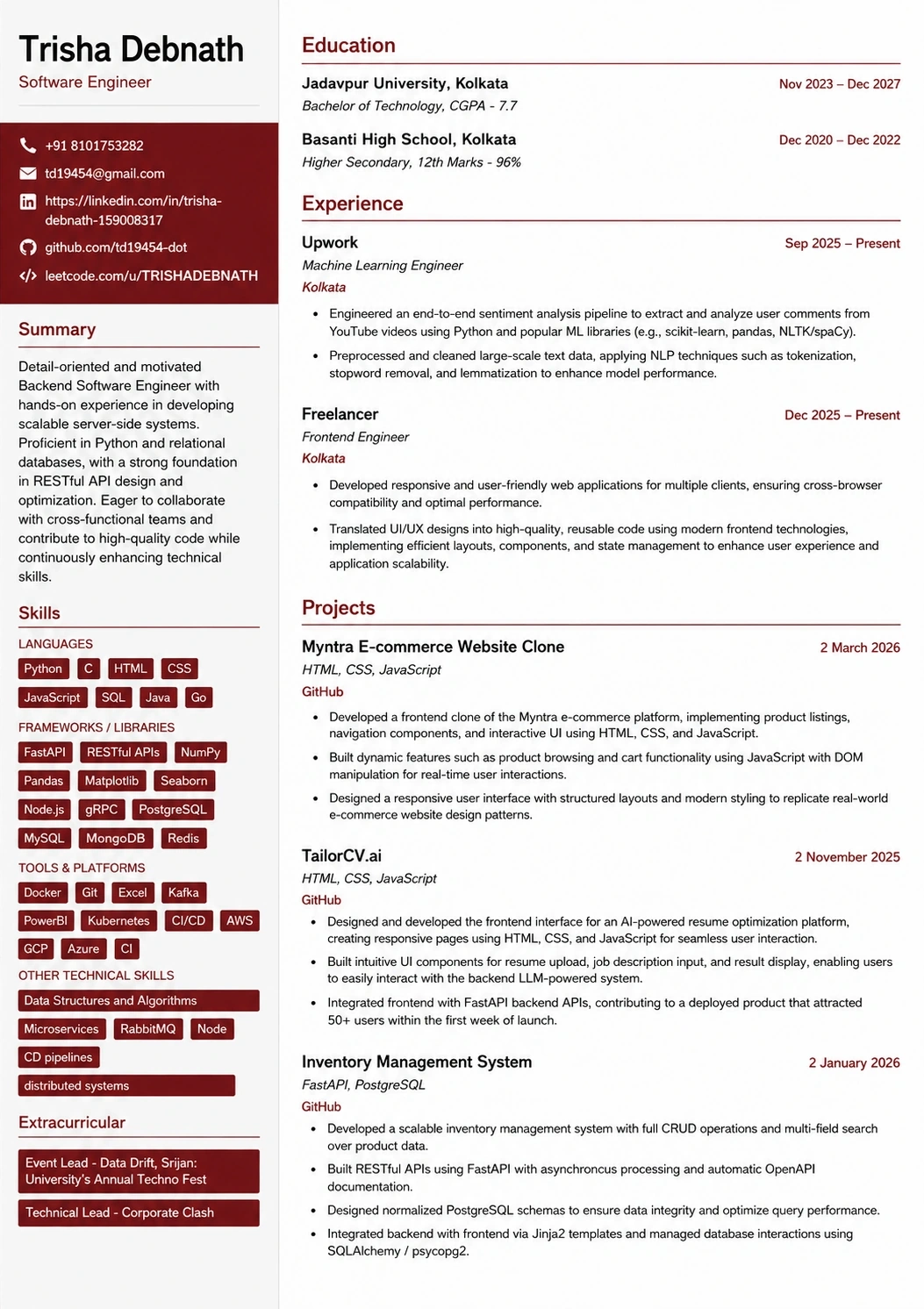
Templates that keep this structure intact
This template is ATS-tested — start from it and the formatting rules in this guide are already handled.
Was this guide useful?
Be the first to rate it.