SS
SS
Key Takeaways
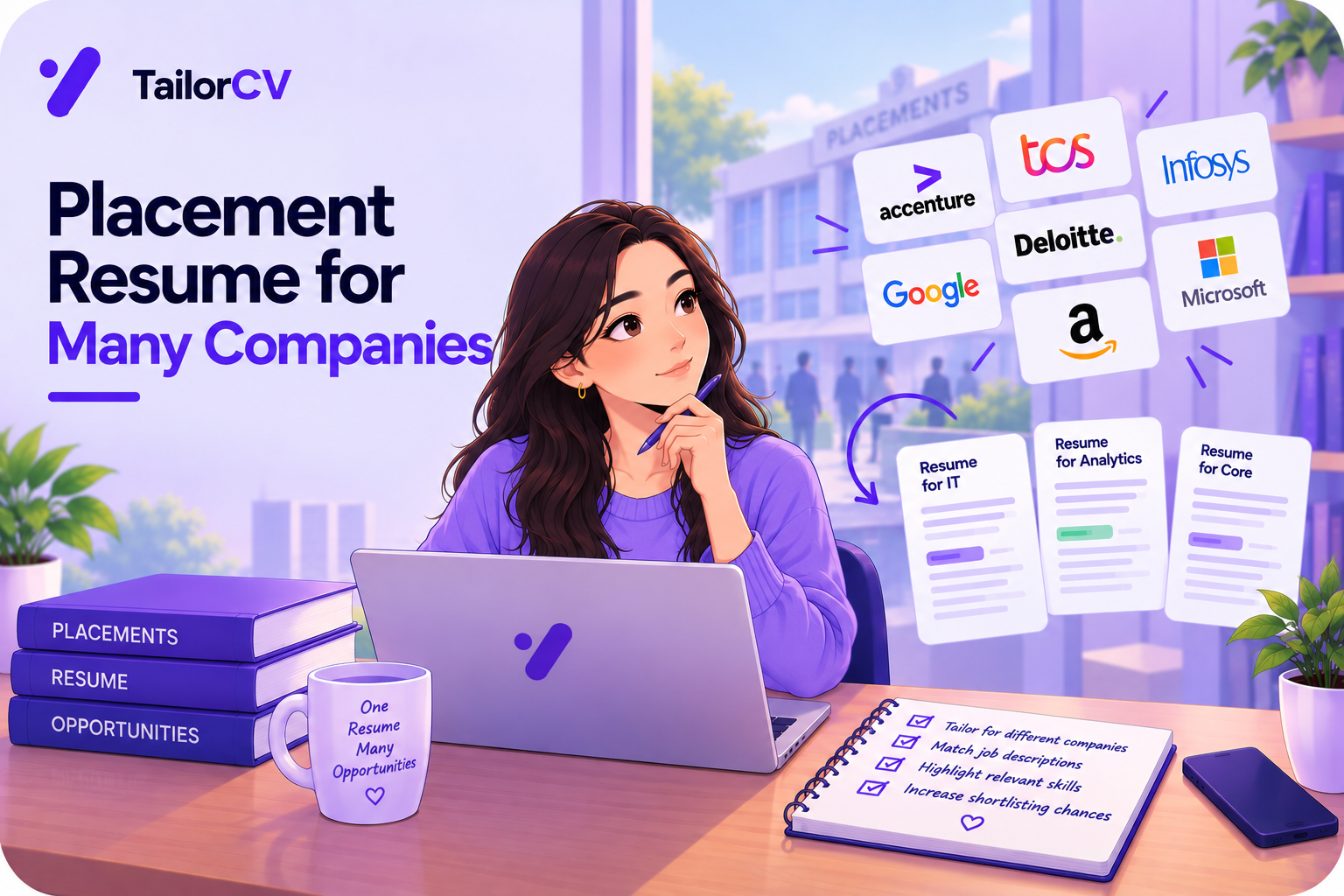
- Most placement resumes go out in batches through the placement cell, so you cannot tailor per company - but you can tailor per company type.
- Build two or three versions for the company types you are targeting: service/IT, product/tech, core engineering, analytics/consulting.
- The top third of the page decides the shortlist. Put the evidence your target company type values most - projects, CGPA, internships or coding profiles - at the top.
- If your college enforces a fixed template, tailor inside it: order of projects, which bullets lead, and the skills line.
- One strong, specific project beats four tutorial-level ones. Recruiters at placements see the same "to-do app" hundreds of times.
- Check the eligibility criteria and job description for each drive. Your resume should never contradict the details you enter on the portal.
Placement season means one resume submitted to twenty, forty or more companies, often through a portal the placement cell controls. You cannot rewrite it for each drive. What you can do is build a small number of versions - one per company type you are targeting - and make sure each version's top third answers what that type of recruiter screens for.
This guide shows how to group companies, what each group looks for, how to tailor within a fixed college template, and how to manage versions through the season.
Why One Generic Placement Resume Underperforms
At placements, recruiters screen hundreds of resumes from the same college in a short window. Most of those resumes look alike: same template, similar CGPAs, similar projects.
The shortlist is decided at the top of the page
With so many near-identical resumes, recruiters look for a quick reason to shortlist. That reason comes from the top third: your education line, your first project or internship, and your skills. If your strongest evidence for this company type is buried below, you blend in. The post on campus placement resume mistakes covers the most common ways students bury their best material.
Different company types value different evidence
A mass-recruiting IT services company, a product startup, a core engineering firm and an analytics consultancy are looking for different signals. A single resume can only lead with one.
Recruiters see the same projects repeatedly
A weather app, a to-do list, a student management system, a basic e-commerce clone - these appear on most resumes in a batch. A specific project, described with real detail and a result, stands out. See final-year project for placement.
Step 1: Group the Companies Coming to Campus
Look at your placement calendar and group companies by what they screen for.
| Company type | Examples of roles | What they screen for first |
|---|---|---|
| IT services / mass recruiters | Graduate engineer trainee, systems engineer | Eligibility (CGPA, no backlogs), communication, basic programming |
| Product / tech companies | SDE, software engineer | DSA ability, coding profiles, strong projects, internships |
| Core engineering | Graduate engineer (mechanical, electrical, civil) | Branch knowledge, core projects, industrial training |
| Analytics / consulting | Business analyst, data analyst, associate consultant | Analytical projects, Excel/SQL, case competitions, communication |
| BFSI / finance | Analyst, management trainee | Quantitative ability, finance coursework, certifications |
Most students target two or three of these. You do not need a version for every type on campus - only the ones you are serious about.
Check each drive's job description
Even for mass-recruitment drives, the placement cell usually shares a JD. Skim it for the role title, required skills and eligibility. The drive's JD tells you which of your versions to submit. How to read a job description properly covers what to look for.
Step 2: Decide What Leads in Each Version
The biggest difference between versions is what appears first after your education.
| Version | Lead section after education | Skills line leads with | Project to feature first |
|---|---|---|---|
| Service / IT | Projects or internship | Core language (Java/Python), SQL, basics | A complete, working project with clear scope |
| Product / tech | Coding profiles + best technical project | DSA, languages, frameworks | Your most technically complex project |
| Core engineering | Industrial training / core project | Branch tools (AutoCAD, MATLAB, SolidWorks, PLC) | Core branch project or plant internship |
| Analytics / consulting | Analytics project or case competition | Excel, SQL, Python/R, Power BI | Data analysis project with a finding |
A note on coding profiles
For product companies, a line with competitive programming ratings or problem counts (LeetCode, Codeforces, CodeChef) can carry real weight. Include it only if the numbers are genuinely good for your batch; a weak rating on the first line can hurt more than help.
Step 3: Tailor Inside a Fixed College Template
Many colleges require a standard format for the placement portal. You cannot change fonts, sections or layout - but you can still tailor.
What you can usually change
- Order of projects within the projects section.
- Which bullets you include and in what order under each project and internship.
- The skills line - order and selection.
- Positions of responsibility - which ones you list and how you describe them.
- The objective or summary line, if your template has one.
What usually stays fixed
- Section order and headings.
- Education block format (CGPA, class 10 and 12 marks).
- Fonts, margins, one-page limit.
Same project, service version: "Built a library management system in Java and MySQL with issue, return and fine tracking; used by our department library for one semester."
Same project, product version: "Designed a library management backend in Java with a MySQL schema of 8 tables; implemented search with indexing that cut lookup time from about 2s to under 200ms on 12,000 records."
The first emphasises completeness and real use - what service recruiters value. The second emphasises design and performance - what product interviewers probe.
Step 4: Write Project Bullets That Survive a Crowded Batch
Placement projects blend together unless you add specifics.
The three details that make a project stand out
- Scale or data: how many users, records, rows, requests.
- A decision you made: why this database, why this algorithm, what trade-off.
- A result: faster, used by someone, placed in a competition, deployed.
Weak: "Developed an e-commerce website using MERN stack."
Strong: "Built a MERN-stack store for a local bakery with cart, payments (Razorpay test mode) and order tracking; handled 150+ test orders during a college fest week."
The strong version shows a real user, a real integration and real usage. For more ways to make fresher projects credible, see fresher resume projects that get interviews.
Positions of responsibility count
Fest committees, club leadership and event management show organisation, budgeting and communication - valued especially by service, consulting and management-trainee recruiters.
"Managed sponsorship for the annual tech fest; raised ₹4.2 lakh from 11 sponsors, up from ₹2.8 lakh the previous year."
Worked Example 1: A CSE Student Targeting Service and Product
Situation: Tanya, CSE, CGPA 7.9, is applying to both mass-recruiting IT companies and product startups. She has three projects: a Java library system, a React weather app, and a Python chatbot for college FAQs. She did one internship at a small SaaS company.
Product version:
- Coding profile line: "LeetCode: 420 problems solved, contest rating 1,780."
- Internship first: "Built two REST endpoints for a SaaS invoicing product in Node.js; wrote unit tests raising module coverage from 40% to 75%."
- Projects: chatbot first (most technical - she built retrieval over 300 FAQ entries), then library system with the performance bullet.
- Skills: "Data structures & algorithms, Java, JavaScript (Node, React), SQL, Git."
Service version:
- Internship first, described with collaboration and delivery: "Worked in a 5-person team using Git and Jira; shipped two features on schedule across 3 sprints."
- Projects: library system first (complete, used by the department), then chatbot.
- Skills: "Java, Python, SQL, HTML/CSS, Git."
- Weather app dropped - it was the most generic.
Same facts, same template, different lead evidence.
Worked Example 2: A Mechanical Student Targeting Core and Analytics
Situation: Arjun, mechanical engineering, wants core roles but is also applying to analytics drives as a backup. He did a summer internship at a two-wheeler plant and a final-year project on vibration analysis. He also completed a data analysis course and analysed IPL data as a side project.
Core version, first entry: "Industrial training - two-wheeler assembly plant: mapped cycle times at 6 stations and proposed a layout change that cut one bottleneck station's time by about 12%."
Analytics version, first entry: "Analysed 12 seasons of IPL ball-by-ball data (250,000+ rows) in Python and SQL to model toss impact on win rate; visualised findings in Power BI."
In the analytics version, the plant internship still appears, reframed around data: "Collected and analysed cycle-time data across 6 stations to identify a bottleneck." For moving across disciplines like this, adjacent skills resume credit helps.
Worked Example 3: A Student With a Low CGPA
Situation: Farhan has a 6.6 CGPA and one cleared backlog. Some companies' cut-offs exclude him; others do not.
His version strategy puts strength first where the template allows: projects and internship before positions of responsibility, strong project detail, and a GitHub link with active repositories. He applies only to drives where he meets eligibility - applying where he does not wastes a slot and can get flagged.
His projects section leads with a deployed app with real users. The low CGPA placement guide and backlog guide cover eligibility strategy in more depth.
Worked Example 4: An ECE Student Targeting Core Electronics and IT
Situation: Sneha studies electronics and communication. She wants core electronics roles (embedded systems, VLSI) but is also applying to IT service companies as a safety net. Her projects: an IoT-based home automation system, a Verilog processor design for coursework, and a Python attendance app.
Core version:
- First project: the Verilog design - "Designed a 5-stage pipelined RISC-V processor in Verilog; verified with 200+ test programs in ModelSim."
- Second project: the IoT system, described with hardware detail (ESP32, sensors, power management).
- Skills: Verilog, embedded C, MATLAB, microcontrollers (ESP32, Arduino).
- Industrial training at a PCB manufacturer listed prominently.
IT service version:
- First project: the IoT system, described around the software side - "Built the mobile dashboard and cloud backend (Python, Firebase) for a home-automation system controlling 8 devices."
- Second project: the attendance app.
- Skills: Python, C, SQL, basic web development.
- The Verilog project kept as one line to show engineering depth.
Same projects, same facts, different lead. For branch-specific placement preparation, see the campus placement preparation timeline.
The One-Page Problem: What to Cut First
Most placement templates enforce one page. When each version needs different content at the top, something has to go. Cut in this order:
| Cut first | Why | Keep instead |
|---|---|---|
| Hobbies and interests | Rarely read; takes 2-3 lines | A project line |
| Workshop and webinar attendance | Low signal; everyone attends them | One certification with a real assessment |
| Generic certificates (e.g. "Introduction to Python") | Common and unverified | A project that uses the skill |
| Duplicate projects (two CRUD apps) | Recruiters see both as one skill | The stronger of the two |
| Minor positions ("class representative") | Weak unless you show results | Positions with numbers - budget, team size |
| School-level achievements | Outdated by final year | College achievements |
| Declaration and signature lines | Not needed on most portals | - |
What never gets cut
Your education block, your best project, your internship (if you have one) and a skills line. These are what every recruiter type screens on. If you are still over one page after cutting everything above, shorten bullets rather than removing sections - most project bullets can drop filler words like "successfully", "various" and "in order to".
A tighter version also reads faster in interviews, when the panel has your resume in front of them and picks lines to ask about.
Managing Versions Through the Season
Placement season moves fast, with drives on consecutive days. Losing track of versions is easy.
A simple system
| Item | How to handle it |
|---|---|
| File names | "Name_Product_v3.pdf", "Name_Service_v3.pdf" |
| Tracker | One sheet: company, date, version sent, round reached |
| Updates | When you add a project or result, update every version the same day |
| Portal consistency | Details typed into the portal must match the resume you upload |
| Final check | Open the PDF before each upload to confirm it's the right version |
For a more detailed approach to keeping versions straight, see managing multiple resume versions.
Keep facts identical across versions
CGPA, dates, internship names, project results - these must be the same in every version. Different emphasis is fine; different facts are not. Interviewers sometimes have your portal data alongside your resume.
At Each Stage of the Season
Placement tailoring changes as the season moves on.
| Stage | Your situation | What to do with your resume |
|---|---|---|
| Pre-final year / internships | Applying for internships through campus | One version, lead with your best project and skills |
| Early placement season | Top companies and dream offers | Your strongest version per company type; maximum detail |
| Mid-season | Mass recruiters and repeat drives | Service and product versions ready; quick turnaround |
| Late season / off-campus | Fewer campus drives | Off-campus applications with per-posting tailoring |
Early in the season: invest in the lead
Dream companies often come first. Your product or analytics version should be at its best before the first drive - there is little time to revise between rounds.
Late in the season: switch to off-campus habits
When campus drives thin out, off-campus applications go through ATS portals, where per-posting tailoring matters. See campus placement vs off-campus.
Edge Cases and Exceptions
The placement cell edits your resume
Some colleges review and standardise resumes. If a coordinator changes your wording, check that every line is still true and something you can explain in an interview.
A company asks for a resume outside the portal
If a recruiter emails asking for your resume directly, you can send a better-tailored version - as long as the facts match what is on the portal.
You hold an offer and keep applying
Some colleges restrict applying after an offer. If you are allowed to continue, add the offer only if the policy and the company expect it, and keep your other versions updated.
Dual-degree or minor specialisations
A minor in data science or management can justify a separate version for analytics or consulting drives, leading with that coursework and related projects.
Common Mistakes During Placements
One resume for every company type
The most common mistake. A single resume usually ends up tuned for whichever company type you thought about first.
Listing every technology you have touched
A skills line with 20 technologies suggests shallow knowledge of all of them. Keep the ones you could answer interview questions on. The skills section guide covers how many to list.
Generic objectives
"Seeking a challenging position in a reputed organisation" wastes a line that could show a project or result. If your template forces an objective, make it specific: "Aspiring backend developer with two deployed Node.js projects and a SaaS internship."
Forgetting the interview uses your resume
Every line is interview material. If you list a technology in the product version, expect to be questioned on it. Campus placement technical interview questions and the HR round questions show how resume lines become questions.
Not updating after a PPO or internship offer
If you convert an internship or get new results mid-season, update all versions. Internship to PPO conversion covers how to present a pre-placement offer if you continue applying.
How This Comes Up in Interviews
At placements, the panel usually has your resume printed in front of them and asks about almost every line. Each version you submit is a script for your interview.
| Resume element | Typical placement question |
|---|---|
| First project | "Explain your project architecture and why you chose that stack." |
| Skills line | "You've listed Java - what's the difference between an interface and an abstract class?" |
| Internship | "What exactly did you build, and what did you learn?" |
| Position of responsibility | "Tell me about a conflict in your team and how you handled it." |
| CGPA or backlog | "What happened in that semester?" |
Prepare answers for every line in every version you submit. Campus placement technical interview questions and the HR round questions show how panels use resumes. The mock interview tool can drill you on your own lines.
Off-Campus Applications Are Different
Off-campus applications go through company portals and ATS systems, where you can and should tailor per posting. There, a match scan and per-posting edits make a real difference. Campus placement vs off-campus compares the two tracks.
For off-campus postings, the free ATS scan shows how your version matches a specific JD in about a minute, and the AI resume optimizer can tailor your base toward it without adding skills you do not have. For campus drives, focus on your two or three type-based versions.
Quick Checklist
- Which company types are you targeting, and do you have a version for each?
- Does each version lead with the evidence that company type screens for?
- Is every project bullet specific - scale, a decision, a result?
- Are CGPA, dates and internship details identical across versions?
- Does the resume fit the college template's one-page limit?
- Are files named clearly by version?
- Can you answer interview questions on every line of every version?
Frequently Asked Questions
Can I use one resume for all companies in campus placement?
You can, but it usually underperforms. Build two or three versions for the company types you are targeting - service, product, core, analytics - and submit the matching one for each drive.
How do I tailor my resume if my college has a fixed format?
Change what the template allows: the order of projects, which bullets lead, the skills line, positions of responsibility, and any objective line. These changes shift what the recruiter sees first.
What should a placement resume focus on for product companies?
Coding ability and technical depth: your strongest technical project, internships, and competitive programming profiles if your ratings are good. Put these near the top.
What do service companies look for in a placement resume?
Eligibility (CGPA and backlogs), solid programming fundamentals, complete working projects and communication. Clear, complete projects and teamwork evidence work well.
How many projects should I put on my placement resume?
Two to four, depending on space. One strong, specific project with scale and results is worth more than several generic tutorial projects.
Should I include class 10 and 12 marks?
Usually yes during campus placements, because many companies screen on them and college templates often require them. Off-campus, they matter less as you gain experience.
Is it OK to have different resumes for different companies at placements?
Yes, as long as the facts are the same in every version. Changing order and emphasis is normal; changing CGPA, dates or results is not.
What if I don't meet a company's CGPA cut-off?
Generally, do not apply to that drive - you will likely be filtered out and may waste your application slot. Focus on drives where you meet eligibility and on off-campus roles with flexible criteria.
Can I change my resume between placement rounds?
Often not for the same company once submitted, but you can usually update your resume on the portal between different companies' drives. Check your placement cell's rules.
Should I include a photo on my placement resume?
Follow your college template and the company's requirements. Most tech and corporate recruiters do not need one; some colleges include it by default.
What to Do Now
Open your placement calendar and group the companies you care about into two or three types. For each type, decide what should lead after your education, then build that version inside your college template.
Make every project bullet specific - scale, a decision, a result. Set up a simple tracker before the first drive. Next, read final-year project for placement to strengthen your lead project, and splitting resume versions for keeping two tracks consistent.
What is your resume scoring right now?
Scan it against a job description and get your ATS match score in about a minute.
Drop your resume here or choose a file
PDF only. Max 2 MB.
We never share your data or use it to train AI models.

Templates that keep this structure intact
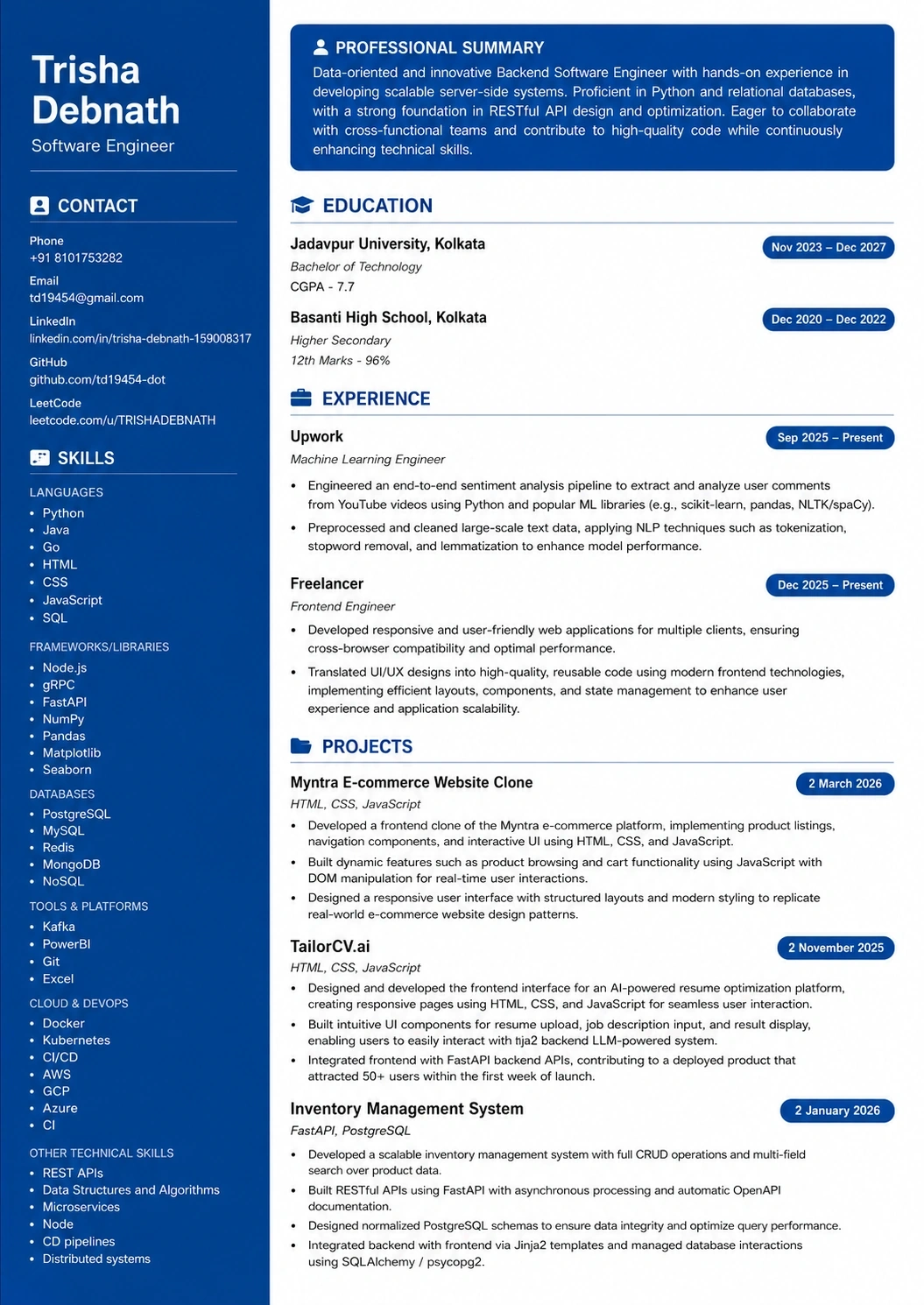
This template is ATS-tested — start from it and the formatting rules in this guide are already handled.
Was this guide useful?
Be the first to rate it.