 SS
SS
Key Takeaways
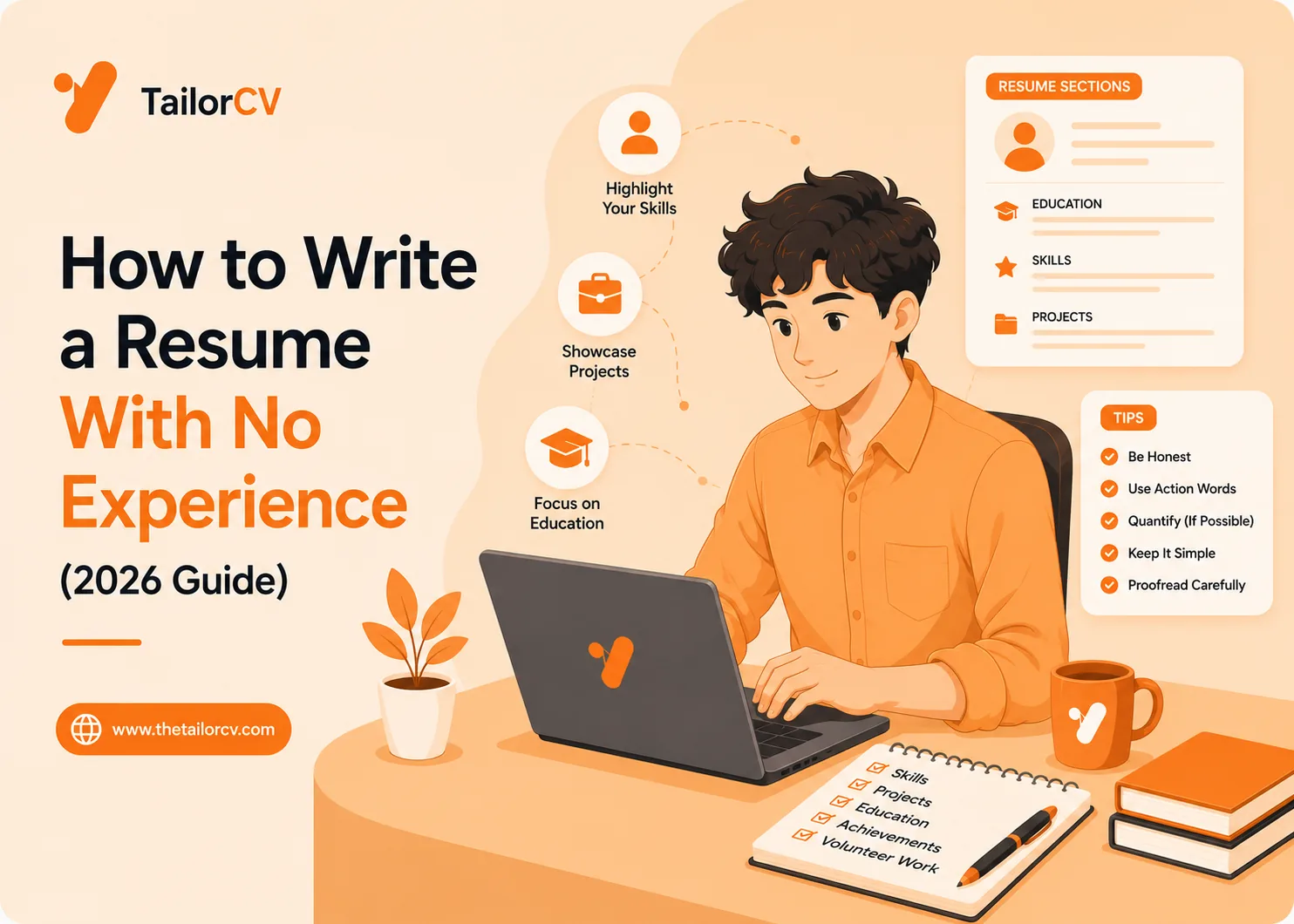
- "No experience" almost never means "nothing to show." Projects, coursework, and volunteering all count.
- Lead with a skills-forward layout, not a bare, one-line work history.
- Every bullet still needs a result — what you built, learned, or improved.
- Tailor the resume to each posting; a generic fresher resume is the easiest to ignore.
Reframe What "Experience" Means
Employers hiring for entry-level roles expect a short work history. What they are really screening for is evidence you can do the work: can you write, build, analyze, or organize? That evidence can come from a class project, a hackathon, a club, a part-time job, or a side project — none of which require a prior full-time role.
The Structure to Use
- Contact + one-line summary — role you want and your strongest angle.
- Skills — the tools and abilities the posting names, that you genuinely have.
- Projects — your most powerful section; treat each project like a job.
- Education — degree, relevant coursework, honors.
- Experience — any part-time work, internships, volunteering.
Projects sit above experience on purpose: for a career starter, a well-described project is stronger proof than a summer retail job.
How to Write a Project Like a Job
Give each project a title, a one-line context, and result-focused bullets:
Building the resume section by section
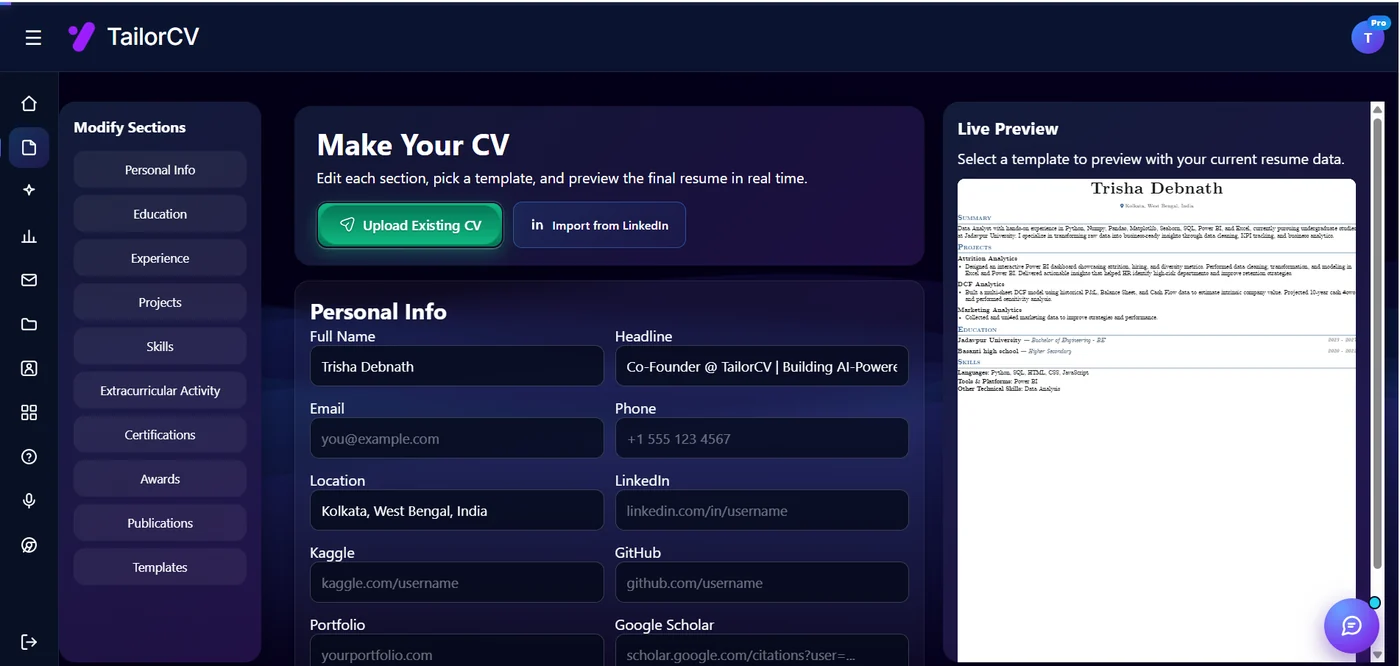
You can start from an existing CV or import from LinkedIn instead of retyping everything.
Personal Finance Tracker — Python, SQLite Built a web app that categorizes bank transactions and charts monthly spending. - Parsed 12 months of CSV data and auto-tagged 90% of transactions with a rules engine. - Deployed the app and wrote setup docs; used by 15 classmates.
That reads like real engineering work, because it is.
Turn Coursework and Clubs Into Bullets
- Coursement: "Completed a semester capstone analyzing 10K survey responses in R, presented findings to a faculty panel."
- Club: "As treasurer of a 40-member society, managed a $5K budget and cut event costs 20%."
Tailor It Every Time
A career starter's biggest advantage is effort. Most freshers send one identical resume everywhere. When you tailor your resume to each posting — matching the exact skills and keywords it lists — you jump ahead of the pile, and you pass the ATS scan that filters most generic resumes out.
A Full Example: From Blank to Strong
Here is what a genuinely strong no-experience resume looks like in outline, for a recent graduate applying to a junior data role.
Summary
Data-curious economics graduate with three analytics projects in Python and SQL, including a dashboard used by a 40-member student society. Seeking a junior data analyst role where I can turn messy data into clear decisions.
Python (pandas, matplotlib) · SQL · Excel · Tableau · statistical analysis · data cleaning
Student Society Membership Dashboard — Python, Tableau - Cleaned and merged three years of membership CSVs (1,200+ records) into a single source of truth. - Built a Tableau dashboard tracking retention and event attendance, adopted by the committee for planning.
Local Rent Price Analysis — Python, pandas - Scraped and analyzed 800 rental listings to identify price drivers by neighborhood. - Presented findings in a written report and a 10-minute talk to a class of 60.
Education
B.A. Economics, [University], 2026 — Relevant coursework: Econometrics, Statistics, Data Structures.
Barista, [Café] (2024 – 2025) — Handled 100+ transactions per shift; trained two new hires.
Notice there is not a single "professional" data job on it, yet it reads as a capable candidate. The projects carry the weight, the skills mirror the posting, and even the café job proves reliability and training ability.
Turn a Part-Time Job Into Real Bullets
Retail, food service, tutoring, and campus jobs all teach transferable skills — you just have to frame them as outcomes rather than duties.
- Not: "Worked at a retail store."
-
Yes: "Handled 100+ customer transactions per shift and resolved complaints calmly, earning employee-of-the-month twice."
-
Not: "Tutored students."
- Yes: "Tutored 12 students in calculus; 9 improved by at least one letter grade over the semester."
The trait the employer cares about — reliability, communication, problem-solving — is proven by the specific result, not asserted by the job title.
Mistakes That Sink a Fresher Resume
- Listing coursework with no outcome. "Took a database course" is weak; "Built a normalized SQL database as a course project" is strong.
- A wall of soft skills. "Hardworking, motivated, team player" proves nothing. Show these traits in your project and job bullets instead.
- Going over one page. With little history, a second page signals padding. Keep it tight.
- A generic objective. "Seeking a challenging role to grow my skills" says nothing. Use a specific summary instead.
- Sending the same resume everywhere. The one thing you fully control is effort. Tailoring beats a fancier template every time.
Where to Find "Experience" You Already Have
If your projects section feels thin, you likely have more material than you realize:
- Course capstones and group projects — treat the best one like a job.
| What | Details |
|---|---|
| Hackathons or competitions | even an unfinished entry shows initiative |
| Volunteering | a nonprofit you helped, an event you organized |
| Clubs and societies | any role with responsibility (treasurer, organizer, lead) |
| Freelance or gig work | a logo you designed, a site you built for a friend's business |
| Self-directed builds | an app, a bot, a dataset analysis you did for fun |
Any of these, described with a result, becomes a legitimate entry. Do one small new project this month if you truly have nothing — a weekend build gives you a bullet no template can fake.
The Mindset Shift That Changes Everything
The phrase "no experience" quietly frames you as lacking something, and that framing leaks into weak resumes full of apology and filler. Reframe it. Employers hiring for entry-level roles are not expecting a long history — they are betting on trajectory: can this person learn fast, do they take initiative, will they figure things out? Every choice on your resume should answer those questions. A described project answers "can they build?" A club leadership role answers "do they take initiative?" A self-taught skill answers "do they learn independently?" Once you see the resume as evidence of trajectory rather than a record of jobs you have not had, it becomes obvious what to include and how to frame it.
Formatting a No-Experience Resume
Structure signals professionalism even when your history is thin. Keep it clean and standard:
- One page. With limited history, a second page reads as padding. A tight, full one page reads as confident.
- Standard, single-column layout that an ATS can parse — no graphics, columns, or text boxes.
- Clear section order: contact and summary, skills, projects, education, then any experience.
- Consistent formatting — one font, one date style, aligned bullets. Sloppiness is one of the few things that actively hurts an early-career resume.
- A real email address and a link to your work — GitHub, portfolio, or LinkedIn.
The goal is a resume that looks like it belongs to someone who takes the process seriously, because that impression is part of what you are selling.
From First Draft to Ready: A Checklist
Before you send a no-experience resume, run it through these checks:
- unchecked: Does every project and job bullet describe a result, not just a duty?
- unchecked: Do your skills mirror the posting's exact terms?
- unchecked: Is there at least one concrete, ownable thing you built or led?
- unchecked: Have you cut every generic soft-skill claim in favor of showing it in a bullet?
- unchecked: Is it one clean page that parses cleanly?
- unchecked: Have you tailored it to this specific role, not sent the same file everywhere?
If you are starting from a blank page, the resume builder gives you an ATS-friendly structure to fill in, and a quick ATS score against the posting shows whether the keywords it wants are actually present before you apply. For a career starter, that final check is the difference between disappearing into the pile and landing the first interview.
Frequently Asked Questions
Should I use an objective statement?
Use a short summary, not a dated "objective." One line: "Computer science graduate seeking a backend role, with project experience in Python and PostgreSQL."
How long should a no-experience resume be?
One page. You do not have enough history to justify two, and a tight page reads as confident.
Do I need a cover letter with no experience?
Yes — it is where you turn potential into a story. See our guide on writing a cover letter with no experience below.
What if I have no projects either?
Then build one this month. A single weekend project — an app, a data analysis, a small website — gives you a concrete, ownable bullet that beats any amount of "eager to learn." It is the fastest way to go from empty to credible.
Should I include my GPA?
Include it if it is strong (roughly 3.3+ / first-class) or if the posting asks. If it is lower, leave it off and let your projects and skills carry the resume.
How do I handle the "years of experience" requirement on postings?
Apply anyway if you meet most of the other criteria. "Years required" is often a wish list, not a filter, especially for junior roles. A tailored resume and a strong project section can outweigh the exact number.
Is a skills-based (functional) layout better when I have no experience?
No — use a standard layout that leads with skills and projects but keeps a clear, dated structure. Pure functional resumes confuse the ATS and worry recruiters. Projects-first-but-still-chronological is the sweet spot.
Should I include hobbies and interests?
Only if they are genuinely relevant or reveal a transferable skill — a coding hobby for a tech role, a competitive sport that shows discipline. A generic list of hobbies wastes space that a project or skill would use better.
How do I make my resume stand out without experience?
Specificity and tailoring. A described project with a real result, skills that mirror the exact posting, and a resume clearly customized to the role beat a generic template every time. Effort is the one advantage you fully control, and it shows.
Handling the Experience Section When It's Nearly Empty
Even with little formal work history, an experience section should rarely be blank — the trick is knowing what legitimately belongs there. Part-time and summer jobs count, and should be framed around transferable results rather than duties. Internships, however short, count. Significant volunteering counts, especially if you held a role with responsibility. Paid freelance or gig work counts, even a one-off logo or a website you built for a friend's business. If you genuinely have none of these, promote your projects and coursework to carry the resume, and consider taking on one small real thing this month — a volunteer stint, a freelance micro-project, an open-source contribution — that gives you a single honest line. The goal is not to inflate; it is to recognize that "experience" is broader than "full-time jobs," and to present the real experience you have in professional terms.
Beating the Confidence Problem
Many career starters undersell themselves out of a belief that they have nothing worth listing, and that belief quietly produces a weak, apologetic resume. The fix is partly practical and partly mindset. Practically, walk through every course, project, job, and activity and extract the concrete thing you did and the result — you will almost always find more than you expected. In terms of mindset, remember what entry-level employers are actually buying: not a long track record, but evidence of trajectory, initiative, and the ability to learn fast. A candidate who describes a class project with the same specificity and pride as a professional would describe a work project reads as someone ready for the real thing. Confidence on the page is not arrogance; it is simply presenting your genuine work as though it matters — because to the employer deciding whether to bet on you, it does.
Putting It All Together
"No experience" is a framing problem, not a dead end. Lead with skills, treat your best projects like jobs, turn part-time work into outcome-focused bullets, keep it to one tailored page, and back it with a cover letter that tells your story. Do that and you stop competing as "the candidate with no experience" and start competing as "the candidate who clearly builds things" — which is exactly who gets the first interview.
Find out where a fresher resume stands
Score yours against a real posting - no account, no cost.
Drop your resume here or choose a file
PDF only. Max 2 MB.
We never share your data or use it to train AI models.

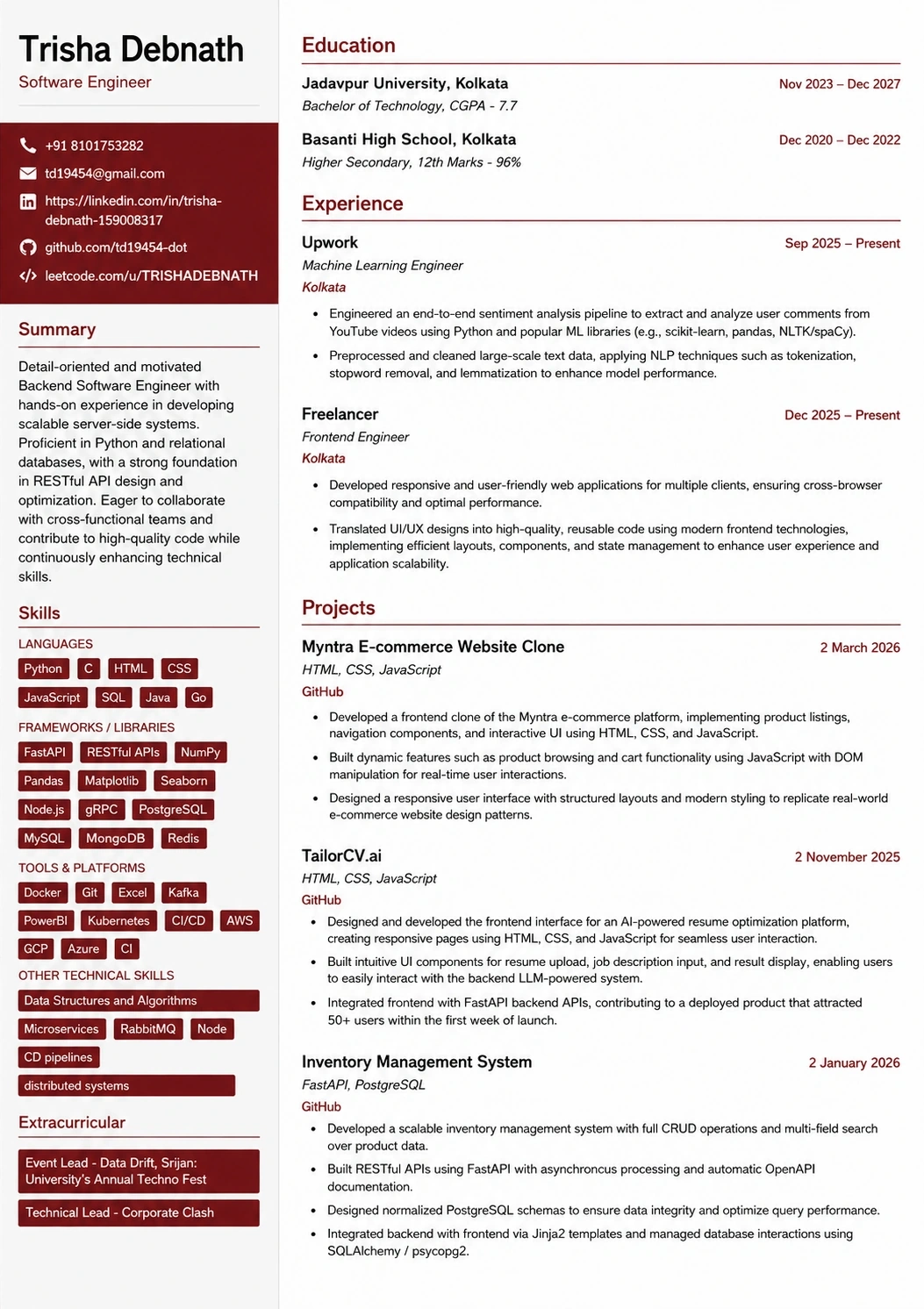
A layout that works with a short history
Leads with skills and projects instead of years of experience you do not have yet.
Was this guide useful?
Be the first to rate it.