 SS
SS
Key Takeaways
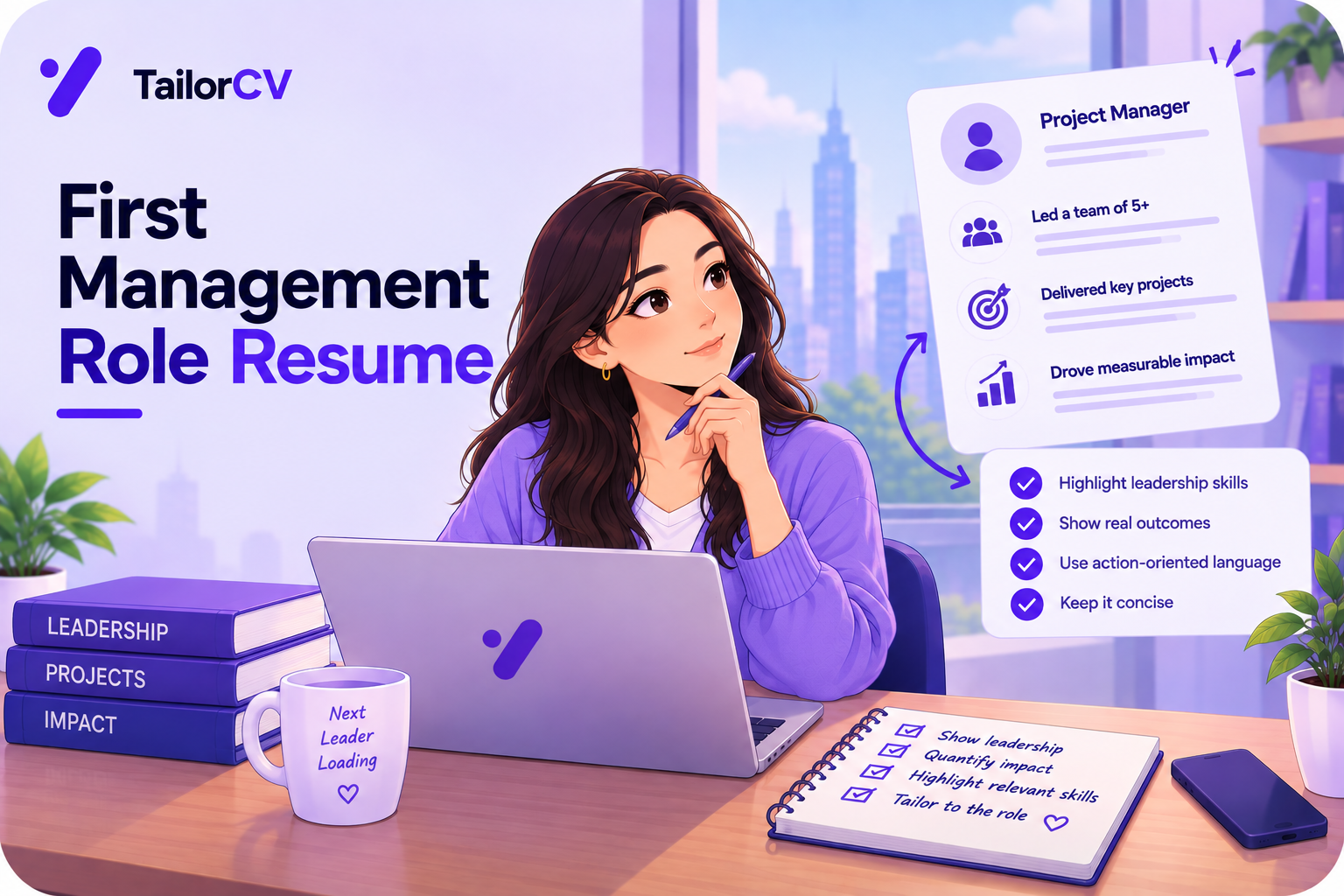
- Hiring managers for first-time managers look for leadership evidence without the title: mentoring, hiring, leading projects, running team processes, and handling conflict.
- Rebalance your resume. Your technical or functional strength stays, but leadership bullets move to the top of your recent roles.
- Show outcomes for people, not just products: someone you mentored who got promoted, a hiring loop you ran, onboarding you improved.
- Describe influence without authority - coordinating across teams, driving decisions, unblocking others. It is the closest thing to management most ICs have done.
- Your summary should name both: the craft you are known for and the leadership you already do.
- Do not relabel yourself as a manager. Describe what you led accurately; a strong IC-with-leadership profile is exactly what first-time manager roles hire.
You are a senior individual contributor - engineer, analyst, designer, marketer, nurse, salesperson - and you want your first management role. Your title has never said "Manager", but you have probably been doing parts of the job for a while: mentoring, running projects, interviewing candidates, leading team rituals. Your resume's job is to make that leadership visible without overstating it, while keeping the craft credibility that makes you a believable leader of people who do that craft.
This guide shows where to find leadership evidence, how to rebalance your resume, and how to tailor it for first-time manager postings.
What Hiring Managers Look For in a First-Time Manager
When a company hires someone into their first management role, they know the candidate has not formally managed. They look for signals that predict it will go well.
| Signal | What it looks like on a resume |
|---|---|
| Develops people | Mentored juniors; mentees promoted or ramped quickly |
| Hires well | Ran interviews, designed hiring exercises, helped build a team |
| Leads delivery | Led projects or workstreams with several contributors |
| Runs team processes | Owned planning, retros, on-call, reviews, standards |
| Influences without authority | Aligned other teams, drove decisions, resolved disagreements |
| Handles difficulty | Managed a conflict, a missed deadline, an underperformer |
| Stays credible in the craft | Still recognised as strong in the underlying work |
The last row matters. Teams want a manager who understands their work. That is why your IC strength stays on the page.
Step 1: Find Your Leadership Evidence
Most senior ICs underestimate how much leadership they already do. Go through the last two or three years and answer these questions.
Questions to surface leadership work
- Who have you mentored, formally or informally? What happened to them?
- Have you interviewed candidates or designed any part of a hiring process?
- Which projects did you lead, and how many people worked on them?
- Which team processes do you run - planning, reviews, standups, on-call rotations, documentation?
- When did you get two teams to agree on something?
- Have you covered for your manager, run the team while they were away, or handled a people issue?
- Have you onboarded new joiners or written onboarding material?
Sorting what you find
| Evidence type | Example bullet |
|---|---|
| Mentoring | "Mentored 3 junior analysts; two promoted within 18 months." |
| Hiring | "Interviewed 40+ candidates and redesigned the take-home exercise; offer-acceptance rate rose from 55% to 75%." |
| Project leadership | "Led a 5-person team through a CRM migration, delivered two weeks early." |
| Team process | "Introduced fortnightly planning and retros for a 7-person team; missed commitments fell by half." |
| Cross-team influence | "Aligned sales, finance and product on a new discount policy after 3 months of stalled debate." |
| Stepping up | "Ran the team for 6 weeks during my manager's leave - weekly 1:1s, sprint planning, stakeholder updates." |
The approach to showing your part in shared work is covered in team vs individual credit.
Step 2: Rebalance Your Recent Roles
For a management application, leadership bullets should lead. Your craft bullets follow.
Before and after: a senior engineer
Before (IC-focused): - "Designed and built the event-streaming platform in Kafka, handling 30M events a day." - "Reduced API latency by 40% through caching and query optimisation." - "Mentored junior engineers."
After (management-focused): - "Led a 5-engineer team to design and ship the event-streaming platform (Kafka, 30M events a day) - set the technical direction, split the work and ran weekly reviews." - "Mentored 3 junior engineers through structured weekly sessions; all three now own services independently, and one was promoted." - "Interviewed 30+ backend candidates and helped hire 4 engineers onto the team." - "Reduced API latency 40% through caching and query optimisation."
The same achievements are there, but the leadership is now first and specific. "Mentored junior engineers" became a bullet with an outcome.
Keep one or two strong craft bullets
Do not remove your technical or functional achievements entirely. A first-time manager's credibility with the team depends on them. One or two strong craft bullets per role is the right balance.
Step 3: Show People Outcomes
Management is judged on what happens to people and teams. Wherever you can, attach outcomes to your leadership.
| Weak (activity) | Strong (outcome) |
|---|---|
| "Mentored new joiners" | "Onboarded 5 new joiners; average time to first independent release fell from 8 weeks to 5" |
| "Conducted interviews" | "Helped hire 4 of the team's 7 engineers; all still on the team after 18 months" |
| "Ran team meetings" | "Introduced retros that led to 3 process changes, including a review checklist that cut rework" |
| "Led a project" | "Led 4 people to deliver the migration on time with no customer-facing incidents" |
For numbers you only know roughly, estimating impact honestly shows how to phrase them defensibly.
Step 4: Rewrite the Summary
The summary should name your craft, your leadership, and what you want next.
IC summary: "Senior data analyst with 6 years in SQL, Python and experimentation for consumer apps."
First-manager summary: "Senior data analyst who leads a 3-person analytics pod for the growth team - setting priorities, mentoring two analysts and running our experimentation review - with 6 years in SQL, Python and experimentation. Looking to lead an analytics team full time."
Stating the goal ("looking to lead a team") is fine and helps the reader understand why a senior IC is applying. For summary structure, see summary in three sentences.
Step 5: Handle the Title Honestly
Do not relabel yourself as a manager
Changing "Senior Engineer" to "Engineering Lead" or "Manager" when that was not your title is a verifiable misstatement. Reference checks will catch it, and it undermines the honest leadership evidence you have.
Clarifiers are fine where accurate
If you were formally a "tech lead" or "team lead" in practice but your title stayed "Senior Engineer", a clarifier is acceptable: "Senior Engineer (tech lead for a 5-person team)". Only use it if your manager would agree. Fixing a non-standard job title covers the format.
Worked Example 1: A Senior Analyst Applying for Analytics Manager
Situation: Ritu has six years as a data analyst and wants an analytics manager role. She mentors two analysts and runs the team's weekly experiment review.
Top bullets after rewrite: - "Lead a 3-person analytics pod for the growth team - prioritise requests from 4 product managers and review all analysis before it goes to leadership." - "Mentored 2 analysts from junior to independent; both now run experiment readouts alone." - "Built and run the weekly experiment review, which vets about 8 tests a month before launch." - "Designed the attribution model the marketing team uses to allocate a ₹15 crore annual budget."
Her summary names the pod and her goal. She applies to analytics manager roles for teams of three to six - the natural first step.
Worked Example 2: A Senior Nurse Moving to Nurse Manager
Situation: Joseph is a senior staff nurse applying for a ward nurse manager role.
- "Charge nurse for a 28-bed medical ward on alternate shifts - allocate patients across 6-8 nurses and handle escalations."
- "Precepted 9 newly qualified nurses through their first 3 months; all passed competency sign-off on schedule."
- "Led the ward's switch to electronic handover, training 30 staff; handover time per shift fell by about 15 minutes."
Charge-nurse shifts, precepting and leading a change are exactly the leadership evidence a nurse manager panel looks for. For healthcare-specific tailoring, see resume tailoring for healthcare.
Worked Example 3: A Top Salesperson Applying for Sales Manager
Situation: Aditi is a top-performing account executive who wants her first sales manager role. Her resume is all quota numbers.
Before: "Achieved 138% of quota in FY25; President's Club."
After (added above her quota bullet): - "Informal lead for 4 new account executives - ran weekly deal reviews and role-play sessions; their average time to first closed deal fell from 5 months to 3." - "Built the team's discovery-call playbook, now used in onboarding for all new AEs." - "Achieved 138% of quota in FY25; President's Club."
Her quota achievement stays - it gives her credibility with the team - but leadership now comes first.
Worked Example 4: A Teacher Applying for Head of Department
Situation: Arjun has taught physics for eight years and wants his first head of department role. He has never had a formal leadership title.
Leadership evidence he found:
- Coordinates the physics curriculum for Classes 9-12 across four teachers.
- Mentored two newly qualified teachers through their first year.
- Set up the school's science olympiad programme, which grew from 12 to 70 students.
- Covered as acting head of department for a term.
Before (top bullet): "Taught physics to Classes 9-12, achieving strong board results."
After (top bullets): - "Coordinate the physics curriculum for Classes 9-12 across a team of 4 teachers, including shared assessments and lesson plans." - "Acting head of department for one term (2025) - timetabling, staff observations and parent escalations for a 7-person science team." - "Mentored 2 newly qualified teachers through their first year; both passed probation with strong observation scores." - "Class 12 physics board average rose from 72% to 81% over three years."
His teaching results stay as the credibility bullet, but the leadership evidence now leads. For school-to-school moves more broadly, see what to tailor when everything is already relevant.
Management Keywords Without Overclaiming
Management postings use a recognisable vocabulary: people management, performance reviews, hiring, coaching, team planning, stakeholder management, roadmap ownership. Some of these you can claim honestly; others you should show indirectly.
Place the terms you can back up inside bullets
"Coaching", "hiring", "onboarding" and "team planning" belong in the leadership bullets that prove them, not only in a skills list. Where to place keywords on a resume explains why context carries more weight, and soft skills nobody can verify explains why a listed "leadership" skill does little on its own.
Leave formal-authority terms out if you did not hold them
"Performance reviews", "compensation decisions" and "headcount planning" imply formal authority. If you contributed - wrote peer feedback, gave input on a hire - describe that contribution precisely rather than claiming the term.
The Internal Route Is Often Easier
Your own company already knows your leadership. Many first-time managers are promoted internally before they ever apply externally, and an internal application needs a slightly different resume - one that assumes the reader knows your work and focuses on readiness. Resume for an internal promotion and internal job application resume cover that version. If you apply externally without formal management experience, treat it as a reasonable stretch; tailoring for a stretch role covers how to present the gap.
First Management Roles at Different Levels
| Starting point | Typical first management role | What to emphasise |
|---|---|---|
| Senior IC, 5-8 years | Team lead / manager of 3-6 | Mentoring, project leadership, hiring involvement |
| Staff / principal IC, 8+ years | Manager of a larger team or managers-in-training | Technical direction, cross-team influence, org-level processes |
| Specialist in a small company | Head of a new function | Building from scratch, hiring, strategy |
| Clinical or frontline expert | Supervisor / charge / ward manager | Shift leadership, training, operational improvement |
Aim for the first rung that matches your evidence. A senior IC with mentoring experience is a strong candidate for managing a small team; managing managers usually needs more.
Edge Cases and Exceptions
You managed people in a previous career
If you managed a team in a different field or earlier job, it counts. Present it clearly, even if your current role is individual.
Your leadership is all informal
Informal leadership - the go-to person, the unofficial reviewer - is common. Describe it concretely with outcomes; avoid titles you did not hold.
The posting wants "3+ years managing people"
That is a real requirement for many roles. If you have none, target team lead or first-line manager roles that accept strong IC leadership evidence instead.
You led a volunteer team
Leading volunteers - a society committee, a community project, a nonprofit team - is genuine people leadership, often harder than managing paid staff. Include it with scale and results.
Common Mistakes
Leading with craft only
A resume that reads as a strong IC will be read as a strong IC. For management roles, leadership bullets go first.
Vague leadership claims
"Strong leadership skills" and "mentored juniors" say little. Name the people, the processes and the outcomes.
Overstating authority
"Managed a team of 5" when you led a project with five contributors is a misstatement. Say "led a 5-person project team". Tailoring without lying covers why this matters.
Deleting craft achievements
Teams want a manager who understands their work. Keep your strongest technical or functional results.
Not explaining the move
A senior IC applying for management without saying why can confuse readers. One line in the summary solves it.
What Interviews for First-Time Managers Test
Expect behavioural questions about leading people. Prepare stories for each leadership bullet.
| Likely question | Resume evidence it draws on |
|---|---|
| "Tell me about someone you helped grow." | Mentoring bullet |
| "How have you handled a team member who was struggling?" | Mentoring, stepping-up experience |
| "Describe a disagreement you resolved between people or teams." | Cross-team influence bullet |
| "How would you balance hands-on work with managing?" | Your craft bullets plus leadership |
| "Why management, and why now?" | Your summary's stated goal |
The manager interview round guide covers these rounds in detail, the interview story bank method keeps your stories organised, and the mock interview tool can practise them from your resume.
How This Fits With Tailoring
The rebalance is a new base for management applications. Then tailor each posting normally:
- Read the posting's team size and priorities (hiring, delivery, process, technical depth).
- Lead with the leadership evidence that matches.
- Keep one or two craft bullets that match the team's domain.
- Rewrite the summary's goal line for the specific team.
If you apply to both IC and management roles, keep two bases - see splitting resume versions. The free ATS scan shows whether your management version covers the posting's leadership terms, in about a minute, and the AI resume optimizer can reframe bullets toward management without inventing authority you did not have.
Quick Checklist
- Have you listed every example of mentoring, hiring, project leadership and team processes?
- Do leadership bullets lead each recent role?
- Do they show outcomes for people and teams, not just activities?
- Are one or two strong craft bullets still there for credibility?
- Does your summary name your craft, your leadership and your goal?
- Are titles accurate, with clarifiers only where your manager would agree?
- Do you have a story ready for each leadership bullet?
Frequently Asked Questions
How do I get my first management role with no management experience?
Show the leadership you already do - mentoring, hiring, leading projects, running team processes, and influencing across teams - with specific outcomes. Put these bullets first and state your goal of leading a team in your summary.
How do I show leadership on my resume without a manager title?
Describe what you led and its results: mentees promoted, projects delivered with several contributors, processes you introduced, hiring you helped with. Be specific about team size and your role.
Should I call myself a team lead on my resume?
Only if that was your role in practice and your manager would agree. A clarifier like "Senior Engineer (tech lead for a 5-person team)" is fine; changing your official title is not.
Should I keep technical achievements on a management resume?
Yes. Keep one or two strong craft achievements per role. They show you understand the work your future team does, which is important for first-time managers.
What if my only leadership experience is mentoring?
Mentoring is valuable evidence, especially with outcomes. Add any project coordination, onboarding or process work you have done. If your evidence is thin, consider taking on a lead role before applying widely.
How big a team should I apply to lead first?
Most first-time managers start with teams of three to six. Aim for roles that match your leadership evidence rather than jumping to managing managers.
Should I explain why I want to move into management?
Yes, briefly - usually one line in your summary. It helps readers understand why a senior IC is applying and sets up a strong interview answer.
Do I need a management course or certification?
It is not required. Real leadership evidence matters far more. A course can help if it fills a specific gap, but list it as supporting evidence, not a substitute.
How do I answer "Why do you want to be a manager?"
Talk about what you enjoy in the leadership you already do - helping people grow, improving how the team works - with an example. Avoid reasons that are only about title or pay.
Can I become a manager without being the best performer on my team?
Yes. Management depends on developing others, communication and judgement. Strong but not top-performing ICs often make excellent managers if they show those skills.
What to Do Now
Answer the seven leadership questions above and write down every example you find, with the people and outcomes involved. Rewrite the top of each recent role so leadership leads and one or two craft bullets follow.
Rewrite your summary to name your craft, your leadership and your goal. Next, read moving back from management to IC for the reverse move, and two years in and applying for a mid-level role for the earlier step in showing ownership.
What is your resume scoring right now?
Scan it against a job description and get your ATS match score in about a minute.
Drop your resume here or choose a file
PDF only. Max 2 MB.
We never share your data or use it to train AI models.

Templates that keep this structure intact
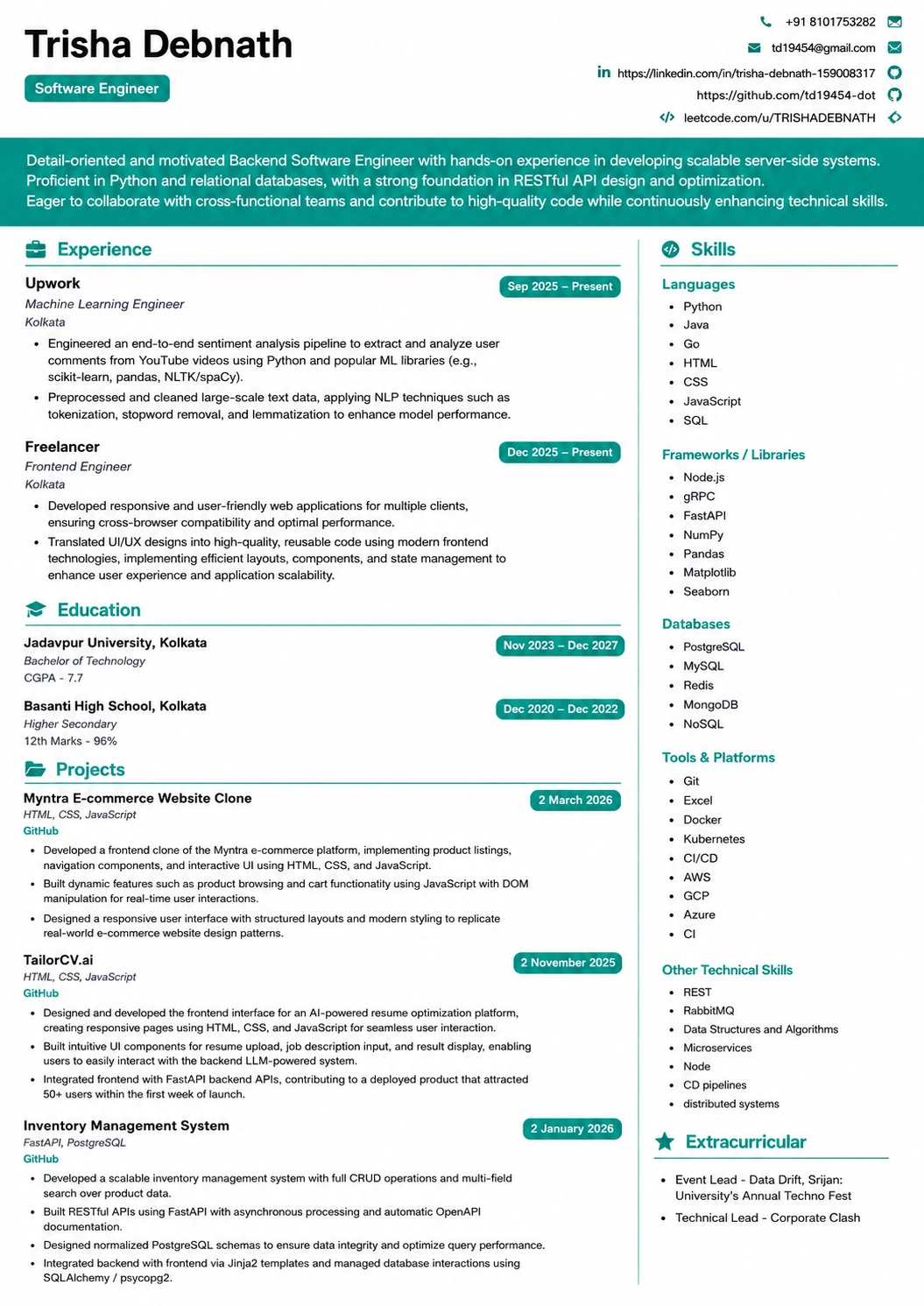
This template is ATS-tested — start from it and the formatting rules in this guide are already handled.
Was this guide useful?
Be the first to rate it.