 SS
SS

Key Takeaways
- "AI-proof" jobs are largely a myth; most roles will be affected by AI in some capacity.
- "AI-resistant" jobs require human judgment, accountability, and physical presence, making them harder to automate.
- "AI-augmented" jobs involve AI handling routine tasks, allowing humans to focus on oversight and complex decision-making.
- Key factors that make jobs resistant to automation include high-stakes judgment calls, physical dexterity in unpredictable environments, and deep interpersonal trust.
- Understanding the underlying skills needed for resilience against AI is more important than memorizing specific job titles.
Every few months another headline claims a language model is about to replace your job, and most people have learned to tune out the panic without ever answering the actual question underneath it: is your specific role exposed, and if so, what should you do about it? The honest answer has less to do with your job title than with what your work actually requires day to day - judgment, physical presence, trust, and accountability are far harder to automate than repetitive pattern-matching on existing data. This is a different question from which jobs survive a recession, which is about budget cuts, not automation - a role can be completely safe from layoffs during a downturn and still be quietly reshaped by AI tools over the same period. Before going further, see exactly how your resume reads today with the free ATS score checker, because the positioning advice below only helps if you're honest about where you're starting from.
"AI-Proof" vs. "AI-Resistant" - Why the Framing Matters
"AI-proof" is a marketing phrase more than a real category. Almost no job is completely untouched by AI tools at this point - even surgeons use AI-assisted imaging, even electricians use AI-generated diagnostics, even skilled trades increasingly quote and schedule jobs through automated systems. Claiming any job is fully immune sets you up for a false sense of security.
"AI-resistant" and "AI-augmented" are more accurate and more useful framings:
- AI-resistant describes work where the core value - judgment, trust, physical presence, accountability - is structurally hard for a model to replicate, even as AI tools chip away at the supporting tasks around it.
- AI-augmented describes work that is changing shape because AI now handles the mechanical parts, freeing (or forcing) the human to focus on oversight, judgment calls, and exception handling.
Most durable careers are actually both at once: a nurse's core clinical judgment and physical care are AI-resistant, while the charting, scheduling, and triage-support tasks around that job are increasingly AI-augmented. The practical skill worth building isn't "find a job AI can never touch" - it's "become someone who works alongside AI tools well enough that you're doing the parts of the job only a human can do." That reframing matters more than any specific list of job titles, because job titles change faster than the underlying skill does.
What Actually Makes a Job Harder to Automate
Rather than memorizing a list of "safe" titles, it helps to understand the pattern so you can evaluate any role yourself - including roles that don't exist yet. Five factors tend to make work resistant to automation:
- High-stakes judgment calls. Decisions with legal, medical, financial, or safety consequences where someone has to be accountable for the call, not just the recommendation. An algorithm can suggest a diagnosis; a licensed physician has to own the decision and its consequences.
- Physical dexterity in unpredictable environments. A robot arm can weld the same joint on an assembly line ten thousand times. It struggles far more with a 40-year-old house that was never built to spec, a patient who won't hold still, or a repair job where the actual problem isn't what the work order said.
- Deep interpersonal trust. Therapy, caregiving, high-touch sales, negotiation, and leadership all depend on a human believing another human understands their situation and has their interests in mind. Trust built this way doesn't transfer to a chat interface, no matter how fluent it sounds.
- Regulatory or legal accountability that requires a human signature. Certain sign-offs - a licensed engineer approving a structural design, a CPA certifying financial statements, an attorney filing a legal brief - exist specifically because the law requires a accountable, licensed human, not just a correct answer.
- Genuinely novel, ambiguous problem-solving. AI tools are extremely good at pattern-matching against things that already exist in their training data. They are far weaker at situations with no real precedent - a brand-new competitive threat, a first-of-its-kind product decision, a crisis with no playbook.
A role rarely needs all five to be resistant - two or three is usually enough. The more a job leans entirely on none of them (repetitive, well-documented, pattern-based, low-stakes-if-wrong), the more exposed it is, regardless of how technical or well-paid it currently is.
Careers With Real AI Resistance (and the Honest Caveats)
These categories hold up well against the framework above, but none of them is uniformly safe - the caveats matter as much as the headline.
Skilled trades and hands-on technical work. Electricians, plumbers, HVAC technicians, and equipment repair roles combine physical dexterity in unpredictable environments with judgment calls that vary job to job. AI tools increasingly help with diagnostics and quoting, but someone still has to be in the crawl space. Adjacent, more design-heavy engineering roles that involve real-world constraints and sign-offs hold up similarly - see the civil engineer resume guide, mechanical engineer resume guide, and electrical engineer resume guide. The caveat: highly standardized, indoor, repeatable manufacturing tasks within trades are more automatable than field service work, so "trade job" isn't automatically synonymous with "safe."
Healthcare and caregiving roles. Nurses, physiotherapists, and pharmacists combine physical care, trust, and judgment in ways that are extremely hard to replicate. See the nursing resume guide, the healthcare and nurse portfolio guide, the physiotherapist resume guide, and the pharmacist resume guide. The caveat: administrative and documentation-heavy parts of these jobs are already being automated aggressively, which is changing the day-to-day shape of the role even where the core clinical work stays human.
Roles requiring regulatory or legal accountability. Financial audit, compliance, and certain engineering sign-offs exist because a licensed human has to be legally answerable for the outcome. See the accountant resume guide and financial analyst resume guide. The caveat: the analysis work that supports these sign-offs - pulling numbers, building models, drafting first-pass reports - is exactly the kind of pattern-based task AI tools are already good at, so the entry-level version of these jobs is changing faster than the senior, sign-off-holding version.
Creative direction and taste-driven work, as distinct from pure execution. Deciding what a brand should feel like, what a campaign should say, or how a product should be positioned requires taste, context, and judgment about a specific audience - something AI can imitate but not originate with real conviction. See the graphic designer resume guide and UX designer resume guide. The caveat, and it's a significant one: execution-only creative tasks - generating a first-draft logo concept, a stock illustration, a routine layout - are now genuinely exposed. Creative professionals whose value is purely output volume are far more at risk than those whose value is direction, taste, and client trust.
Complex relationship-based sales and account management. Selling a five-figure enterprise contract or managing a strategic account involves negotiation, trust-building, and reading a room in ways transactional, catalog-style selling does not. See the sales executive resume guide. The caveat: high-volume, low-touch, script-driven sales (inbound SDR-style qualifying calls, basic order-taking) is already heavily AI-assisted and shrinking as a distinct headcount category.
People management and organizational leadership. Coordinating humans - resolving conflict, setting direction under ambiguity, making judgment calls about who's ready for what - doesn't reduce to a dataset. See the project manager resume guide. The caveat: management built purely around status reporting and task tracking (the mechanical parts of the job) is being absorbed by AI-assisted tools quickly, which is part of why management layers themselves are being flattened at some companies even while the truly people-facing parts of leadership remain valuable.
Cybersecurity deserves its own mention: adversarial, constantly evolving threats need human strategists thinking about what an attacker will try next, not just automated pattern detection on known threats. See the cybersecurity engineer resume guide. And AI-adjacent roles themselves - the people who build, evaluate, and govern these systems - are growing precisely because someone has to do that work. See the resume for AI engineer guide, the prompt engineer resume guide, and the machine learning engineer resume guide.
The Roles Being Reshaped Fastest Right Now
Some categories of work are changing quickly, and pretending otherwise doesn't help anyone. Being clear-eyed about this is more useful than either panic or denial.
- Entry-level coding and routine software tasks. AI coding tools have gotten genuinely good at generating boilerplate, writing first-pass functions, and fixing well-specified bugs. The junior developer role that used to consist mostly of these tasks is shrinking in scope, even as demand for senior engineers who can architect systems and review AI-generated code stays strong.
- First-draft content writing. Producing a first pass of routine, low-stakes copy - product descriptions, basic blog posts, templated emails - is now something AI tools do quickly and cheaply. Writers whose entire value proposition was fast first drafts are more exposed than writers who bring original reporting, a distinct voice, or subject-matter expertise. See the content writer resume guide for how to reposition around the parts of the craft that still require a human.
- Basic data entry and routine transcription. This category was already shrinking before generative AI arrived, and AI tools have accelerated the trend. There's very little defensible ground left here.
- Junior-level data analysis. Pulling standard reports, running routine queries, and producing first-pass dashboards is increasingly automatable. The analysts who remain valuable are the ones who can interpret ambiguous results, ask the right question in the first place, and explain what a number actually means to a skeptical stakeholder. See the data analyst resume guide for how to frame analytical work around judgment rather than just output.
None of this means "avoid tech" or "avoid writing" or "avoid analysis" as fields - it means recognizing that the pure-execution layer of almost every knowledge-work field is under real pressure, while the judgment-and-oversight layer above it is not. The practical move is to deliberately climb toward that layer rather than staying in the execution layer and hoping it holds. If you're early in your career and worried this rules out entire fields, it doesn't - see how to get your first tech job and fresher resume projects that get interviews for how to build toward judgment-heavy work from day one rather than getting stuck doing only the automatable parts.
How to Future-Proof Your Resume and Skillset, Whatever Field You're In
Regardless of industry, three durable moves matter more than chasing a specific "safe" job title.
1. Demonstrate AI fluency, not AI avoidance. The goal isn't to prove you can work without AI tools - it's to prove you use them well. Employers increasingly expect candidates to already know how to use AI tools relevant to their field, the same way "proficient in Excel" became a baseline expectation two decades ago. List the specific tools you use confidently, and be ready to talk about how you verify their output rather than just accepting it. See skills to add to your resume in 2026 for a current list by field.
2. Pair technical skill with context and judgment AI doesn't have. AI tools are strong at execution within a known pattern and weak at knowing which pattern actually applies to your specific, messy, real-world situation. On your resume, that means foregrounding decisions and outcomes, not just tasks completed - "chose to escalate a vendor issue that would have cost the company $80K if left unresolved" reads completely differently than "monitored vendor performance." See how to quantify resume achievements for a full framework on making this concrete.
3. Treat adaptability itself as the durable skill. The specific tools will keep changing - what won't change is the value of someone who can pick up a new system, question its output, and integrate it into their work quickly. Employers can sense the difference between a resume that lists tools because they're trendy and one that shows a track record of actually adapting. Reflect this in your language, not just your skills list - see how to stop sounding generic on your resume for how to avoid buzzword-heavy phrasing that undercuts this.
It's worth applying the same standard to your own job search. Using AI tools to speed up drafting, research, or practice is smart; letting them replace your own judgment about what to say and why is not. See how AI resume matching actually works, AI resume tailoring without losing your voice, and a responsible AI job search workflow for how this plays out in practice.
A Quick Self-Assessment: How Exposed Is Your Specific Role?
Job titles are a poor unit of analysis - two people with the same title can have very different exposure depending on what they actually spend their time on. Ask yourself these questions about your real day-to-day work, not your title:
- If you wrote down every task you did last week, what fraction of it was pattern-matching against something that's happened before, versus judgment calls on something genuinely new or ambiguous?
- If you got something wrong, who is accountable for the consequences - you personally, or just "the system"? Roles with personal, named accountability tend to stay human longer.
- Does your work require you to be physically present in an unpredictable environment, or could it be done entirely through a screen with well-defined inputs and outputs?
- Do clients, patients, or colleagues specifically want you, based on trust built over time - or would they be equally satisfied by any competent provider of the same output?
- Is the value you provide mostly about speed and volume of output, or about the quality of the decisions behind that output?
If most of your answers land on the pattern-matching, low-accountability, screen-only, interchangeable, volume-driven side, that's not a reason to panic - it's useful information. It means the highest-leverage move is deliberately shifting your responsibilities, over time, toward the judgment and oversight side of your field, rather than assuming your current tasks will look the same in three years.
The Honest Caveat: Nobody Can Predict This With Certainty
Anyone who tells you they know exactly which jobs will exist in ten years is overstating their confidence, including sources that sound authoritative. AI capability has moved faster than most forecasts in some areas and slower than expected in others, and the gap between "AI can technically do this" and "companies have actually restructured jobs around it" has consistently been larger than headlines suggest.
A few things are worth holding onto without pretending they're guarantees:
- Resilience is relative, not absolute - the goal is reducing exposure and building adaptability, not finding a job that's permanently untouchable.
- The pattern (judgment, physical presence, trust, accountability, novel problem-solving) is more durable than any specific list of job titles, because the pattern lets you re-evaluate as things change instead of relying on a list that goes stale.
- The people who do best through periods of rapid change are rarely the ones who found the perfect safe job - they're the ones who kept building transferable skills and stayed genuinely willing to adapt what they do and how they do it.
If your current field feels shaky for reasons that have nothing to do with AI - budget cuts, hiring freezes, company-specific trouble - that's a related but different problem, and the recession-proof jobs guide covers that angle in more depth.
Make This Practical
Start by seeing exactly where your resume stands today with the free ATS score checker - you can't reposition around judgment and AI fluency if you don't know your current baseline. Update your skills section using skills to add to your resume in 2026, then use the resume templates library to format the update cleanly. If your work is visual or project-based, showcase judgment calls and decisions - not just deliverables - with the portfolio builder. Draft a cover letter that explains your positioning around judgment and AI fluency with the AI cover letter generator, and practice articulating this in your own words with the AI mock interview tool before you need it in a real interview.
FAQ
Will AI eventually replace every job?
Unlikely in any near-term, predictable way - most roles are being reshaped by AI rather than eliminated outright, and the timeline for deeper changes is genuinely uncertain. The more immediate risk for most people isn't total replacement, it's falling behind peers who learn to use AI tools well within their field.
Should I avoid tech jobs because of AI?
No - many tech roles, especially those focused on building, evaluating, or governing AI systems, are among the fastest-growing categories right now. See the resume for AI engineer guide and prompt engineer resume guide for how to position yourself in these roles specifically.
How do I show AI resistance on my resume?
Emphasize judgment-based outcomes, decisions you made under ambiguity, and stakeholder trust you built, rather than describing tasks in purely mechanical terms. Combine this with how to stop sounding generic on your resume so the judgment actually comes through instead of getting buried in vague language.
Is it safe to use AI tools in my own job search?
Yes, when you use them as an assistant rather than letting them replace your own judgment about what to say and why. See a responsible AI job search workflow for a practical approach that keeps you in control of the final output.
What's the difference between an AI-proof job and an AI-resistant one?
"AI-proof" implies total immunity, which is rarely accurate for any job today. "AI-resistant" is the more honest framing - it means the core value of the work is structurally hard to automate, even as the supporting tasks around it change.
Is creative work safe from AI, or is it one of the most exposed fields?
It depends heavily on which part of creative work you do. Creative direction, taste, and client trust hold up well, while execution-only tasks - generating routine drafts, stock-style visuals, or templated copy - are genuinely exposed. See the graphic designer resume guide for how to reposition around direction rather than pure output.
I'm in an entry-level or junior role that feels exposed. What should I actually do?
Focus on moving toward the judgment and oversight layer of your field rather than leaving it entirely - take on tasks that involve interpreting ambiguous results, making recommendations, or handling exceptions, not just executing routine requests. See fresher resume projects that get interviews for how to build a resume that reflects this even early in your career.
Does being AI-resistant mean I don't need to learn AI tools?
No - the opposite. Even the most AI-resistant roles are being reshaped by AI tools around their edges, and knowing how to use them well is quickly becoming a baseline expectation, not a differentiator. Being AI-resistant is about the core of your work being hard to fully automate, not about avoiding AI tools altogether.
Next Step
Check exactly how your resume reads today, including whether it reflects judgment-based, AI-resistant experience or reads as purely task-based, with the free ATS score checker.
What optimizing actually does to your resume
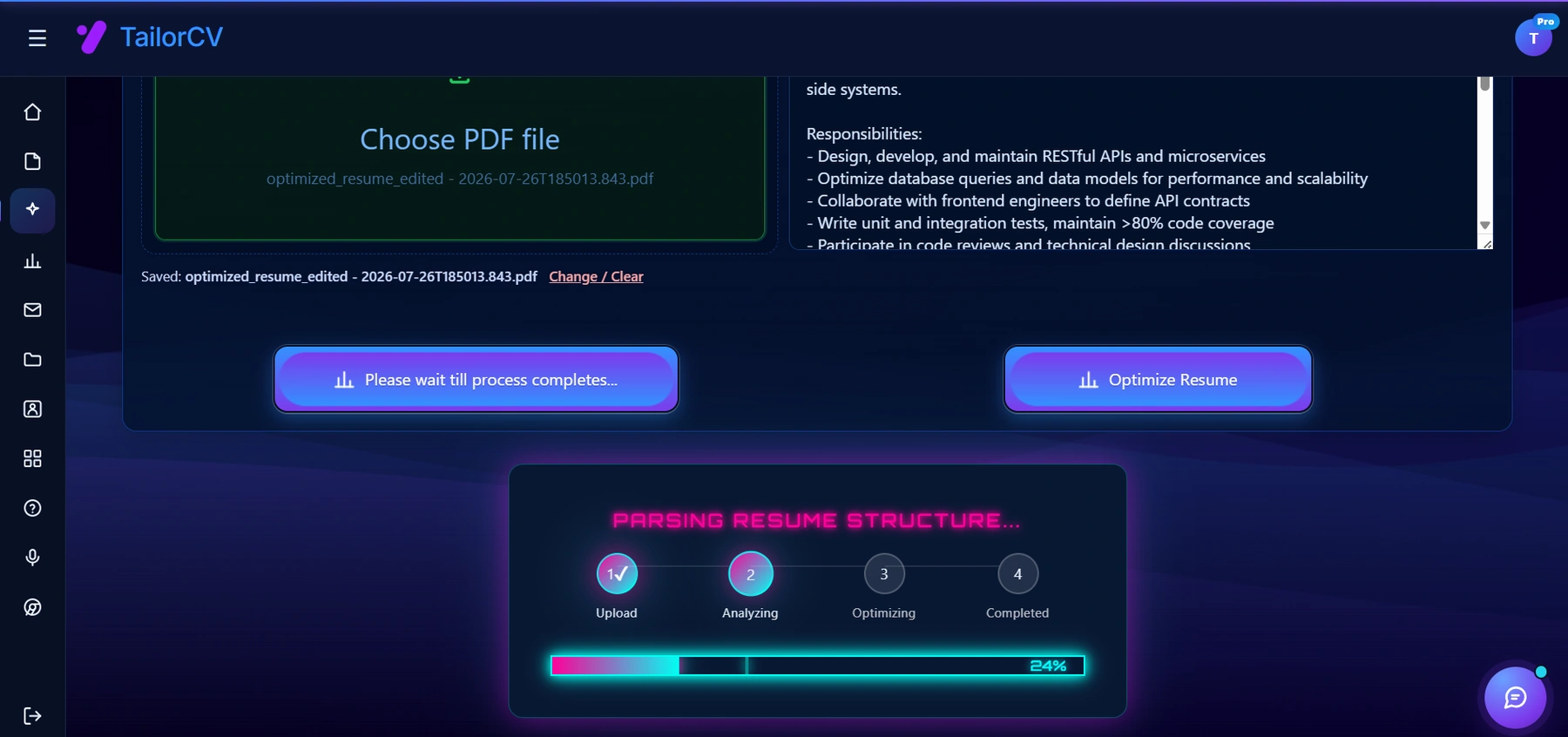
Optimising runs against the specific job description you paste in, not in the abstract.
What is your resume scoring right now?
Scan it against a job description and get your ATS match score in about a minute.
Drop your resume here or choose a file
PDF only. Max 2 MB.
We never share your data or use it to train AI models.

Was this guide useful?
Be the first to rate it.