 SS
SS

Key Takeaways
- Awards and achievements enhance a resume by providing independent validation of performance and making candidates more memorable.
- Place awards within the relevant Work Experience or Education sections, or create a dedicated "Awards & Achievements" section if you have multiple notable recognitions.
- Include high-value awards such as prestigious recognitions, competition wins, and significant academic honors, while using discretion for lower-value awards.
- Frame awards with context to highlight their significance, including what the award was for, its selectivity, and your contributions to earning it.
Awards and achievements can significantly strengthen a resume - but only when they are positioned correctly, framed in a way employers care about, and relevant to the role. Knowing where to put them, how to write them, and when a dedicated section helps versus hurts is the difference between impressive and cluttered.
Before adding achievements, run your resume through the TailorCV ATS checker to check your overall score, and start from an ATS-friendly template.
Why Awards Matter on a Resume
Awards and achievements serve a purpose that job duties alone cannot: they provide independent validation of your performance. When a third party (your company, a university, an industry association, a competition) recognizes you above your peers, it signals something that a self-reported bullet point cannot.
Used well, awards add:
- Credibility: External recognition validates your accomplishments
- Differentiation: Awards make you memorable in a competitive pool
- Specificity: Named awards are concrete evidence, not vague claims
Where to Put Awards on a Resume
You have three placement options:
Option 1: Inside the Work Experience or Education Section (Recommended First Choice)
If the award is tied to a specific role or educational institution, integrate it directly into that section as a bullet:
In Work Experience:
"Awarded Employee of the Quarter (Q3 2024) for leading a product launch that acquired 15,000 new users within 30 days"
"Recognized as Top Sales Performer (2023) - ranked #1 in North America region, closing $3.2M in new contracts"
In education:
"Dean's List - 4 consecutive semesters (GPA: 3.87/4.0)"
"Winner, National Coding Competition 2023 - 1st place out of 850 teams"
Option 2: A Dedicated Achievements/Awards Section
Create a separate "Awards & Achievements" or "Honors" section when:
- You have 3 or more notable awards
- The awards are from multiple roles and don't fit neatly in one section
- The awards are particularly prestigious and deserve prominence
Example section:
Awards & Achievements
- Forbes 30 Under 30 - Technology, 2025
- Winner, Y Combinator Startup Hackathon 2024 (out of 400+ teams)
- ACM Programming Contest Regional Champion, 2022
- President's Award for Excellence, TechCorp Inc. (2023, 2024)
Option 3: In the Summary Section
If your most impressive award is a headline-worthy credential (Forbes 30 Under 30, Rhodes Scholar, national competition winner), mention it in your professional summary as a differentiator:
"software engineer and Forbes 30 Under 30 honoree with 6 years of experience building high-scale systems..."
Types of Awards to Include
High-Value Awards (Always Include)
- Prestigious named awards (Forbes, Fortune, industry publications)
- Competition wins (hackathons, case competitions, coding contests)
- Company-wide recognition (Employee of the Year, Top Performer)
- Academic honors (valedictorian, summa cum laude, national merit)
- Scholarships (especially named or competitive ones)
- Peer recognition programs (based on merit, not just tenure)
Medium-Value Awards (Include Contextually)
- Department-level recognition ("Best Q3 Marketing Campaign")
- Regional competition placement
- Team or project-based awards
- Academic dean's list / honor roll
Low-Value Awards (Use Judgment)
- Participation certificates
- Generic "good work" recognition
- Awards so niche they need extensive explanation
- High school awards (once you have a college degree and 1+ years of experience)
How to Frame Awards for Maximum Impact
An award listed without context is weaker than it could be. Add context that shows:
- What the award was for
- How selective it was (how many candidates, what the competition was)
- What you did to earn it
Weak: "Received Employee of the Month award"
Strong: "Employee of the Month, March 2024 - recognized for leading a 3-week incident response that recovered $2.1M in revenue following a critical database outage"
Weak: "Won hackathon"
Strong: "1st place, TechFest 2024 National Hackathon - built an AI-powered accessibility tool in 24 hours, selected best project by a panel of senior engineers from Google, Meta, and Microsoft (out of 320 teams)"
Academic Awards: How Experience Level Changes the Calculus
Recent Graduates and Freshers
Academic awards carry significant weight. List them prominently:
- Scholarships (especially named scholarships)
- Academic rank/GPA honors
- Research prizes or thesis awards
- Club/society leadership awards
- Internship performance recognition
Read resume with no experience guide and internship resume guide for fresher-specific advice.
Mid-Career Professionals (3-8 Years)
Transition away from academic awards toward professional ones. Remove high school and minor college awards. Keep any continuing education, industry certification honors, or competition wins.
Senior Professionals (8+ Years)
Academic awards are largely irrelevant unless exceptionally prestigious (Rhodes Scholar, Fulbright, top national scholarship). Professional awards, speaking engagements, industry recognitions, and board service are more relevant at this stage.
Awards by Industry
Tech/Engineering
- Hackathon wins, open source contributions, patents
- Conference speaker invitations
- "GitHub Stars" or "Most Forked Repository" signals for developers
Sales/Business Development
- President's Club, Top 10% Quota Attainer, Regional Sales Champion
- Revenue milestones ("first on team to close $1M in a single quarter")
Finance/Consulting
- Deal awards, analyst rankings, client satisfaction honors
Marketing
- Effie Awards, Cannes Lions, industry content awards
- Campaign performance records ("highest-performing campaign in company history")
Academia/Research
- Fellowships, grants, publication distinctions, teaching awards
What Not to Include
- Participation awards (everyone got one)
- Generic "team recognition" where the award was for the entire department
- Awards so obscure they require three sentences of explanation
- Old awards that are no longer relevant to your current career
- Awards that contradict the image you want to project (e.g., humor awards in a serious industry)
ATS and Awards
ATS systems do not specifically look for an "Awards" section but will scan your achievement text for keywords. Ensure:
- Award names use recognizable terms ("Dean's List," "hackathon," "scholarship")
- Associated accomplishments include industry-relevant keywords
- The section has a clear standard heading: "Awards," "Achievements," or "Honors"
Test your resume's full ATS score with the TailorCV checker.
Related Guides
- The Anatomy of a Perfect Resume
- How to Quantify Resume Achievements
- How to Write Resume Bullet Points That Get Results
- How to List Certifications on a Resume
- Resume with No Experience Guide
- Internship Resume Guide
- How to List Education on a Resume
- What Not to Put on a Resume
- Chef & Culinary Resume Guide 2026
Make This Practical
Use this guide as part of a complete job-search workflow. Check your resume with the free ATS score checker, improve targeting with the Resume Optimization Guide, and choose a clean format from the ATS-friendly resume templates.
After the resume is ready, strengthen the rest of the application. Draft a targeted letter with the AI cover letter generator, practice interviews with the AI mock interview tool, and create a project-backed proof page with the portfolio website builder if you need a stronger online presence.
Conclusion
Awards and achievements belong on a resume when they are relevant, contextual, and framed around impact. Integrate them into work experience and education sections when they are role-specific, or create a dedicated section when you have 3 or more notable recognitions.
Every achievement becomes stronger with context: what it was for, how selective it was, and what you did to earn it. Build your full resume on an ATS-friendly template, run it through the TailorCV ATS checker, and use the mock interview tool to practice explaining your achievements in conversation.
Frequently Asked Questions
Why should I include awards on my resume?
Including awards on your resume can significantly enhance your credibility and differentiate you from other candidates. Awards serve as independent validation of your performance, showcasing that you have been recognized by third parties for your achievements. This can make you more memorable in a competitive job market, especially when paired with a well-structured resume.
How do I decide where to place my awards on my resume?
You have a couple of options for placing awards on your resume. The recommended choice is to integrate them into the relevant sections, such as Work Experience or Education, to provide context. For example, listing an award directly under a job title or degree can illustrate how your achievements relate to your professional journey. For more insights on resume structure, check out The Anatomy of a Perfect Resume.
Can I create a separate section for my awards and achievements?
Yes, you can create a dedicated section for awards and achievements if you have multiple accolades that are relevant to the job you're applying for. However, ensure that this section does not clutter your resume or distract from more critical information. Use this section strategically to highlight notable accomplishments that align with the role. For tips on crafting effective bullet points, refer to our guide on how to write resume bullet points.
What types of awards should I include on my resume?
Focus on awards that are relevant to the job you are applying for, such as professional accolades, industry recognitions, or academic honors. It's best to include awards that demonstrate your skills, leadership, and contributions, making sure they align with the qualifications sought by employers. For a comprehensive understanding of resume components, explore What Is a Resume and Why Does It Matter?.
How can I ensure my resume is ATS-friendly when listing awards?
To make your resume ATS-friendly while listing awards, use clear and concise language, and avoid overly complex formatting. Place awards in relevant sections, and make sure to use standard headings. Before submitting your resume, run it through the Free ATS score checker to ensure it meets the necessary criteria for applicant tracking systems.
What is your resume scoring right now?
Scan it against a job description and get your ATS match score in about a minute.
Drop your resume here or choose a file
PDF only. Max 2 MB.
We never share your data or use it to train AI models.

Templates that keep this structure intact
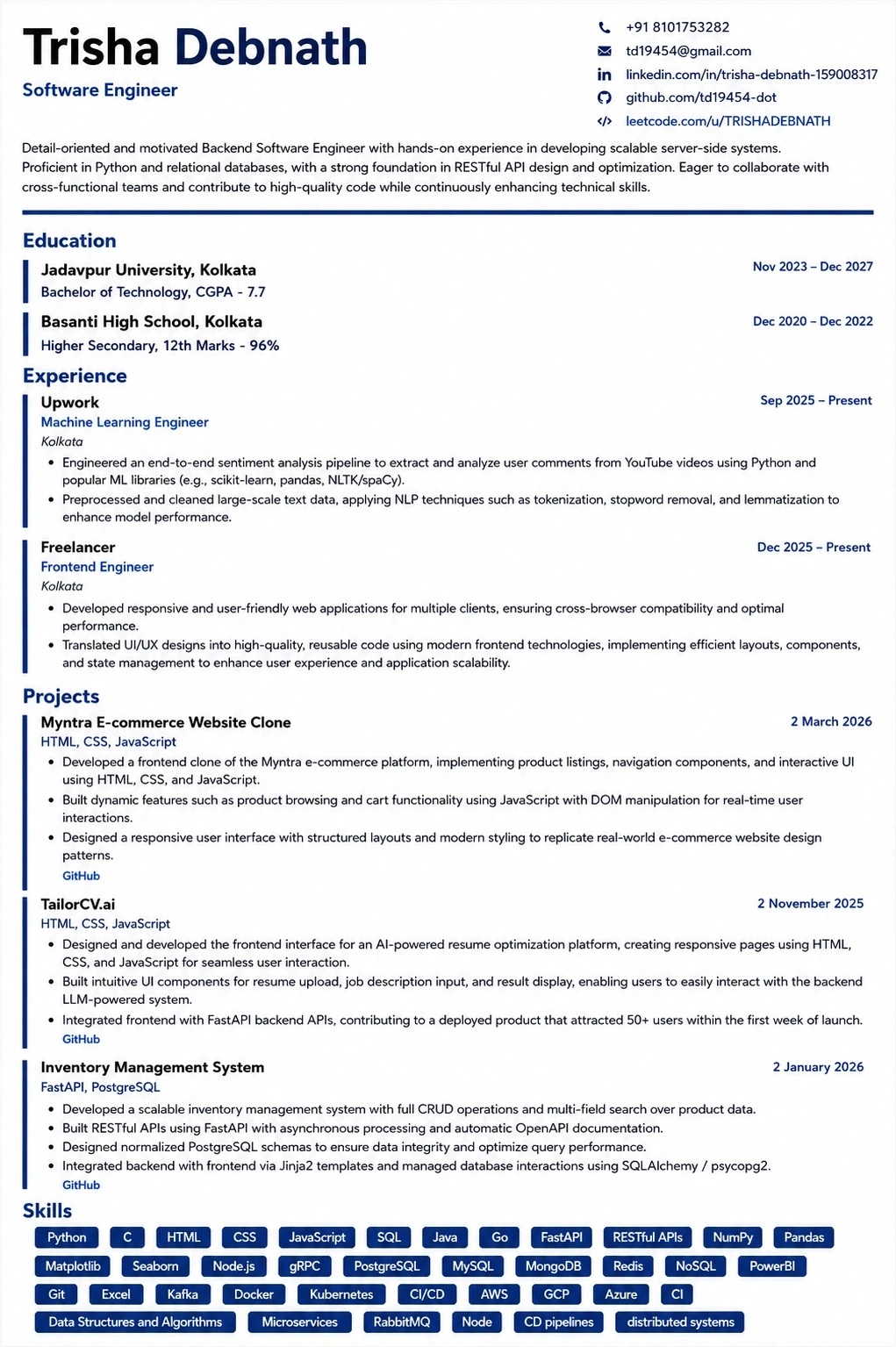
This template is ATS-tested — start from it and the formatting rules in this guide are already handled.
Was this guide useful?
Be the first to rate it.