TD
TD

Key Takeaways
- Machine learning interviews assess a blend of coding, mathematical reasoning, and communication skills across technical and non-technical audiences.
- Interview questions are categorized into five areas: ML fundamentals, statistics & probability, model evaluation & tradeoffs, applied case studies, and behavioral communication.
- Candidates often overprepare in ML fundamentals while neglecting applied and behavioral questions, which can be crucial for interview success.
- Effective answers should include precise definitions followed by concrete examples to demonstrate true understanding of concepts.
- When discussing model evaluation, always relate metric choices back to the specific business problem at hand.
machine learning interviews sit in an unusual spot between software engineering and applied statistics — you're expected to code, reason about math, discuss real model tradeoffs, and communicate all of it clearly to both technical and non-technical interviewers. That range is exactly why candidates who are strong in one area (say, deep learning theory) still stumble in another (say, explaining a model's business impact in a behavioral round).
This guide organizes the questions you're most likely to be asked into the categories interviewers actually test, with a framework for answering each type — not just a list to memorize.
The Five Categories of ML Interview Questions
Most ML interview loops draw from five distinct buckets:
See it in action: a resume-based mock interview
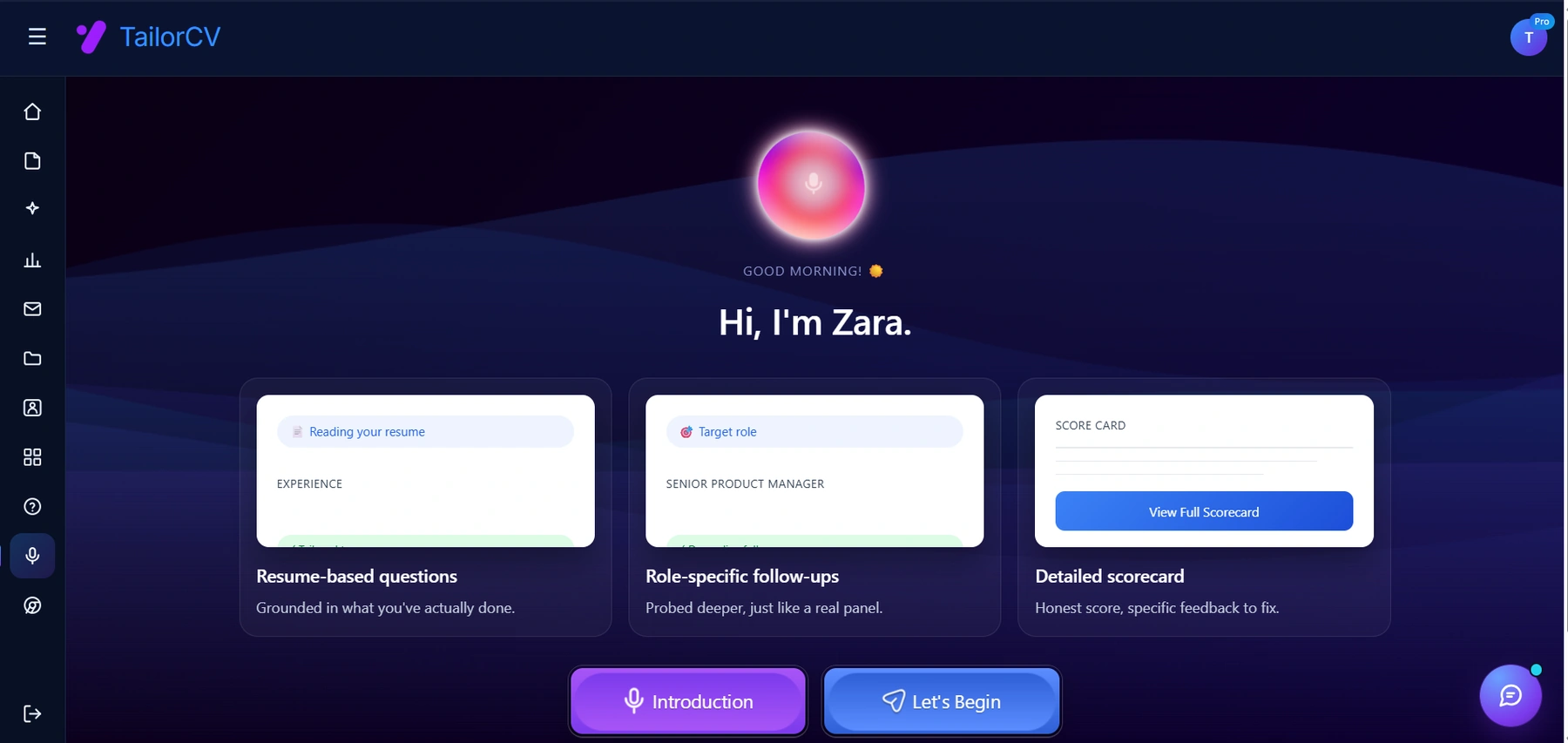
Rather than a fixed question list, the session is built from your own resume and target role, and ends with a scorecard naming the specific things to fix.
- ML fundamentals — core concepts every ML role expects you to know cold.
- Statistics & probability — the mathematical foundation under every model.
- Model evaluation & tradeoffs — how you judge whether a model is actually good.
- Applied / case-study questions — how you'd approach an open-ended real-world problem.
- Behavioral & communication — how you explain your work to non-technical stakeholders.
Treating these as one undifferentiated "ML interview" is the most common prep mistake — each bucket rewards a different kind of preparation, and most candidates over-index on fundamentals while neglecting the applied and behavioral rounds that often decide the outcome.
Category 1: ML Fundamentals
Common questions:
- What is the bias-variance tradeoff?
- Explain the difference between supervised, unsupervised, and reinforcement learning.
- What is overfitting, and how do you prevent it?
- Explain how a decision tree splits nodes.
- What is regularization, and what's the difference between L1 and L2?
- How does gradient descent work, and what happens if the learning rate is too high or too low?
- What is the curse of dimensionality?
- Explain the difference between bagging and boosting.
How to answer: Give a precise definition first, then a concrete example — interviewers are checking whether you actually understand the concept or have just memorized the term. For the bias-variance tradeoff, for instance: define both terms, explain that total error decomposes into bias, variance, and irreducible error, and then give an example of a high-bias model (linear regression on non-linear data) versus a high-variance one (a deep, unpruned decision tree).
Category 2: Statistics & Probability
Common questions:
- Explain p-values and statistical significance in plain terms.
- What is the Central Limit Theorem, and why does it matter?
- What's the difference between correlation and causation?
- Explain Bayes' theorem and give a practical example.
- What is A/B testing, and how do you determine sample size?
- What's the difference between Type I and Type II error?
- How would you handle imbalanced classes in a dataset?
How to answer: These questions test whether you can translate statistics into plain language — a common failure mode is reciting the formula without explaining what it means in practice. For "correlation vs. causation," a strong answer includes a concrete example of a confound (ice cream sales and drowning rates both rising with temperature) rather than just stating the definition.
Category 3: Model Evaluation & Tradeoffs
Common questions:
- How do you choose between precision and recall for a given problem?
- What is ROC-AUC, and when is it misleading?
- How do you evaluate a regression model versus a classification model?
- What is cross-validation, and why does it matter?
- How would you detect if a model is overfitting in production?
- How do you decide between a simple model and a complex one?
- What's the difference between a validation set and a test set?
How to answer: Always tie the metric choice back to the business problem. "I'd prioritize recall over precision" means nothing without context — a strong answer specifies why, e.g., "for a fraud detection model, missing a fraudulent transaction (false negative) is far more costly than flagging a legitimate one for review, so I'd optimize for recall and accept more false positives." This is the same instinct that makes a resume achievement credible — see how to quantify resume achievements for the same principle applied to writing.
Category 4: Applied & Case-Study Questions
Common questions:
- How would you build a recommendation system for [a specific product]?
- How would you detect fraudulent transactions in real time?
- A model's performance has degraded in production — how do you debug it?
- How would you design an A/B test to measure the impact of a new feature?
- How would you approach a problem with very little labeled data?
- Walk me through how you'd take a model from prototype to production.
How to answer: These are structurally similar to system design interviews — the interviewer wants to see how you think through ambiguity, not a single "correct" architecture. Start by clarifying the actual business objective and constraints (latency, data availability, interpretability requirements) before jumping to a solution. For "a model's performance has degraded in production," a strong answer walks through a structured debugging process: check for data drift, check for a pipeline or feature bug before assuming the model itself is the problem, and confirm the evaluation metric hasn't silently changed.
Category 5: Behavioral & Communication Questions
Common questions:
- Tell me about a time you had to explain a technical result to a non-technical stakeholder.
- Describe a project where your model didn't perform as expected — what did you do?
- Tell me about a time you disagreed with a teammate on model approach.
- How do you prioritize between model accuracy and interpretability for a business?
- Tell me about a time you had to work with messy or incomplete data.
How to answer: Use the STAR structure — Situation, Task, Action, Result — and always close with a measurable outcome, exactly as you would for any behavioral interview question. ML-specific behavioral answers should demonstrate one extra layer beyond a typical engineering answer: translating a technical tradeoff into a business consequence a non-technical stakeholder actually cared about.
Sample answer (explaining a technical result to a non-technical stakeholder):
"I built a churn prediction model for a product team that didn't have a data science background. Instead of presenting AUC or precision-recall curves, I framed the output as 'these are the 200 customers most likely to cancel this month, ranked by risk' and paired it with three concrete factors driving each prediction. The team acted on the list directly, and we saw an 8% reduction in churn within the quarter — because the output was usable, not just accurate."
How to Build Your Own Question Bank
Don't try to prepare a fresh answer for every possible variation — build a smaller, reusable set instead:
- Pick 2–3 strongest projects from your resume and be ready to go deep on each — the model choice, the metric you optimized for, what you'd change if you rebuilt it today. If your resume doesn't currently make these projects easy to talk about, it's worth tailoring it to the specific role first, especially since ML and data scientist resumes or machine learning engineer resumes are read differently than typical software engineering resumes.
- Prepare 4–5 behavioral stories covering a technical disagreement, a failed model, a messy-data situation, and a stakeholder communication challenge.
- Drill fundamentals and statistics out loud, not just by reading — explaining a concept clearly under time pressure is a different skill from recognizing the right multiple-choice answer.
- Practice at least one applied case study end-to-end, narrating your reasoning the whole way through, the same way you'd approach a system design interview.
- Rehearse the behavioral round specifically — it's the round ML candidates most often under-prepare for, and a free AI mock interview built from your actual resume will ask about the exact projects you'd need to defend live.
A Realistic Prep Timeline
Weeks 1–2: Fundamentals and statistics Drill core concepts daily in short sessions, explaining each one out loud as if to an interviewer, not just reviewing flashcards silently.
Week 2 (parallel): Model evaluation and applied case studies Work through 2–3 applied problems slowly, focused on structure and reasoning rather than speed.
Final week: Resume depth and behavioral prep Go through every project on your resume and make sure you can defend the decisions behind it for five minutes straight. Build your behavioral story bank and rehearse it out loud — see the technical interview preparation guide and coding interview preparation guide if the role also includes a general coding round, which many ML roles do.
Final 48 hours: Logistics Confirm the interview format (some ML loops include a take-home, others don't), and prepare a few genuine questions about the team's data infrastructure and model deployment process.
Don't Forget the Portfolio
For ML and data science roles especially, a portfolio of real projects often carries as much weight as the resume itself, since it's the clearest evidence of applied skill. See the data scientist portfolio guide and data analyst portfolio guide for what to include, and make sure any code you're pointing interviewers to is clean and well-documented — see GitHub portfolio optimization. If you're deciding what kind of project to build to fill a gap, the developer portfolio project ideas guide is a useful starting point.
If you're coming from a data analyst background and moving toward ML or data science roles, it's worth understanding how the two are actually evaluated differently — see data analyst vs. data scientist.
FAQ
What are the most commonly asked machine learning interview questions?
Bias-variance tradeoff, overfitting and regularization, precision vs. recall, and applied case studies like designing a recommendation system or debugging a model's production performance are asked across nearly every ML interview loop.
Do machine learning interviews include coding rounds?
Often, yes — many ML roles include a general coding round similar to a software engineering coding interview, in addition to ML-specific fundamentals and case studies.
How important are behavioral questions in ML interviews?
More than most candidates expect. ML roles require translating technical tradeoffs into business impact, and behavioral rounds are where interviewers test whether you can actually do that — not just build the model.
How should I prepare for applied ML case-study questions?
Treat them like system design questions — clarify the actual business objective and constraints first, then reason through tradeoffs out loud, rather than jumping straight to a specific architecture. See the system design interview guide for the same structure applied more generally.
What's the best way to practice explaining ML concepts clearly?
Say the answer out loud, ideally to someone without an ML background, and check whether it still makes sense without the jargon. A free AI mock interview built from your resume can also walk you through your specific projects with realistic follow-up questions.
Related Guides
- Technical Interview Preparation Guide
- Coding Interview Preparation Guide
- System Design Interview Guide
- Behavioral Interview Questions and Answers
- Machine Learning Engineer Resume 2026
- Data Scientist Resume 2026
- Data Scientist Portfolio Guide
- Data Analyst vs. Data Scientist
- GitHub Portfolio Optimization
- Free Mock Interview Practice
Final Thoughts
machine learning interviews reward range, not just depth in one area. Fundamentals and statistics prove you understand the theory, model evaluation and case studies prove you can apply it, and behavioral rounds prove you can communicate it — miss any one of the three and even a technically brilliant candidate can lose the offer.
Start by making sure your resume and portfolio actually reflect the depth of your projects — check and tailor your resume here — then run a free AI mock interview to rehearse explaining your own work clearly before a real interviewer asks.
Practice My ML Interview — Free
Was this guide useful?
Average 5.00 / 5.00 · 1 rating