 TD
TD
Key Takeaways
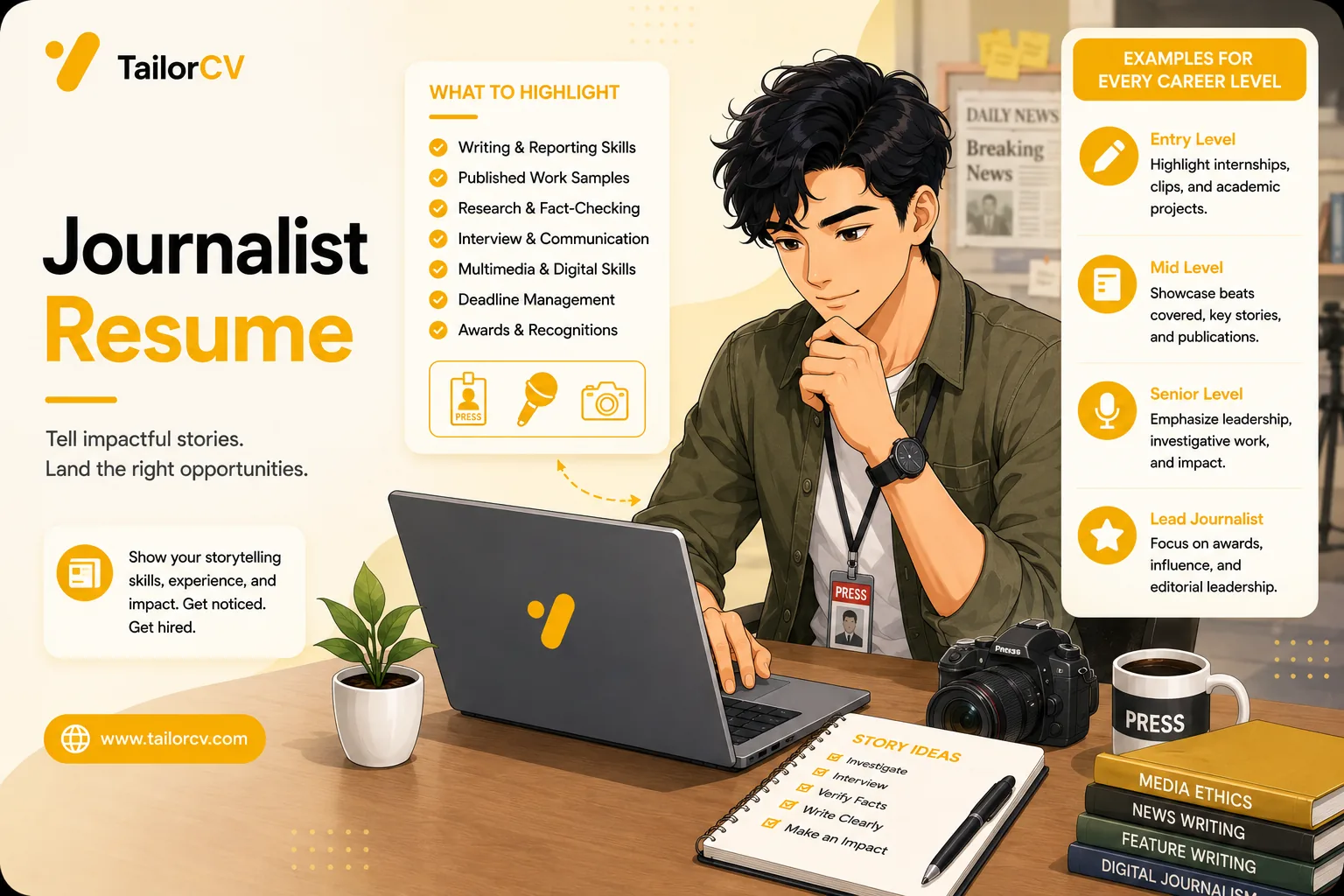
- Editors hire reporters who can find stories, write cleanly under deadline, and bring an audience; the ATS scans for beat and skill keywords.
- State your focus and where you have published right at the top.
- Modern journalism is measured, so quantify audience and output wherever you can.
- Cover reporting, interviewing, fact-checking, editing, SEO, CMS, analytics, and any multimedia skills.
- Bylines are your portfolio - link your best clips prominently, ideally collected on one site.
Newsrooms and digital media move fast and hire on evidence — your beats, your bylines, and the reach of your work. A journalist's resume should read tight and lead-first, just like a good story, and it has to clear the ATS that most publishers now use to screen applications. That means your keywords have to match the job description before an editor ever reads your clips.
Before applying, run your draft through the free ATS score checker, start from an ATS-friendly template, and read the ATS score guide. If you write in a related field, the content writer resume guide and technical writer resume guide share the same fundamentals.
What editors and the ATS are looking for
Editors hire reporters who can find stories, write cleanly under deadline, and bring an audience. The ATS, meanwhile, is scanning for beat and skill keywords — "investigative," "SEO," "CMS," "data journalism," "audio." Your resume has to satisfy both: lead with a clear beat and bylines for the editor, and mirror the posting's exact language for the software. Miss the keywords and even a decorated reporter's resume gets no responses.
Your resume after optimization
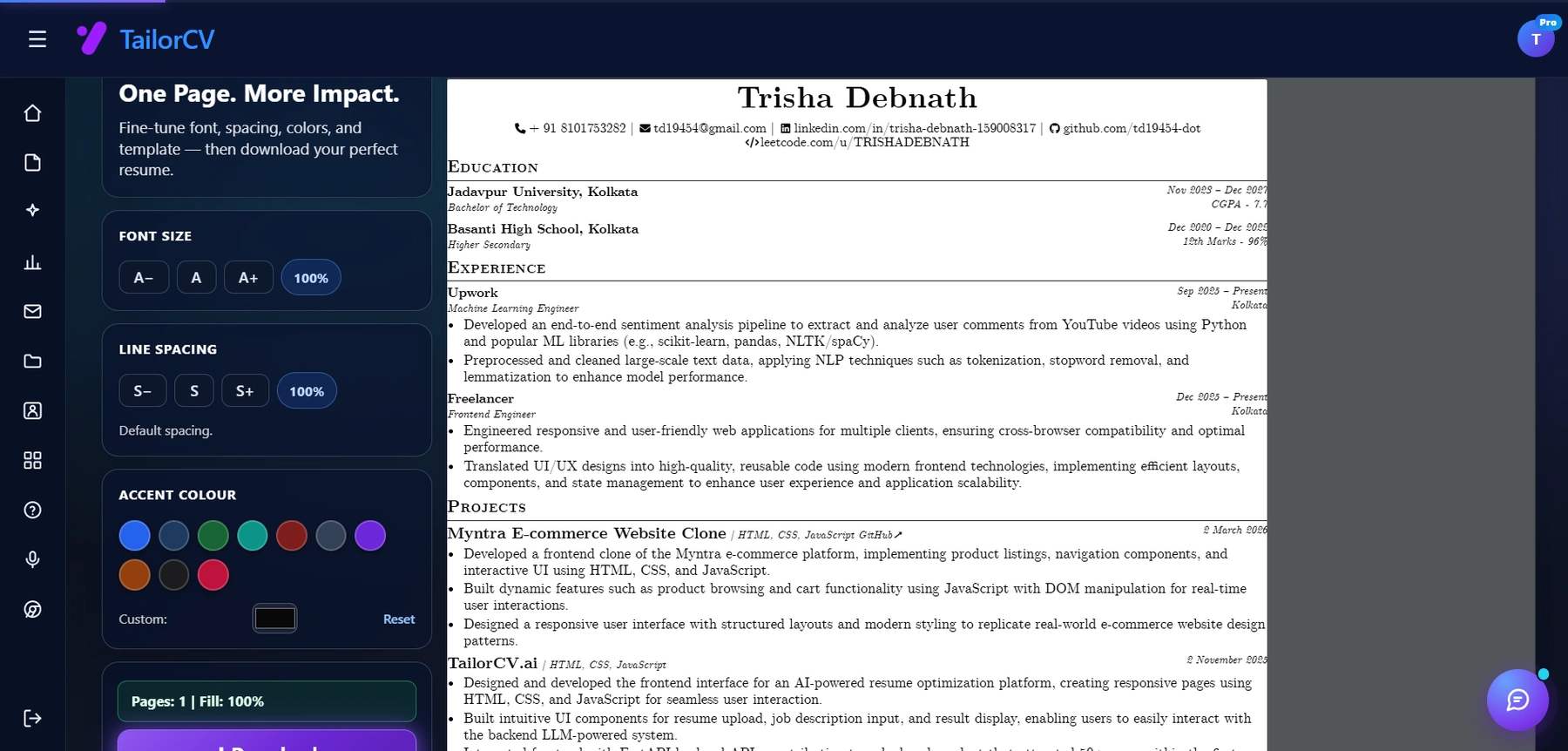
This is the resume after tailoring - the content is already matched, and these controls are how you fit it onto one page.
Lead with beats and outlets
State your focus and where you've published right at the top: "Investigative and political reporter — bylines in [outlets]." Editors want to know your beat immediately, and your beat is one of the strongest keywords the ATS scans for. A tight summary frames the rest:
"Digital reporter covering technology and business, with bylines in three national outlets. Broke a story that drew 500K+ page views and grew a tech newsletter to 25,000 subscribers. Skilled in SEO, CMS, and data journalism."
See resume objective vs summary for the opening lines, and how to craft a strong headline that mirrors the role.
Quantify audience and output
Modern journalism is measured, so quantify wherever you can using the bullet point formula — a strong action verb, the work, and a result:
- "Published 120+ stories per year across web and print."
- "Grew a newsletter to 25,000 subscribers in 18 months."
- "Broke a story that drew 500K+ page views and national pickup."
- "Ranked on page one for competitive news keywords through on-page SEO."
Numbers separate a working journalist from an aspiring one — the quantify achievements guide shows how to add them credibly.
Show range and tools
The skills section should cover reporting, interviewing, fact-checking, editing, SEO, CMS (WordPress), analytics, social media, and any multimedia skills — audio, video, or data journalism. Mirror the job description and confirm coverage with the ATS score checker. Increasingly, digital newsrooms want reporters who understand distribution, so SEO and audience skills are genuine differentiators.
Link your clips and portfolio
Bylines are your portfolio, so link your best clips prominently — a personal portfolio website that collects your strongest work makes an editor's job easy. Read how to write a portfolio case study for framing bigger projects, and understand portfolio vs resume so each does its job.
Structure a journalist resume
- Header — name, beat, phone, email, portfolio/clips link.
- Summary — three lines, beat- and impact-forward.
- Skills — reporting, SEO, CMS, multimedia.
- Experience — outlet, role, quantified bullets.
- Education — journalism degree or relevant training.
This mirrors the layout in the resume builder. For ordering, see the resume section order guide.
Keep it lead-first and ATS-safe
Front-load impact, keep it to one page early-career, use a readable font, and avoid graphics that break parsing — see how to make your resume ATS-friendly. Then confirm parsing with the ATS score checker and proofread meticulously — for a writer, a typo is a credibility killer.
Freelance or breaking in?
If you're freelance or building your first clips, treat published work, student journalism, and internships as real experience — the resume with no experience guide shows how. Group freelance clients cleanly, and read the freelancing vs full-time guide if you're weighing the path. A steady stream of bylines on a portfolio can outweigh a thin staff history.
Tailor to each outlet
A national daily, a trade publication, and a digital-first startup want different emphases. Tailor each application with the resume optimizer so your keywords match, and see how much to change your resume for every job.
Where journalists find roles
Journalism jobs live across legacy outlets, digital-first publishers, trade publications, and content teams inside companies, so cast a wide net. Beyond job boards, reporters find work through industry networks, editors they've pitched, and direct outreach — a sharp cold email with links to your best clips can start a conversation. Networking and a strong LinkedIn presence matter enormously in media, and the best job search websites guide covers the rest. Many journalists also pivot into adjacent roles — content marketing, comms, content writing, or SEO — where reporting and writing skills transfer directly; the career change resume guide helps you reframe for those.
Prepare for the interview
Journalism interviews often include an editing test or a pitch conversation. Prepare story ideas and clips, practice with a free AI mock interview, and use the interview prep tool. Afterward, send a thank-you email and follow up. Generate a tailored cover letter if needed.
Sample journalist resume bullets
Strong bullets pair a action verb with output and a quantified result:
- "Published 120+ stories per year across web and print on the technology beat."
- "Broke an investigation that drew 500K+ page views and national pickup."
- "Grew a tech newsletter to 25,000 subscribers in 18 months."
- "Ranked stories on page one for competitive news terms through on-page SEO."
Numbers separate a working journalist from an aspiring one — the quantify achievements guide shows how. Run yours through the resume optimizer to confirm the keywords land.
Journalist resume summary examples
Match your summary to your level:
- Recent grad: "Multimedia journalism graduate with student-paper and internship bylines, skilled in reporting, CMS, and social. Seeking a reporting role."
- Mid-career: "Digital reporter covering business and tech with bylines in three national outlets; broke a story with 500K+ views."
- Senior/editor: "Senior editor with 12 years leading newsroom coverage, managing reporters, and growing digital audience 40%."
Journalist resume FAQ
How long should it be? One page early-career; two only with extensive experience — see the ideal resume length guide.
How do I show my clips? Link a portfolio of your strongest bylines; understand portfolio vs resume.
I'm freelance — how do I present it? Group clients cleanly and treat published work as real experience, per the resume with no experience guide.
Do digital skills matter? Increasingly yes — SEO, CMS, and audience skills are real differentiators.
Final checklist
Your journalist resume is ready when it:
- unchecked: Leads with your beat and bylines.
- unchecked: Quantifies audience and output with numbers.
- unchecked: Names reporting and digital skills from the job description.
- unchecked: Links your best clips and passes the ATS score checker.
Write a lead-first resume in the resume builder, score it with the free ATS checker, and tailor it to every outlet.
What is your resume scoring right now?
Scan it against a job description and get your ATS match score in about a minute.
Drop your resume here or choose a file
PDF only. Max 2 MB.
We never share your data or use it to train AI models.

Templates that keep this structure intact
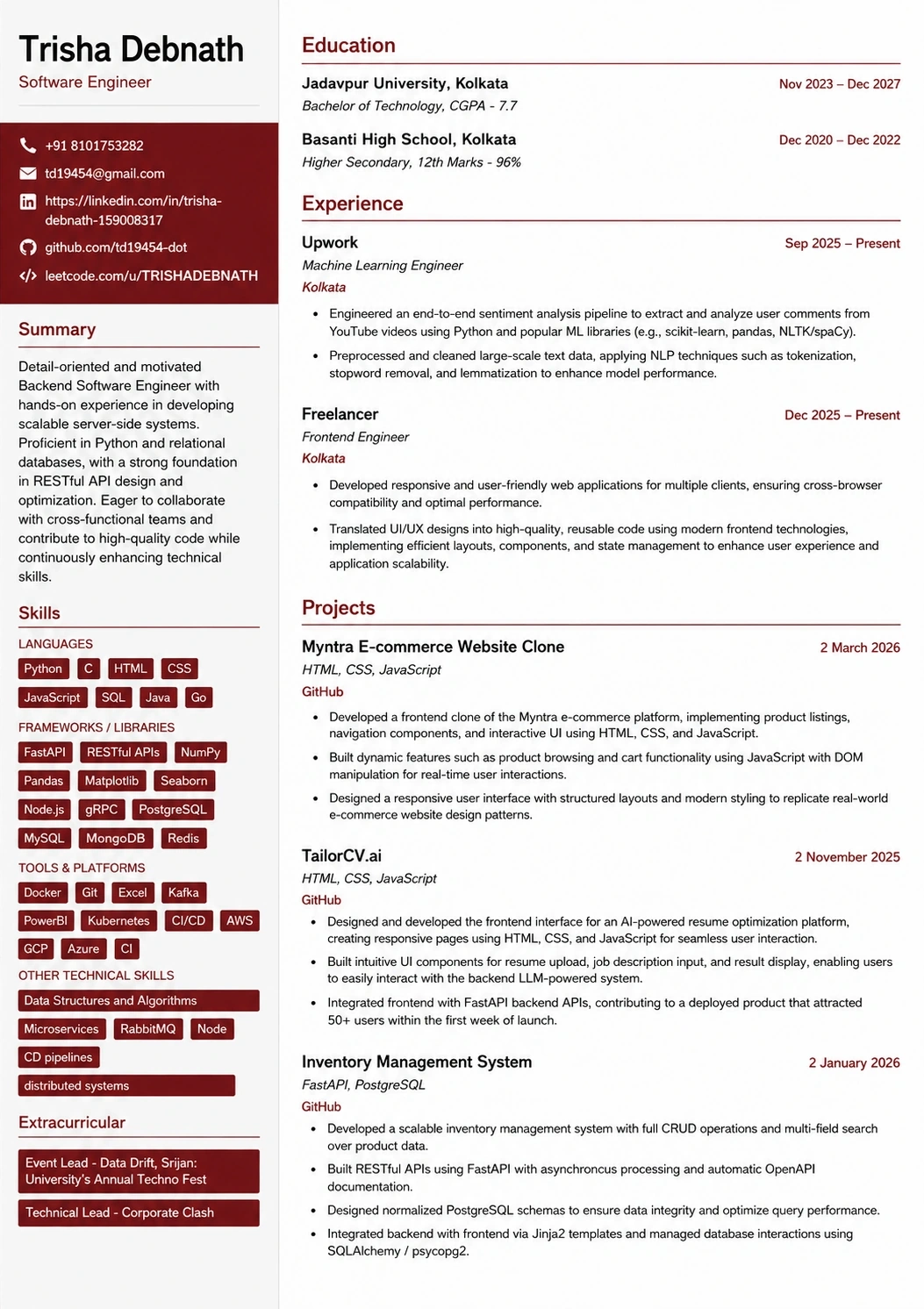
This template is ATS-tested — start from it and the formatting rules in this guide are already handled.
Was this guide useful?
Be the first to rate it.