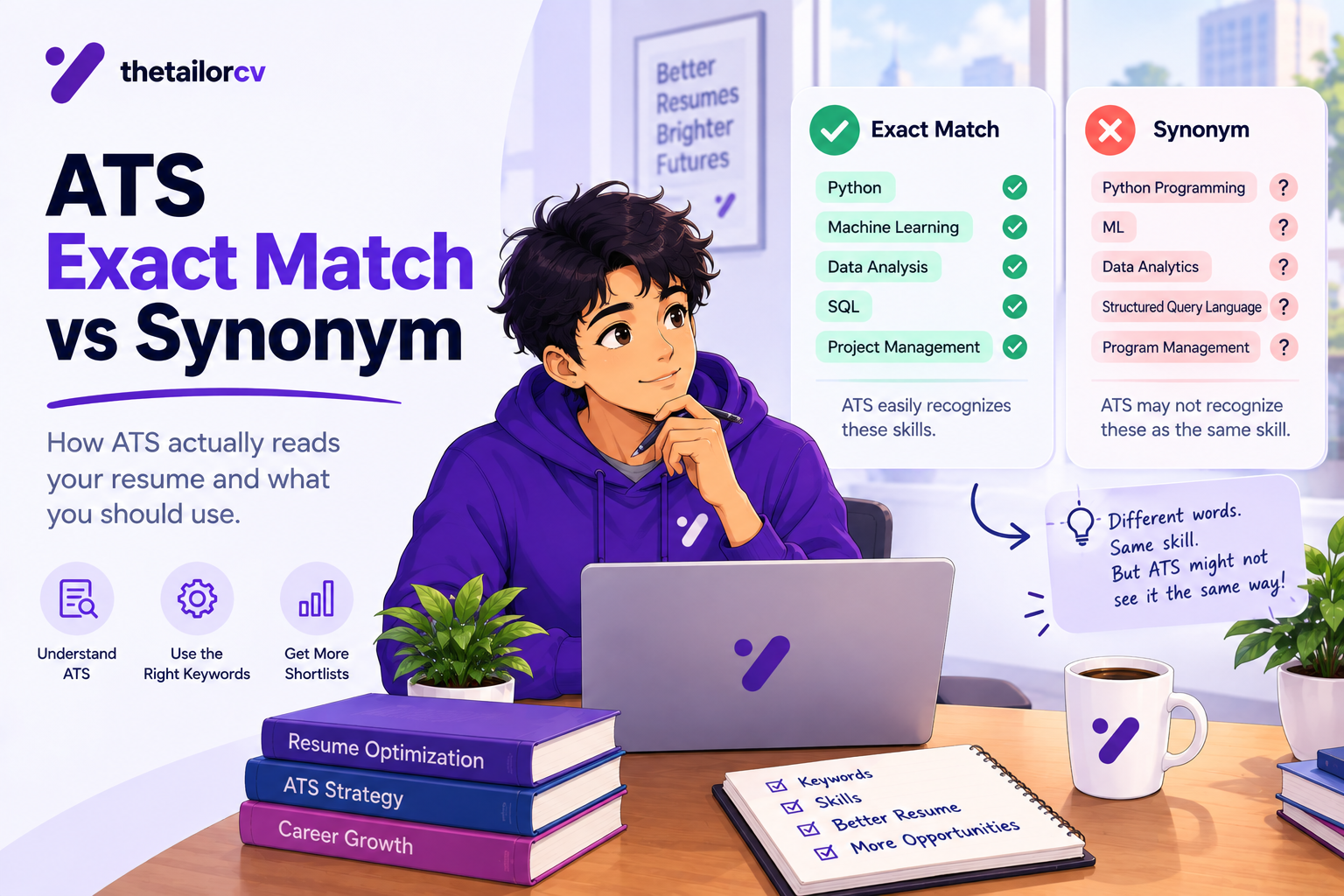
 SS
SS

Key Takeaways
- Coverage means your real experience is named in the posting's vocabulary; stuffing means terms appear without evidence behind them.
- The distinguishing test is whether you could talk about the term for two minutes under questioning.
- Recruiters spot stuffing in seconds - keyword clusters in parentheses, skills lists longer than the experience section, terms that appear nowhere in your history.
- Modern screening increasingly weights context, so stuffing has become less effective and no less visible.
- Coverage tends to improve a resume for human readers too; stuffing always degrades it.
Both approaches put the job posting's language on your resume. That is where the similarity ends.
Coverage is translation - you did the work, you name it the way the employer names it. Stuffing is decoration - the word is present, the work is not.
The Two-Minute Test
For any term on your resume, ask: if an interviewer picks this and asks me to talk about it for two minutes, can I?
Not a definition - a real account. What you used it for, a decision you made, something that went wrong.
Pass, and it is coverage. Fail, and it is stuffing, regardless of how naturally it is written.
This test matters because interviewers choose probe topics from your skills section. Stuffing does not fail quietly at the scanning stage; it fails loudly at the stage that decides whether you get hired.
Why the two-minute version and not thirty seconds
Thirty seconds of plausible talk is achievable from a documentation page. Two minutes is not, because two minutes requires specifics: what you were building, what constraint you hit, what you chose instead.
That is the level at which a competent interviewer is listening, and it is why a skills section you cannot defend costs more than the gap it was covering.
Applying it to your current resume
Go through your skills section and mark each item pass, fail, or borderline. Most people find two or three failures and a handful of borderlines.
Delete the failures. For the borderlines, decide whether there is a real bullet you could attach them to - if there is, the term belongs in that bullet rather than in the list.
What Coverage Looks Like
You managed relationships with enterprise clients. The posting calls it stakeholder management.
Before: Worked closely with our biggest clients to keep them happy and sort out problems.
After: Owned stakeholder management for 12 enterprise accounts, running quarterly business reviews and resolving escalations within agreed SLAs.
The second names the work in the employer's vocabulary. Every term maps to something that happened. It scores better and reads better - which is the signature of coverage done properly.
Coverage is mostly a renaming exercise
The common misunderstanding is that coverage means adding content. Usually it means renaming work you already describe.
You have the experience. It is sitting on your resume under your industry's word for it, and the employer searches for theirs. Nothing needs inventing; the sentence needs translating.
What Stuffing Looks Like
Same underlying job, optimised instead:
Worked closely with clients (stakeholder management, account management, client relations, relationship management, customer success) to sort out problems (escalation management, issue resolution, conflict resolution).
Higher score. Immediately recognisable. A recruiter reads this and learns that you know how to find the keyword list, not that you can do the job.
A Second Example: The Senior Engineer
The first example is a mid-level operations case. Stuffing looks different at senior level, and it is more damaging, because senior hiring is almost entirely a judgement about depth.
A backend engineer with eight years applying for a staff role. The posting names distributed systems, Kubernetes, observability, and mentoring.
Stuffed: Senior engineer with expertise in distributed systems, microservices, Kubernetes, Docker, service mesh, Istio, observability, Prometheus, Grafana, OpenTelemetry, mentoring, technical leadership, and cross-functional collaboration in an Agile environment.
Thirteen terms, one sentence, no evidence. At junior level this reads as eager. At staff level it reads as someone who has not done the work, because a staff engineer would have led with a system.
Covered: Led the decomposition of a monolithic billing service into six services on Kubernetes, cutting deploy time from 40 minutes to four. Built the observability layer - Prometheus metrics and OpenTelemetry tracing - that reduced mean time to detection from 20 minutes to under three. Mentored four engineers through the migration, two of whom now own services outright.
Nine of the thirteen terms appear. All nine have proof attached. The reader now knows the scale, the decisions and the outcome - and every term survives the two-minute test.
Why stuffing scales badly with seniority
A junior resume with a long skills list is forgivable; there is little history to fill the page and the reader adjusts expectations. A senior resume with the same list invites the opposite reading.
The more experience you claim, the more a reader expects your terms to be attached to specific systems, decisions and outcomes. Seniority raises the evidence bar, which is why reading as the wrong level is such a common cause of silence from well-qualified applicants.
The Signals Recruiters Read
Parenthetical clusters. Synonyms bracketed after a phrase. There is no honest reason to write four names for one thing.
A skills section longer than your experience section. Thirty tools listed, five referenced anywhere in your history. The mismatch is obvious at a glance.
Terms that appear exactly once, in the skills list. If Kubernetes is a real skill, it appears in the context of work you did. If it appears only as a word in a list, that tells its own story.
Sentences that read oddly. Stuffing distorts grammar. Phrases like "utilised Agile methodologies and Agile frameworks in an Agile environment" are the tell.
Skills inconsistent with your level. A two-year analyst listing enterprise architecture and executive stakeholder governance reads as a list assembled from postings.
The signal you cannot see from inside
The hardest one to self-diagnose is proportion. Every individual line can be true while the document as a whole overstates you.
Read your resume as if it belonged to someone else and ask what job this person obviously does. If the answer is unclear because the page covers too much ground, you have a proportion problem - the same failure that makes a generic resume detectable even when every sentence is accurate.
Stuffing vs Coverage: The Decision Table
The distinction is easier to apply against concrete cases than in the abstract.
| The situation | Stuffing version | Coverage version | Why the second wins |
|---|---|---|---|
| Posting says "stakeholder management", you did client work | Add the phrase to your skills list | Rewrite the client bullet using the phrase | Term arrives with proof attached |
| Posting names three BI tools, you know one | List all three | Name the one, evidenced | The cluster means "one of these" |
| Posting wants Kubernetes, you have used it twice | Put it in skills | Mention it in the bullet where it happened | Context shows the real depth |
| Posting wants Kubernetes, you have never used it | Add it anyway | Leave it out | It fails the two-minute test |
| Your title is unusual | Add four title variants | Bracket the market equivalent | One clarification, verifiable |
| You have 30 genuine skills | List all 30 | List the 10 this posting names | Thirty items are remembered as none |
| An acronym could be written two ways | Write both, separately | Write "SEO (search engine optimisation)" once | Covers both forms, reads normally |
| A soft skill appears in the posting | Add it to skills | Show it in a bullet | Asserted traits are discounted |
| You did the work on a personal project | Describe it as professional | Label it under Projects | Accurate context, still counts |
| The posting repeats one requirement | Mention it six times | Once in skills, once evidenced | Repetition past two reads oddly |
| You are missing one central term | Invent adjacent phrasing | Name the real gap and decide | Overclaiming fails at interview |
| Your score is 68 and you want 90 | Pad until it rises | Fix bullets, accept the number | Score past a point predicts nothing |
The pattern across every row: coverage puts the term where the evidence already is, and stuffing puts the term wherever it will be counted.
Why Stuffing Has Stopped Working
Two changes.
Screening increasingly weights context - where a term appears, whether it sits inside described work, whether the surrounding text supports it. A word in a list carries less weight than the same word inside an achievement.
And recruiters have seen a great deal of it. The patterns above are recognised in the seven-second scan. A resume flagged as stuffed is often read less carefully than a plain one.
The result is that stuffing now costs more than it gains in most cases.
The arithmetic that makes it a bad trade
Stuffing buys a few points of score. Those points matter only if they move you across a ranking threshold on this specific posting, which you cannot observe.
Against that, it risks the reader discounting the entire document, and it risks a two-minute interview question you cannot answer. The upside is invisible and marginal; the downside is decisive and permanent. That is not a trade worth taking, and it is the same reasoning that makes the white-text trick indefensible rather than merely risky.
Where the Line Actually Sits
Neither extreme is right. A resume written with no attention to the posting's vocabulary loses legitimate matches. A resume written only for the scanner loses the human.
Working rules:
Name your real work the way the employer names it. This is the whole of coverage and it is nearly always safe.
One name per concept. Pick the posting's term and use it. Do not list synonyms.
Put terms where the evidence is. A skill mentioned in an achievement is stronger than the same skill in a list, which is why placement changes what a keyword is worth.
Keep the skills section to things you could discuss. If you would not want to be asked about it, it does not belong there.
Read the result aloud. Stuffing is audible. If a sentence sounds strange spoken, it will look strange read.
The Edge Cases
The rules above cover most situations. These are the ones that genuinely feel ambiguous.
You are a career changer with thin direct evidence
The temptation to pad is strongest here, and it is the worst place to give in - a career changer is already being read sceptically, so an unsupported claim confirms the doubt.
The better move is to lead with transferable evidence stated in the target field's vocabulary. That is coverage, and bridging experience across fields is a legitimate exercise as long as a practitioner would accept the equivalence.
You genuinely used the tool, but years ago
Currency matters and pretending it does not is how people get caught. Name it with its context: "built the original reporting layer in Tableau (2019-2021)" is honest and still earns the match.
What fails is listing it flat alongside your current stack, which implies present fluency you would have to demonstrate.
The posting lists a tool you know under a different brand
Tool families transfer. Postgres to MySQL, Tableau to Looker, Jira to Asana. Naming the family or the adjacent tool is fair; silently substituting the brand you have never opened is not.
Write what you used, and let the adjacency be visible rather than concealed.
You are applying through a referral
A referral changes who reads you first, and it raises the cost of stuffing rather than lowering it. Your referrer's judgement is attached to your document.
The scanner may be bypassed entirely on a referred application, which means the only reader is the one who spots padding fastest.
The posting is vague and there is little to cover
Some postings have no extractable requirements worth targeting. Stuffing them with the handful of generic nouns present produces a worse resume.
Tailor lightly, spend the time on a clearer posting, and treat vagueness as information about the role rather than a tailoring problem to solve.
What This Looks Like at Each Level
The same principle, applied to different amounts of history.
Fresher or first job. Your skills section is doing more work because your experience section is short. That is legitimate - but every item still needs a project, a module or a placement behind it. Six defensible items beat twenty aspirational ones, and projects are the right place to give them evidence.
Two to five years. The transition point. Your experience section should now be carrying the terms, with the skills list providing coverage for things already demonstrated. This is where a long skills list starts to read as compensation.
Senior and above. Terms should appear almost entirely inside described systems and outcomes. A staff-level resume that leads with a technology list reads as someone describing what they have been near rather than what they have owned.
Career changers, any level. Lead with the transferable evidence, named in the target field's language, and be explicit about the translation rather than hoping it is inferred.
A Reasonable Skills Section
For a mid-level data analyst applying to a posting naming SQL, Python, dbt, Snowflake and Tableau:
Technical: SQL (advanced), Python (pandas, scikit-learn), dbt, Snowflake, Tableau, Git Analysis: A/B testing, cohort analysis, forecasting, data modelling
Eleven items. Each one used in real work, most referenced again inside the experience bullets. It covers the posting without listing everything the candidate has heard of - and every line survives a follow-up question.
The same section, stuffed
Technical: Python, R, Java, Scala, SQL, NoSQL, MongoDB, PostgreSQL, MySQL, Snowflake, Redshift, BigQuery, Databricks, Spark, Hadoop, Kafka, Airflow, dbt, Tableau, Power BI, Looker, Excel, Git, Docker, Kubernetes, AWS, Azure, GCP
Twenty-eight items. Some are genuine strengths and the reader cannot tell which, so they discount all of them. The order of your skills section stops mattering once the list is long enough to be ignored wholesale.
Common Mistakes
Treating the missing-keywords list as a to-do list. A scan reports what is absent, not what you should add. Half of a typical missing list is terms worth ignoring - other people's tools, generic nouns, requirements you genuinely lack.
Adding a term in the skills list to "cover" it. This is the single most common form of stuffing, and it is the weakest placement available. If the term matters, it belongs in a bullet.
Optimising after the score is already reasonable. Past a workable score, further keyword work returns almost nothing while bullet quality still returns a lot.
Copying phrasing you would not say out loud. If you would not describe your own work that way in conversation, an interviewer will notice the gap between the document and the person.
Assuming the reader only sees the rendered page. Recruiters work from the parsed text in their system. Anything you thought was visually buried is plainly visible there.
Keeping one stuffed master resume and tailoring from it. The padding propagates into every application. Fix the base once - duty statements and tool lists are weak for every posting, not just this one.
Frequently Asked Questions
Is there a keyword density I should target?
No. Density thinking is what produces stuffing. Cover the posting's central terms once each, inside real evidence, and stop.
Can a scanner detect stuffing?
Some penalise unnatural repetition, and context-weighted systems give less credit to terms that appear without supporting content. But the reliable detector is the recruiter.
Should I repeat an important keyword several times?
Once in the skills section and once inside an achievement is plenty. More repetition adds little and starts to read oddly.
What if I genuinely have thirty skills?
List the ones relevant to this posting. A long list dilutes attention - the reader remembers nothing from thirty items, and something from ten.
Is using the posting's exact phrasing dishonest?
No, when it describes work you did. Employer vocabulary for your real experience is translation. Employer vocabulary for work you did not do is the line.
Does a longer skills section at least help me appear in more searches?
Marginally, and it costs you on every search where a human then reads the page. Recruiter searches surface candidates; the resume decides what happens next, and a padded one converts worse.
How do I cover a requirement I half-meet?
State the real extent. "Built two services on Kubernetes" is a smaller claim than "Kubernetes" in a list, and it is far more credible because it is specific about its own limits.
Will removing skills lower my score?
Sometimes by a few points. That is usually the right trade - you are removing the terms with no evidence behind them, which are the ones that would have failed at interview anyway.
Does this apply to LinkedIn as well?
Yes, with one difference: LinkedIn's skills section feeds recruiter search directly, so coverage there has more reach. The two-minute test still governs what belongs on it.
My industry genuinely uses several names for the same thing. Which do I pick?
The posting's. You are writing to be found by this employer's reader, not documenting your field's vocabulary - the same logic that decides exact match versus synonym.
Check Coverage Without Crossing the Line
The practical question is which of the posting's central terms are genuinely absent from your resume, and which of those you can honestly claim.
Scan your resume against the posting, then apply the two-minute test to anything you are considering adding. Terms that fail it should stay off the page whatever the score says.
Work through the claimable ones by rewriting the bullet where that work already lives, rather than appending to your skills list. That single habit is most of the difference between the two documents in this article. If you want the rewrite drafted against the posting's own wording, the tailoring tool works from the same comparison.
Related: missing keywords you should ignore and how many keywords a resume actually needs.
See which keywords you are missing
Scan your resume against the posting and get the exact terms it did not find.
Drop your resume here or choose a file
PDF only. Max 2 MB.
We never share your data or use it to train AI models.

Where those keywords actually go
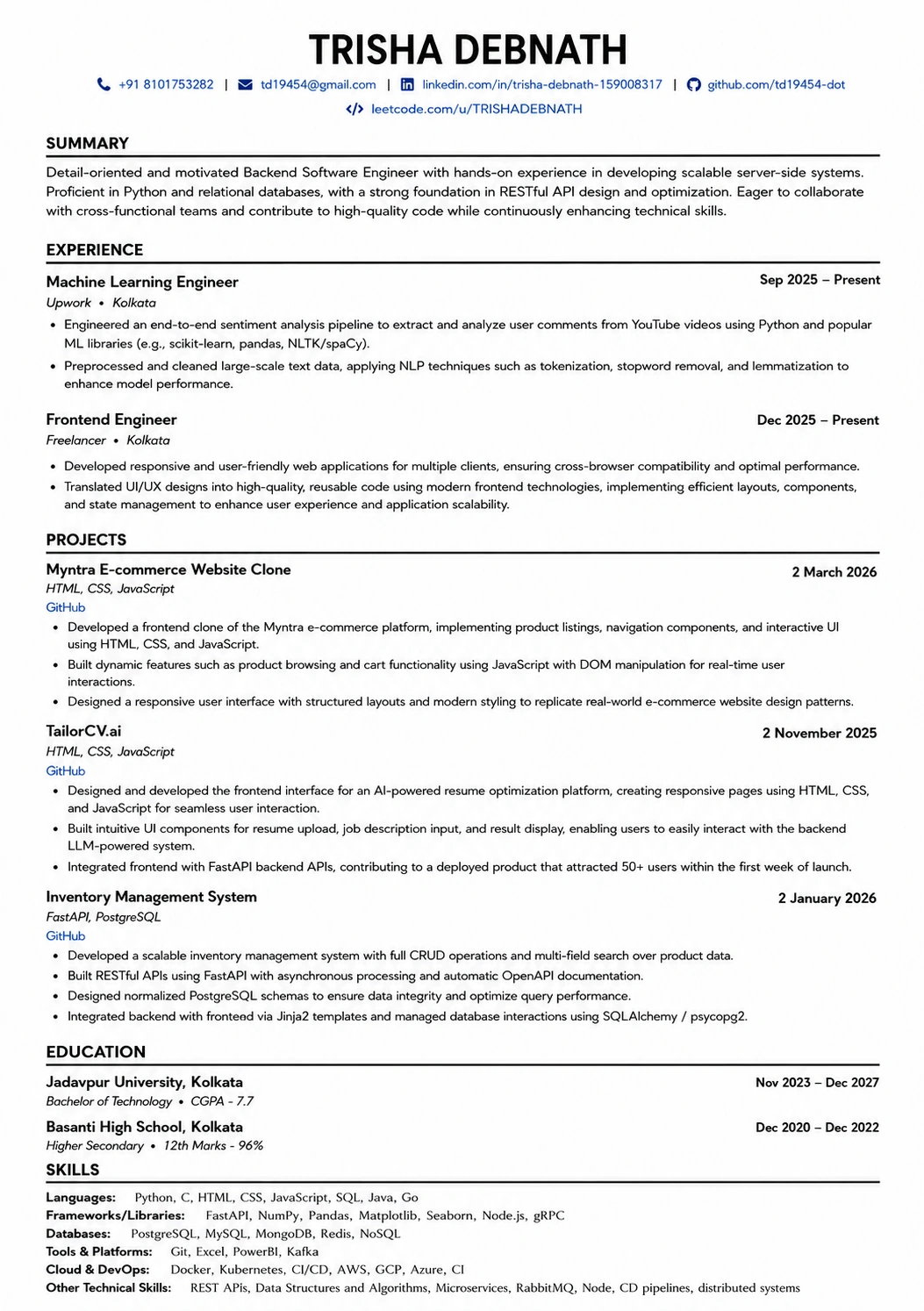
A layout with a real skills section gives the parser somewhere clean to find every term you just added.
Was this guide useful?
Be the first to rate it.