 TD
TD

Key Takeaways
- ATS systems evaluate resumes through parsing, keyword matching, section weighting, job title alignment, and contextual scoring.
- Generic resumes often fail to match critical keywords specific to job postings, resulting in low keyword match scores.
- Job title alignment is crucial; using vague or internal titles can lead to significant mismatches and low ATS scores.
- Non-standard section names in generic resumes can confuse ATS parsers, negatively impacting the overall score.
Most job seekers think ATS systems are simple keyword matchers. The reality is more sophisticated - and more unforgiving for generic resumes. Modern ATS platforms score your resume on multiple signals simultaneously, and a resume that hasn't been tailored to the specific role will fail on several of them at once. Here is exactly how it happens.
See how your resume scores right now with the free ATS checker.
What ATS Actually Does When It Receives Your Resume
When you submit an application, the ATS does not just store your resume - it parses it, scores it, and ranks it against every other candidate before a recruiter opens a single file. That ranking determines who gets a call.
The scoring process involves:
- Parsing - extracting text, sections, and metadata
- Keyword matching - comparing your terms against required and preferred skills
- Section weighting - evaluating how prominent key information is
- Job title alignment - checking whether your current/recent title maps to the role
- Contextual scoring - some modern ATS platforms use AI to assess whether skills appear in meaningful context
A generic resume fails at steps 2, 3, and 4 simultaneously.
Signal 1 - Keyword Match Score Is Low
Every job posting is tied to a keyword profile inside the ATS. That profile is built from:
What an ATS score report actually shows you

A score on its own is not actionable. The per-check list beside it - missing LinkedIn, skills gap, formatting the parser cannot read - is what you work through.
- The required and preferred skills in the posting
- Skills common to the role category
- Tools and technologies specified by the hiring team
Your resume is scored on how many of those keywords it contains. A generic resume - one written for a category of job, not a specific posting - will match some keywords by accident but miss many by design.
Example:
A generic "Marketing Resume" might score 45% on a "Growth Marketing Manager" posting because it mentions "marketing campaigns" and "social media" but doesn't include "paid acquisition," "conversion rate optimization," "HubSpot," "CAC," or "LTV" - all of which appear in the posting.
A tailored version of the same resume that mirrors the posting's exact language would score 75-85%.
For a complete guide to matching keywords, see how to match resume keywords to job description and best resume keywords to beat ATS systems.
Signal 2 - Job Title Mismatch
ATS systems place significant weight on job title alignment - both your most recent title and the title you are applying for. A generic resume often uses vague or internally-specific titles that don't map cleanly.
| What You Have | What the ATS Wants | Impact |
|---|---|---|
| "Marketing Associate" | "Digital Marketing Specialist" | Moderate mismatch - partial credit |
| "Technology Consultant" | "Cloud Solutions Architect" | High mismatch - low score |
| "Sales" | "Account Executive, Enterprise" | High mismatch |
| "Software Developer" | "Full Stack Engineer (React/Node)" | Moderate mismatch |
The fix is simple: mirror the job title in your resume headline and summary. See how to write a resume headline for the exact approach.
Signal 3 - Section Structure Problems
Generic resumes often have non-standard section names that confuse the ATS parser. When the parser can't identify a section, it may skip it entirely - meaning your experience or skills section gets zero scoring weight.
Section names that confuse ATS parsers:
- "What I Bring" instead of "Professional Summary"
- "Where I've Been" instead of "Work Experience"
- "Things I Know" instead of "Skills"
- "My Journey" instead of "education"
Standard section headers score higher because they map cleanly to what the ATS expects. If you are using a creative template, this is one of the most common ways a strong resume gets destroyed in ATS. See ATS resume formatting mistakes for the full list.
Signal 4 - Low Skills Section Relevance
ATS systems compare your skills section against the required and preferred skills in the posting. A generic skills section - "Communication, Teamwork, Microsoft Office, Problem Solving" - will score near zero for most technical or professional roles because none of those terms appear in the job's skills profile.
What scores well is a skills section populated with the specific tools, technologies, certifications, and methodologies the posting names.
See ATS keywords to boost your score for the complete breakdown of keyword types and where to place them.
Signal 5 - Sparse or Vague Experience Descriptions
Modern ATS platforms - especially those using AI scoring - don't just check for the presence of a keyword. They check whether it appears in a meaningful context. "Managed projects" scores lower than "Managed cross-functional teams of 8-12 people to deliver software projects on schedule and within budget."
Generic resumes tend to have thin, task-based bullets that don't provide enough context for the ATS to identify strong relevance. Tailored resumes embed keywords inside accomplishments.
Read how to quantify resume achievements to turn generic task descriptions into high-scoring achievement bullets.
Signal 6 - Low Match Rate Triggers Auto-Rejection in Many Systems
Many ATS platforms are configured with a minimum score threshold. Any resume below that threshold - typically 60-70% - is auto-rejected before a recruiter ever views it. A generic resume for a competitive role will often fall below this threshold without the candidate ever knowing.
That is why candidates are frequently told "we'll keep your resume on file" without any actual review happening.
For a full explanation of how scoring works, read the ATS score guide.
How to Beat ATS Detection
The answer is not tricks - it is alignment. Make your resume a close match to the specific posting and you score well.
The fastest way to do this:
- Identify the top 10 keywords from the job description
- Confirm every one you genuinely possess appears in your resume
- Mirror the job title in your headline and summary
- Use standard section headers
- Verify with the free ATS checker at TailorCV - it shows your exact score and the missing keywords
This process takes about 5-10 minutes. Read how to tailor a resume in 5 minutes for the full checklist.
Frequently Asked Questions
Can ATS tell if a resume is generic?
Yes. It scores on keyword match, job title alignment, and skills relevance - all of which are low on an untailored resume.
Do all companies use ATS?
Over 90% of large companies and a growing number of mid-sized companies use ATS. Even when a human reviews your resume, the ATS score influences where it appears in their queue.
How do I know my ATS score?
Use the free ATS checker at TailorCV. Upload your resume and paste the job description to see your score in about 60 seconds.
What is a good ATS score?
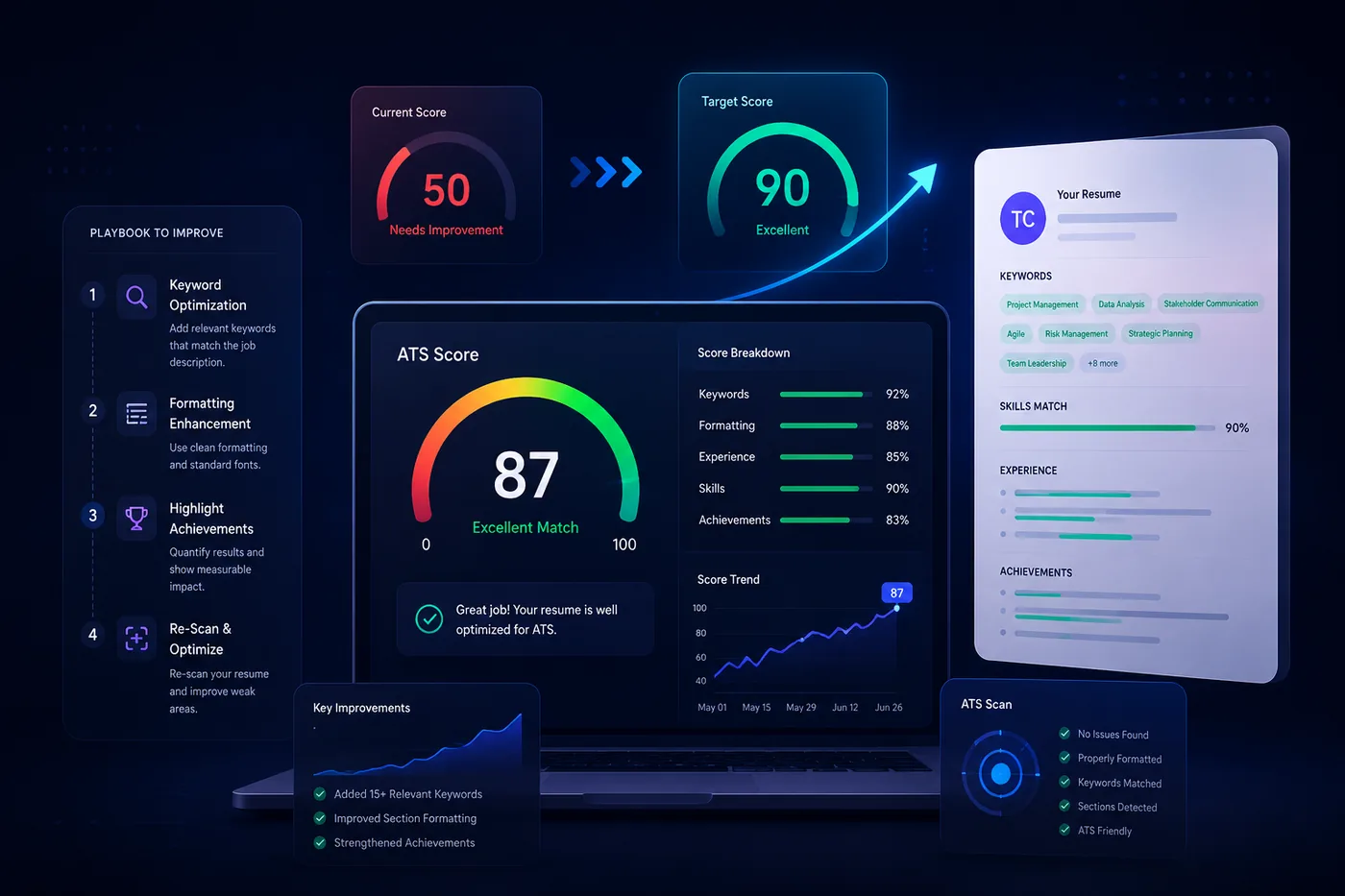
Aim for 75% or above. Scores above 80% consistently land in recruiter review queues. See the ATS score guide for benchmarks by role type. For tips on improving your score, check out How to Increase Your ATS Score From 50 to 90 (2026).
Related Guides
- How Recruiters Spot Generic Resumes
- How to Tailor a Resume in 5 Minutes
- Best Resume Keywords to Beat ATS Systems
- ATS Keywords - How to Find and Add Them
- ATS Score Guide for 2026
- ATS Resume Formatting Mistakes
- How to Check Your ATS Score for Free
- Does My Resume Pass ATS? A 12-Point Checklist
- How to Make Your Resume ATS-Friendly
- ATS Resume Checker - How It Works and How to Pass
- How to Match Resume Keywords to Job Description
- How to Quantify Resume Achievements
Make This Practical
Do not guess whether the resume is ready. Upload it to the free ATS score checker, compare the result with the ATS Score Guide, and fix formatting issues using ATS Resume Formatting Mistakes and ATS Resume Parser Friendly Format.
After the technical cleanup, improve relevance. Use Resume Matching With Job Description, strengthen keyword coverage with the Resume Keywords Guide, and avoid overdoing it by checking ATS Keyword Mistakes. If the layout itself is weak, rebuild with an ATS-friendly resume template.
Conclusion
ATS doesn't hate you - it just doesn't recognize you when your resume wasn't written for the role you're applying to. Every signal it uses to detect a generic resume is fixable in minutes: mirror the job title, match the keywords, use standard section headers, and verify with a tool. Do that consistently and you will see your interview rate climb.
What is your resume scoring right now?
Scan it against a job description and get your ATS match score in about a minute.
Drop your resume here or choose a file
PDF only. Max 2 MB.
We never share your data or use it to train AI models.
Templates that keep this structure intact
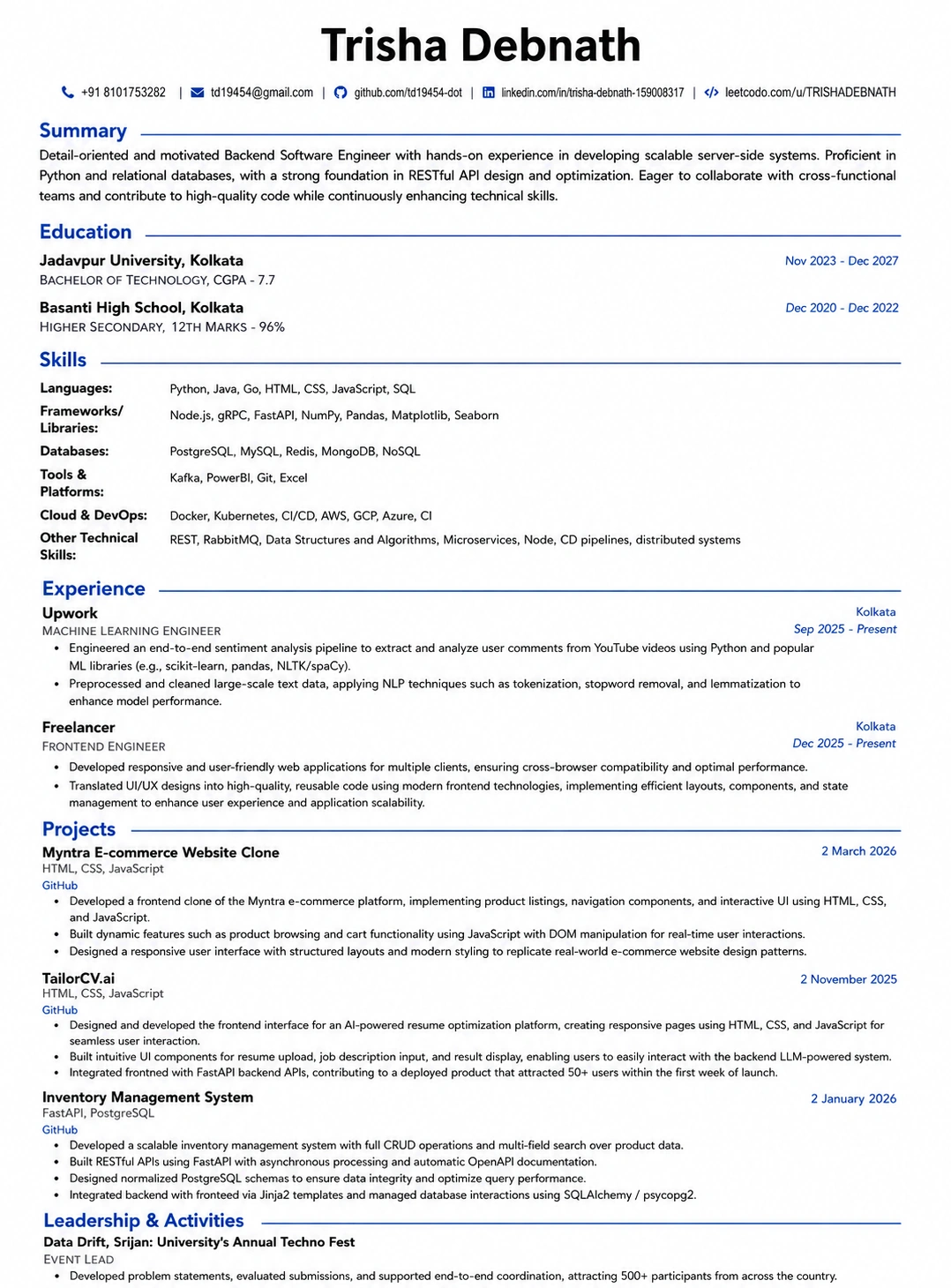
This template is ATS-tested — start from it and the formatting rules in this guide are already handled.
Was this guide useful?
Be the first to rate it.