TD
TD
Key Takeaways
- The Red-White-Red Card is Austria's points-based route for qualified third-country workers, and it is unusually transparent about what it rewards.
- Categories include Very Highly Qualified Workers, Skilled Workers in Shortage Occupations, Other Key Workers, Graduates of Austrian universities, Start-up Founders and Regular Workers.
- Graduates of Austrian institutions have their own category with a lower threshold — the most relevant route if you studied there.
- Very Highly Qualified Workers can obtain a six-month job seeker visa to come and look for work before having an offer.
- EU/EEA and Swiss citizens need none of this — free movement applies.
How the points system works
Austria assesses qualified third-country applicants against published criteria and a threshold. That transparency is the system's real advantage: you can calculate your position before investing months.
Points are awarded across categories including your highest qualification, work experience, language skills in German and English, age, and in some categories studies completed in Austria.
Each category has its own threshold and its own criteria — the scoring for a Very Highly Qualified Worker is not the scoring for a Skilled Worker in a Shortage Occupation.
Younger applicants score better on age, which is unusual to state plainly but is how the system works.
Language points are available for both German and English, which matters because it means English ability is genuinely credited rather than merely tolerated.
The published criteria are the authority. Migration.gv.at is the official portal, and the point values and thresholds are revised — check there rather than relying on any summary, including this one.
The categories, and which fits you
Very Highly Qualified Workers. The top category, for people with strong qualifications and experience. Its distinguishing feature is that you do not need a job offer to apply — reach the threshold and you can obtain a job seeker visa valid for six months to come to Austria and look. Once you have an offer, it converts.
Skilled Workers in Shortage Occupations. For occupations on Austria's published shortage list, which is updated annually and includes many engineering, technical and health roles. Requires a job offer matching the occupation.
Other Key Workers. For roles that do not fit the above but where the employer can demonstrate the need, subject to a labour market test and minimum pay.
Graduates of Austrian universities and colleges. A dedicated category with more favourable conditions for people who completed a degree in Austria. This is the route most students should be planning around.
Start-up Founders. For entrepreneurs with an innovative product or service, a business plan and capital.
Regular Workers, and separately the EU Blue Card, which Austria also operates with its own salary threshold.
The Austrian graduate route
If you studied in Austria, this is your route and it is a good one.
After completing a degree at an Austrian university or university of applied sciences, you can obtain a residence permit to stay and look for work.
Once you find a qualifying job, you apply for a Red-White-Red Card under the graduates category, which has a lower minimum salary threshold than the general routes — a deliberate policy to retain people the country has already educated.
No labour market test applies to this category, which removes the largest source of employer hesitation.
The strategic implication is the same as everywhere else in this series: studying in the destination country is the most reliable route into its labour market, and Austria has structured its policy to make that explicit.
After the card
The Red-White-Red Card is initially tied to your employer and valid for a defined period.
The Red-White-Red Card plus is the next stage — it grants free access to the labour market, meaning you are no longer tied to one employer. You become eligible after a qualifying period.
Long-term residence (Daueraufenthalt-EU) follows a longer qualifying period and carries an integration requirement, including German language ability and knowledge of Austrian society.
Family members can be included, with their own conditions and, in some cases, their own labour market access.
Check current thresholds and periods on migration.gv.at. Every figure in this area moves.
The application process
Who does what, and the sequence.
Your employer usually initiates. For most categories the Austrian employer applies to the regional authority, or you apply jointly, with the employer providing details of the position and pay.
AMS assesses the criteria — the public employment service checks the points, the salary and, where applicable, the labour market test.
You apply for the residence title at an Austrian representation abroad, or in Austria if you are already there legally under certain conditions.
Documents you will need: passport, qualification certificates with translations, evidence of experience, language certificates, proof of accommodation and health insurance, and the employment offer.
Qualification recognition may be required, and for regulated professions it is mandatory. This is the step most likely to delay everything, so start it early.
Processing takes weeks to months, depending on the category and the completeness of your file.
On arrival, complete your Meldezettel and collect your card.
Renewals are applied for before expiry, and the transition to Red-White-Red Card plus is applied for once you meet the qualifying period.
Comparing Austria to its neighbours
Useful context if you are choosing between German-speaking countries.
Against Germany. Similar language and industrial character. Germany's market is far larger with correspondingly more competition; Austria's points system is more transparent than Germany's route structure. Germany's Opportunity Card is a closer analogue to Austria's job seeker visa than anything else in the region.
Against Switzerland. Switzerland pays considerably more and is far harder to enter for third-country nationals, with quotas and a priority test. Austria's points route is genuinely open by comparison.
Against the Netherlands. The Netherlands is much more English-friendly and its orientation year is more generous to foreign graduates. Austria requires German for most of the market but has less competition.
The honest summary: Austria suits a German-speaking qualified graduate very well, particularly in engineering, and suits a non-German-speaker only in Vienna's international sector.
What can go wrong
The failure modes, most of them preventable.
Points fall short. Calculate before you commit. The published criteria make this knowable in advance, and discovering it late wastes months.
The salary is below the category threshold. Each category has a minimum, and an offer below it cannot support the application regardless of enthusiasm on either side.
Qualification recognition is missing. For regulated professions this is mandatory, and it is the step most likely to delay a file. Start it before you have an offer if you can.
Documents are untranslated or uncertified. Certificates generally need certified German translations, and some need apostille or legalisation from the issuing country.
The employer stalls. Austrian employers unfamiliar with the process sometimes underestimate it. Ask early whether they have done it before, and be prepared to explain the steps yourself.
The occupation does not match the shortage list. If you are applying under that category, the match has to be genuine — the list is specific about occupations rather than broad fields.
And the file is incomplete. Austrian administrative processes are unforgiving about completeness. One missing document restarts the clock rather than being chased for.
Family and the longer view
The questions that follow an approval.
Family reunification is available to Red-White-Red Card holders for spouses, registered partners and children, subject to conditions including adequate accommodation, health insurance and sufficient income.
A spouse receives a Red-White-Red Card plus in many cases, which carries free labour market access — a genuinely favourable arrangement compared with systems where a spouse's right to work is restricted.
German language requirements apply to family members in some circumstances, both before entry and as part of integration obligations afterwards.
Children's schooling is free and public, taught in German, with support provision for newcomers.
The integration agreement (Integrationsvereinbarung) obliges most residence title holders to reach a defined German level within a set period. This is not optional and it matters for renewals and for long-term residence.
Long-term residence and citizenship both carry higher German requirements and longer residence periods, and Austria's citizenship rules are among the more restrictive in Europe on dual nationality. Check the current position before assuming.
Mini checklist
- unchecked: EU/EEA status confirmed — if yes, none of this applies
- unchecked: Points calculated against the correct category
- unchecked: Shortage occupation list checked for your field
- unchecked: Austrian graduate category considered if you studied there
- unchecked: Job seeker visa route checked if you are highly qualified
- unchecked: German and English levels documented for points
- unchecked: Qualification recognition started if your profession is regulated
- unchecked: Salary threshold for your category confirmed
- unchecked: Path to Red-White-Red Card plus understood
Scenarios
Scenario 1: You have a strong qualification and no job offer
Check whether you reach the Very Highly Qualified Workers threshold. If you do, the six-month job seeker visa lets you come to Austria and search from inside the country — a materially better position than applying from abroad.
Scenario 2: You are studying in Austria
Plan around the graduates category. Lower salary threshold, no labour market test, and a permit to stay and look for work first. It is the smoothest route the system offers.
Scenario 3: Your occupation is on the shortage list
Say so explicitly to employers. The shortage occupation route is more straightforward for them, and many hiring managers do not know the list exists.
Tip: Calculate your points before doing anything else. Austria publishes its criteria and thresholds, which means you can know in an evening whether this route is realistically open to you — a certainty almost no other European system offers.
Do's and Don'ts
Do
- Calculate points against the specific category
- Check the shortage occupation list annually
- Use the graduates category if you studied in Austria
- Document your German and English levels for points
- Consider the job seeker visa if you qualify
- Read migration.gv.at for current figures
Don't
- Assume one set of criteria covers all categories
- Overlook the graduates route
- Rely on point values quoted secondhand
- Forget that English ability earns points too
- Assume the card gives free labour market access immediately
- Leave qualification recognition until late
Common Mistakes
- Not calculating points. The system is transparent and the answer takes an evening.
- Using the wrong category's criteria. Each has its own scoring and threshold.
- Missing the graduates route. Lower threshold, no labour market test.
- Ignoring English points. German is not the only language that scores.
- Assuming immediate labour market freedom. That comes with the Red-White-Red Card plus, later.
- Stale figures. Thresholds and points are revised regularly.
Related Guides
Keep building on this with the related guides in this series:
- Working in Austria as an International Graduate
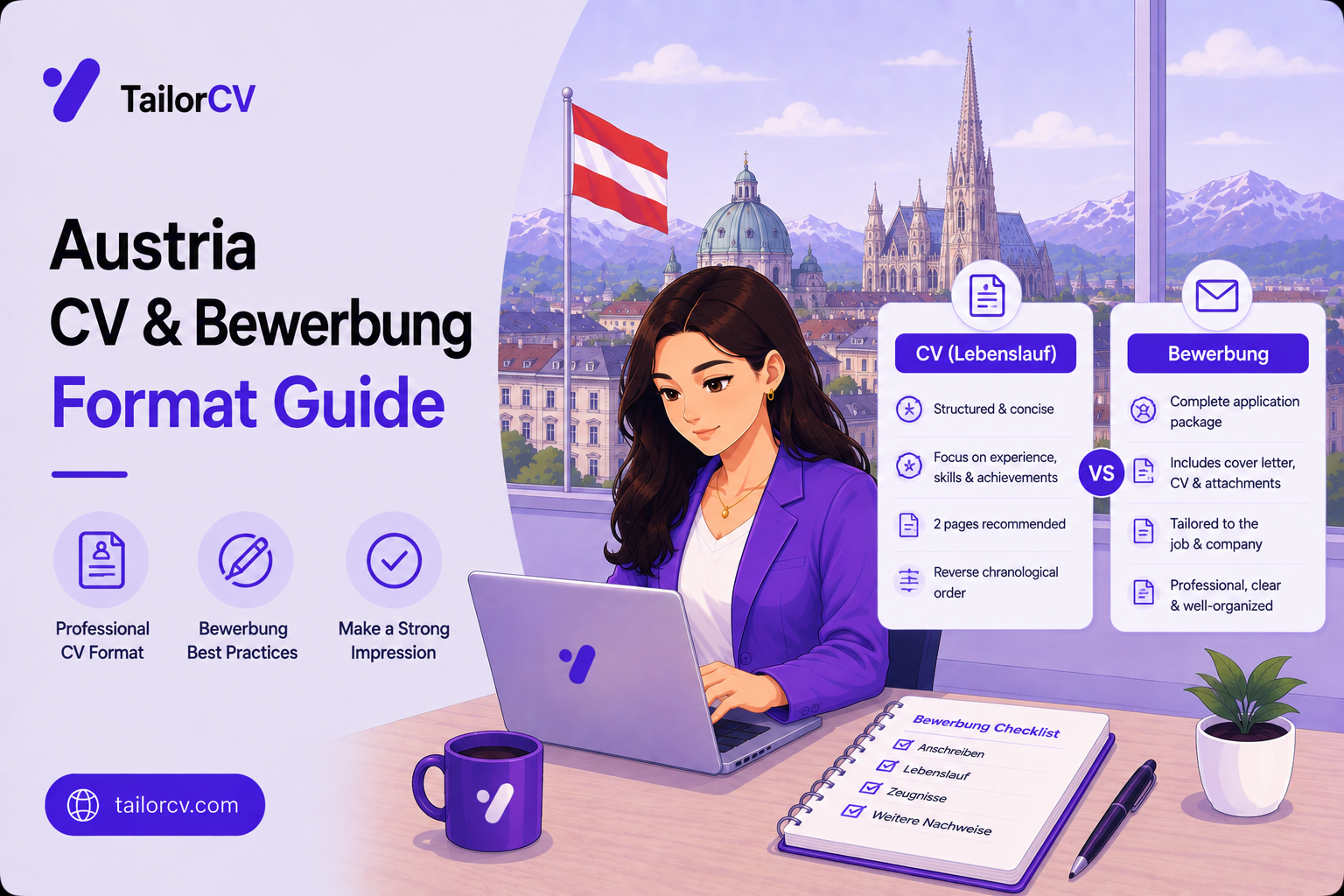
- The Austrian Bewerbung and CV Format
- The EU Blue Card for Graduates
- Swiss Work Permits for Graduates
- The Norwegian Skilled Worker Permit
You can also check your resume's ATS score for free, generate a tailored cover letter, or build a portfolio website in minutes.
Frequently Asked Questions
What is the Red-White-Red Card?
Austria's points-based residence and work permit for qualified third-country nationals, scoring qualification, experience, language ability and age against a published threshold.
Can I come to Austria without a job offer?
If you reach the Very Highly Qualified Workers threshold, yes — a six-month job seeker visa lets you come and look for work, converting once you have an offer.
Is there a special route for Austrian graduates?
Yes, with a lower minimum salary threshold and no labour market test. It is the most favourable route in the system and the reason studying in Austria is a strong strategy.
Do EU citizens need a Red-White-Red Card?
No. EU, EEA and Swiss citizens have free movement and none of this applies to them.
Does English count for points?
Yes. Points are available for both German and English ability, so English is genuinely credited rather than merely tolerated.
What is the Red-White-Red Card plus?
The next stage, granting free access to the labour market rather than being tied to one employer. You become eligible after a qualifying period on the initial card.
Who applies for the Red-White-Red Card, me or my employer?
Usually the employer initiates with the regional authority, with AMS assessing the points, salary and any labour market test. You then apply for the residence title at an Austrian representation.
How does Austria compare to Germany for a graduate?
Similar language and industry with a smaller, less competitive market and a more transparent points system. Germany offers scale; Austria offers clarity and less competition.
What causes Red-White-Red Card applications to fail?
Points falling short of the category threshold, salary below the minimum, missing qualification recognition, untranslated documents, or an occupation that does not genuinely match the shortage list.
Can my family join me on a Red-White-Red Card?
Yes, subject to accommodation, insurance and income conditions. A spouse frequently receives a Red-White-Red Card plus with free labour market access, which is favourable compared with many systems.
What is the integration agreement?
An obligation on most residence title holders to reach a defined German level within a set period. It is not optional and it affects renewals and long-term residence.
What is your resume scoring right now?
Scan it against a job description and get your ATS match score in about a minute.
Drop your resume here or choose a file
PDF only. Max 2 MB.
We never share your data or use it to train AI models.

Was this guide useful?
Be the first to rate it.