 TD
TD

Key Takeaways
- The decisive difference is who controls the permit: you, or an employer. Canada and the UK give the graduate an open permit; the US and Singapore route control through employers.
- Runway length varies enormously, and it determines how many chances you get at a longer-term status.
- The US is the only one of the four where the main long-term route runs through a lottery.
- Canada is the only one where the graduate route is designed as a step toward permanent residence.
- Rules in all four have changed in recent years. Verify current details with the official authority before making decisions.
The comparison at a glance
| Who applies | Employer-tied | Typical runway | Route to longer stay | |
|---|---|---|---|---|
| USA | You (OPT), employer (H-1B) | OPT no, H-1B yes | 12 months, 36 with STEM | H-1B lottery, or cap-exempt employers |
| UK | You | No | Graduate route, fixed period | Skilled Worker visa, employer-sponsored |
| Canada | You | No | Tied to programme length | Work experience feeds PR pathways |
| Singapore | Employer | Yes | Tied to the job | Renewal, then longer-term residence routes |
The table is a shape, not a legal summary. Every one of these has changed recently and all four have detail the table cannot hold.
The United States
You apply for OPT yourself, and it is not employer-tied — you can change jobs freely. Twelve months, extendable by a further period if your degree is STEM-designated.
The complication is what comes next. The main long-term route for graduates is the H-1B, which is employer-sponsored, capped, and allocated by random lottery. Being an excellent candidate does not improve your odds within a pool.
That single fact shapes everything. Because registration happens once a year, your number of attempts is decided by how long your work authorisation lasts — which is why STEM eligibility matters more than almost any other administrative detail in the US system.
Best suited to: graduates in STEM fields who want maximum earning potential and can tolerate uncertainty, or anyone who can access cap-exempt employers such as universities and affiliated non-profits, where no lottery applies.
Hardest part: the mismatch between a hiring calendar that runs a year ahead and a permit clock that starts at graduation.
The United Kingdom
The Graduate route is applied for by you, is not tied to an employer, and does not require a job offer. You can work, switch jobs, be self-employed, or look for work.
The transition afterwards is to the Skilled Worker visa, which does require an employer — and specifically an employer holding a sponsor licence, meeting salary thresholds for the role.
The practical consequence is a two-phase search. Phase one is free: any employer will hire you because there is no sponsorship burden. Phase two is narrow: only licensed sponsors can retain you. Graduates who spend their whole graduate-route period at a non-sponsoring employer arrive at the end with no route forward.
Best suited to: graduates who want time to explore without employer dependency, and who are deliberate about moving to a sponsoring employer before the clock runs down.
Hardest part: the temptation to take any job because the permit allows it, then discovering the employer cannot sponsor.
Canada
The post-graduation work permit is an open permit, applied for by you, with length tied to your programme.
What makes Canada structurally different is the destination. The permit is explicitly a bridge to permanent residence: Canadian work experience feeds Express Entry and provincial nominee programmes. You are accumulating something durable rather than waiting for a lottery or an employer's willingness.
That changes how you should choose a first job. The occupational classification of the role, and the province you work in, can matter as much as the salary, because they affect which PR pathways you qualify for and how strongly.
Best suited to: graduates whose goal is permanent residence rather than maximum short-term earnings.
Hardest part: the permit is normally issued once, so when you use it is a real decision. And rules have changed repeatedly, including field-of-study requirements for some programmes.
Singapore
The most employer-controlled of the four. The Employment Pass is applied for by the employer and tied to that job. There is no equivalent of an open graduate permit you hold independently.
Qualifying salary rises with age, which favours fresh graduates — you face the lowest threshold on the scale. A points-based assessment sits alongside it, scoring things including the employer's workforce composition, which is why two firms respond differently to identical candidates.
Best suited to: graduates of local institutions, and anyone with skills scarce enough that employers will absorb the process.
Hardest part: you cannot hold status independently, so a job loss is a status problem, not just an income problem.
How to choose
The right answer depends entirely on what you are optimising for, and being honest about that up front prevents most bad decisions.
If your goal is permanent residence: Canada, clearly. It is the only one of the four where the system is built for it. The permit is open, the work experience counts toward defined pathways, provincial streams add further routes, and the sequence is knowable in advance. The trade-off is generally lower salaries than the US and a job market concentrated in a few centres. The permit mechanics are worth understanding before you choose a programme, because eligibility now depends on your specific course and institution.
If your goal is maximum earnings and you are in a STEM field: the US, with clear eyes about the lottery. Salaries at the top are meaningfully higher than anywhere else on this list, the extension gives you several attempts rather than one, and the outcome at the decisive step is not merit-based. You are accepting genuine uncertainty in exchange for a higher ceiling. Understand employer eligibility before you apply anywhere, because it narrows your realistic market substantially.
If you want freedom to explore first: the UK. The graduate route is unsponsored, so you can take any job, change employers freely, and work out what you want without an employer holding your status. The trade-off is that continuing beyond it requires moving onto a sponsored route with its own thresholds, and that transition is a real hurdle rather than a formality.
If you want a regional base in Asia and have a scarce skill: Singapore.
No lottery, a shorter and more predictable path than the US, low taxes, and a hub position. The trade-off is that employment depends on an employer being able to sponsor you, the qualifying threshold rises with age, and the points assessment scores employer-side factors you cannot influence.
A caution on all four. Every one of these has changed materially in the last few years — US extension rules and processing, UK route length and salary thresholds, Canadian programme eligibility, Singaporean thresholds and the addition of the points assessment. Anything you read about this, including this page, should be verified against the official authority in the relevant country before you make a decision on it. And the decision worth making first is not which visa, but which job, in which city, at which kind of employer — because the visa question only becomes answerable once you know that.
The comparison, at a glance
| United States | United Kingdom | Canada | Singapore | |
|---|---|---|---|---|
| Post-study route | Training period, extendable for designated STEM fields | Graduate route, unsponsored | Post-graduation work permit | No general post-study permit |
| Who controls it | You initially; employer thereafter | You | You | Employer |
| Open permit? | Employer-linked in practice | Yes | Yes | No |
| Runway | Short, longer with STEM extension | Fixed period, longer for doctorates | Tied to programme length | N/A — employment pass from the start |
| Main long-term route | Lottery-based | Sponsored route with salary threshold | Points-based residence pathway | Pass renewal, then residence application |
| Designed toward residence? | No | Not directly | Yes, explicitly | Not directly |
| Employer must qualify? | Yes, for the extension and for petitions | Sponsor licence needed for the next stage | No | Yes — points assessment scores the employer |
| Issued more than once? | Extension is one-time | Generally once | Normally once in a lifetime | Renewable while employed |
The line that matters most is the second one: who controls the permit.
The UK and Canada hand the graduate an open permit and let them find work. That means you can take a job at an employer who has never hired an international graduate, leave a bad first job without losing your status, and work while you look. It is a fundamentally different position from the other two.
The US and Singapore route control through employers. Your options are constrained to employers who are both willing and structurally able to hire you — which is a much smaller set than the job market, and which you must filter for before you apply anywhere.
The other line worth reading carefully is the last-but-one. Canada is the only one of the four where the graduate route is explicitly designed as a step toward permanent residence, with the work experience you accumulate feeding directly into the main pathways. The others require a separate transition that is not guaranteed and, in the US case, runs through a lottery.
Country by country, in more detail
The United States.
A post-graduation training period, with an extension available to graduates of designated STEM fields. The extension is the pivotal feature: it multiplies your attempts at the main long-term route, which is allocated by lottery.
Two things constrain you beyond your own qualifications. Employer eligibility — the extension requires the employer to be enrolled in a federal verification scheme and to sign a training plan, and many smaller employers are not enrolled. And the lottery itself, which is the only step among these four countries where the primary path is not merit-based at the point of selection.
Best suited to: STEM graduates targeting high-paying technical roles who can accept genuine uncertainty at the decisive step. Hardest part: the lottery, and the fact that a strong career can still end in departure through no fault of yours.
The United Kingdom.
A graduate route giving a fixed period of unsponsored work rights, longer for doctoral graduates. Open — no employer needs to do anything, which means you can work anywhere, change jobs freely, and take time to work out what you want.
Continuing beyond it means moving onto a sponsored route with salary thresholds and an employer holding a sponsor licence. That transition is a real hurdle rather than a formality, and it is worth understanding before the route expires rather than during its final months.
Best suited to: graduates who want freedom to explore, and those in fields where the salary threshold for the next stage is comfortably clearable. Hardest part: the transition to sponsorship, which arrives as a cliff rather than a slope.
Canada.
An open post-graduation work permit whose length is tied to your programme's length, normally issued once. Uniquely among these four, the system is explicitly designed as a step toward permanent residence — the skilled work experience you accumulate feeds the main pathways, and provincial streams add further routes.
Eligibility has narrowed and now depends on your specific programme and institution, which is a recent change that catches people out. The permit mechanics are worth reading before choosing a course, not after.
Best suited to: anyone whose goal is permanent residence rather than maximum short-term earnings. Hardest part: the occupational category of your first job, which determines whether your experience counts — and which is invisible unless you check before accepting.
Singapore.
No general post-study permit. Employment runs through an employer-applied pass with a qualifying salary that rises with age and a points assessment scoring employer-side factors you cannot influence.
The compensating advantages are real: no lottery, a shorter and more predictable path than the US, low taxes, and a regional hub position. The threshold is also lowest for fresh graduates, which makes entering early structurally easier than arriving later.
Best suited to: graduates with scarce skills who want a base in Asia and value predictability over ceiling. Hardest part: employer dependence — your realistic market is limited to employers who are both willing and structurally able to sponsor, which is a much smaller set than the job market.
What each route asks of you
A different way to compare them: not by what they offer, but by what you have to be good at to succeed under each.
The US asks you to be good at targeting. Because employer eligibility narrows your market before you apply, and because the extension multiplies your lottery attempts, the decisive skill is filtering — building a list of employers who are enrolled, who have a filing history, and who hire graduates in your field. Candidates who apply broadly without that filter waste most of a season. Preparation and interview performance matter, and they matter downstream of a list built correctly in September.
The UK asks you to be good at conversion. The open route hands you time and freedom; what it does not hand you is a path beyond it. The skill that matters is using that window to reach a role that clears the sponsored route's threshold, at an employer with a sponsor licence. Graduates who spend the whole period in roles that cannot lead to sponsorship arrive at the end with nothing to convert.
Canada asks you to be good at planning. The permit is open and generous and the pathway is explicit — which means the failure mode is not a closed door but an accumulated mismatch. Wrong occupational category, experience that does not count, an application started too late. It is the route where reading the rules carefully in advance produces the largest return.
Singapore asks you to be good at employer selection. Your eligibility is not a property of you; it is a property of the employer hiring you. The skill is identifying organisations that are structurally able to sponsor and applying to those, early, while the age-linked threshold is at its lowest.
What none of them asks for is the thing students spend most of their anxiety on — being the strongest candidate in the abstract. In all four, the constraint that binds is structural, knowable in advance, and addressed by research rather than by effort. Which is genuinely good news: it means the highest-return work in this whole area is an afternoon with the official guidance and a spreadsheet, done a year before it matters.
Where to verify each one
Everything on this page should be checked against the official source before you act on it, because all four have changed materially in recent years and secondhand summaries go stale quietly.
United States. The immigration services agency for petition and status rules, and the student and exchange visitor programme guidance for training-period rules. Your institution's international student office is the authority on your own designation and dates.
United Kingdom. The government's immigration pages for route eligibility, length and salary thresholds, and the register of licensed sponsors to check whether an employer can sponsor the next stage.
Canada. The federal immigration department for permit eligibility, duration and residence pathways, plus the relevant provincial programme pages, since provincial streams have their own criteria.
Singapore. The Ministry of Manpower for pass types, qualifying salaries and the points assessment.
Two habits worth adopting. Check the page's last-updated date before relying on it, and prefer the official source over any article, including this one, for anything decision-critical. Where your case is unusual — a change of status, a gap, an uncertain designation — pay for advice on your specific facts rather than generalising from someone else's.
Common Mistakes
- Assuming the permit is the destination. All four are bridges; the question is what they bridge to.
- Taking any job because the permit allows it. In the UK especially, a non-sponsoring employer is a dead end.
- Ignoring occupational classification in Canada. It affects PR eligibility more than salary does.
- Assuming STEM status in the US. It is determined by programme code, not by how technical the subject sounds.
- Relying on articles for current rules. Including this one — all four systems have changed recently.
- Starting the search after graduating. Every one of these clocks starts running whether or not you are ready.
The mistakes that cost the most
Each of these is common, and each is made at a point where it is still avoidable.
Choosing a country before checking whether it hires internationally in your field.
Some fields are gated by licensing, certification or clearance in ways that no amount of academic performance overcomes. Fifty real job postings in your target city tells you this in an afternoon, and the country-choice guide sets out how to read them.
Assuming a permit is a path. A post-study work permit is a window, not a destination. What matters is what it leads to and whether the transition is realistic for you. Canada is the only one of these four where the connection is designed in.
Ignoring employer eligibility until offer stage. In the US and Singapore, whether an employer can hire you is a separate question from whether they want to, and it is answerable before you apply. Candidates who leave it late spend entire seasons applying into pools that were never open to them.
Taking the first job without checking what it counts as. Most damaging in Canada, where the occupational category of your work — not the salary or the title — determines whether the experience feeds a residence pathway. Fifteen minutes of checking before you sign.
Reading old information. All four countries have changed rules materially in the last few years: US processing and extension details, UK route length and thresholds, Canadian programme eligibility, Singaporean thresholds and the new points assessment. Forum posts and undated articles are the most common source of expensive errors here.
Optimising for the wrong variable. Salary is easy to compare and it is rarely the binding constraint. Runway length, who controls the permit, and whether the route leads anywhere matter more to the outcome, and they are the variables people weigh last.
Deciding the visa before deciding the job. The most fundamental one. Work backwards from the role, the city and the employer type — the visa question only becomes answerable once you know what you are actually trying to do.
Frequently Asked Questions
Which country is easiest for international graduates?
Canada is generally the most structurally welcoming, because the permit is open and leads toward permanent residence by design. Easiest to enter is not the same as best for your field or earnings.
Can I move between these countries later?
Yes, and many people do. Work experience in any of the four is portable, and several systems weight foreign work experience in their points assessments.
Does a master's help?
In the US it improves H-1B lottery odds because advanced-degree holders get two draws. Elsewhere its effect is mainly on employability and salary thresholds rather than on permit mechanics.
Which has the longest runway?
It depends on programme length and field. STEM graduates in the US and graduates of longer Canadian programmes generally have the most, but the comparison is not like-for-like because the routes lead to different destinations.
Do I need a job offer before graduating?
Not for the US, UK or Canadian graduate routes, which you hold independently. For Singapore, yes — the pass is employer-applied and tied to the role.
How current is this?
The structures described are stable; the specific durations, thresholds and eligibility criteria are not. Check USCIS, the Home Office, IRCC and MOM respectively before making a decision that depends on a number.
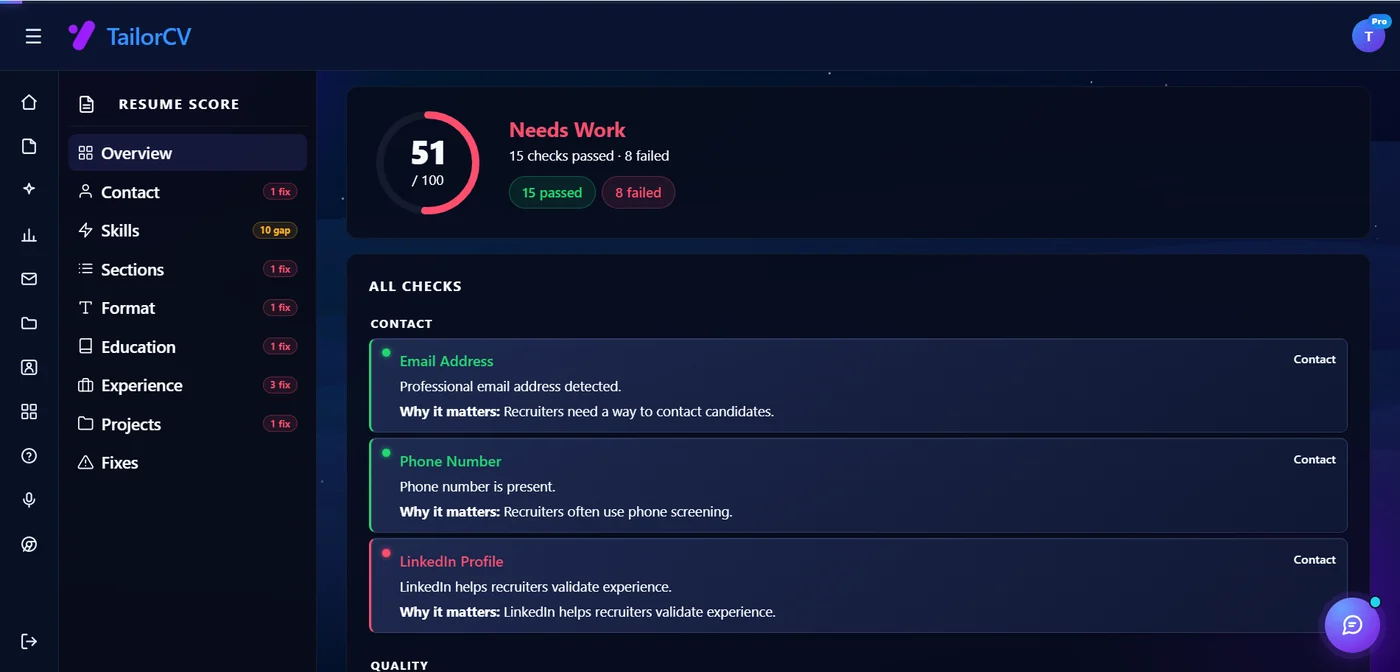
What is your resume scoring right now?
Scan it against a job description and get your ATS match score in about a minute.
Drop your resume here or choose a file
PDF only. Max 2 MB.
We never share your data or use it to train AI models.
Was this guide useful?
Be the first to rate it.