 SS
SS
Key Takeaways
- Italy operates an annual quota system — the decreto flussi — for most non-EU work permits, with a fixed application window that opens once a year.
- The nulla osta is the authorisation the employer obtains before you can apply for a visa; nothing proceeds without it.
- Several routes sit outside the quota, including the EU Blue Card, intra-corporate transfers, researchers and some highly qualified categories.
- Graduates of Italian universities can convert a study permit to a work permit, which is a substantially easier path.
- The permesso di soggiorno — residence permit — must be applied for within days of arriving.
The quota system
This is the structural fact that shapes everything for non-EU applicants.
Italy sets annual quotas by decree — the decreto flussi — specifying how many non-EU workers may be admitted in which categories, from which countries, for the year.
Applications open in a defined window, often for a limited period, and are submitted electronically. Demand routinely exceeds the quota within a very short time of opening.
This means timing is decisive. An employer who is not ready to submit within the window waits a year, regardless of how much they want to hire you.
Subordinate work quotas cover ordinary employed work, with sub-quotas by sector and nationality.
Seasonal quotas are separate and cover agriculture and tourism.
The practical implication for a graduate: if your route depends on the quota, plan around the window, and make sure your employer knows it exists. Many Italian SMEs do not.
The routes that bypass the quota
Which is why this section matters more than the last one for most readers.
The EU Blue Card. For highly qualified workers with a higher education qualification and a salary above the applicable threshold. It sits outside the quota, which makes it dramatically easier, and Italy has broadened its Blue Card provisions in recent years. If you are a qualified graduate with a decent offer, this is the route to aim at.
Intra-corporate transfers, for people moving within a multinational.
Researchers, under the specific research permit route.
Highly specialised workers in certain defined categories.
Conversion from a study permit. Graduates of Italian universities can convert their study residence permit into a work permit, and this conversion has its own provisions rather than competing in the general quota.
Self-employment has its own quota and its own more complex requirements.
The strategic read is the same as everywhere else in this series: studying in Italy is by a wide margin the most reliable route into the Italian labour market for a non-EU national.
The nulla osta and the sequence
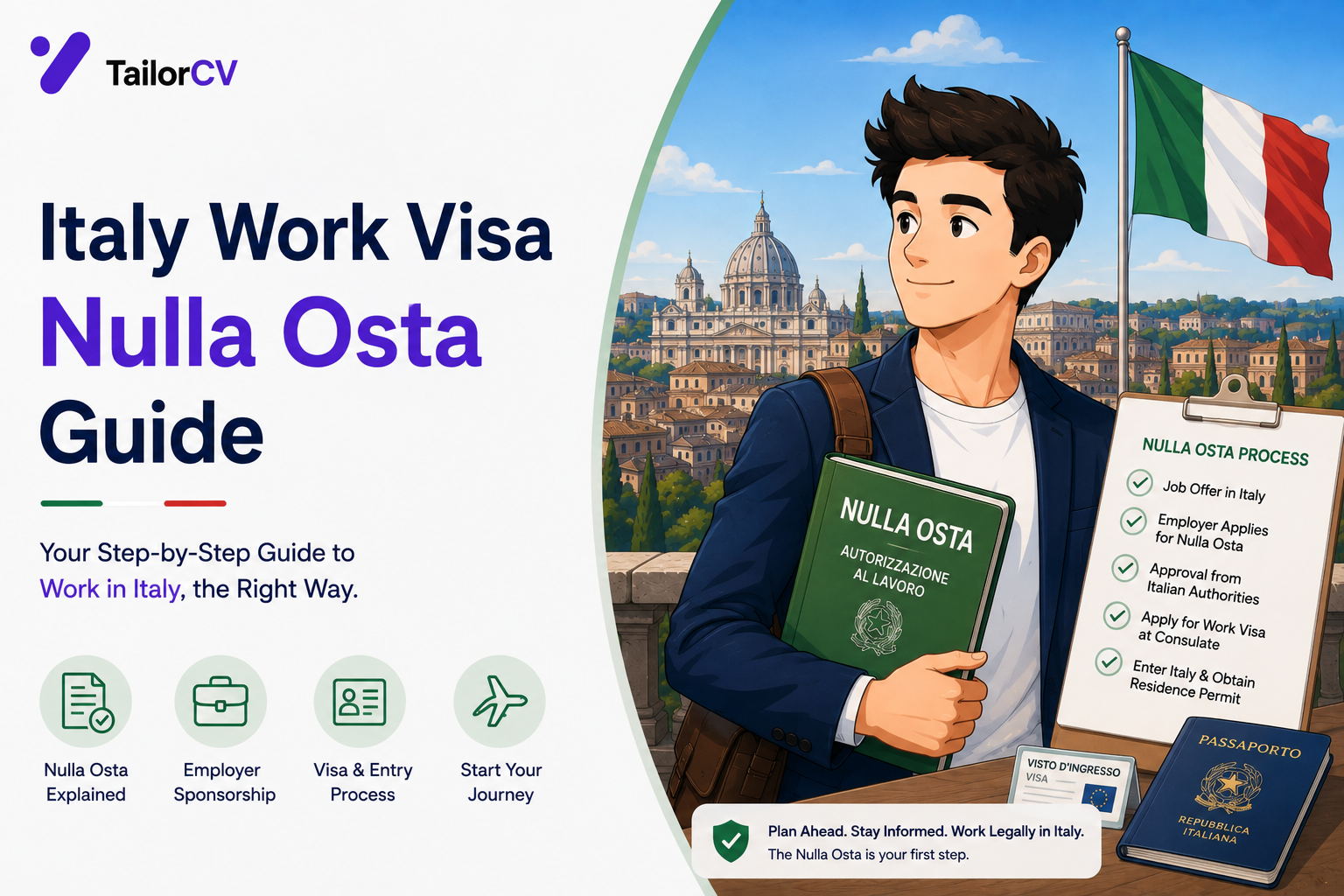
The employer applies for the nulla osta — literally "no impediment" — from the Sportello Unico per l'Immigrazione, the single immigration desk, in the province where the work will be performed.
The employer must show a genuine job offer, appropriate accommodation for you, and terms meeting Italian standards including the applicable collective agreement.
Once the nulla osta is granted, it is transmitted to the Italian consulate in your country, where you apply for the entry visa.
You enter Italy on the visa, and then — critically — apply for the permesso di soggiorno within eight days of arrival. This is a hard deadline and missing it creates real problems.
The application goes through a post office kit, of all things, followed by an appointment at the questura for fingerprints.
The permesso is issued for a defined period tied to your contract and is renewable.
Codice fiscale — the Italian tax code — is needed for almost everything and is obtained separately.
After arriving
The administrative sequence, which is more involved than in most of Europe.
Codice fiscale — the tax code — from the Agenzia delle Entrate. Needed for a contract, a bank account, a rental agreement and a phone.
Permesso di soggiorno application within eight days, submitted through the designated post office kit, followed by a questura appointment for fingerprints.
Residenza — registering your residence with the comune, which triggers an address verification visit and is required for full healthcare registration.
Tessera sanitaria — the health card, following registration with the local health authority, which assigns you a family doctor.
Bank account, which generally needs the codice fiscale and proof of address.
Expect the process to be slow and paper-heavy. Italian administration is genuinely more demanding than in Northern Europe, appointments can be hard to obtain, and patience is a practical requirement rather than a virtue.
Keep copies of everything. Multiple copies. This is not paranoia in the Italian administrative context.
Family and the longer view
Family reunification is available to permit holders, with conditions on income and accommodation, and it sits outside the quota system.
Blue Card holders have more favourable family provisions than the general route — another reason to aim for that card.
A spouse's right to work generally follows from the family permit, but confirm your specific case.
Schooling is free and public, taught in Italian, with support for newcomers.
Long-term residence — the permesso di soggiorno UE per soggiornanti di lungo periodo — follows a qualifying period of legal residence plus an Italian language test at a defined level and income requirements.
Citizenship by residence requires a longer period, with a shorter path for EU nationals and for spouses of Italian citizens, plus a language requirement. Italy also has ancestry-based citizenship provisions that are worth checking if you have Italian descent — this is a genuinely common route that many people are unaware applies to them.
Common misreadings
Five beliefs that cost people a year.
"I can find a job and then sort the paperwork." For most non-EU routes the employer must obtain the nulla osta before you enter, and the general route depends on an annual quota window.
"The quota is a formality." It fills within a very short period of opening. Timing is genuinely decisive.
"All work permits go through the quota." They do not. The Blue Card, intra-corporate transfers, researchers and study conversions sit outside it, and these are the routes most qualified graduates should use.
"Eight days is approximate." It is not. The permesso deadline is enforced.
"My employer will know the process." Large employers do. Italian SMEs frequently have never hired a non-EU worker and will need you to explain the sequence.
"An EU passport from another member state has restrictions here." It does not — EU, EEA and Swiss citizens have free movement and none of the quota system applies.
Renewals and changing jobs
Renew before expiry. Applications are submitted in advance, and holding a receipt of a pending renewal generally allows you to remain and work while it is processed.
Changing employer is possible and the process depends on your permit type. A permesso for subordinate work is not always tied rigidly to one employer, but the change must be properly recorded.
Periods of unemployment are provided for — a permit holder who loses their job generally has a defined period registered as available for work before their status is at risk.
Converting between permit types — student to work, work to self-employment — has its own rules, and some conversions are constrained by the quota while others are not.
Keep every document. Contracts, payslips, permit decisions and residence registrations. Long-term residence and citizenship applications are evidence-based, and Italian administration will want the paper.
Costs and timelines to plan around
The nulla osta application is made by the employer and carries administrative costs on their side.
The visa fee at the consulate, paid by you.
The permesso di soggiorno carries a fee, a revenue stamp and the postal kit cost, plus a further electronic permit charge.
Document legalisation and certified translation for your qualifications and civil documents — frequently the largest single cost and the slowest step.
Timeline realistically: the quota window, the nulla osta decision, the visa appointment and issue, travel, and then the permesso process after arrival. Months rather than weeks even when everything goes smoothly.
The Blue Card route is faster because it sits outside the quota, but the document preparation is the same.
Do not resign a current job until the nulla osta is granted and the visa is in your passport.
Mini checklist
- unchecked: Nationality position established — EU or third country
- unchecked: Blue Card eligibility checked against qualification and salary
- unchecked: Quota window dates identified if you need the general route
- unchecked: Employer made aware of the decreto flussi timing
- unchecked: Study permit conversion considered if you studied in Italy
- unchecked: Codice fiscale obtained
- unchecked: Eight-day permesso deadline diarised
- unchecked: Accommodation evidence prepared for the employer's application
- unchecked: Documents legalised and translated as required
Scenarios
Scenario 1: You are a qualified graduate with a good offer
Aim for the EU Blue Card. It sits outside the annual quota, which removes the single biggest obstacle in the Italian system, and many employers do not know to apply under it.
Scenario 2: You are studying at an Italian university
Plan the study-to-work conversion. It has its own provisions rather than competing in the general quota, and it is the smoothest route the system offers.
Scenario 3: Your employer has never hired a non-EU worker
Tell them about the decreto flussi window early. An Italian SME that misses the annual opening cannot hire you for another year, and many are genuinely unaware of how the system works.
Tip: Apply for your permesso di soggiorno within eight days of arriving in Italy. It is a hard deadline, it is enforced, and it catches out people who assume they have a settling-in period first.
Do's and Don'ts
Do
- Target the Blue Card if you qualify
- Check the quota window if you need the general route
- Make sure your employer understands the timing
- Convert a study permit if you studied in Italy
- Apply for the permesso within eight days
- Get a codice fiscale early
Don't
- Assume your employer knows the quota system
- Miss the eight-day permesso deadline
- Rely on the general quota if a Blue Card route exists
- Underestimate the accommodation evidence requirement
- Leave document legalisation and translation late
- Expect the process to be fast
Common Mistakes
- Not knowing about the quota. It opens once a year and fills quickly.
- Missing the Blue Card option. It sits outside the quota entirely.
- The eight-day deadline. Hard, enforced, and frequently missed.
- Assuming employer knowledge. Many Italian SMEs have never done this.
- Late document preparation. Legalisation and certified translation take weeks.
- Ignoring the study conversion route. It is the easiest path for Italian graduates.
Related Guides
Keep building on this with the related guides in this series:
- Working in Italy as an International Graduate
- The Italian CV and Lettera di Presentazione
- Fashion, Design and Engineering Careers in Italy
- The EU Blue Card for Graduates
- The Red-White-Red Card Explained
You can also check your resume's ATS score for free, generate a tailored cover letter, or build a portfolio website in minutes.
Frequently Asked Questions
What is the decreto flussi?
Italy's annual decree setting quotas for non-EU workers by category and nationality, with a fixed application window that opens once a year and fills quickly.
What is a nulla osta?
The authorisation an Italian employer obtains from the immigration desk before you can apply for an entry visa. Nothing proceeds without it.
Does the EU Blue Card avoid the quota?
Yes, and that is its main practical advantage in Italy. For qualified graduates with a suitable offer it removes the single biggest structural obstacle.
Can I convert my Italian student permit to a work permit?
Yes. Graduates of Italian universities have provisions for converting a study residence permit into a work permit, outside the general quota competition.
When must I apply for the permesso di soggiorno?
Within eight days of arriving in Italy. It is a hard deadline and missing it creates real problems.
What is a codice fiscale?
The Italian tax code, needed for employment, banking, renting and essentially every administrative transaction. Obtain it as early as possible.
What must I do after arriving in Italy?
Get a codice fiscale, apply for the permesso di soggiorno within eight days through the post office kit, register your residence with the comune, and obtain your health card.
Can I get Italian citizenship through ancestry?
Italy has ancestry-based citizenship provisions that many people with Italian descent are unaware apply to them. It is worth checking your family history against the current rules.
Can I change employer on an Italian work permit?
Generally yes, depending on your permit type, with the change properly recorded. Periods of unemployment are also provided for, with a defined window registered as available for work.
Do EU citizens face the Italian quota system?
No. EU, EEA and Swiss citizens have free movement and none of the decreto flussi applies to them.
What is your resume scoring right now?
Scan it against a job description and get your ATS match score in about a minute.
Drop your resume here or choose a file
PDF only. Max 2 MB.
We never share your data or use it to train AI models.

Was this guide useful?
Be the first to rate it.