 TD
TD
Key Takeaways
- Placement drives frequently give a day or two of notice, so documents assembled in advance are documents you actually have.
- Marksheets for every semester, plus tenth and twelfth, are the most commonly requested set.
- Keep both digital scans and physical copies, named clearly and stored in one place.
- Discrepancies between your resume and your marksheets are checked at offer stage and cause real problems.
- A formal photograph, ID proof and a clean email address are small things that block applications when missing.
Placement season is the wrong time to discover your tenth standard marksheet is at home in another city, or that your only photograph is a cropped selfie. Drives are announced with short notice, forms have deadlines measured in hours, and a missing document is a straightforward way to lose an opportunity you had earned.
Assembling this once, before the season, takes an afternoon.
This guide is the checklist.
Start with the document everything else supports — run your resume through the free ATS score checker.
Academic documents
All semester marksheets. Every semester to date, not just recent ones. Companies frequently ask for the full set at verification.
Tenth and twelfth standard marksheets and certificates. Many companies screen on these, and students routinely do not have them to hand.
Degree certificate or provisional certificate, once available.
Consolidated marksheet or transcript, if your institution issues one.
Backlog clearance certificates, if applicable — see the campus placement backlog guide.
Bonafide or student status certificate from your institution, which some companies request.
CGPA to percentage conversion certificate. Many companies specify percentage criteria while your institution reports CGPA. The conversion formula varies by university, and a certificate from your institution resolves the ambiguity. Students discover this need at the worst moment.
Identity and personal
Photo ID — Aadhaar, PAN, passport or driving licence. Have at least two forms.
PAN card. Required at joining for payroll, and applying for one takes time. If you do not have one, start now.
Passport, if you have one. Some roles involve travel and companies ask early. Applying takes weeks, so if a role might require it, do not wait.
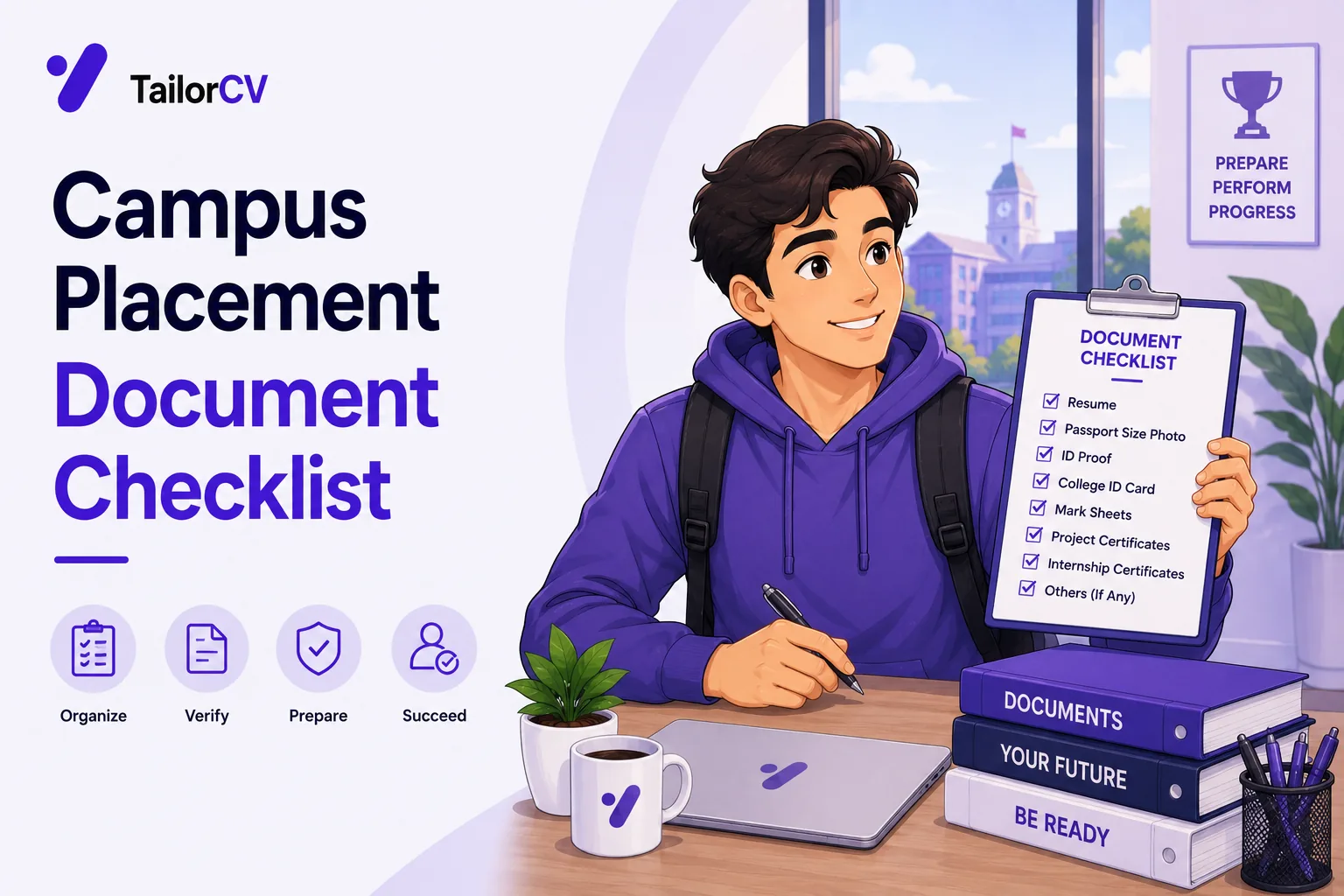
Formal photograph. Plain background, formal clothing, neutral expression, recent. You will need both digital and printed copies, in passport size and stamp size.
Bank account details, needed at joining.
What takes time to obtain — start these first
Most of the checklist is photocopying. These five are the ones with a waiting period, and every year students discover them during a two-day application window.
| Document | Typical wait | Where to start | When to do it |
|---|---|---|---|
| PAN card | 2–3 weeks | Online application, then verification | Now, if you do not have one |
| Passport | 4–8 weeks incl. police verification | Passport Seva appointment | Now, if any target role involves travel |
| CGPA→% conversion certificate | Few days to 2 weeks | Your examination or academic section | Start of final year |
| Bonafide certificate | 2–7 days | Department or administrative office | Start of final year, get two copies |
| Name correction on any document | Weeks to months | Depends on the document | Immediately, if there is a mismatch |
| Duplicate 10th/12th marksheet | 2–6 weeks | Your school board | Now, if the original is lost |
The last two rows are the ones that genuinely end applications. A name spelled differently on your Aadhaar and your marksheet is not something you can resolve in the forty-eight hours before a drive, and a lost tenth marksheet takes weeks to replace through a board.
Check your name on every document this week. Aadhaar, PAN, tenth marksheet, twelfth marksheet, degree records. If any two disagree — an initial expanded on one, a surname spelled differently, a middle name present on one and absent on another — start the correction now.
Professional documents
Your resume, in PDF, named properly — Firstname_Lastname_Resume.pdf. Keep two or three versions for different company types — see how to get shortlisted for campus placement.
Internship certificates and offer letters.
Project documentation and live links, ready to share — see choosing a final year project for placements.
Certifications, with completion certificates rather than just claims.
Achievement certificates — hackathons, competitions, leadership positions.
A GitHub link that works. Test it — see how to optimise your GitHub profile.
Organising it
One folder, two formats.
Digital: a single cloud folder with clearly named PDF scans — 10th_Marksheet.pdf, Sem5_Marksheet.pdf. Scans, not photographs taken at an angle. Many forms have file size limits, so keep compressed versions too.
Physical: a single file with photocopies of everything, plus originals kept separately and safely. Bring the file to every drive.
Naming matters more than it sounds. Uploading IMG_20260812_094533.jpg to an application portal looks careless, and some portals reject unclear filenames.
Keep a compressed copy of everything
Application portals routinely cap uploads at 500KB or 1MB per file, and a phone scan of a marksheet is frequently 4MB. Discovering this with twenty minutes left on a form is a genuinely common way to lose an application.
Keep two versions of every scan in the same folder:
10th_Marksheet.pdf— full quality, for printing and verification10th_Marksheet_small.pdf— compressed under 500KB, for portals
Also keep your photograph in three sizes: a high-resolution original, one under 200KB for forms, and a printed set in passport and stamp size. Forms specify dimensions and file size separately, and the combination catches people out.
Test one upload before the season. Take any portal that accepts a document and confirm your compressed files actually go through.
Consistency — the thing that causes real problems
Your resume, your marksheets and your application forms are read together at verification.
Check that these match exactly:
- Your name, spelled identically everywhere. Variations between documents cause genuine delays.
- Date of birth, consistent across ID documents and forms.
- CGPA or percentage, matching your marksheets exactly rather than rounded up.
- Dates of internships and projects.
- Institution name, as officially written.
Discrepancies get flagged at offer stage, which is the worst possible time. A rounding difference in your CGPA is a small thing that reads as carelessness at best.
Before each drive
A short pre-drive routine that prevents most problems:
- Read the eligibility criteria properly, including tenth and twelfth requirements
- Check which documents that specific company requires
- Confirm your resume version matches the company type
- Charge your laptop and test your internet if the round is online
- Have your file, ID and photographs with you physically
- Note the reporting time and location
Common Mistakes
Not having tenth and twelfth marksheets. Many companies screen on them and students frequently leave them at home.
Discovering a name mismatch during a drive. Corrections take weeks to months and cannot be done inside an application window.
No CGPA-to-percentage conversion certificate. Companies specify percentages while institutions report CGPA, and the formula varies by university.
Only having full-size scans. Portals cap uploads at 500KB or 1MB and a phone scan is frequently several times that.
Photographs of documents instead of scans. Angled, shadowed images look careless and some portals reject them.
Careless file names. IMG_20260812.jpg on an application portal reads badly and occasionally gets rejected outright.
Rounding your CGPA upward. It is checked against marksheets at verification, and the discrepancy reads as dishonesty rather than approximation.
No PAN card. It is needed at joining and applying takes two to three weeks.
Assembling documents after a drive is announced. Notice periods are frequently a day or two, which is not enough.
Frequently Asked Questions
Which documents are asked for most often?
All semester marksheets, tenth and twelfth marksheets, photo ID, a formal photograph and your resume. Many companies also want a CGPA-to-percentage conversion certificate.
Which ones should I start on first?
Anything with a waiting period — PAN card, passport, conversion certificate, and any name correction. The rest is photocopying and can be done in an afternoon.
Do I need tenth and twelfth marksheets?
Frequently yes — a meaningful number of companies screen on those marks, and students routinely do not have them available.
What is a CGPA to percentage conversion certificate?
An institutional document stating the official conversion formula, since companies specify percentage criteria while universities report CGPA and formulas differ.
My uploads keep failing on the portal. Why?
Almost always file size. Portals commonly cap at 500KB or 1MB while a phone scan is several megabytes. Keep a compressed copy of every document alongside the full-quality one.
What kind of photograph do I need?
Formal — plain background, formal clothing, neutral expression, recent. Have a high-resolution version, one under 200KB, and printed passport and stamp sizes.
Should I carry physical documents to drives?
Yes, in a single file with photocopies. Some rounds verify on the spot, and having it with you costs nothing.
What if my name is spelled differently on two documents?
Start the correction immediately. It takes weeks to months, and it causes real delays at offer and joining stage if left.
When should I get a PAN card?
Now, if you do not have one. It is required at joining and the application takes two to three weeks you will not have during the season.
Your resume is the document all of this supports. Check your ATS score free.
Make This Practical
Check your name on your Aadhaar, PAN, tenth marksheet, twelfth marksheet and degree records this week, and confirm they match exactly — same spelling, same initials expanded or not, same middle name present or absent. A mismatch takes weeks to months to correct and cannot be resolved inside a two-day application window, which is where students usually find it.
Then start the slow items now rather than in October: PAN card if you lack one, passport if any target role involves travel, and the CGPA-to-percentage conversion certificate from your examination section. Everything else on this list is photocopying and takes an afternoon.
Finally, scan everything twice — full quality for printing and verification, plus a compressed copy under 500KB for portals that cap uploads. Discovering the file size limit with twenty minutes left on a form is an entirely avoidable way to lose an application you had already earned.
What is your resume scoring right now?
Scan it against a job description and get your ATS match score in about a minute.
Drop your resume here or choose a file
PDF only. Max 2 MB.
We never share your data or use it to train AI models.

Was this guide useful?
Be the first to rate it.