 TD
TD
Key Takeaways
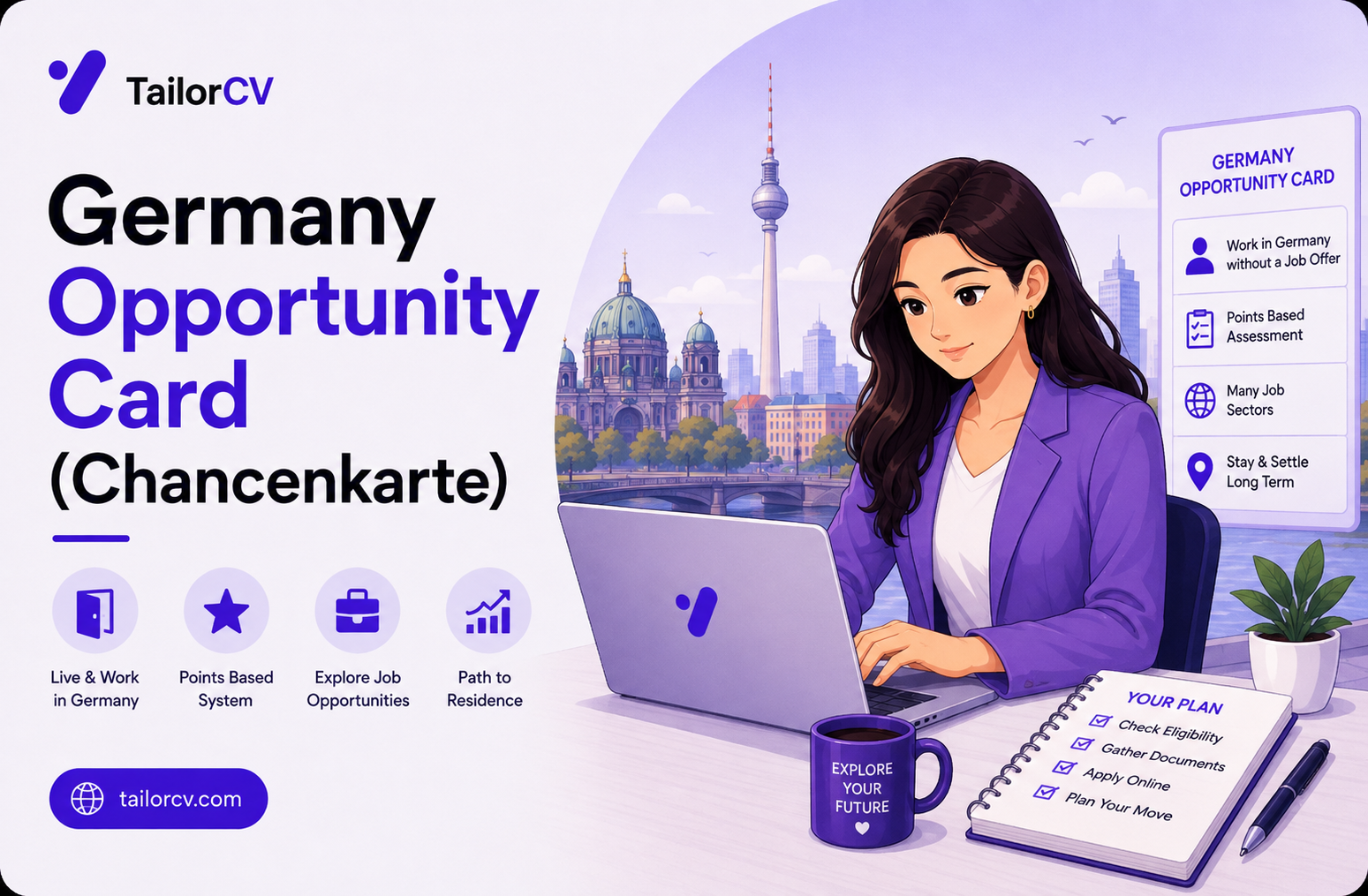
- The Chancenkarte (Opportunity Card) lets qualified people live in Germany and look for work before holding a job offer — the reverse of how most work visas operate.
- It runs on a points system scoring qualification, German and English ability, work experience, age, and prior ties to Germany.
- There is a baseline eligibility gate before points matter at all: a recognised qualification and proof you can support yourself.
- Card holders can work part-time while searching, and take trial employment with a prospective employer.
- It is a bridge, not a destination — the goal is to convert into a Blue Card or a standard work permit once you have an offer.
Why this route exists at all
Most work visas have a chicken-and-egg problem: you need an offer to get the visa, but employers are reluctant to hire someone who is not yet in the country and cannot start for months.
The Chancenkarte breaks that loop. It is a job-seeker permit — you arrive, you are legally resident, you attend interviews in person, you can start quickly when an offer comes. For anyone who has tried applying to German employers cold from another continent, the difference in response rate is the entire point.
Germany introduced it as part of a broader skilled-immigration reform aimed at addressing genuine labour shortages. It is a deliberate policy of bringing qualified people in to look, not an obscure loophole.
The eligibility gate, before points
Two things have to be true before the points system is even relevant.
A recognised qualification. Either a German-recognised university degree, or a vocational qualification of at least two years recognised by the German authorities. This is where anabin matters again — it is the database that determines how your foreign qualification is classified. Check it first.
Proof you can support yourself. You are arriving without a job, so you must demonstrate you can fund your stay. This is normally satisfied by a blocked account (Sperrkonto) holding a set amount, or by a formal declaration of commitment from someone in Germany. Part-time work is permitted once you arrive, but it is not accepted as proof at application.
A special case worth knowing: if your qualification is fully recognised as equivalent to a German one, you may qualify without needing to score on points at all. Check this before assembling a points case you may not need.
What earns points
| Factor | How it scores |
|---|---|
| German language | Scores at each level from A1 upward; higher levels score materially more |
| English language | Scores from B2 upward |
| Work experience | Relevant experience in the last several years, more for more |
| Age | Younger applicants score higher, with bands |
| Qualification | A qualification in a shortage occupation scores additionally |
| Ties to Germany | Previous study, residence or work in Germany |
| Spouse/partner | A partner who also meets the criteria adds points |
The exact points per band and the total required are set by regulation and revised, so check the current table on the Make it in Germany portal rather than any article — including this one.
The strategic read: German language is the factor most within your control and it scores at every level, not just at fluency. Someone sitting one point short is usually better served by taking an A2 or B1 certificate than by trying to move any other factor.
What you can actually do on it
- Look for work, in person, for the duration of the card.
- Work part-time — capped at a limited number of hours per week — to support yourself while searching.
- Take trial employment (Probebeschäftigung) with a prospective employer, up to two weeks, in a role matching your qualification. This is unusual and genuinely useful: it lets an employer try you before committing.
- Convert to a work permit or Blue Card once you have a qualifying offer, without leaving Germany.
What you cannot do is treat it as a general residence permit. It is time-limited and its purpose is finding qualified employment.
Who it actually suits
It suits you if: you have a recognised qualification, some German, savings to fund the blocked account, and you are applying into a market where being physically present changes your odds — which describes most of Germany outside the Berlin startup scene.
It suits you less if: you have no German at all and no savings buffer, or you are targeting exactly the internationally visible employers who already interview remotely and sponsor directly. In that case, applying for a job first and going straight to a Blue Card is simpler and cheaper.
What it actually costs to do this
The card fee is minor. The cost of the route is everything around it, and underestimating this is the most common practical failure.
The blocked account is the big one. You are demonstrating you can support yourself for the whole stay without employment, and the required sum is set by regulation and revised annually. It is not lost money — you draw it down monthly once you arrive — but you need it available upfront, and it is a serious amount to have sitting idle.
Then the smaller costs stack up: certified translations of your certificates, possible apostille or legalisation in your home country, a ZAB assessment if your degree needs one, health insurance for the full period, the visa fee itself, flights, and a deposit plus first rent on arrival.
German rental deposits are typically three months' cold rent (Kaltmiete), payable before you move in. In a competitive city market that is a substantial sum arriving at exactly the moment you have no income.
Budget for the full duration of the card, not for the first month. People arrive funded for six weeks, then take the first job offered rather than the right one, which defeats the purpose of coming to search properly.
Making the search work once you land
Being in the country is the advantage — use it rather than continuing to apply the way you would have from abroad.
Register your address (Anmeldung) immediately. Almost everything administrative in Germany depends on it: a bank account, a tax ID, a phone contract. Appointments at the Bürgeramt book out, so do this in your first days.
Get a German phone number and a German address on your CV. A local number and address materially change how a Mittelstand employer reads your application, because it answers the question of whether you can actually start.
Say plainly on your CV and in your cover letter that you hold an Opportunity Card and can start without sponsorship delay. Many German employers, especially smaller ones, assume any foreign candidate means a long visa process. One sentence removes that objection entirely — and it is the single most valuable thing you can write on the document.
Go to things in person. Meetups, job fairs, industry events. The whole reason for being physically present is that in-person contact converts at a rate cold applications never do.
After the card: what conversion actually requires
The card is a search window, and the conversion at the end of it is the part worth planning for from day one.
When you receive a qualifying offer, you apply to change status from inside Germany at your local Auslanderbehoerde. You do not leave and re-enter. Which permit you convert to depends on the offer: a graduate-level role clearing the salary threshold goes to the Blue Card, while a role that does not meet those conditions may still support a standard work permit.
Two practical points people miss. First, appointment waiting times at busy city immigration offices are long, so book as soon as you have a signed contract rather than waiting for your start date to approach. Second, the offer has to match your qualification - the whole route is built on qualified employment, and a job unrelated to your degree does not convert cleanly.
Keep every document from the original application. The conversion draws on the same evidence, and reassembling certified translations under time pressure is avoidable work.
Mini checklist
- unchecked: Qualification checked on anabin
- unchecked: Whether you qualify without points (full equivalence) confirmed
- unchecked: Current points table checked on Make it in Germany
- unchecked: Your own score calculated honestly
- unchecked: Language certificate obtained, if it lifts you over the line
- unchecked: Blocked account funded, or declaration of commitment arranged
- unchecked: Health insurance arranged
- unchecked: A target employer list built before you arrive
- unchecked: Budget for the full card duration, not the first month
Scenarios
Scenario 1: You are one point short
Take a German exam. Language scores at every level from A1 up, it is the fastest factor to move, and a certificate is worth more than another year of experience for points purposes.
Scenario 2: You have a strong offer already in hand
You probably do not need this card. Go directly for the Blue Card or a standard work permit — it is faster, cheaper, and does not require a blocked account.
Scenario 3: You are targeting the Mittelstand
This is the best case for the Chancenkarte. Mid-sized German employers overwhelmingly prefer candidates who are already in the country and can attend an interview in person, and many will not engage seriously with an overseas application at all.
Tip: Before building a points case, check whether your qualification is assessed as fully equivalent to a German one on anabin. If it is, you may not need the points route at all — and people spend weeks assembling evidence they never needed.
Do's and Don'ts
Do
- Check anabin before anything else
- Calculate your points against the current official table
- Take a language exam if it moves you over the threshold
- Fund the blocked account properly before applying
- Use trial employment to convert an interest into an offer
- Build a target employer list before you land
Don't
- Assume the points table from an article is current
- Treat part-time earnings as your proof of funds
- Arrive without health insurance arranged
- Use this route when you already have a qualifying offer
- Budget only for the first month
- Forget the card is time-limited and conversion is the goal
Common Mistakes
- Skipping anabin. Recognition is the gate before points, and an unrecognised qualification stops the route entirely.
- Assembling a points case unnecessarily. Full equivalence can qualify you without scoring on points at all.
- Using stale points figures. The table is set by regulation and revised; check the official portal.
- Underfunding the blocked account. It is proof of support for the whole stay, not a first-month buffer.
- Ignoring the language lever. German scores at every level and is the fastest factor to improve.
- Treating it as a residence permit. It is a time-limited search window; conversion to a work permit is the objective.
Related Guides
Keep building on this with the related guides in this series:
- Graduate Jobs in Germany - How the Market Actually Works
- The EU Blue Card for Graduates
- The German Lebenslauf - CV Format for International Graduates
- Technology Jobs in Berlin and Munich
- Comparing Graduate Work Visas Across Countries
You can also check your resume's ATS score for free, generate a tailored cover letter, or build a portfolio website in minutes.
Frequently Asked Questions
Can I work on the Opportunity Card?
Part-time, up to a capped number of hours per week, to support yourself while you search. You can also take trial employment of up to two weeks with a prospective employer.
How many points do I need?
The threshold and the points per factor are set by regulation and revised periodically — check the current table on the Make it in Germany portal rather than any secondary source.
Do I always need points?
No. If your qualification is assessed as fully equivalent to a German one, you may qualify without scoring on the points system. Check anabin first.
What is a blocked account?
A Sperrkonto — an account holding a set sum that you draw down monthly, used as proof you can support yourself. It is the standard way to satisfy the funding requirement.
What happens when I find a job?
You convert to a Blue Card or a standard work permit from inside Germany, without leaving. That conversion is the entire purpose of the card.
Is this better than applying from abroad?
For most of the German market, yes — particularly for Mittelstand employers who prefer candidates already in the country. If you are targeting international employers who interview remotely and sponsor directly, applying first is simpler.
How much money do I need for the blocked account?
The required sum is set by regulation and revised annually — check the current figure on the official portal. Budget for the full duration of the card, not just the first weeks.
What should I do first when I arrive?
Register your address (Anmeldung) at the Bürgeramt. A bank account, tax ID and phone contract all depend on it, and appointments book out quickly.
Does having a German address really help my applications?
Yes, materially — particularly with Mittelstand employers. A local address and phone number, plus a line saying you hold an Opportunity Card and need no sponsorship delay, removes the main objection to a foreign candidate.
What is your resume scoring right now?
Scan it against a job description and get your ATS match score in about a minute.
Drop your resume here or choose a file
PDF only. Max 2 MB.
We never share your data or use it to train AI models.

Was this guide useful?
Be the first to rate it.