 SS
SS
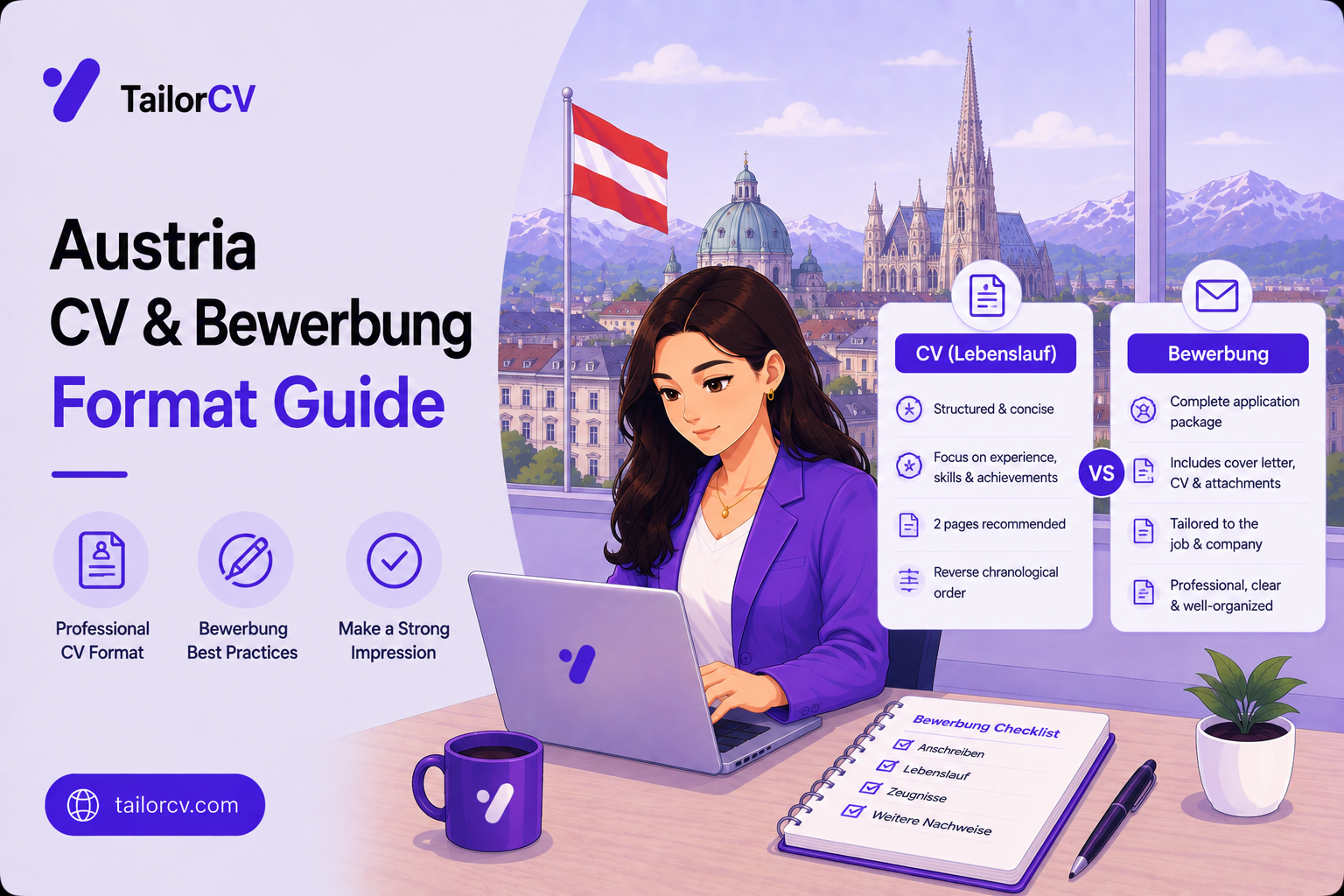
Key Takeaways
- Austrian applications are a complete Bewerbung — cover letter, CV and certificates — not a CV alone.
- A photo is still conventional, as are more personal details than a UK or US CV carries.
- Dienstzeugnisse — employment certificates from previous employers — are expected, and their absence needs explaining.
- Academic titles matter genuinely in Austria and belong on your documents and in your correspondence.
- Write in German unless the advert is in English, and match the formal register precisely.
The dossier
Austrian employers expect a complete package, and an incomplete one reads as careless.
Anschreiben — the cover letter, one page.
Lebenslauf — the CV, two pages, with photo.
Zeugnisse — certificates: your degree certificate, transcripts, and employment certificates from previous roles.
Language and professional certificates where relevant.
Combine into a single well-named PDF unless the portal asks for separate uploads, ordered as above. A recruiter opening one tidy file thinks better of you than one opening seven attachments.
Inside the Lebenslauf
Personal details at the top: name with any academic title, address, phone, email, date of birth, nationality, and — for a third-country national — your permit status. Austrian convention includes more personal data than the Anglo-American norm.
A photo, top right, plain and professional. This is still standard in Austria, and its absence is noticed even though it is not legally required.
Berufserfahrung — work experience, reverse chronological, with employer, location, role, dates and concrete responsibilities and outcomes.
Ausbildung — education, with institution, qualification, dates and grades. State the qualification precisely; Austrian readers calibrate carefully on this.
Kenntnisse — skills, including languages with CEFR levels and IT competencies listed specifically.
Weiterbildung — further training and courses, which Austrian employers read as evidence of initiative.
Do not use a creative layout. Austrian professional documents favour clarity and completeness. A designed CV signals a cultural mismatch rather than initiative.
Academic titles, which genuinely matter
This surprises people from Anglo-American backgrounds and it is not a small thing.
Austria uses academic titles actively. Mag., Dipl.-Ing., Dr., BSc, MSc and MA appear on business cards, in email signatures, on doorbells and in forms of address.
Use your own. If you hold a master's degree, the Austrian equivalent title belongs before your name on your documents. Omitting it is not modesty; it reads as either not having the qualification or not understanding the convention.
Use theirs. Addressing a letter to "Sehr geehrter Herr Dr. Müller" rather than "Sehr geehrter Herr Müller" is a genuine courtesy, and getting it wrong is noticed.
Foreign degrees can carry Austrian title equivalents, and there is a formal process for having a foreign qualification's title recognised for use in Austria if you need it.
In English-language applications to international organisations, normal English conventions apply and this whole section relaxes.
The Anschreiben
One page, formal, specific.
Address a named person with the correct title where you can find one. "Sehr geehrte Damen und Herren," only when you genuinely cannot.
Open with the position and where you saw it. Austrian letters are direct about their purpose immediately.
Middle paragraphs: why this company, what you bring, and evidence connecting your experience to their stated requirements.
State your availability — a possible start date — and your permit position if relevant.
Close formally with "Mit freundlichen Grüßen" and your name.
Write in German for a German-language advert. If your German cannot support a professional letter unaided, that is meaningful information about the role's suitability. A tailored draft solves the blank page, but the final language should be yours and proofread by a native speaker.
Getting foreign qualifications recognised
Austria weights formal qualifications heavily, and a foreign degree sometimes needs translating into Austrian terms before it can be evaluated.
ENIC NARIC Austria handles the assessment of foreign qualifications and can issue a statement of comparability describing how yours relates to the Austrian system.
Nostrifikation is the formal recognition process where full equivalence to an Austrian degree is required, and it is more involved than a comparability statement.
Regulated professions — medicine, nursing, law, teaching, architecture, several engineering fields — require formal recognition rather than an employer's judgement. Start early; it takes real time.
For unregulated roles, recognition is not legally required and an employer forms their own view. A comparability statement helps them do that accurately, and one line on your CV describing the level and duration of your degree helps almost as much.
Certified translations are generally required for certificates not in German, by a court-certified translator.
Include the transcript, not just the certificate. Austrian readers look at what you actually studied.
Automated screening and following up
The mechanics around the dossier.
Larger Austrian employers screen with software. Standard section headings, single column, no text inside images, and the advert's exact terminology where it is genuinely true of you. Run the document through an ATS check once.
Apply through the portal where one exists; email to a general address rarely lands at a larger employer.
One polite follow-up after ten days to two weeks is acceptable, in a formal register with correct titles. Beyond that, wait.
Expect a slower process than in the UK or the Netherlands. Multiple rounds over several weeks is normal and not a signal of disinterest.
References are checked, and Dienstzeugnisse are read carefully — including, in the German-speaking convention, for what they imply rather than only what they state.
The interview after the dossier
The document gets you the Vorstellungsgespräch; the room tests whether it was accurate.
Formal register. Business dress, a handshake, Sie and surnames with titles. Wait to be invited to sit.
Expect a chronological walk through the CV. Austrian interviewers frequently go entry by entry, and approximations are found here.
Know your own dates and titles precisely. A discrepancy between your CV and your certificate is noticed.
Structured questions with real examples. Prepare five or six situations with concrete outcomes.
Language will be tested if claimed. Writing C1 German means part of the conversation will happen in German.
Prepare a Selbstpräsentation — a two-minute account of your background and why you are here. It is a standard opening request in the German-speaking world.
Ask substantive questions about the role, the team and the company's direction. No questions reads as no interest.
Salary is discussed openly because the collective agreement minimum is already public in the advert, which makes the conversation more factual than in most markets.
Adapting an international CV for Austria
Four shifts most international candidates do not make.
Add back what Anglo-American convention strips. Photo, date of birth, nationality, marital status is optional but common. What reads as oversharing in London is standard here.
Add your title. Covered above, and worth repeating because it is the most common omission.
Reorder for a graduate. Education before experience until you have meaningful professional history.
Convert claiming language to specifics. German-speaking professional documents are factual rather than promotional. Replace strong adjectives with what happened and what resulted.
And keep an English version current for the international organisations and multinationals, updating both together rather than letting one drift.
Sector-specific emphasis
The base dossier holds; what you foreground shifts by field.
Engineering and manufacturing. Name the standards and codes you have worked to, the CAD and simulation packages by exact name, and quantify by project scale. Austrian industrial employers read technical specificity immediately.
Semiconductors. Process, node, tooling and methodology specifics. Infineon and ams-OSRAM screen for genuine domain vocabulary.
Banking and finance. Professional qualifications prominently, plus any Central and Eastern European market exposure — Austrian banks' regional orientation makes that experience unusually valuable here.
International organisations. Ignore Austrian convention entirely. Use their competency framework, their application system and their formats, and mirror the vacancy notice's language exactly.
Tourism and hospitality. Languages first, with levels, plus the specific properties or brands you have worked for and their scale.
Research and academia. Publications, conference contributions and funding involvement, formatted to the academic CV convention rather than the two-page industry one.
Managing versions across German-speaking markets
If you are applying in Austria, Germany and Switzerland, one set of documents does not fit all three.
The shared base is large. All three expect a dossier, a photo is conventional in all three, formal register throughout, and employment certificates matter everywhere.
Austria uses academic titles most actively of the three. Germany uses them; Switzerland less so.
Switzerland expects the fullest dossier, with work certificates and diplomas attached as standard.
Germany is the least formal of the three in register, and Austria the most.
Salary conventions differ. Austria's fourteen payments, Switzerland's thirteenth month, Germany's varying practice. Never assume an annual figure means the same thing across borders.
Keep one master and three renders, updating only the master. Editing a render directly creates a second source of truth and one of them will be wrong when it matters.
Mini checklist
- unchecked: Complete dossier assembled, not just a CV
- unchecked: Professional photo included
- unchecked: Academic title used correctly on your own name
- unchecked: Recipient addressed with their correct title
- unchecked: Dienstzeugnisse included or their absence explained
- unchecked: Certificates and transcripts attached
- unchecked: Languages with CEFR levels
- unchecked: Permit status stated if you are a third-country national
- unchecked: Written in the advert's language and proofread
- unchecked: Combined into one well-named PDF
Scenarios
Scenario 1: You are applying to an Austrian industrial employer
Full dossier, photo, German throughout, formal register, and your qualification title used correctly. Convention here is itself part of the message.
Scenario 2: You are applying to a UN agency in Vienna
Entirely different. International organisations use their own English-language application systems and formats, and Austrian conventions do not apply. Follow their instructions exactly.
Scenario 3: You have no Dienstzeugnisse
Explain it in one line — employment certificates are not issued in most jurisdictions — and provide reference letters and named referees instead. Silence on the point is the only real error.
Tip: Put your academic title before your name exactly as Austrian convention uses it, and address your recipient with theirs. It costs nothing, it signals that you understand the market, and omitting it quietly marks you as an outsider.
Do's and Don'ts
Do
- Send a complete Bewerbung
- Include a professional photo
- Use academic titles correctly, yours and theirs
- Explain missing employment certificates
- State languages with CEFR levels
- Write in the advert's language
Don't
- Send a CV alone
- Use a creative or designed layout
- Omit your qualification title out of modesty
- Ignore the Dienstzeugnis question silently
- Apply in German beyond your real ability
- Apply Austrian conventions to international organisations
Common Mistakes
- Sending only a CV. Austria expects a full dossier and an incomplete one reads as careless.
- Omitting the photo. Still conventional here, unlike the UK, Ireland or the Nordics.
- Dropping academic titles. They are used genuinely in Austria and omitting yours is conspicuous.
- Ignoring employment certificates. Explain their absence rather than saying nothing.
- Creative formatting. Austrian documents favour completeness and clarity.
- Using Austrian convention at the UN. International organisations have their own entirely different process.
Related Guides
Keep building on this with the related guides in this series:
- Working in Austria as an International Graduate
- The Red-White-Red Card Explained
- How to Write a German Lebenslauf
- The Swiss Application Dossier
- Writing a CV for the Norwegian Market
You can also check your resume's ATS score for free, generate a tailored cover letter, or build a portfolio website in minutes.
Frequently Asked Questions
What is a Bewerbung?
The complete Austrian application package — cover letter, CV and certificates — submitted together rather than a CV alone.
Should I include a photo on an Austrian CV?
Yes. A plain professional headshot remains conventional in Austria, and its absence is noticed even though it is not legally required.
Do academic titles really matter in Austria?
Genuinely, yes. They are used on business cards, in email and in forms of address. Use your own on your documents and address recipients with theirs.
What is a Dienstzeugnis?
An employment certificate issued by a previous employer describing your role and performance. Austrian recruiters expect them; if you have none, explain why and provide references instead.
Which language should I apply in?
The language of the advert. German for Austrian employers, English for international organisations and multinationals that advertise in English.
How long should an Austrian CV be?
Two pages, plain and complete. Precision and completeness matter more than brevity.
Do I need my foreign degree recognised in Austria?
For regulated professions, yes — and it takes real time, so start early. For unregulated roles a comparability statement from ENIC NARIC Austria helps employers evaluate you accurately but is not required.
Should I follow up on an Austrian application?
One polite follow-up after ten days to two weeks, in a formal register with correct titles. Austrian processes are slower than British or Dutch ones and repeated chasing reads badly.
What are Austrian interviews like?
Formal — business dress, Sie and titles, a chronological walk through your CV, and a standard request for a two-minute Selbstpräsentation. Any language level you claimed will be tested.
How should I adapt a UK or US CV for Austria?
Add the photo, date of birth and nationality that Anglo-American convention omits, add your academic title, put education first if you are a graduate, and replace promotional adjectives with concrete facts.
Should I adapt my Austrian dossier by sector?
Yes. Engineering and semiconductor employers read technical vocabulary and standards; banks value Central and Eastern European exposure; and international organisations use their own competency framework rather than Austrian convention.
Does your formatting survive the parser?
Upload your resume and see what an ATS actually reads back.
Drop your resume here or choose a file
PDF only. Max 2 MB.
We never share your data or use it to train AI models.

Was this guide useful?
Be the first to rate it.