 TD
TD
Key Takeaways
- Spanish CVs run to two pages with a photo still common, though international employers increasingly do not expect one.
- Languages are frequently the most important section — Spain's shared service centre economy hires specifically for language combinations.
- The carta de presentación is standard and read, though shorter and less formal than the French or German equivalent.
- Write in Spanish unless the advert is in English, and note that Catalonia adds a further consideration.
- Practical experience beats coursework — internships (prácticas) count and should be described as real work.
The structure
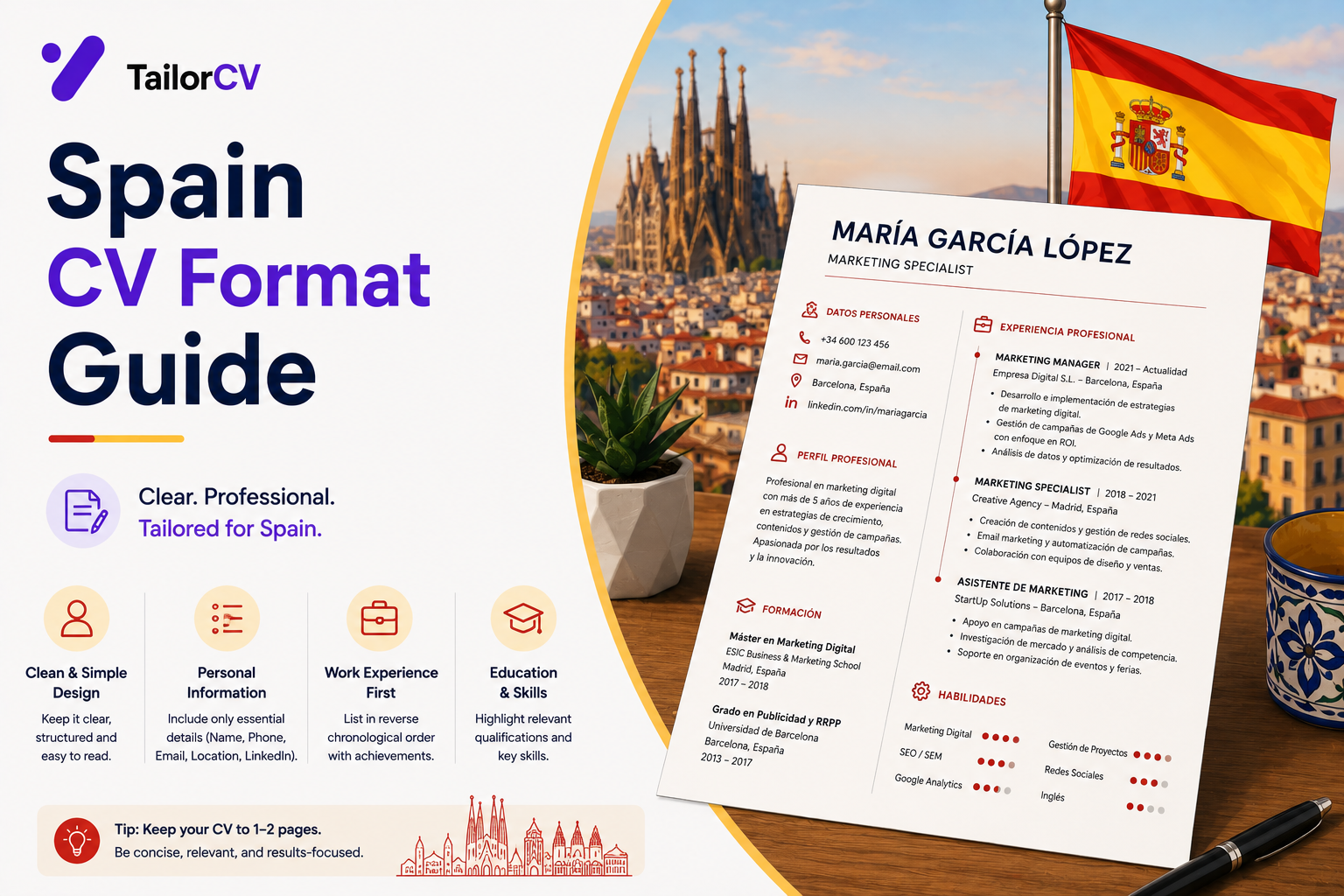
Datos personales at the top: name, phone, email, city, LinkedIn, and often nationality. Date of birth still appears on many Spanish CVs though it is not required of you. Include your work authorisation status if you are a non-EU national.
A photo in the top corner remains common in Spain, particularly at domestic employers. International companies and technology firms increasingly do not expect one, and omitting it there is safe.
Perfil profesional — a short profile of three or four lines, concrete.
Experiencia profesional, reverse chronological, with employer, location, role, dates and outcomes. Include prácticas — internships are real experience in Spain and should be described as such.
Formación académica — education, with institution, qualification and dates. Include your specialisation.
Idiomas — languages, and this section deserves prominence for reasons covered below.
Conocimientos informáticos — IT skills, listed specifically.
Otros datos — certifications, driving licence, volunteering.
Why the languages section matters so much in Spain
This is the single most Spain-specific piece of advice on this page.
Spain's shared service centre economy runs on language combinations. Multinationals operate European finance, HR, customer support and IT functions from Madrid, Barcelona and Málaga specifically because they can hire multilingual staff there at reasonable cost.
Those employers screen on languages first. A candidate with English plus German, or English plus Dutch, or English plus a Nordic language, is directly employable in a way that a monolingual candidate with a better degree is not.
So put languages high and make them precise. CEFR levels, distinguishing spoken and written where they genuinely differ, and naming any certificates — DELE for Spanish, Goethe for German, and so on.
Do not inflate. Language claims are tested, frequently by an interviewer simply switching mid-conversation, and shared service centre recruiters are experienced at doing this.
Native or bilingual ability in a less common European language is genuinely valuable here in a way it is not in most markets, and it is worth leading with rather than burying at the bottom.
The carta de presentación
Standard, read, and shorter than its French or German counterparts.
One page, three or four short paragraphs.
Address a named person where you can — "Estimado/a Sr./Sra. [Apellido]" — or "Estimados señores" where you genuinely cannot.
Open with the role and something specific about the company.
Connect your experience to their requirements with one or two concrete examples.
State your availability and, if relevant, your work authorisation.
Close with a standard formula — "Atentamente" or "Un cordial saludo" — and your name.
Write in Spanish for a Spanish-language advert. For English-language postings from international employers, English is correct. A tailored draft solves the blank page, and a native speaker should read the final version.
Automated screening and application mechanics
Larger Spanish employers screen with software, and InfoJobs itself is structured.
InfoJobs uses a structured profile as much as an uploaded CV. Fill the profile completely — many recruiters search it rather than reading attachments.
Standard section headings in Spanish where you apply in Spanish — Experiencia profesional, Formación académica, Idiomas.
Single column, no text inside images, and no design-led layouts outside actual creative roles.
Mirror the advert's terminology including the Spanish technical vocabulary of your field.
Export as PDF named with your own name and confirm the text is selectable.
Follow up once after a week or two. Spanish processes vary in speed and a polite enquiry is acceptable.
Adapting an international CV for Spain
Four practical shifts.
Move languages up. Covered above and the most important Spain-specific change.
Add the photo for domestic employers and omit it for international ones — decide by employer type rather than by rule.
Describe prácticas as jobs, with employer, dates, responsibilities and results.
Translate your qualification. Spanish employers calibrate on institution and level, and a degree with no obvious equivalent benefits from one clarifying line. Homologación is the formal recognition process, required for regulated professions and slow enough to start early.
Add your work authorisation if you are non-EU — it is the first practical question a Spanish recruiter has.
Keep a Spanish and an English version current, updating them together so neither goes stale when you need it.
Interviewing in Spain
What the document has to survive.
Warm and conversational, with genuine rapport-building rather than a straight interrogation.
Your languages will be tested if you claimed them, often by simply switching mid-conversation. Shared service centre recruiters do this as a matter of routine.
Expect questions about staying. Spain attracts people who come for a year and leave, and employers ask.
Competency questions are used but less rigidly than in Northern Europe.
Punctuality expectations are looser than in Germany or Switzerland, though you should still arrive on time.
Ask about the team and the company, and show you know something specific about them.
Salary is usually discussed openly with reference to the convenio collective agreement level.
Follow up once politely; processes vary considerably in speed between the international sector and domestic employers.
Regional considerations
Spain's autonomous communities add a layer worth knowing about.
Catalonia. Catalan is co-official and matters for public-sector roles and for some local employers. Private-sector and international companies in Barcelona overwhelmingly do not require it, but mentioning any Catalan you have is noticed favourably.
Basque Country. Euskara is co-official and genuinely required for many public-sector positions. The private industrial sector operates in Spanish.
Galicia. Galician is co-official with similar public-sector implications.
Valencia. Valencian, closely related to Catalan, with the same pattern.
The practical rule: for private-sector and international roles, Spanish plus English is what matters. For public-sector work in these regions, the co-official language is frequently a hard requirement rather than a preference.
And if you are learning one, say so. Demonstrated effort on a co-official language is genuinely well received in these communities.
Adapting for shared service centres specifically
Because they are the most accessible entry and they screen differently.
Lead with the language combination in your profile line, not just in the languages section. "Trilingual customer operations professional — English C2, German C1, Spanish B2" tells the recruiter everything in one line.
Name the certificates. Goethe, DELF, TOEFL, Cambridge, DELE. These recruiters are used to verifying and a certificate short-circuits the doubt.
Describe process experience concretely. Ticket volumes, SLAs, systems used (SAP, Salesforce, ServiceNow), and the markets you supported.
Mention shift flexibility if you have it, since many centres cover multiple time zones.
And apply directly. The large centres recruit continuously through their own portals rather than only through job boards.
Common failure modes
Five things that go wrong.
Burying the languages. In a market where language combinations are the qualification, this is the costliest mistake on the list.
Vague language claims. "Nivel alto" means nothing. Use CEFR and name certificates.
Presenting internships as student activities. Prácticas are real experience in Spain.
Ignoring InfoJobs' structured profile. Many recruiters search the profile rather than opening attachments.
Sending a three-page CV. Spanish employers expect two, and a graduate should manage one and a half.
Tailoring efficiently
Keep one complete master and cut it per application rather than rewriting.
Reorder for the employer type. Languages high for shared service centres, technical skills high for engineering, experience high for corporate roles.
Use the advert's exact Spanish terminology where it is genuinely true of you.
Update quarterly so everything generated from the master stays current.
And maintain the English version in parallel, because Barcelona's international sector and Madrid's multinationals will want it.
The Europass question in Spain
Less central than in Italy but worth knowing.
Spanish public administration and EU-funded roles sometimes request Europass specifically.
Most private-sector employers do not, and a conventional CV reads better.
Modelo Europass in Spanish is what a Spanish employer means if they ask, so use the Spanish-language version.
Fill it completely if you use it — blank fields are visible and look worse than a conventional document.
Its languages grid is genuinely useful and worth borrowing for your ordinary CV, particularly in a market where languages carry this much weight.
Mini checklist
- unchecked: Two pages, plain formatting
- unchecked: Photo decision made by employer type
- unchecked: Languages section placed prominently with CEFR levels
- unchecked: Language certificates named
- unchecked: Prácticas described as real experience
- unchecked: Work authorisation stated if non-EU
- unchecked: Written in the advert's language
- unchecked: Carta de presentación written specifically
- unchecked: Exported as PDF and checked with an ATS check
Scenarios
Scenario 1: You speak English plus another European language
Put the languages section immediately after your profile, above experience. For shared service centre roles it is the qualification, and burying it costs you interviews.
Scenario 2: You are applying to a Barcelona technology company
Closer to an international application — English is likely fine, no photo needed, conventional international CV structure. Read the advert's language and follow it.
Scenario 3: Your only experience is internships
Describe them as jobs. Prácticas are genuine experience in Spain, and presenting them under a student heading throws away the strongest material a graduate has.
Tip: If you speak a less common European language, put it in the top third of your Spanish CV. Spain's shared service centre economy hires on language combinations first, and a Nordic or Dutch capability there is worth more than an extra line of experience.
Do's and Don'ts
Do
- Lead with languages if you are multilingual
- Use CEFR levels and name certificates
- Describe prácticas as real experience
- Match the application language to the advert
- Keep it to two pages
- State your work authorisation if non-EU
Don't
- Bury your language combination at the bottom
- Inflate a language level
- Present internships as student activities
- Assume a photo is required at international employers
- Write in Spanish beyond your real ability
- Send a generic carta de presentación
Common Mistakes
- Burying the languages section. In Spain it is frequently the deciding qualification.
- Inflating language levels. Recruiters switch language mid-interview to check.
- Underselling internships. Prácticas are real experience here.
- Wrong language. Match the advert, always.
- Three pages. Spanish employers expect two.
- Ignoring the carta. It is standard and it is read.
Related Guides
Keep building on this with the related guides in this series:
- Working in Spain as an International Graduate
- Spanish Work Visas and the Digital Nomad Route
- Technology Jobs in Barcelona and Madrid
- The Italian CV and Lettera di Presentazione
- The French CV and Lettre de Motivation
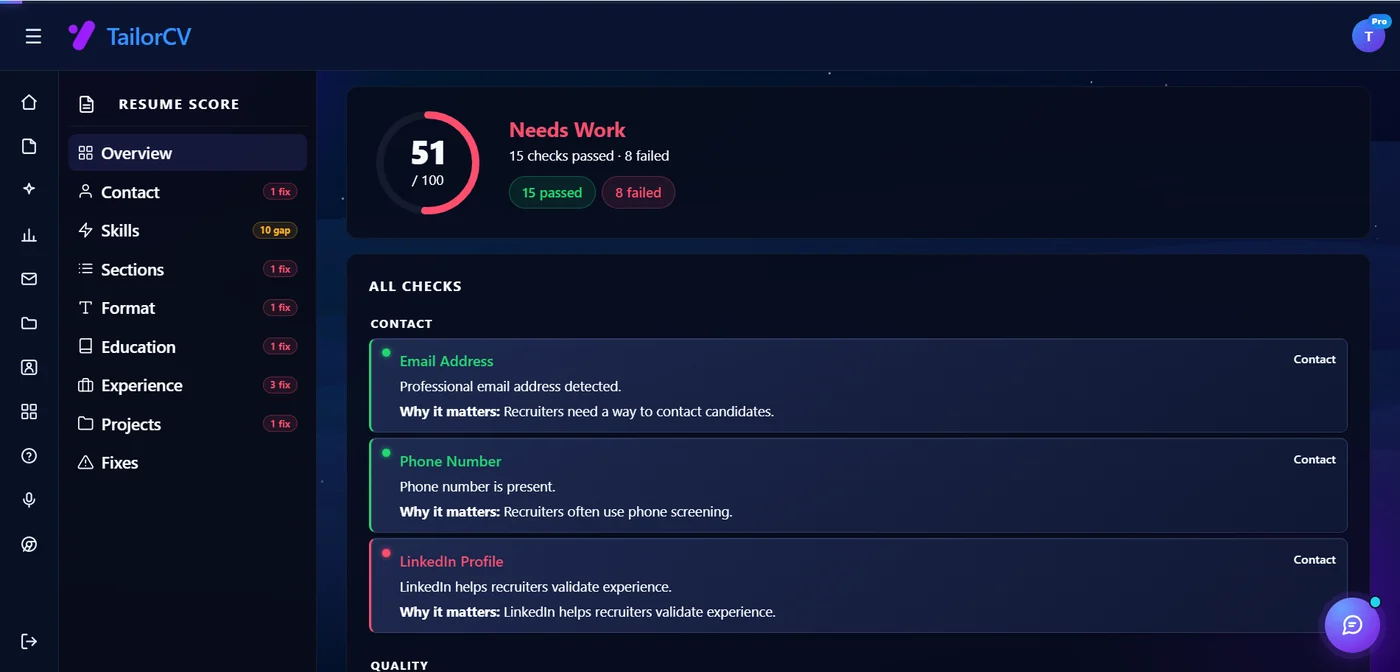
You can also check your resume's ATS score for free, generate a tailored cover letter, or build a portfolio website in minutes.
Frequently Asked Questions
Should I include a photo on a Spanish CV?
It remains common at domestic employers. International companies and technology firms increasingly do not expect one, and omitting it there is safe.
Why does the languages section matter so much in Spain?
Because Spain's shared service centre economy hires specifically for language combinations. English plus another European language is frequently the qualification itself.
How long should a Spanish CV be?
Two pages. Plain formatting, reverse chronological, with concrete outcomes rather than adjectives.
Do internships count as experience?
Yes. Prácticas are genuine experience in Spain and belong in the experience section, described as work rather than as student activities.
Is the carta de presentación read?
Yes, though it is shorter and less formal than the French or German equivalent. A generic one still works against you.
Which language should I apply in?
The language of the advert. Spanish for domestic employers, English for international companies and technology firms that post in English.
Does InfoJobs matter more than my CV file?
Frequently, yes. InfoJobs uses a structured profile that many recruiters search directly, so completing it fully matters as much as the document you upload.
Do I need my degree formally recognised in Spain?
For regulated professions, yes — homologación is required and slow, so start early. For other roles a clarifying line about level and duration usually suffices.
Will my language claims be tested in a Spanish interview?
Frequently, and without warning — an interviewer may simply switch language mid-conversation. Shared service centre recruiters do this routinely, so accurate CEFR levels matter.
Do I need Catalan, Basque or Galician?
For private-sector and international roles, no — Spanish plus English is what matters. For public-sector work in those communities the co-official language is frequently a hard requirement.
How should I write a CV for a shared service centre?
Lead with your language combination in the profile line, name your language certificates, describe process experience with concrete volumes and systems, and mention shift flexibility.
Is Europass used in Spain?
Sometimes for public administration and EU-funded roles, rarely in the private sector. Use it when requested, in the Spanish-language version, and complete it fully.
Does your formatting survive the parser?
Upload your resume and see what an ATS actually reads back.
Drop your resume here or choose a file
PDF only. Max 2 MB.
We never share your data or use it to train AI models.
Was this guide useful?
Be the first to rate it.