 TD
TD

Key Takeaways
- Greek CVs run to two pages with a photo still common, and more personal detail than a UK or US document.
- Networks matter substantially. Personal recommendation carries more weight in Greece than in Northern Europe, and it is not corruption — it is how employers manage risk.
- English CVs are standard in shipping, technology and international companies.
- Languages carry real weight, and English proficiency is close to assumed for professional roles.
- Internships and any Greek work experience count disproportionately in a market where local familiarity is valued.
The structure
Personal details at the top: name, phone, email, city, LinkedIn. Date of birth and nationality still appear on many Greek CVs, and including them is unremarkable.
A photo in the top corner remains common at domestic employers. International companies and shipping firms are more variable, and omitting it there is safe.
A short profile of three or four lines, concrete rather than adjectival.
Work experience, reverse chronological, with employer, location, role, dates and outcomes. Include internships properly — they count.
Education, with institution, degree and dates. Greek employers pay attention to which institution, and for foreign degrees a clarifying line on the level helps.
Languages with CEFR levels. English is close to assumed for professional roles, and additional languages are genuinely valued given the international orientation of shipping and tourism.
Skills, listed concretely.
Military service appears on Greek CVs for Greek men; as a foreign candidate this does not apply to you.
References available on request is acceptable.
Networks and how hiring actually works
The most important practical point about the Greek market.
Personal recommendation carries substantial weight. A candidate introduced by someone credible moves differently from a cold application, and this is more pronounced in Greece than in most of Northern Europe.
This is not corruption. It is a high-trust-network culture where a referral is how an employer reduces hiring risk, and it operates alongside formal processes rather than instead of them.
Practically, it means that a university connection, a former colleague, an alumni network or a professional contact does more work than an extra fifty applications.
Shipping in particular is relationship-driven, and entry frequently comes through a graduate scheme, a specialist qualification or someone who knows you.
Which means: if you are targeting Greece seriously, invest in connections deliberately. LinkedIn outreach, alumni associations, professional bodies and sector events all matter more here than the volume of applications you submit.
The application and interview
Apply in the language of the advert — Greek for domestic employers advertising in Greek, English for shipping, technology and international companies.
A cover letter is expected and is read, though less formally structured than the French or German equivalent.
Interviews are warm and conversational, with genuine rapport-building rather than a straight interrogation.
Expect questions about staying. Greece has seen substantial emigration and employers ask whether you intend to be there.
Your Greek will be tested if you claimed it.
Formality is moderate — professional but not stiff, warming quickly after the first meeting.
And processes can be slow, with silence more often administrative than a decision.
How Greek screening works
The mechanics behind the document.
Kariera.gr carries substantial domestic volume and parses applications.
Skywalker.gr is widely used across sectors.
LinkedIn is well used, particularly in shipping, tourism management and by international employers.
Larger employers run their own systems, which screen before a human reads anything.
Which means standard ATS discipline applies — conventional headings, clean structure, no text hidden in images or complex tables, and terminology matching the posting.
Referrals carry real weight in a relationship-driven market, and Greek professional networks reward genuine contact.
Run an ATS check before submitting anywhere that screens.
Writing the experience section
Where applications are decided.
Lead with achievement rather than responsibility.
Quantify wherever you can, since numbers read the same in any language.
Name systems and tools specifically, because employers screen on them.
Three to five bullets for recent roles, fewer for older ones.
Give one line of company context where the name will not be recognised.
Write natural Greek rather than translating English phrasing literally, or write in English where the posting is in English.
And tailor each application — a tailored document consistently outperforms one generic version.
Languages and qualifications
Weighted carefully in this market.
Language levels are stated explicitly and read closely, with English proficiency being a genuine differentiator particularly in shipping, tourism and international companies.
Certificates support the claim and are worth listing, since Greek employers are familiar with the standard frameworks.
Degree recognition through DOATAP applies where a foreign qualification needs formal Greek recognition, which is a separate process from any job application and worth starting early if your field requires it.
Professional chamber membership applies in regulated fields including engineering and law.
And postgraduate study carries real weight, more so than in several other European markets.
Photographs and personal details
The conventions and where they are heading.
Photographs appear on Greek CVs, more so at traditional employers and less so at international companies and in technology.
Date of birth is sometimes included and is declining.
Marital status and family details appear on older-style Greek CVs and are best omitted.
Military service status is sometimes stated by Greek male candidates, since service is compulsory and affects availability.
The practical approach is to omit the photograph and personal details for international companies, shipping multinationals and technology employers, and to consider a plain headshot for smaller and more traditional ones.
Never include your tax number, identity card number or social security number, which are requested at hiring and have no place on an application document.
And if uncertain, omit. No serious employer rejects a strong candidate for the absence of a photograph.
Sectors and what each expects
Greece is not uniform and the conventions differ meaningfully by industry.
Shipping is the most internationally oriented sector in the country, frequently runs its processes in English, and expects a conventional international CV.
Tourism and hospitality at management level values languages heavily and expects them stated prominently, with seasonal experience being read as relevant rather than as instability.
Technology and startups follow international practice, with a portfolio and deployed work mattering more than the document itself.
Banking and professional services are more formal and weight qualifications and institutions heavily.
The public sector runs its own defined processes with formal requirements that sit outside anything covered here.
And smaller family businesses, which make up a very large share of Greek employment, are the most traditional and the most relationship-driven of all.
The cover letter
Worth doing selectively.
A cover letter is not universally expected and is read where offered.
Three or four paragraphs covering why this employer, what you bring and what you want.
In Greek for domestic employers, English for shipping, technology and international companies.
Address a named person where you can identify one, which matters in a relationship-driven market.
Reference something specific about the company, since generic letters read as generic.
And a tailored cover letter for the applications that matter is worth the effort, while a generic one attached to everything adds nothing.
Applying as a foreigner
The additional considerations for anyone applying from outside Greece.
Address your right to work directly. EU and EEA nationals should state it plainly, since it removes the largest question a Greek employer has. Third-country nationals should be equally direct about what sponsorship would involve.
State your Greek level honestly, and be clear if you have none, since it determines which sectors are realistic.
Target the sectors where foreign hiring genuinely happens — shipping, tourism management, technology, international companies and the growing remote and relocation-driven segment — rather than the general domestic market.
Explain why Greece, because a specific answer about the shipping industry or the technology scene reads far better than general enthusiasm about the country.
Have any Greek reviewed by a native speaker, since errors in a foreign applicant's document confirm the concern the reviewer already had.
Position international experience as an asset, particularly for shipping and tourism where it is directly relevant.
And be realistic about seasonality, since a substantial share of Greek employment in tourism and hospitality is seasonal by design rather than by accident.
Common mistakes worth avoiding
Small things that cost applications.
Translating English phrasing literally, which produces Greek that is correct and stylistically odd.
Including identity, tax or social security numbers, which are requested at hiring and never belong on an application.
Overstating language levels, which is tested at any employer that actually needs the language.
Sending the same document everywhere, which reviewers notice.
Omitting quantification, since numbers carry across languages and most Greek CVs underuse them.
And ignoring the sector conventions, since a document that suits a shipping multinational reads quite differently from one that suits a family business.
Mini checklist
- unchecked: Two pages, plain formatting
- unchecked: Photo decision made by employer type
- unchecked: Languages with CEFR levels
- unchecked: Internships described as real experience
- unchecked: Application language matched to the advert
- unchecked: Network activated before cold applying
- unchecked: Cover letter written specifically
- unchecked: Work authorisation stated if non-EU
- unchecked: Checked with an ATS check
Scenarios
Scenario 1: You are applying to a shipping company in Piraeus
English throughout, no photo needed, and lead with any maritime, commercial or finance specifics. This is an international industry and the document should read as an international application.
Scenario 2: You are applying to a domestic Greek employer
Greek if the advert is in Greek, photo included, personal details in the local convention, and a warm rather than clinical cover letter.
Scenario 3: You have no Greek connections
Build some before applying at volume. Alumni networks, LinkedIn outreach to people in your target companies, and professional bodies all do more work in Greece than in Northern Europe.
Tip: Invest in connections before volume. Greek hiring runs on personal recommendation to a degree that surprises people from Northern Europe, and one credible introduction moves an application further than fifty cold submissions.
Do's and Don'ts
Do
- Match the application language to the advert
- Build connections deliberately
- Include internships as real experience
- List languages with CEFR levels
- Write a warm, specific cover letter
- Consider a photo for domestic employers
Don't
- Rely on cold applications alone
- Assume Northern European hiring norms apply
- Inflate your Greek level
- Send a clinical, impersonal application
- Expect fast processes
- Omit personal details if applying domestically
Common Mistakes
- Cold applications only. Networks carry more weight here than almost anywhere in the EU.
- Northern European register. A clinical application reads as cold in a warmer hiring culture.
- Inflating Greek. It will be tested and most international-sector roles run in English anyway.
- Burying internships. They count as real experience.
- Giving up on silence. Greek processes are slow and quiet more often than negative.
- One CV for both markets. Shipping and domestic employers expect different documents.
Related Guides
Keep building on this with the related guides in this series:
- Working in Greece as an International Graduate
- Greece's Digital Nomad and Work Visa Routes
- The Italian CV and Lettera di Presentazione
- The Spanish CV Format
- Cyprus Jobs for International Graduates
You can also check your resume's ATS score for free, generate a tailored cover letter, or build a portfolio website in minutes.
Frequently Asked Questions
Should I include a photo on a Greek CV?
At domestic employers it remains common. Shipping companies and international firms are more variable, and omitting it there is safe.
How much do connections matter in Greece?
Substantially more than in Northern Europe. Personal recommendation is how employers manage hiring risk, and it operates alongside formal processes rather than replacing them.
Which language should I apply in?
The language of the advert. Greek for domestic employers advertising in Greek; English for shipping, technology and international companies.
Is the cover letter read?
Yes, though less formally structured than the French or German equivalent. A warm, specific letter works better than a clinical one.
How long should a Greek CV be?
Two pages, with more personal detail than a British or American CV would carry.
Why are Greek hiring processes so slow?
A combination of smaller HR functions, relationship-led decision making and general administrative pace. Silence is more often process than rejection.
Do Greek employers use applicant tracking systems?
Yes. Kariera.gr and Skywalker.gr carry substantial volume and parse applications, and larger employers run their own screening before a human reads anything.
How important are language certificates in Greece?
Genuinely. Levels are stated explicitly and read closely, with English proficiency being a real differentiator in shipping, tourism and international companies.
Should I include a photograph on a Greek CV?
It depends on the employer. International companies, shipping multinationals and technology employers increasingly do not expect one; smaller and more traditional employers still commonly do.
Do CV conventions differ by sector in Greece?
Considerably. Shipping is internationally oriented and often runs in English, technology follows international practice, banking is formal and qualification-weighted, and family businesses are the most traditional.
How should a foreigner approach applications in Greece?
Address your right to work directly, state your Greek level honestly, target shipping, tourism management, technology and international companies rather than the general market, and explain why Greece specifically.
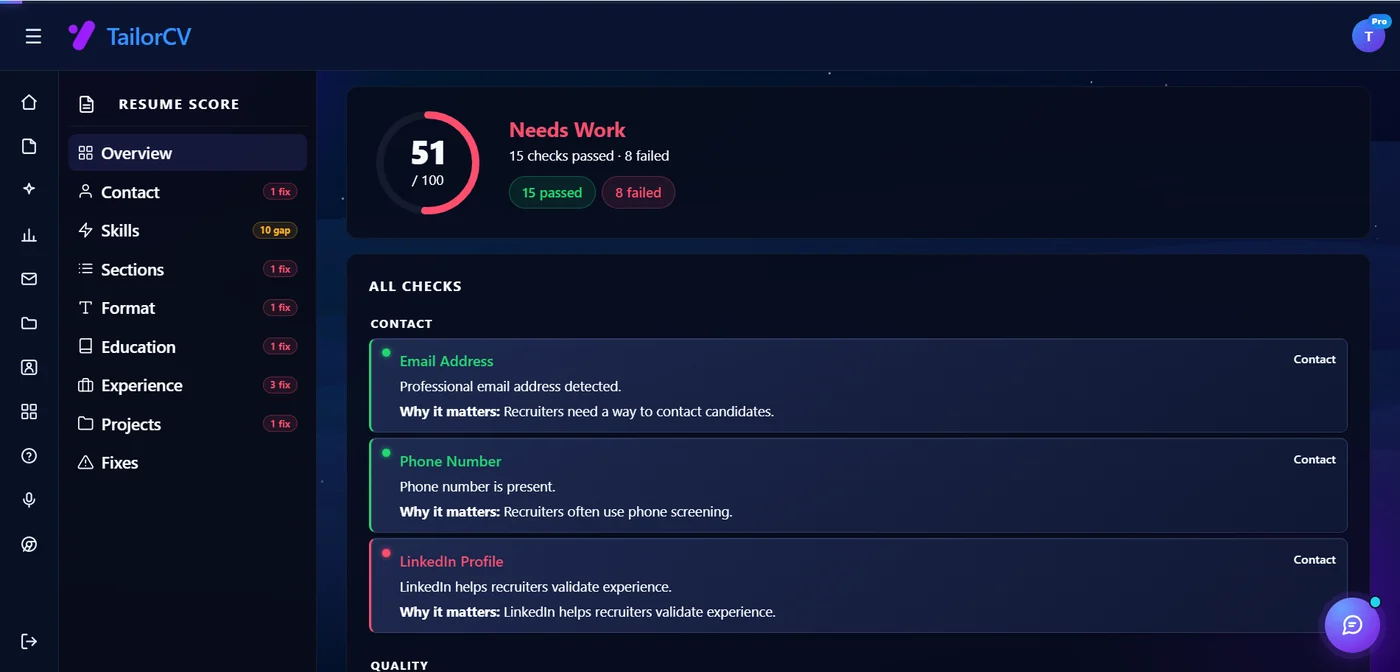
What is your resume scoring right now?
Scan it against a job description and get your ATS match score in about a minute.
Drop your resume here or choose a file
PDF only. Max 2 MB.
We never share your data or use it to train AI models.
Was this guide useful?
Be the first to rate it.