 TD
TD
Key Takeaways
- The French CV is one page for a graduate — considerably shorter than the German or Swiss convention.
- The lettre de motivation is still standard and genuinely read, and a generic one actively damages an otherwise good application.
- A photo is common but optional, and increasingly omitted by large and international employers.
- Education carries unusual weight, and where you studied does real work on a French CV.
- Write in French unless the advert is in English — and a poor French letter is worse than a strong English one.
The one-page rule
French recruiters expect concision, and a graduate CV running to two pages signals an inability to prioritise.
One page, always, for anyone under about ten years of experience. Senior professionals may use two.
État civil at the top: name, address, phone, email, and often age or date of birth. Nationality is common, and if you need a work permit, stating your status is genuinely helpful.
A title. French CVs frequently carry a short title under the name stating the target role — "Ingénieur Data — Recherche CDI". It orients the reader immediately and its absence is noticeable.
Formation (education) often comes before experience for a recent graduate, which reverses the Anglo-American order. Institution, qualification, year, and any distinction.
Expérience professionnelle, reverse chronological, including stages and alternance, which are counted as real experience in France rather than discounted as student work.
Compétences — technical skills, languages with levels, and software.
Centres d'intérêt. French CVs conventionally include a short interests line, and it is genuinely read as a signal of personality. Keep it specific — "marathon, photographie argentique" says more than "sport, cinéma".
The photo question
It is common and it is optional.
Traditional French practice includes a small professional photo. Large employers and international companies increasingly discourage it on anonymised-recruitment grounds, and some ATS-driven processes strip it anyway.
The safe position: include it for traditional French employers and smaller companies, omit it for large corporates, international firms and anywhere the advert mentions anonymised recruitment. If you include one, make it a plain professional headshot.
The lettre de motivation
Unlike the UK, where cover letters are frequently skimmed, the French letter is a real part of the assessment.
One page. Three or four paragraphs.
The classical structure is sometimes described as vous, moi, nous — you, me, us. Open with the company and why it interests you specifically; continue with what you bring and the evidence for it; close with what the two of you would do together.
Address a named person where possible, with the correct formula. "Madame, Monsieur," is the safe default when you genuinely cannot find a name.
The closing formula is formal and fixed. "Je vous prie d'agréer, Madame, Monsieur, l'expression de mes salutations distinguées" or a close variant. This is not optional flourish — it is the convention, and getting it wrong marks you out immediately.
Do not restate the CV. The letter connects your specific background to their specific need.
Write it in French for a French-language advert. If your French will not support a professional letter unaided, that is meaningful information about whether the role suits you. A tailored draft built against the actual posting solves the blank page, but the final language should be yours.
Stages and alternance on a CV
This is where an international CV most often undersells itself in France.
Internships count as experience. A six-month stage at a recognised company is real professional experience in French eyes, and it belongs in the experience section described with outcomes, not in a student activities footnote.
Alternance is highly regarded. An apprenticeship contract combining study and work signals both academic capability and professional maturity, and French recruiters read it very positively.
Describe them properly. Employer, dates, team, what you actually did, and what came of it. "Stage de fin d'études" with no description wastes the strongest thing on many graduate CVs.
Long-term casual work counts too. Sustained part-time employment alongside studies is read as evidence of seriousness rather than as filler.
Automated screening and French employers
Large French employers screen with software, and the design instincts the market rewards can work against you here.
Keep the layout single-column. Two-column CVs are visually common in France and they parse badly, which means a document that looks polished to a human can arrive at the recruiter as scrambled text.
Use conventional section headings — Formation, Expérience professionnelle, Compétences, Langues. A creatively named section is one that does not get extracted.
Avoid text inside images or icons. Icon-heavy contact blocks are a French design habit that costs you information in a parser.
Mirror the advert's vocabulary exactly, in French. Matching is literal, and a synonym does not count.
Export as PDF with a sensible filename — "Dupont_Marie_CV.pdf".
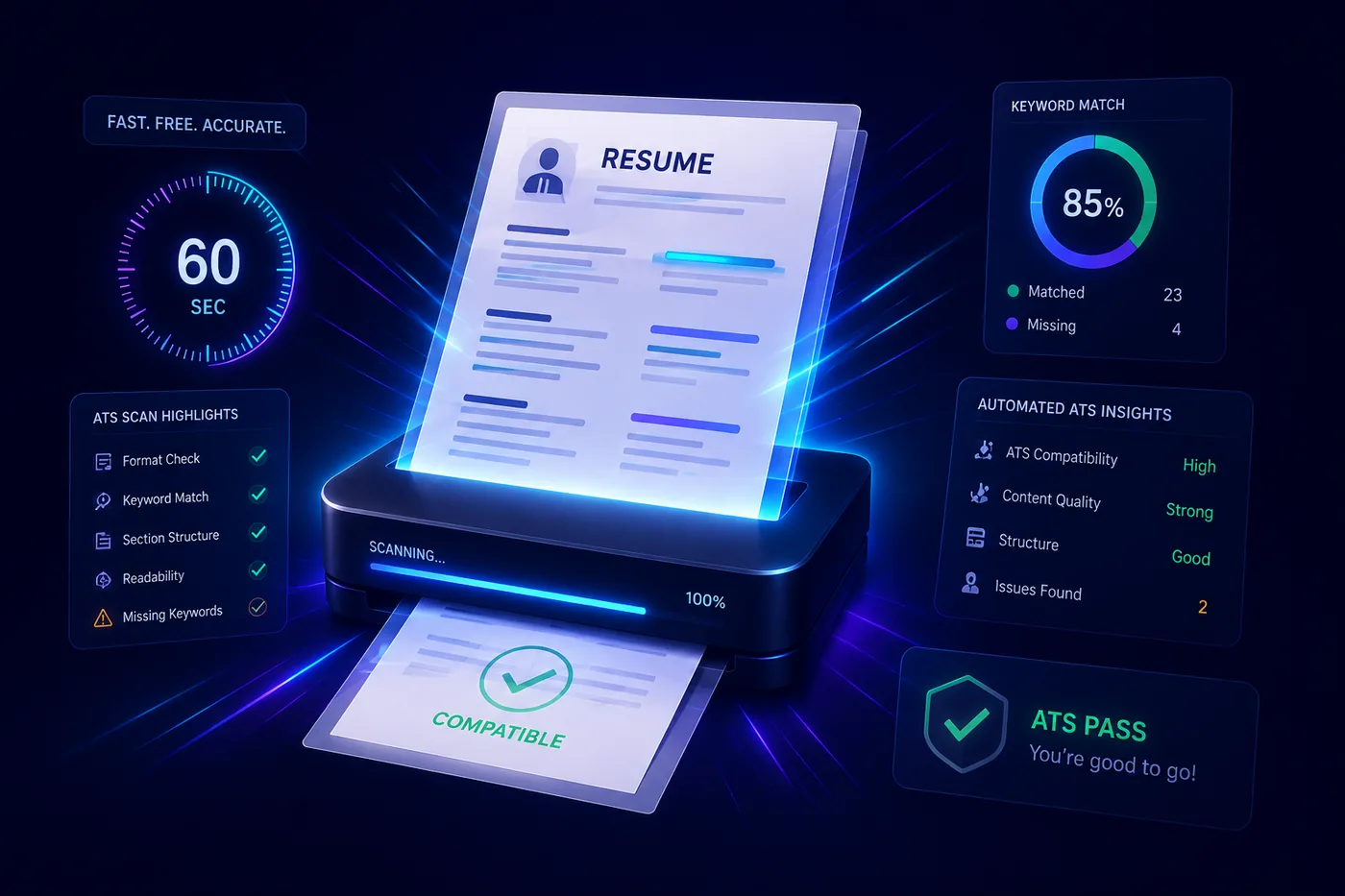
Check it parses with an ATS scan before you send it anywhere. It takes a minute and it removes a whole category of silent rejection.
Tailoring, and the details that get noticed
French readers are attentive to form, and small errors carry disproportionate weight.
Accents matter. A CV in French with missing accents reads as careless at best and as a weak language claim at worst.
Be consistent with dates and formatting. French documents are read as formal records.
Claim language levels honestly, using CEFR. If you write C1 French, part of the interview will be in French.
Adapt the title line per application. It takes ten seconds and it makes each CV look aimed rather than broadcast.
Have a native speaker read the letter. The lettre de motivation is the document where errors are least forgiven, because the whole point of it is that you wrote it for them.
Keep an English version current. Paris technology, research institutions and international companies will want one, and maintaining both means you can respond to either the day a posting appears.
Adapting an international CV for France
Three shifts that most international candidates do not make.
Reorder for a French reader. Education first for a graduate, a title line under the name, and the interests section that would look odd elsewhere. These are conventions, and following them signals familiarity with the market.
Translate your qualification into recognisable terms. French readers calibrate carefully on education, and a degree title with no French equivalent needs one clarifying line — the level, the duration, and the field.
Convert achievements into French professional register. Anglo-American CVs use strong claiming verbs; French CVs are somewhat more measured. Describe what you did precisely and let the results carry the emphasis rather than the adjectives.
Include the stage properly. This is worth saying twice because it is the most commonly wasted asset on an international CV in France.
Keep the English version too. Paris technology and research run in English, and having both ready means you can respond to either the day it appears.
Following up in France
The etiquette is specific and mostly unwritten.
One follow-up after ten days to two weeks is normal and welcome. Use a formal register.
Use the correct formulas even in a short email. The opening ("Madame, Monsieur," or a named form) and the closing formula matter as much in an email as in the letter.
Do not chase repeatedly. French hiring is not fast, particularly at large employers where multiple approvals are involved, and impatience is read as poor judgement.
Networking works, quietly. French professional networks — school alumni associations especially — are effective, and a cooptation referral from an employee carries real weight and often a bonus for the referrer.
Salon and forum recruitment events are a genuine channel in France, including school-specific forums that international candidates rarely think to attend.
Interviewing in France
The document gets you the entretien; the interview has its own conventions.
Formality first. Vouvoiement, a handshake, business dress at most employers. Wait to be invited to sit.
Expect intellectual questions. French interviews often probe how you think rather than only what you did — a question about a trade-off, a judgement, or an opinion on something in your field. Answering with a considered position and its reasoning lands better than a rehearsed story.
Your education will come up. Where you studied, what you specialised in, and why. Have a clear account of it.
Case and technical exercises are common in consulting, finance and engineering.
Prepare a présentation de votre parcours. A two-minute account of your career path is a standard opening request, and a rambling one sets a poor tone.
Ask about the role, the team and the company's direction. Curiosity is expected, and a candidate with no questions reads as a candidate with no interest.
Salary comes up later than in the Netherlands or the UK, and is usually discussed in gross annual terms.
Mini checklist
- unchecked: One page for a graduate
- unchecked: Title line under your name stating the target role
- unchecked: Education placed prominently
- unchecked: Stages and alternance described as real experience
- unchecked: Languages with CEFR levels
- unchecked: A specific centres d'intérêt line
- unchecked: Photo decision made by employer type
- unchecked: Lettre de motivation written to vous, moi, nous
- unchecked: Correct formal closing formula used
- unchecked: Written in the advert's language and proofread
Scenarios
Scenario 1: You are applying to a large French corporate
Omit the photo, keep to one page, place education prominently, and write a formal French letter with the correct closing formula. Convention here is the message.
Scenario 2: You are applying to a Paris startup with an English advert
Apply in English, keep it to one page, and lead with what you have built. Station F-adjacent companies are the most internationally normal part of the French market.
Scenario 3: Your only experience is internships
Describe them as jobs. In France a six-month stage is genuine professional experience, and burying it under a student heading gives away the strongest material you have.
Tip: Put a short title line under your name — "Développeuse Full-Stack — Recherche CDI". French recruiters use it to place you within two seconds, and CVs without one make the reader do work that a competitor's CV did for them.
Do's and Don'ts
Do
- Keep it to one page
- Add a title line stating your target role
- Place education prominently
- Describe stages and alternance as real experience
- Use the correct formal closing in the letter
- Include a specific interests line
Don't
- Run to two pages as a graduate
- Skip the lettre de motivation
- Use an informal or invented closing formula
- Bury internships under student activities
- Include a photo without considering the employer
- Write in French beyond your actual level
Common Mistakes
- Two pages. For a graduate it signals an inability to prioritise.
- A generic cover letter. The French letter is genuinely read, so a generic one is worse than none.
- Wrong closing formula. The conventions are fixed and errors are conspicuous.
- Underselling internships. A stage is real experience in France.
- Omitting the title line. It costs nothing and orients the reader instantly.
- Skipping centres d'intérêt. It is a genuine convention, not filler.
Related Guides
Keep building on this with the related guides in this series:
- Working in France as an International Graduate
- The Swiss Application Dossier
- How to Write a German Lebenslauf
- How to Write a Dutch CV That Gets Read
- CV Format Differences Around the World
You can also check your resume's ATS score for free, generate a tailored cover letter, or build a portfolio website in minutes.
Frequently Asked Questions
How long should a French CV be?
One page for a graduate and for anyone under roughly ten years of experience. Two pages is for senior professionals only.
Should I include a photo?
It is common but optional. Include it for traditional and smaller French employers; omit it for large corporates, international firms, and anywhere anonymised recruitment is mentioned.
Is the lettre de motivation really read?
Yes, genuinely, unlike cover letters in some markets. A generic one damages an otherwise strong application.
Do internships count as experience in France?
Very much so. A six-month stage is real professional experience, and alternance is regarded highly. Describe both properly in the experience section.
What is the correct closing formula?
A formal set phrase such as "Je vous prie d'agréer, Madame, Monsieur, l'expression de mes salutations distinguées". Improvised closings are conspicuous.
Should I include a centres d'intérêt section?
Yes — it is a genuine French convention and it is read. Keep it specific rather than listing generic categories.
Do French employers use automated screening?
Larger ones do. Keep the layout single-column, use conventional section headings, avoid icons and text in images, and check the document parses before sending.
Do accents really matter on a French CV?
Yes. Missing accents read as careless and undermine any language level you have claimed elsewhere on the document.
How should I follow up on a French application?
One formal follow-up after ten days to two weeks, using proper opening and closing formulas. Repeated chasing is read as poor judgement.
Does referral work in France?
Yes. Cooptation — employee referral — carries real weight and often a bonus for the referrer, and school alumni networks are effective channels.
What is your resume scoring right now?
Scan it against a job description and get your ATS match score in about a minute.
Drop your resume here or choose a file
PDF only. Max 2 MB.
We never share your data or use it to train AI models.

Was this guide useful?
Be the first to rate it.