 SS
SS
Key Takeaways
- Italian CVs run to two pages, usually with a photo, and are more personal than Anglo-American documents.
- A data-protection consent line is conventionally included at the end — its absence is noticed because it has a legal basis.
- Europass is genuinely common in Italy, more so than in most of Europe, particularly for public-sector and academic roles.
- The lettera di presentazione is standard, formal, and read.
- Write in Italian unless the advert is in English, and mirror the formal register precisely.
The structure
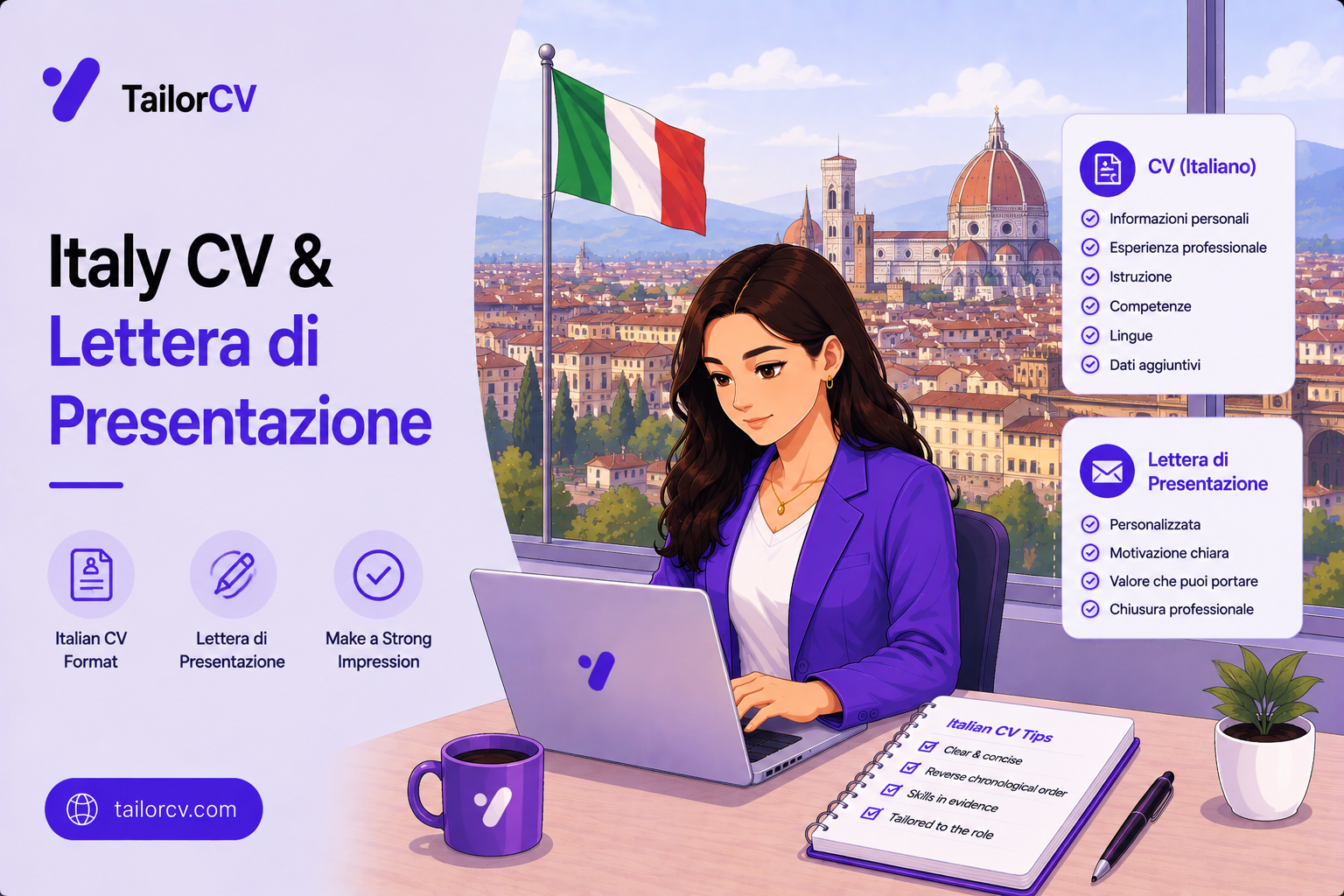
Dati personali at the top: name, address, phone, email, date of birth, nationality, and often place of birth. Italian CVs carry more personal information than British or American ones and this is unremarkable here.
A photo in the top corner is conventional, though its use is declining at international employers.
Profilo or obiettivo — a short profile of three or four lines. Keep it concrete.
Esperienza professionale, reverse chronological, with employer, location, role, dates and responsibilities. Include internships (tirocini) properly — they are real experience in Italy.
Istruzione e formazione — education, with institution, qualification, dates and final grade. Italian employers pay attention to the grade, which is stated on a defined scale, so include it.
Competenze linguistiche — languages with CEFR levels.
Competenze informatiche — IT skills, listed specifically.
Altre competenze — other skills, certifications, driving licence category where relevant.
And the privacy line at the end — covered below.
The privacy consent line
The detail that marks out someone who has actually applied in Italy before.
Italian CVs conventionally end with a line authorising the processing of personal data, referencing the applicable data protection legislation — historically Italian privacy law and now the GDPR.
A standard form is: "Autorizzo il trattamento dei miei dati personali ai sensi del Regolamento UE 2016/679 (GDPR) e del D.Lgs. 196/2003."
Why it matters: without it, an employer arguably cannot lawfully process your CV in a recruitment database. Many Italian recruiters treat its absence as a practical obstacle, and some applicant systems will not accept a document without it.
Include it. It costs one line and its absence is the kind of thing that quietly disqualifies an otherwise good application.
For English-language applications to international employers in Italy, an equivalent English line is fine.
Europass in Italy
Italy uses the EU's standardised CV format more than almost any other member state.
Public administration, academic posts and EU-funded projects frequently request it specifically, and sometimes require it.
Some private employers ask for it too, particularly in more traditional sectors.
When it is requested, use it and complete it fully. A half-filled Europass looks worse than a conventional CV because the blank fields are visible.
When it is not requested, a well-written conventional CV usually reads better — Europass is verbose and its rigid structure buries your strongest material.
Its language section is genuinely useful and worth borrowing for your normal document.
The lettera di presentazione
One page, formal, and specific.
Address a named person with the correct title — "Gentile Dott. Rossi" or "Spettabile [Company]" where you cannot find a name.
Open with the position and where you saw it.
Middle paragraphs: why this company specifically, what you bring, and concrete evidence connecting the two.
State your availability and, if relevant, your permit position.
Close with a formal formula — "Distinti saluti" or "Cordiali saluti" — and your name.
Write it in Italian for an Italian-language advert. If your Italian will not carry a professional letter unaided, that is real information about the role. A tailored draft solves the blank page, and a native speaker should read the final version.
Automated screening and application channels
Larger Italian employers screen with software like everyone else.
Standard section headings in Italian — Esperienza professionale, Istruzione e formazione, Competenze. A parser looks for recognisable structure.
Single column, no text inside images. Design-led CVs are tempting in a country with a strong visual culture and they parse into nonsense.
Mirror the advert's exact terminology, including the Italian technical vocabulary of your field.
Export as PDF, named with your own name, and confirm the text is selectable. Run it through an ATS check once.
Apply through the company portal where one exists; email to a generic address is less effective at larger employers.
Follow up once after ten days to two weeks, formally. Italian processes are slow and repeated chasing does not accelerate them.
Adapting an international CV for Italy
Five shifts most international candidates do not make.
Add the personal details back. Date of birth, place of birth and nationality are conventional here and their absence looks like an incomplete form rather than discretion.
Add the photo for Italian employers.
Add the grade. Your degree result on its scale, stated plainly.
Add the privacy line. Covered above and the single most Italy-specific item on this page.
Use professional titles where you hold them, and address recipients with theirs.
Describe internships as jobs, with employer, dates, responsibilities and outcomes rather than as a student footnote.
And keep an English version current for Milan's multinational sector, updating both together rather than letting one go stale.
The interview
What the document has to survive.
Formal at first, warming quickly. Lei rather than tu initially, professional titles used, business dress at most employers.
Relationship-building is part of the conversation rather than a preamble to it. Expect some conversation that is not strictly about the job and do not try to redirect it.
Expect questions about why Italy. Employers want to know whether you understand what you are choosing, particularly given the salary reality.
Your Italian will be tested if you claimed it, often by simply continuing in Italian.
Competency questions are used though less rigidly than in Northern Europe, and the conversation can be more open-ended.
Ask about the team and the company's direction, and show that you know something specific about them — Italian employers respond well to demonstrated interest in the organisation itself.
Salary comes up late and often refers to the applicable collective agreement level rather than an open negotiation.
Follow up once, politely and formally. Processes are slow, and silence is more often administrative than a decision.
Sector-specific emphasis
The base format holds; what you foreground shifts.
Engineering and machinery. Standards and codes you have worked to, the exact CAD, PLC and simulation packages, and project scale in your discipline's units. Italian industrial employers read technical vocabulary immediately and discount everything else.
Fashion and luxury. A portfolio link at the top, the specific houses or manufacturers you have worked with, and the product categories you know. Languages matter enormously here because the market is global.
Design. The portfolio is the application. Keep the CV to one clean page pointing at it.
Finance and consulting. Professional qualifications prominently, the institution you studied at, and your final grade — Milan's professional services firms genuinely screen on academic record.
Food and agriculture technology. Process specifics, hygiene and safety standards, and the plant scales you have worked at.
Academia and research. Publications, conference contributions and funding, in the academic CV format rather than the two-page industry one.
Managing versions
If you are applying across Italy, Spain and France, one document does not serve all three.
The shared base is genuine. All three expect more personal detail than an Anglo-American CV, all three value internships as real experience, and all three read the cover letter.
Italy uniquely wants the privacy line and the degree grade stated.
France wants one page and a title line; Italy and Spain accept two.
Photos are conventional in Italy, optional and declining in France, and common in Spain.
Keep one master and three renders, updating only the master. Editing a render directly guarantees that one version goes stale exactly when you need it.
Common failure modes
Five things that go wrong, in order of damage.
Missing the privacy line. Covered twice already because it is the one item unique to Italy that people never know about.
Omitting the degree grade. Italian employers look for it and its absence reads as concealment rather than modesty.
Sending an Anglo-American minimalist CV. No photo, no date of birth, no personal details reads as an incomplete document here rather than a discreet one.
A design-led layout. Tempting in a country with strong visual culture; it parses into nonsense and it is not what employers expect outside actual design roles.
A recycled cover letter. The lettera is read, and a generic one damages an otherwise decent application.
Mini checklist
- unchecked: Two pages, plain formatting
- unchecked: Photo included unless applying to an international employer that discourages it
- unchecked: Final grade stated for your degree
- unchecked: Internships described as real experience
- unchecked: Languages with CEFR levels
- unchecked: Privacy consent line included at the end
- unchecked: Europass used only if requested, and completed fully
- unchecked: Lettera di presentazione written specifically
- unchecked: Written in the advert's language and proofread
Scenarios
Scenario 1: You are applying to an Italian manufacturing company
Italian throughout, photo included, full personal details, the privacy line at the end, and a formal lettera di presentazione. Local convention is itself part of the signal.
Scenario 2: You are applying to a multinational in Milan
Closer to an international application — English, no photo required, conventional international CV structure. Read the advert's language and follow it.
Scenario 3: The posting asks for a Europass CV
Use it and fill it completely. A partially completed Europass is more damaging than a conventional CV, because the empty sections are conspicuous.
Tip: Add the data-protection consent line at the end of your Italian CV. It is one sentence, it has an actual legal basis, and its absence is a small practical obstacle that quietly costs applications from candidates who never knew about it.
Do's and Don'ts
Do
- Include the privacy consent line
- State your final degree grade
- Include a photo for Italian employers
- Describe internships as real experience
- Use Europass when it is requested
- Write in the advert's language
Don't
- Omit the data-protection line
- Send a half-completed Europass
- Use Europass when a conventional CV would read better
- Leave out your degree grade
- Write in Italian beyond your real ability
- Assume Anglo-American conventions transfer
Common Mistakes
- Missing the privacy line. It has a legal basis and its absence creates a practical obstacle.
- Omitting the degree grade. Italian employers look for it and its absence reads as concealment.
- Half-filled Europass. Worse than a conventional CV because the gaps are visible.
- Burying internships. The tirocinio is genuine experience in Italy.
- Wrong language. Match the advert, always.
- Anglo-American minimalism. Italian CVs carry more personal detail and that is normal here.
Related Guides
Keep building on this with the related guides in this series:
- Working in Italy as an International Graduate
- Italian Work Visas and the Nulla Osta
- Fashion, Design and Engineering Careers in Italy
- The French CV and Lettre de Motivation
- The Belgian CV Format
You can also check your resume's ATS score for free, generate a tailored cover letter, or build a portfolio website in minutes.
Frequently Asked Questions
What is the privacy line on an Italian CV?
A sentence authorising the processing of your personal data under the GDPR and Italian privacy law. It is conventional, has a legal basis, and its absence can obstruct an application.
Should I include a photo on an Italian CV?
For Italian employers, yes — it remains conventional. International employers in Milan increasingly do not expect one.
Is Europass common in Italy?
More than in most EU countries, particularly for public administration, academic roles and EU-funded projects. Use it when requested and complete it fully.
Should I state my degree grade?
Yes. Italian employers look for the final grade on its defined scale, and omitting it is noticed.
How long should an Italian CV be?
Two pages, plain formatting, with more personal detail than a British or American CV would carry.
Is the cover letter read in Italy?
Yes. The lettera di presentazione is standard and formal, and a generic one works against you.
Do Italian employers use automated screening?
Larger ones do. Use standard Italian section headings, single-column layout, avoid design-led formatting, mirror the advert's technical vocabulary, and confirm your PDF text is selectable.
How should I adapt a UK or US CV for Italy?
Add date of birth and nationality, add a photo, state your degree grade, include the privacy consent line, use professional titles, and describe internships as real jobs.
What are Italian interviews like?
Formal at first and warming quickly, with genuine relationship-building as part of the conversation rather than a preamble. Expect to be asked why Italy, and expect any Italian you claimed to be tested.
How do I adapt my CV across Italy, Spain and France?
They share more than they differ — more personal detail than Anglo-American CVs, internships as real experience, and cover letters that are read. Italy uniquely wants the privacy line and degree grade; France wants one page.
What is your resume scoring right now?
Scan it against a job description and get your ATS match score in about a minute.
Drop your resume here or choose a file
PDF only. Max 2 MB.
We never share your data or use it to train AI models.

Was this guide useful?
Be the first to rate it.