 SS
SS

Key Takeaways
- Barcelona has Spain's largest and most international technology scene, with a substantial share of teams working in English.
- Madrid holds the corporate and enterprise technology weight — banks, telecoms, energy and consulting.
- Málaga has built a genuine technology cluster with dramatically lower living costs and far less competition.
- Salaries are well below Northern European levels and the gap narrows once housing is counted, though not entirely.
- Spain is unusually strong for remote-first international companies hiring locally.
Barcelona
The most internationally-minded technology city in Southern Europe.
Why it happened. A combination of quality of life attracting international talent, a strong design and creative tradition, business schools like IESE and ESADE producing founders, and a deliberate municipal strategy around the 22@ innovation district.
What is there. Glovo, Typeform, Factorial, Wallbox, TravelPerk, Preply and a substantial startup ecosystem, alongside the Barcelona operations of international companies.
Mobile World Congress anchors an annual global telecommunications gathering that generates real business and contacts.
The Barcelona Supercomputing Center is one of Europe's significant research computing facilities.
Working language. A large share of Barcelona startups operate in English because their teams are international. This is genuinely different from the rest of Spain.
The catch. Salaries are noticeably below Northern European levels, housing costs have risen sharply, and the city's popularity means competition from international candidates is high.
Madrid
Larger economy, more corporate, less international in flavour.
The banks. Santander and BBVA run very large technology organisations, and both have made significant digital investments. This is genuine engineering at scale.
Telecommunications. Telefónica is a major technology employer with substantial R&D.
Energy. Iberdrola, Repsol and Naturgy all run large technical organisations.
Consulting and systems integration. Indra, Accenture's Spanish operations and the Big Four employ enormous numbers of technology graduates — this is the volume employer in Spain and it is frequently the first job.
Insurance and corporate technology across the head-office economy.
Working language. More Spanish-dominant than Barcelona, though international companies and some technology teams operate in English.
The trade-off: larger and more stable employers, more Spanish required, and a somewhat lower cost of living than Barcelona though not by much.
Málaga and the alternatives
The genuinely under-known option.
Málaga's Andalusia Technology Park has attracted a growing number of technology companies, with Google, Vodafone and others establishing operations there.
The strategy has worked. Málaga has become a real destination rather than an aspiration, helped by climate, an airport, and living costs a fraction of Barcelona's.
Valencia has a growing startup scene and similar cost advantages.
Bilbao and the Basque Country hold Spain's most sophisticated industrial technology base — automation, machine tools, energy engineering.
Seville has aerospace and a growing services sector.
Remote-first companies hiring in Spain are a genuine category. A substantial number of international companies now employ people living in Spain on local or contractor arrangements, and for a technology worker this can mean Northern European pay with Spanish costs — which is the best available arithmetic in this whole guide.
How hiring runs
Recognisable, with a few Spanish specifics.
- Application, often through InfoJobs, LinkedIn or the company portal.
- Recruiter screen — motivation, languages, salary expectations, work authorisation.
- Technical assessment — a take-home, a live coding exercise, or both depending on the employer.
- Technical interviews with the team.
- Cultural fit conversation, taken seriously at startups.
- Offer, with the convenio level and the number of pagas clarified.
Timelines vary widely. International startups move quickly; large Spanish corporates and consultancies move slowly.
Salary is discussed relatively openly, often with reference to the collective agreement band.
Ask how many payments the annual figure is divided into — twelve or fourteen — because it changes your monthly reality substantially.
Show deployed work. A portfolio site or a live project does more than a repository, and Spanish technical recruiters will click.
Run your CV through an ATS check — the large consultancies and corporates screen at volume.
Building a career from Spain
Where it leads, which matters given the salary reality.
The international companies are the bridge. Working for a multinational's Spanish operation makes an internal move to another country far easier later.
Startup experience travels if the company is internationally recognised.
Consulting builds a broad base quickly, which is exactly why so many Spanish technology careers start at Indra, Accenture or the Big Four and move on after two or three years.
Remote-first employment is increasingly the answer for people who want to stay in Spain without accepting Spanish pay.
Spanish is a genuine career asset beyond Spain — Latin American markets, US Hispanic markets, and international organisations all value it.
And the pattern many people follow is a few years in Spain early, a move north or to a remote-first employer for the earning years, and a return later. That is a legitimate plan rather than a failure to commit.
The Spanish technology stack, sector by sector
What the work actually is, beyond the city labels.
Fintech and payments. Madrid's banking base created a genuine payments and fintech ecosystem, and the incumbent banks' technology organisations do serious work here.
Travel and mobility. Amadeus is a global travel technology company headquartered in Madrid and one of Spain's most significant engineering employers. Cabify and the mobility sector sit alongside it.
Health technology. Barcelona's biomedical research cluster around the hospitals and PRBB produces genuine health and bio-informatics work.
Gaming. A smaller but real sector, with studios in Barcelona and Madrid.
Telecommunications. Telefónica's R&D and network engineering, plus the wider operator ecosystem.
Energy and utilities technology. Iberdrola and the renewables sector run substantial technical organisations, and Spain's position in solar and wind makes this genuinely interesting engineering.
Retail technology. Inditex — Zara's parent — runs a large technology organisation in Galicia that almost nobody outside Spain associates with software, and it handles genuine scale.
Living in each city
The practical comparison that decides more than the job title does.
Barcelona. Compact, walkable, coastal, and internationally saturated. Housing costs have risen sharply and the rental market is competitive. The international community is large, which makes arriving easy and means much of your circle is transient.
Madrid. Larger, more Spanish in daily life, better connected domestically, and slightly cheaper on housing though the gap has narrowed. Summers are extremely hot and the city empties in August.
Málaga. Dramatically cheaper, coastal, growing fast, and with a smaller professional community. Excellent if the arithmetic matters more than the variety.
Valencia. Between Barcelona and Málaga in most respects — real employment, coastal, considerably cheaper than Barcelona.
Across all of them, public transport is good and cheap, healthcare is public and solid, and daily costs outside housing are low.
And the honest note: Spain's appeal is real and its salaries are not. People who thrive here have either brought their income with them, joined an international employer paying above the local market, or made peace with saving less in exchange for the life.
Practical steps for a technology search
Concrete actions rather than general advice.
Build a target list of thirty companies across your chosen cities — international startups, scale-ups, the banks' technology arms, and remote-first employers hiring in Spain.
Check which operate in English before applying, since it determines whether your application is even viable.
Complete your InfoJobs profile fully even if you prefer LinkedIn, because Spanish recruiters search it directly.
Ask about the number of payments in every offer conversation — twelve versus fourteen changes your monthly reality substantially.
Ask about remote and hybrid policy explicitly. Spanish employers vary enormously and the answer affects whether you can live somewhere cheaper.
Check the Highly Qualified Professional route with any employer who would need to sponsor you.
And run one honest calculation — net salary after tax, minus rent in the specific neighbourhood you would live in. Do it before you fall in love with the idea of the city.
Mini checklist
- unchecked: City matched to what you want — startups, enterprise or cost
- unchecked: English-language employers identified if your Spanish is limited
- unchecked: Málaga and Valencia considered seriously
- unchecked: Remote-first international companies included in your search
- unchecked: Consulting and systems integration considered as an entry route
- unchecked: Salary compared against real rent in the specific city
- unchecked: Highly Qualified Professional visa route checked if you need one
- unchecked: Portfolio or deployed work ready to show
- unchecked: Spanish study started
Scenarios
Scenario 1: You want an international startup environment
Barcelona. It has the largest scene, the most English-working teams, and the strongest international community — with the highest competition and housing costs to match.
Scenario 2: You want stability and scale
Madrid. The banks, Telefónica and the energy companies run large technology organisations doing serious work, and consulting is the volume entry route into Spanish technology.
Scenario 3: You want Spanish life without Spanish salaries
Look for remote-first international companies hiring in Spain, and consider Málaga or Valencia. Northern European pay with Southern European costs is the strongest arithmetic available here.
Tip: Look at remote-first international companies that hire people living in Spain. It is the one arrangement in this guide that gives you Northern European pay with Spanish living costs, and it is a genuine and growing category rather than a theoretical one.
Do's and Don'ts
Do
- Choose the city by what you want, not by reputation
- Consider Málaga and Valencia seriously
- Include remote-first international employers
- Use consulting as an entry route if needed
- Show deployed work rather than describing it
- Learn Spanish for the domestic market
Don't
- Assume Barcelona and Madrid are interchangeable
- Expect Northern European salaries
- Ignore the banks' technology organisations
- Overlook Bilbao's industrial technology base
- Compare salaries without the specific city's rent
- Assume English works across all of Madrid
Common Mistakes
- Treating the two cities as the same. Barcelona is international and startup-led; Madrid is corporate and Spanish-dominant.
- Ignoring Málaga. A genuine and fast-growing cluster with a fraction of the cost and competition.
- Dismissing the banks. Santander, BBVA and Telefónica run large, serious engineering organisations.
- Missing remote-first employers. The best pay-to-cost ratio available in Spain.
- Expecting Northern European pay. Spanish technology salaries are substantially lower.
- Comparing without rent. Barcelona housing has risen sharply and changes the comparison.
Related Guides
Keep building on this with the related guides in this series:
- Working in Spain as an International Graduate
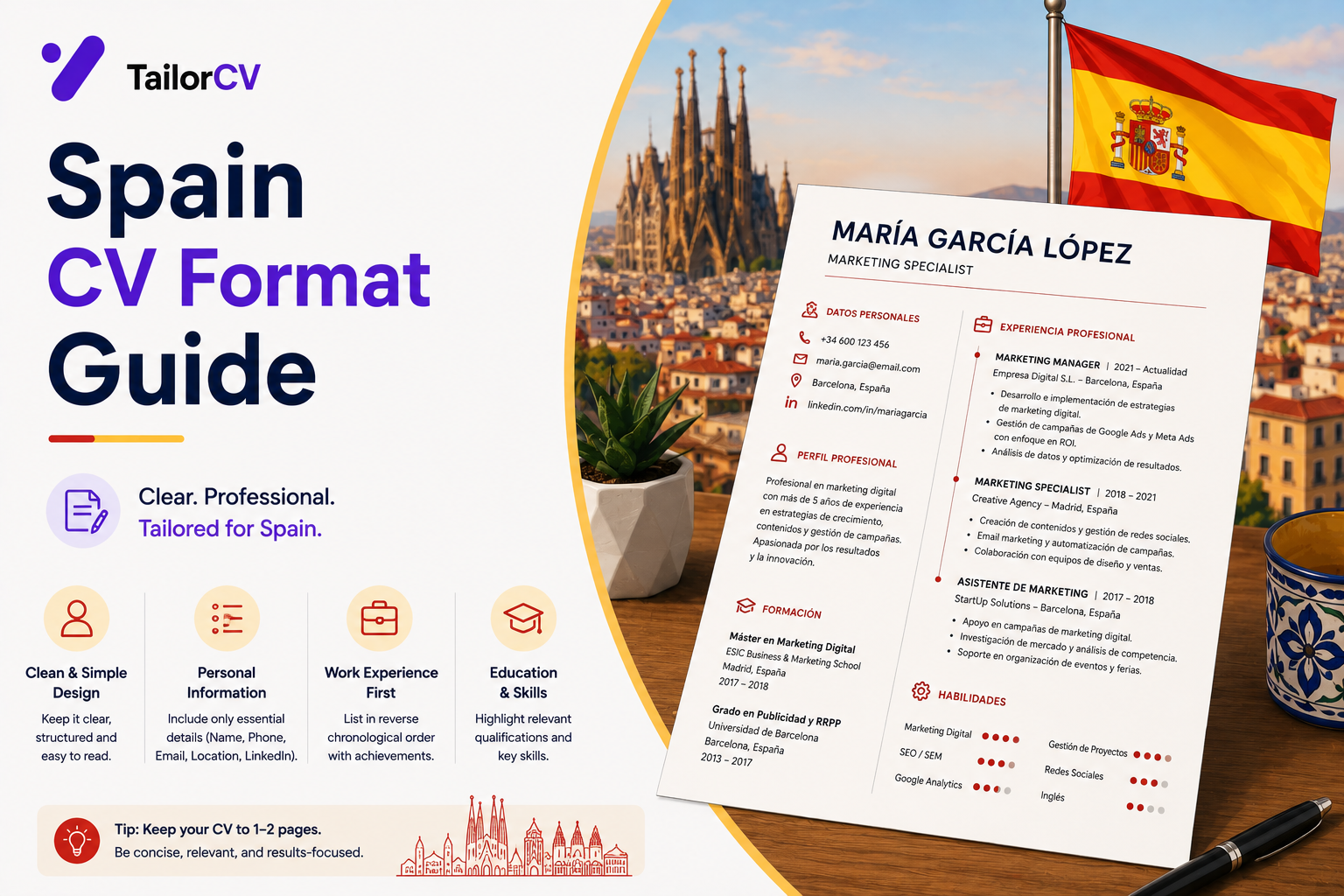
- The Spanish CV Format
- Spanish Work Visas and the Digital Nomad Route
- Lisbon and Porto's Technology Scene
- Fashion, Design and Engineering Careers in Italy
You can also check your resume's ATS score for free, generate a tailored cover letter, or build a portfolio website in minutes.
Frequently Asked Questions
Barcelona or Madrid for technology jobs?
Barcelona for international startups and English-working teams; Madrid for corporate and enterprise scale at the banks, telecoms and energy companies.
Is Málaga a real technology destination?
Yes. The Andalusia Technology Park has attracted genuine operations including Google and Vodafone, with living costs a fraction of Barcelona's.
Do Spanish tech jobs pay well?
Below Northern European levels, noticeably. Lower living costs close part of the gap but not all of it, particularly in Barcelona where rents have risen sharply.
Can I work in English?
In much of Barcelona's startup scene and at international companies, yes. Madrid's domestic corporate market is more Spanish-dominant.
What about remote work for a foreign company?
It is a genuine and growing category, and it produces the best pay-to-cost arithmetic available in Spain. Spain's digital nomad visa exists specifically for it.
Is consulting worth considering?
As an entry route, frequently yes. Indra, Accenture and the Big Four are the volume employers of technology graduates in Spain and many careers start there.
What does the Spanish tech hiring process look like?
Application, recruiter screen covering languages and work authorisation, a technical assessment, team interviews and a fit conversation. International startups move fast; large corporates and consultancies move slowly.
Where does a Spanish tech career lead?
International companies' Spanish operations make later internal moves abroad easier, consulting builds a broad base quickly, and remote-first employment increasingly lets people stay in Spain without accepting Spanish pay.
What technology sectors is Spain strong in?
Fintech and payments in Madrid, travel technology at Amadeus, health technology in Barcelona, telecommunications at Telefónica, renewables engineering, and a large retail technology organisation at Inditex in Galicia.
Barcelona, Madrid, Málaga or Valencia?
Barcelona for international startups with the highest costs; Madrid for corporate scale and a more Spanish daily life; Málaga and Valencia for dramatically lower costs with real but smaller markets.
What practical steps should I take for a Spanish tech search?
Build a thirty-company target list, check which operate in English, complete your InfoJobs profile fully, ask about payment count and remote policy in every conversation, and calculate net pay minus real neighbourhood rent.
What is your resume scoring right now?
Scan it against a job description and get your ATS match score in about a minute.
Drop your resume here or choose a file
PDF only. Max 2 MB.
We never share your data or use it to train AI models.

Was this guide useful?
Be the first to rate it.