 TD
TD
Key Takeaways
- Language choice is the first decision — Dutch in Flanders, French in Wallonia, and French, Dutch or English in Brussels depending on the employer.
- Belgian CVs run to two pages, plain and factual, with a photo optional and increasingly omitted.
- Language levels are the most important section on the document and should use CEFR with specifics.
- The motivatiebrief / lettre de motivation is standard and read.
- EU institution applications ignore all of this and follow their own format entirely.
Which language to write in
Get this wrong and nothing else matters.
Flanders. Dutch, unless the advert is in English. An application in French to a Flemish employer is a genuine misstep, and the language politics behind that are real.
Wallonia. French, unless the advert is in English.
Brussels. Read the advert. A Belgian employer advertising in French wants French; one advertising in Dutch wants Dutch; an international organisation or multinational advertising in English wants English.
When the advert is in English, apply in English regardless of region. That is the employer telling you their working language.
When you genuinely cannot tell, English is the safer default in Brussels and the wrong default in Flanders or Wallonia.
Never send the same document in two languages hoping one lands. It reads as not having made a decision.
The structure
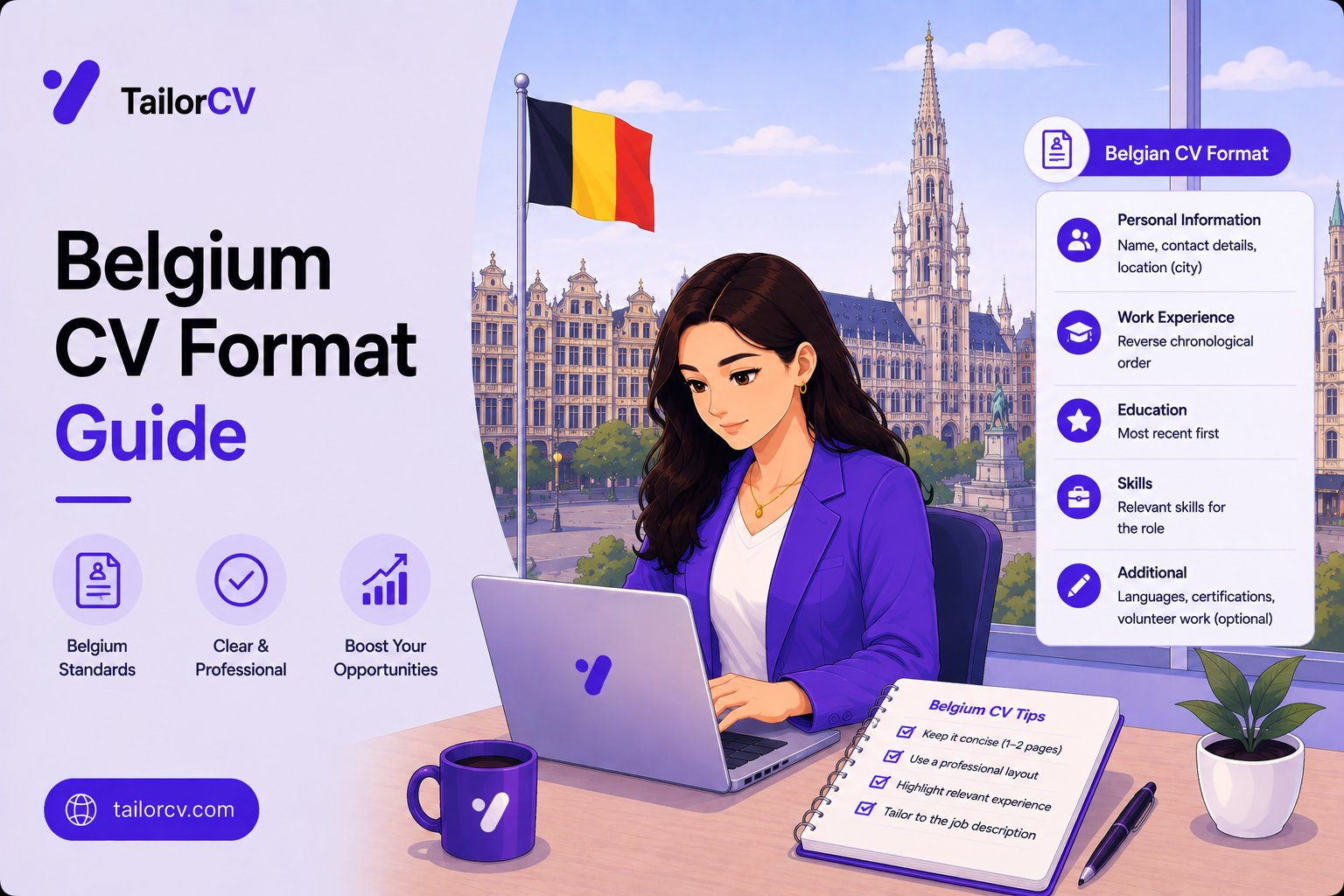
Personal details: name, phone, email, city, LinkedIn, and nationality. Date of birth still appears on many Belgian CVs though it is not required of you. A photo is optional and increasingly omitted, particularly at international employers.
A short profile of three or four lines, specific.
Work experience, reverse chronological, with employer, location, role, dates and concrete outcomes. Include internships (stage) properly described — they count here.
Education, with institution, qualification, dates and results. Belgian employers pay attention to which institution.
Languages — and this section carries more weight in Belgium than in almost any other country. Use CEFR levels and be specific and honest. "Dutch B2 (professional working proficiency, used daily in previous role)" tells a reader far more than "Dutch: good".
Skills, listed concretely.
Extracurriculars and volunteering, which Belgian employers read positively.
References available on request is acceptable here, unlike in Norway or New Zealand.
The language section, in detail
Because it deserves its own treatment in a trilingual country.
Use CEFR levels — A1 to C2 — rather than words like "fluent" or "notions", which are interpreted inconsistently.
Distinguish spoken from written where they genuinely differ. Many people speak a language considerably better than they write it, and saying so is credible rather than weak.
Mention certificates. Selor certification for public-sector language ability, or DELF/DALF for French, or NT2 for Dutch. These are recognised currency.
Be honest about the level. In Belgium your language claim will be tested — sometimes in the interview by simply switching languages mid-conversation. Overstating is found out immediately.
English proficiency is worth stating explicitly even though it is widely assumed, particularly for Brussels roles.
If you are learning one of the national languages, say so with the level you have reached and where you are studying. Belgian employers respond well to demonstrated effort on this specifically.
The motivation letter
Standard in Belgium and genuinely read, so it deserves real effort.
One page, three or four paragraphs, in the same language as the CV.
Open with something specific about the organisation — a product, a market, a recent decision. Generic enthusiasm reads as generic enthusiasm.
Connect your experience to their stated requirements with one or two concrete examples rather than a summary of your CV.
Address your language situation directly if it is relevant. If you are working in your second or third language, saying so plainly with your level is better than leaving it ambiguous.
State your availability and, if you need one, your permit position.
Close with the standard formal formula in French or Dutch — these are conventional phrases and improvising one is conspicuous.
Have it proofread by a native speaker if it is not your first language. In a country where language ability is itself a qualification, errors in the letter undercut the level you claimed.
Adapting an international CV for Belgium
Four practical shifts.
Decide the language and commit. Covered above and worth repeating because it is the highest-stakes decision on the document.
Expand the language section. What is a one-line afterthought on a British CV is a substantive section here.
Describe internships properly. The stage is real experience in Belgium, as in France, and burying it under student activities wastes it.
Translate your qualification. Belgian employers calibrate on institution and level. If your degree has no obvious equivalent, add a clarifying line. NARIC Vlaanderen and its francophone counterpart handle formal equivalence, which is required for regulated professions.
Keep versions in parallel. If you are applying across Flanders, Brussels and international employers, maintain the language versions together rather than letting one drift stale.
And check parsing. Larger Belgian employers screen with software — standard headings, single column, selectable text, and an ATS check once before you send anything.
Region-by-region differences in detail
The base format holds; the details shift.
Flanders. Dutch, sober formatting, and a preference for concision. Flemish employers read a two-page CV as complete and a three-page one as unfocused. Photo increasingly omitted.
Wallonia. French, with conventions closer to the French market — a title line under your name is common, and the lettre de motivation carries the formal closing formulas French readers expect.
Brussels, Belgian employers. Whichever language the advert used, with the other one's presence on your language list noticed favourably.
Brussels, international sector. English, international CV conventions, no photo, and a competency-oriented framing if you are applying anywhere near the institutions.
Across all of them, the languages section is read first and hardest.
Interviewing in Belgium
What the document has to survive.
Politely direct. Belgian interviewers are less blunt than Dutch ones and less formal than French ones, and they will probe an inconsistency without making it uncomfortable.
Language switching happens. If you claimed Dutch B2, expect part of the conversation to move into Dutch without announcement. This is the standard check and it is why honest levels matter.
Competency questions with real examples. Prepare five or six situations with concrete outcomes.
Expect questions about staying. Brussels has a transient international population and employers ask, particularly outside the institutions, whether you intend to be here in three years.
Compromise is valued. A question about handling disagreement is looking for someone who can negotiate an outcome, not someone who wins.
Ask about the joint committee covering the role if pay comes up. It shows you understand how Belgian employment actually works.
Europass and when to use it
Belgium is one of the countries where you will actually be asked for it.
Europass is the EU's standardised CV format, and some Belgian public-sector employers, EU-funded projects and academic positions request it specifically.
Use it when asked and not otherwise. For ordinary private-sector applications it is verbose and structurally rigid, and a well-written conventional CV reads better.
Its language section is genuinely good, forcing the spoken/written/reading breakdown that Belgian employers want anyway. Borrowing that structure for your normal CV is a reasonable idea.
Fill it completely if you use it. A half-completed Europass looks worse than a conventional document, because the empty fields are visible.
Keep the content the same. The format changes; the facts and the tailoring do not.
Common failure modes
Six things that go wrong, in rough order of how much damage they do.
Wrong language. Already covered twice because it is the one that ends applications outright.
A vague languages section. In a country where language is a qualification, "good French, some Dutch" is not an answer.
Copying a French CV wholesale into Flanders. The conventions differ, and a Wallonian-style document with a title line and French formal closings sent to Ghent reads as not knowing where you are.
Three pages. Belgian employers expect two, and Flemish employers particularly read length as an inability to prioritise.
Ignoring the joint committee. If salary comes up and you have no idea which paritair comité governs the role, you look unprepared in a market where that framework determines pay.
Treating Brussels as one market. A Belgian employer in Brussels and an EU institution in Brussels are entirely different applications with entirely different documents.
Mini checklist
- unchecked: Language of application decided from the advert
- unchecked: Two pages maximum
- unchecked: Photo decision made by employer type
- unchecked: Languages listed with CEFR levels, spoken and written
- unchecked: Language certificates named
- unchecked: Internships described as real experience
- unchecked: Region-appropriate conventions applied
- unchecked: Motivation letter written specifically
- unchecked: Exported as PDF and checked with an ATS check
Scenarios
Scenario 1: You are applying to a company in Antwerp
Dutch, unless the advert is in English. Applying in French to a Flemish employer is a real misstep rather than a neutral choice.
Scenario 2: You are applying to an EU institution
Ignore everything on this page. The institutions use their own application systems and CV formats, and following their instructions exactly is the entire task.
Scenario 3: You are learning Dutch and have reached B1
Say so explicitly, with where you are studying and what level you are working toward. Belgian employers respond well to demonstrated effort on the national languages, and hiding a work-in-progress helps nobody.
Tip: Write your language section with precision — CEFR level, spoken versus written, and any certificate. In a trilingual country it is the section a recruiter reads first, and vagueness there costs you more than anywhere else on the document.
Do's and Don'ts
Do
- Match the application language to the advert
- Use CEFR levels with spoken and written distinguished
- Name any language certificates you hold
- Describe internships as real experience
- Say if you are actively learning a national language
- Keep it to two pages
Don't
- Apply in French to a Flemish employer
- Send the same CV in two languages
- Use vague terms like "fluent" or "notions"
- Overstate a language level
- Apply Belgian conventions to EU institution vacancies
- Assume English is safe outside Brussels
Common Mistakes
- Wrong language. The single most damaging error, particularly French to a Flemish employer.
- Vague language claims. In a trilingual market this is the section that gets read hardest.
- Overstating ability. Interviewers switch language mid-conversation to check.
- Hedging both ways. Sending two language versions reads as indecision.
- Using local conventions at the institutions. They have their own format entirely.
- Omitting a language in progress. Demonstrated effort is genuinely valued here.
Related Guides
Keep building on this with the related guides in this series:
- Working in Belgium as an International Graduate
- Careers in the EU Institutions
- The French CV and Lettre de Motivation
- How to Write a Dutch CV That Gets Read
- The Austrian Bewerbung and CV Format
You can also check your resume's ATS score for free, generate a tailored cover letter, or build a portfolio website in minutes.
Frequently Asked Questions
Which language should I write my Belgian CV in?
The language of the advert. Dutch in Flanders, French in Wallonia, and whichever the employer used in Brussels. When the advert is in English, apply in English.
Should I include a photo?
Optional and increasingly omitted, particularly at international employers. Including a plain professional one is not a mistake either.
How important is the languages section?
More than in almost any other country. Use CEFR levels, distinguish spoken from written, and name any certificates — it is frequently the first section a Belgian recruiter reads.
What is Selor certification?
The official Belgian language certification used for public-sector roles. It is the recognised currency for demonstrating French and Dutch ability in that market.
Can I send my CV in two languages?
No. It reads as not having decided. Pick the language the advert used and commit to it.
Do EU institution applications follow Belgian conventions?
No. The institutions use their own application systems and formats entirely, and following their instructions precisely is what matters there.
Is the motivation letter read in Belgium?
Yes, and it is standard. One page in the same language as the CV, opening with something specific about the organisation and closing with the conventional formal formula.
Do I need my degree formally recognised in Belgium?
For regulated professions, yes — NARIC Vlaanderen and its francophone counterpart handle equivalence. For other roles a clarifying line about the level and duration usually suffices.
Will my language level be tested in a Belgian interview?
Frequently, and without warning — an interviewer may simply switch language mid-conversation. This is the standard check and it is why honest CEFR levels matter more here than elsewhere.
Do CV conventions differ between Flanders and Wallonia?
Yes. Flanders prefers sober, concise documents in Dutch; Wallonia follows conventions closer to the French market, including a title line and the formal closing formulas in the letter.
Should I use a Europass CV in Belgium?
Only when it is specifically requested — some public-sector, EU-funded and academic roles ask for it. For private-sector applications a well-written conventional CV reads better.
What are the most common Belgian CV mistakes?
Applying in the wrong language, a vague languages section, using French conventions for a Flemish employer, running to three pages, and treating Belgian employers and EU institutions in Brussels as the same market.
Does your formatting survive the parser?
Upload your resume and see what an ATS actually reads back.
Drop your resume here or choose a file
PDF only. Max 2 MB.
We never share your data or use it to train AI models.

Was this guide useful?
Be the first to rate it.