 SS
SS
Key Takeaways
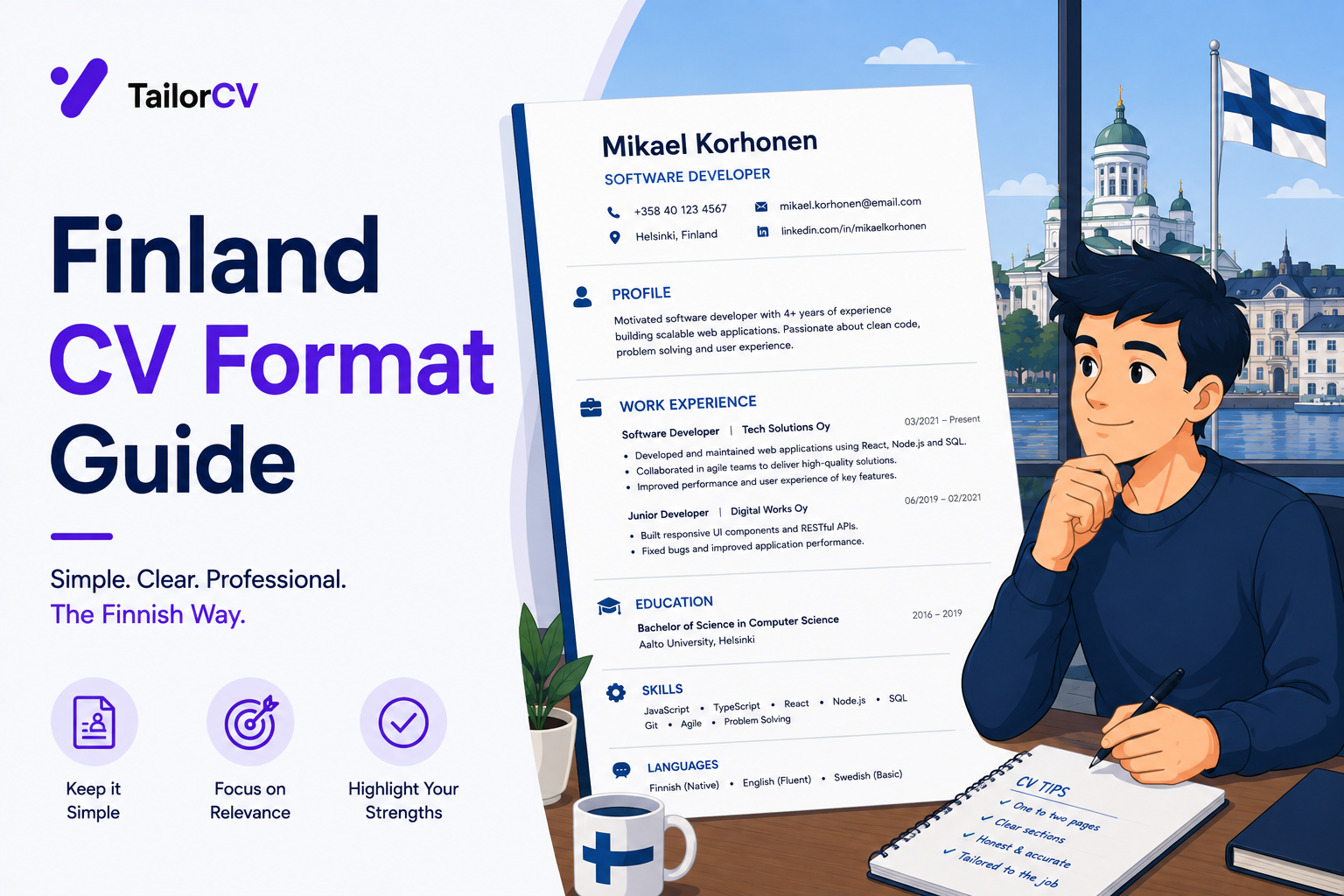
- A Finnish CV — ansioluettelo — runs to two pages, plain and factual, with no photo required and no personal details beyond the basics.
- The application letter is standard and read, though shorter and less formal than the German or Swiss equivalent.
- Understatement is the register. Finnish professional culture is direct and low-key, and overselling actively damages credibility.
- Summer jobs count. Finnish students work summers as a matter of course and employers read that history as normal and positive.
- State your Finnish level honestly in CEFR terms, and your work permission plainly.
The structure
Finnish employers want a document that is quick to verify and free of decoration.
Personal details: name, phone, email, city, LinkedIn. A photo is optional and increasingly omitted, particularly at international employers. Date of birth still appears on some Finnish CVs but is not expected of you.
A short profile of three or four lines, concrete rather than adjectival.
Work experience, reverse chronological, with employer, location, role, dates and what you did. Include summer and part-time work — this is important and covered below.
Education, with institution, degree, dates and any notable results. Finnish employers pay attention to which institution and which programme.
Skills, listed concretely — software, systems, methods.
Languages with CEFR levels. In a bilingual country with a large English-speaking professional sector, this section does real work.
Courses, certifications and licences, which Finnish employers read as concrete evidence.
Positions of trust and volunteering. Finnish student culture involves substantial guild, union and association activity, and employers read it as genuine responsibility rather than as filler.
References, named with permission, or a clear statement that they are available.
Why summer jobs belong on the document
This is the biggest single adjustment an international candidate should make.
Finnish students work summers as standard. It is a near-universal norm, supported by dedicated summer job recruitment at large employers, and a Finnish graduate's CV routinely shows three or four summers of work.
Employers read it as evidence of ordinary competence — turning up, working with people, holding responsibility. Its absence in a young candidate's history is noticeable.
So do not delete the warehouse, the café, the shop or the factory. Many international candidates strip these out believing they look unserious. In Finland the opposite is true.
Describe them briefly but properly. Employer, dates, what you were responsible for. One line each is enough.
Summer jobs at large employers are a real graduate pipeline. KONE, Wärtsilä, Nokia and the banks all run summer programmes that feed permanent hiring, and if you are studying in Finland this is the single most effective route in.
The register: direct and low-key
Finnish professional communication has a specific character and matching it matters.
Directness is normal. Finnish colleagues say what they mean without extensive softening, and this is not rudeness. Correspondingly, elaborate hedging in your writing reads as evasive.
Overstatement is penalised heavily. "Visionary leader with unparalleled expertise" is close to disqualifying. Finnish readers discount unverifiable claims and the discount extends to the rest of the document.
Silence is comfortable. In interviews, pauses are normal and rushing to fill them reads as nervousness. Answer the question, then stop.
Specificity is how competence is conveyed. "Rebuilt the reporting pipeline, cutting the monthly close from six days to two" needs no adjective and cannot be disputed.
Modesty plus evidence is the combination that works — the same pattern as Sweden and Norway, and for the same cultural reasons.
Automated screening in Finland
Larger Finnish employers screen with software, and the constraints are the usual ones.
Standard section headings the parser recognises. A creatively named section may not be extracted as a section.
Single column, no text inside images. Two-column layouts interleave into nonsense, and contact details in a graphic are invisible.
Mirror the advert's exact terms. Matching is literal — name the exact software, standard or method where it is genuinely true of you.
Export as PDF, named with your own name, and confirm the text is selectable.
Keep both a Finnish and an English version if you are applying across sectors, and update them together so neither goes stale.
Adapting an international CV for Finland
Three shifts most international candidates miss.
Strip the promotional language. Adjective-heavy summaries written for other markets read as unserious here. Replace them with facts.
Add the modest jobs back. As covered above, this is the single most common and most costly omission.
Translate your qualification into recognisable terms. Finnish employers pay attention to institution and programme. If your degree has no obvious local equivalent, one line stating the level and duration helps. For regulated professions, formal recognition is required rather than optional — check the Finnish National Agency for Education.
Explain gaps in one line. An unexplained hole generates a question you will be asked anyway.
Keep dates and details precise. Finnish readers verify, and approximation stands out in an otherwise specific document.
The interview, and what the CV has to survive
The document gets you the haastattelu; the room tests whether it was accurate.
Expect a walk through your CV. Finnish interviewers frequently go chronologically, asking about each entry. Vague or approximate claims are found here.
Silence is normal. Pauses will happen and rushing to fill them reads as nervous. Answer, then stop.
Competency questions with real examples. Prepare five or six situations with concrete outcomes.
Punctuality is close to absolute. Arrive early. Being late without notice is genuinely poorly received.
Modesty plus specificity. Describe what happened, not how impressive it was.
"Why Finland?" is asked of international candidates, and the honest answer about the industry or the company works far better than praise for the country.
Ask substantive questions. Curiosity about how the work is actually done lands well; questions only about progression do not.
Language will be tested if you claimed it. If you wrote B2 Finnish, expect part of the conversation to switch.
Tailoring efficiently across applications
Finnish employers expect a document aimed at the role, and a master-and-cut approach is how you do that without rewriting.
Keep one complete master with everything you have done. It is never sent.
Cut for each application. Remove the irrelevant, reorder so the relevant sits highest, and adjust the profile to name the role and the organisation.
Use the advert's own nouns. If the posting names a framework, a standard or a method, use that exact word where it is genuinely true of you.
Write the letter fresh each time. It is the one component that cannot be recycled convincingly.
Keep a record of what you sent where. Finnish processes run over weeks and being asked about a document you cannot recall is avoidable.
And update the master quarterly — after a finished project, a new tool, a new responsibility. Everything you send inherits from it.
Structuring for a graduate with little experience
The most common situation, and the one people handle worst.
Lead with education, including your programme, specialisation and thesis topic.
Describe your thesis as a project. The problem, the constraint, the method, the result. This is usually the most substantial technical work a graduate has done and it routinely appears as a single line.
Treat course projects as work where they were genuinely substantial. A term-long team project with a real client is experience.
List guild and association positions properly. Budget managed, events organised, people coordinated. Finnish employers read these as management experience.
Keep the summer jobs. Covered above, and worth repeating because it is the most common deletion.
Link something that runs. A repository, a deployed page, a portfolio site. Finnish reviewers are practical and will click.
Application channels and etiquette
Where the document goes and how to behave afterwards.
Apply through the employer's own system where one exists. Email to a general address rarely lands.
Some portals want structured entry rather than an upload. Keep a plain-text version so pasting does not carry broken formatting into a form.
One polite follow-up after a week or two is acceptable. Beyond that, wait — Finnish processes are unhurried and repeated chasing reads poorly.
Midsummer to early August is dead. The Finnish summer holiday is near-universal and hiring genuinely pauses. Applying in mid-July and worrying about silence is a waste of your own energy.
Open applications are read. Writing to a company that has not advertised is accepted practice, particularly at smaller employers.
Mini checklist
- unchecked: Two pages maximum
- unchecked: Photo decision made — optional, often omitted
- unchecked: Summer and part-time jobs included
- unchecked: Guild, union and association roles described as responsibility
- unchecked: Languages with CEFR levels
- unchecked: Finnish level stated honestly
- unchecked: Work permission stated plainly
- unchecked: Understated register with concrete evidence
- unchecked: Application letter written for this specific role
- unchecked: Exported as PDF and checked with an ATS check
Scenarios
Scenario 1: You are applying to a Helsinki game studio
English throughout, plain formatting, and lead with what you have actually shipped. Link a playable build or a portfolio — in this sector the work speaks louder than the document.
Scenario 2: You studied in Finland and worked three summers
Put all three on the CV with a line each. That history reads as completely normal to a Finnish employer and its presence is an advantage over an international candidate who deleted theirs.
Scenario 3: The advert is in Finnish
Apply in Finnish only if you can write professionally unaided. A weak Finnish application undermines the language level you claimed, and a role advertised in Finnish will operate in it.
Tip: Do not delete your summer and part-time jobs. Finnish students work every summer as a matter of course, employers expect to see that history, and its absence in a graduate's CV is more conspicuous than any modest job on it.
Do's and Don'ts
Do
- Keep it to two pages, plain
- Include summer and part-time work
- List languages with CEFR levels
- Describe association and guild roles properly
- Understate and evidence
- Write a specific application letter
Don't
- Oversell with strong claiming adjectives
- Delete modest early jobs
- Inflate your Finnish level
- Use a heavily designed layout
- Write in Finnish beyond your real ability
- Hedge everything into vagueness
Common Mistakes
- Deleting summer jobs. They are expected in Finland and their absence is noticed.
- Overselling. Finnish readers discount unverifiable claims and it damages the whole document.
- Inflating Finnish. It will be tested, and most technology roles run in English anyway.
- Burying association roles. Guild and student union work is read as real responsibility.
- Designed layouts. Plain and factual is the expectation.
- A generic application letter. It is read, so a recycled one works against you.
Related Guides
Keep building on this with the related guides in this series:
- Working in Finland as an International Graduate
- Finnish Residence Permits for Graduates
- Technology and Gaming Jobs in Finland
- Writing a CV for the Norwegian Market
- Nordic Graduate Job Markets Compared
You can also check your resume's ATS score for free, generate a tailored cover letter, or build a portfolio website in minutes.
Frequently Asked Questions
Do I need a photo on a Finnish CV?
It is optional and increasingly omitted, particularly at international employers. Including a plain professional one is not a mistake either.
How long should a Finnish CV be?
Two pages, plain and factual. Reverse chronological, with concrete descriptions rather than adjectives.
Should I include summer jobs?
Yes, definitely. Finnish students work summers as standard and employers expect that history — deleting it is a common and costly international mistake.
Is the application letter read in Finland?
Yes, though it is shorter and less formal than the German or Swiss equivalent. A generic one still works against you.
How should I list my Finnish level?
Honestly, in CEFR terms. It will be tested in any role that actually runs in Finnish, and most technology roles do not.
Do student association roles matter?
Yes. Finnish guild, student union and association activity is read as genuine responsibility and belongs in the experience section rather than a footnote.
Do Finnish employers use automated screening?
Larger ones do. Use standard headings, single-column layout, mirror the advert's exact terminology, and confirm the text in your exported PDF is selectable.
Does my foreign degree need recognition in Finland?
For regulated professions, yes — the Finnish National Agency for Education handles it. For unregulated roles it is not required, though a clarifying line about the level and duration helps.
What are Finnish interviews like?
Structured and low-key. Expect a chronological walk through your CV, competency questions with real examples, comfortable silences, and a genuine test of any language level you claimed.
How should a Finnish graduate CV be structured?
Education and thesis first, described as a real project with problem, method and result, followed by summer and part-time work, guild and association roles, and a link to something that runs.
Does your formatting survive the parser?
Upload your resume and see what an ATS actually reads back.
Drop your resume here or choose a file
PDF only. Max 2 MB.
We never share your data or use it to train AI models.

Was this guide useful?
Be the first to rate it.