 SS
SS
Key Takeaways
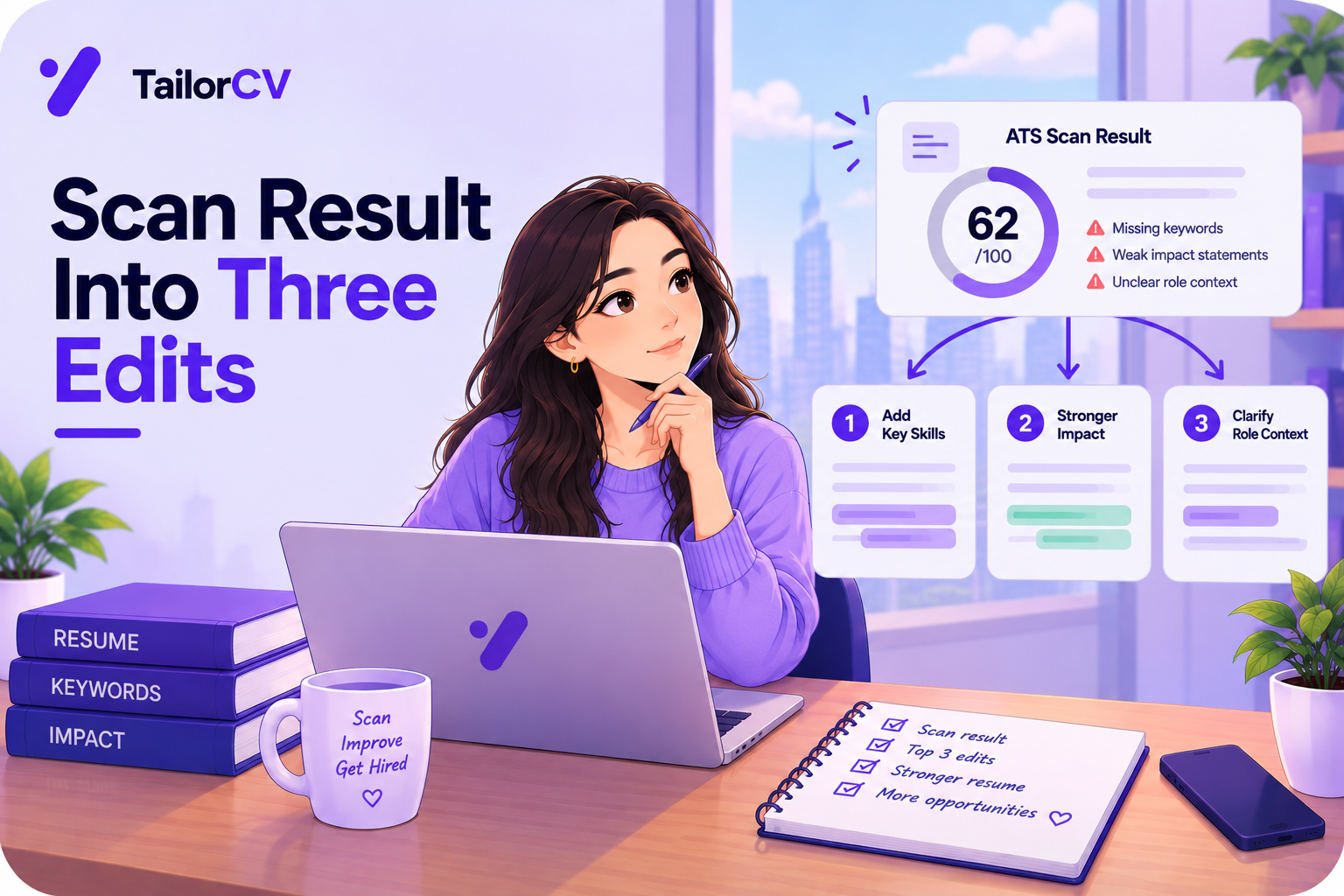
- Most scan reports list 10-25 gaps. Three well-chosen edits usually capture most of the available improvement.
- Edit 1 is almost always a parsing or title fix. If the scanner misread your structure or your title does not match, nothing else counts properly.
- Edit 2 is the top missing hard skill you genuinely have, placed in context - a bullet, not just the skills list.
- Edit 3 is the summary or first bullet rewritten to answer the posting's top requirement.
- Ignore missing terms you do not have, soft skills, and company-specific jargon. They are the bulk of most reports.
- Re-scan once after your three edits. If the score barely moves, the problem is usually fit, not wording.
You ran your resume against a job posting and got a score with a long list of missing keywords and warnings. Do not work through the list top to bottom. Pick three edits: fix anything that stopped the scanner reading you properly, add your most important missing hard skill in context, and rewrite your summary or first bullet around the posting's top requirement. Then re-scan once and stop.
This guide shows how to find those three in any report, how to make each one well, and what to do if the score does not move.
Why Three Edits, Not Twenty
A scan report is a diagnosis, not a to-do list. Treating every line as a task causes two problems.
Most of the list does not matter
A typical report mixes real gaps with noise: soft skills, generic phrases, terms from the company boilerplate, tools you have never used. The post on how to read your ATS report sorts these into four buckets; usually only one bucket deserves action.
Chasing every gap makes the resume worse
Adding every missing term leads to keyword stuffing, awkward phrasing, and claims you cannot defend. Keyword stuffing vs coverage explains how the score can rise while the resume gets weaker. Weak bullets behind a good score shows the same trap from the recruiter's side.
A few changes do most of the work
The fixes with the most impact are structural (can the system read you?), relevance-based (do you have their top requirements?) and positional (is the best evidence where readers look?). Three edits can address all three.
Before You Edit: Read the Report in This Order
Different scanners lay reports out differently, but most contain the same parts. Read them in this order.
| Report section | What to look for | Why first |
|---|---|---|
| Parsing / formatting warnings | Missing sections, unreadable dates, contact info not found | If parsing failed, every other number is unreliable |
| Job title match | Does your title line match the posting's title? | Title is heavily weighted by both ATS and recruiters |
| Missing hard skills | Tools, methods, certifications | The substance of the match |
| Missing soft skills | "Leadership", "communication" | Usually low value - skim |
| Overall score | The number | Read last; it summarises the above |
The number is the least useful part. The sections above it tell you what to do.
Edit 1: Fix What Stopped the Scanner Reading You
If the report shows parsing problems, fix those before anything else.
Common parsing problems and fixes
| Symptom in the report | Likely cause | Fix |
|---|---|---|
| "No work experience found" | Non-standard heading or text in a table | Use "Experience" as the heading; move content out of tables |
| Dates missing or wrong | Unusual date format or dates in a sidebar | Use "Jan 2024 - Mar 2026" in the main column |
| Contact details not found | Details in the page header/footer or an image | Put contact info in the body, as text |
| Skills not detected | Skills shown as graphics or rating bars | List skills as plain text |
| Jobs merged together | Two-column layout read left-to-right across columns | Use a single-column layout |
Each of these has its own detailed guide: employment dates parsed wrong, two-column resumes and ATS, and parsing errors that delete a job. The fastest check is the copy-paste ATS test.
If parsing is fine, Edit 1 is the title
No parsing warnings? Then make your first edit the job title match. If the posting says "Business Analyst" and your headline says "Data & Insights Professional", change your headline to "Business Analyst" - if that is a truthful description of what you do. Use the posting's job title covers how to do this honestly.
Before headline: "Data & Insights Professional"
After headline: "Business Analyst - SQL, Reporting & Process Improvement"
Edit 2: Add Your Most Important Missing Hard Skill - In Context
Now go to the missing hard skills list.
Pick the right one
Filter the list down to skills you genuinely have. Of those, choose the one the posting emphasises most - mentioned in the title, the first requirements, or more than once.
| Missing skill | You have it? | Posting emphasis | Pick? |
|---|---|---|---|
| Power BI | Yes, used daily | In title and requirements | Yes - top pick |
| Stakeholder management | Yes | Mentioned once | Skip - soft skill |
| Snowflake | No | Required | No - you don't have it |
| Jira | Yes, occasionally | "Nice to have" | Maybe - add to skills line only |
| Agile | Yes | Mentioned once | Skip for now |
If none of the missing hard skills are ones you have, skip to Edit 3 - and read missing a required skill: what to do.
Add it where it counts
Adding a skill only to the skills list gets you partial credit. Adding it inside a bullet that shows what you did with it gets you both the match and the proof. Where to place keywords on a resume explains why context matters.
Before: "Built weekly sales reports for regional managers."
After: "Built weekly sales dashboards in Power BI for 12 regional managers, replacing a manual Excel pack."
Then add the skill to your skills line as well, in the posting's exact spelling. One bullet plus the skills line is enough - do not repeat it four times.
Edit 3: Rewrite the Summary or First Bullet Around the Top Requirement
The third edit is about position, not keywords. The posting's single most important requirement should be answered in the first thing a recruiter reads.
Find the top requirement
It is usually the first responsibility listed, the phrase in the title, or the requirement mentioned more than once. Reading a JD like a recruiter covers how to spot it.
Answer it in the first sentence
Posting's top requirement: "Own end-to-end reporting for the commercial team."
Before summary: "Analyst with 3 years' experience in data analysis, SQL and Excel, passionate about insights."
After summary: "Analyst who owns weekly and monthly commercial reporting for a 40-person sales team - SQL, Power BI and Excel, with a focus on reports people actually use."
If your summary is already strong, apply the same edit to the first bullet of your most recent role instead - reorder so the bullet that answers the top requirement leads. See reordering bullets by relevance.
What to Ignore on the Report
Most of the report can be left alone. These categories are safe to skip in almost every case.
| Category | Examples | Why you can ignore it |
|---|---|---|
| Soft skills | "Team player", "detail-oriented" | Low ranking value; better shown than listed |
| Tools you don't have | A platform you've never used | Adding it would be false |
| Company boilerplate | Their values, product names, "our mission" | Nobody searches for these |
| Generic verbs and phrases | "Drive", "leverage", "passionate" | Adds nothing |
| Near-duplicates you already cover | "Data visualisation" when you list Power BI dashboards | Already matched in substance |
| Degree or years you don't meet | "MBA preferred", "7+ years" | Not fixable by editing |
The full list, with edge cases, is in ATS missing skills you can ignore and JD keywords that are not real requirements.
Worked Example 1: A Fresher's First Scan
Situation: Neha, a final-year commerce student, scans her resume against a Junior Financial Analyst posting. Score: 48%. The report lists 19 missing terms and one warning: "Skills section not detected."
Edit 1 (parsing): Her skills were shown as icons with star ratings. She replaces them with a plain text line: "Excel (pivot tables, VLOOKUP), financial modelling, Tally, basic SQL."
Edit 2 (hard skill): Of the missing terms, she genuinely has "financial modelling" - she built a three-statement model for a college case competition. She adds a project bullet:
"Built a three-statement financial model for a listed FMCG company in a college case competition; placed 2nd of 40 teams."
Edit 3 (top requirement): The posting's top requirement is "support monthly variance analysis". Her summary now leads: "Commerce graduate who built monthly budget-vs-actual reports for the college fest's ₹6 lakh budget, and a three-statement model for a case competition."
Re-scan: 71%. The remaining missing terms are "SAP", "IFRS" and "stakeholder communication" - two she does not have and one soft skill. She stops.
Worked Example 2: An Experienced Candidate Whose Score Won't Move
Situation: Manoj, a senior marketing manager, scans against a Head of Growth posting. Score: 58%. No parsing warnings. His title already matches reasonably.
Edit 1 (title): "Senior Marketing Manager" becomes "Growth Marketing Lead - Acquisition & Retention", which truthfully describes his role.
Edit 2 (hard skill): He has "lifecycle marketing" experience but described it as "CRM campaigns". He rewrites one bullet using the posting's term, with the result.
Edit 3 (top requirement): The posting's top requirement is "own the P&L for paid acquisition". He moves his paid-media budget bullet (₹3 crore annual spend, 2.8x ROAS) to the top of his current role.
Re-scan: 63%. The remaining gaps are "SQL", "experimentation platform", "product-led growth" - experience he does not have.
This is the important outcome. A small score move after good edits means the remaining gap is fit, not wording. His best next step is not more editing; it is deciding whether to apply as a stretch, which tailoring for a stretch role covers. High ATS score, no interviews covers the opposite situation.
Worked Example 3: A Designer Whose Scan Was Mostly Noise
Situation: Ira, a product designer, scans her resume against a "Senior Product Designer" posting and gets 61%. The report lists 22 missing terms.
Sorting the list: 11 are soft skills ("empathetic", "curious", "collaborative"), 5 are company-specific ("our design principles", product names), 3 are tools she does not use (Sketch, InVision, Principle), and 3 are real: "design systems", "usability testing" and "Figma" (she wrote "Figma" only in her portfolio, not her resume).
Her three edits:
- Edit 1: No parsing problems, so she changes her headline from "UI/UX Designer" to "Senior Product Designer - Design Systems & Research".
- Edit 2: She adds Figma inside her top bullet: "Built and maintain a 150-component design system in Figma used by 6 designers and 20 engineers."
- Edit 3: The posting's top requirement is research-led design, so her summary now opens: "Product designer who runs usability testing on every major flow before handoff - 40+ sessions last year."
Re-scan: 76%. The remaining 19 terms are the soft skills, company jargon and tools she does not use. She stops there - adding any of them would be filler or false.
How Long the Three Edits Should Take
The whole routine fits in about 20 minutes. If an edit is taking much longer, that is a signal - usually that you are trying to write around a skill you do not have.
| Step | Typical time | If it takes longer... |
|---|---|---|
| Read the report in order | 3 min | You are reading every missing term - skim soft skills |
| Edit 1: parsing or title | 2-10 min | Layout problems may need a new template |
| Edit 2: hard skill in a bullet | 5 min | You may not have strong evidence for the skill |
| Edit 3: summary or first bullet | 5 min | The top requirement may not match your background |
| Re-scan and decide | 2 min | - |
Layout fixes are the one place where extra time is justified: if the scanner cannot read a two-column design, moving to a single-column ATS-friendly template is faster than patching the old one.
When to Make a Fourth Edit
Sometimes three is not quite enough. Make one more edit only if all of these are true:
- There is a second missing hard skill you genuinely have.
- The posting names it as required, not preferred.
- You can add it inside a real bullet with evidence.
Otherwise, stop. More edits past this point usually add length and repetition, not relevance. What counts as a good ATS score and when to stop gives score thresholds.
At Each Career Stage
| Stage | Most common Edit 1 | Most common Edit 2 | Most common Edit 3 |
|---|---|---|---|
| Fresher | Skills shown as graphics or ratings | A tool used in a project but not listed | Objective replaced by a specific summary |
| Early career | Title too vague ("Associate") | Tool buried in a duty bullet | First bullet is a duty, not a result |
| Mid-career | Title doesn't match posting's term | Key method named differently | Summary describes the career, not the role |
| Senior | Two-column or design-heavy layout | Leadership skills listed but not shown | Summary too broad for the specific role |
Freshers: parsing first
Student resumes built from design templates often fail parsing. Fix the layout before anything else, or every other edit counts for less.
Senior candidates: summary first
Experienced resumes usually parse well and cover skills, but open with a summary that tries to describe everything. Edit 3 matters most.
Edge Cases and Exceptions
Your score is already high
If you score 80% or more, skip straight to Edit 3 and check the top of the page reads well. More edits rarely help at this point.
Your score is very low (under 30%)
A very low score after parsing is fixed usually means a real fit gap. Check the posting's top requirements against your experience before editing.
The report lists your own company's jargon as missing
Some scanners flag your employer's internal terms as irrelevant. Replace them with generic equivalents anyway - recruiters will not know them either.
Two scanners disagree
Different tools weight terms differently. Focus on the substance both agree on. See why ATS checkers disagree.
Common Mistakes After a Scan
Pasting missing keywords into a hidden or extra section
Hidden text and keyword dumps can be detected and look bad when a human reads the resume. The white-text keyword trick post explains why it backfires.
Re-scanning after every tiny change
Scores can shift slightly between runs and tools. Make your three edits, then re-scan once. Why ATS checkers disagree explains the variation.
Trusting a score drop without checking why
If your score falls after an edit, check whether you removed a term or changed a heading. ATS score dropped after an edit walks through the usual causes.
Treating the score as the goal
A human still reads the resume. ATS score vs recruiter judgment covers where the two diverge.
How This Comes Up in Interviews
Every edit you make from a scan puts a skill in front of the interviewer. Make sure each one holds up.
| Edit | What the interviewer may ask |
|---|---|
| New headline matching their title | "What does a typical week look like in your current role?" |
| A hard skill added in a bullet | "Tell me about a time you used Power BI to change a decision." |
| Summary rewritten around their top requirement | "Walk me through your experience with end-to-end reporting." |
For each of your three edits, prepare one short story with a specific example. If a scan-driven edit leaves you without a story, the edit was too far. The mock interview tool can drill you on exactly the lines you changed.
How This Fits Into Tailoring
The three-edit routine is the tailoring loop for one application:
- Scan your base resume against the posting.
- Edit 1: parsing or title.
- Edit 2: top missing hard skill, in context.
- Edit 3: summary or first bullet around the top requirement.
- Re-scan once.
- Submit, or decide the role is a stretch.
TailorCV's free ATS scan gives the score and missing terms against any posting in about a minute. If you want the edits drafted for you, the AI resume optimizer rewrites toward the posting but only uses skills your resume already shows evidence for - so the output still passes the "can I defend this?" test. Either way, read the result before sending. For the broader per-application process, see the tailoring checklist per application.
Quick Checklist
- Did you read parsing warnings before anything else?
- Edit 1: parsing fixed, or title matched truthfully?
- Edit 2: top missing hard skill you actually have, added inside a bullet?
- Edit 3: summary or first bullet rewritten around the top requirement?
- Did you skip soft skills, tools you lack and company jargon?
- Did you re-scan once, not repeatedly?
- If the score barely moved, have you considered whether it is a fit gap?
Frequently Asked Questions
What should I do after an ATS scan?
Make three edits: fix any parsing or title problem, add your most important missing hard skill inside a bullet, and rewrite your summary or first bullet to answer the posting's top requirement. Then re-scan once.
How do I improve my ATS score quickly?
Fix parsing issues first, match the posting's job title if it truthfully describes you, and add missing hard skills you actually have in context. These usually produce the largest gains in the least time.
Should I add every missing keyword from the report?
No. Most missing terms are soft skills, tools you do not have, or company jargon. Add only hard skills you genuinely have, and put them in bullets with evidence.
Why didn't my score go up after I edited?
Either the edits did not touch the high-weight areas (title, hard skills, parsing), or the remaining gaps are experience you do not have. A small move after good edits usually signals a fit gap, not a wording problem.
How many times should I re-scan my resume?
Once after your main edits is usually enough. Re-scanning after every small change leads to chasing minor score variations rather than making meaningful improvements.
What score should I aim for?
For most roles, a match in the 70-80% range on a good scanner, with the remaining gaps being skills you lack or soft skills, is a reasonable place to stop.
Is it worth fixing formatting warnings?
Yes - they come first. If the scanner cannot read your dates, sections or skills, the rest of the report is based on incomplete data, and real ATS systems may have the same problem.
Can I trust one scanner's results?
Treat any single scanner as a guide, not a verdict. Different tools weight terms differently. Focus on the substance - parsing, title, real hard skills - which every system cares about.
Can I trust the missing-keyword list completely?
No. It is a mix of real gaps and noise. Treat it as a list of candidates to consider, not instructions to follow.
What if the report shows no missing skills but my score is still low?
Check parsing and layout first, then the job title match. A low score with few missing terms often means the scanner could not read part of your resume.
What to Do Now
Open your latest scan report. Check parsing warnings first; if there are none, check the title match. Then pick the single most important missing hard skill you actually have and add it inside a bullet. Finally, rewrite your first summary sentence around the posting's top requirement.
Re-scan once with the free ATS scan. If the score moves meaningfully, submit. If it barely moves, read what counts as relevant experience to judge whether this role is a fit - and how much tailoring is too much before you keep editing.
What is your resume scoring right now?
Scan it against a job description and get your ATS match score in about a minute.
Drop your resume here or choose a file
PDF only. Max 2 MB.
We never share your data or use it to train AI models.

Templates that keep this structure intact
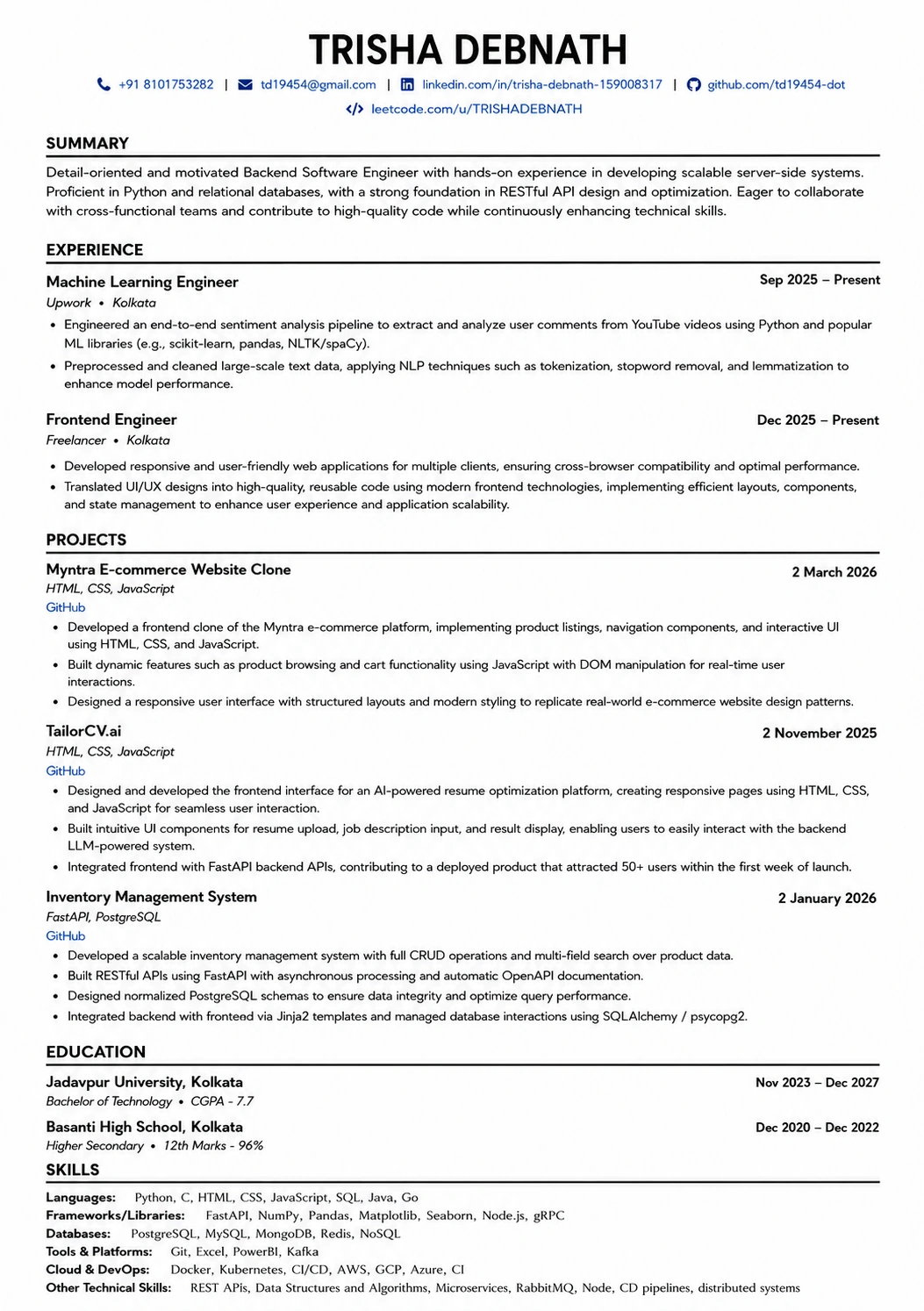
This template is ATS-tested — start from it and the formatting rules in this guide are already handled.
Was this guide useful?
Be the first to rate it.