 SS
SS
Key Takeaways
- When the same role appears in several places with different wording, the company's own careers page (or its ATS listing) is usually the source of truth - it is closest to what the hiring manager wrote.
- First check that it really is one job. Different levels, locations, teams or requisition IDs often mean two separate roles.
- Tailor to the union of the versions, weighted by overlap: requirements that appear in every version are the core; items in only one version are secondary.
- Apply through the channel whose version you matched most closely - usually the company's own listing - unless a recruiter or referral gives you a better route.
- Recruiter and job-board versions are often shortened, reworded or padded. Use them for extra clues, not as the main reference.
- If the versions genuinely conflict (different seniority or core skills), ask the recruiter or pick the company's version.
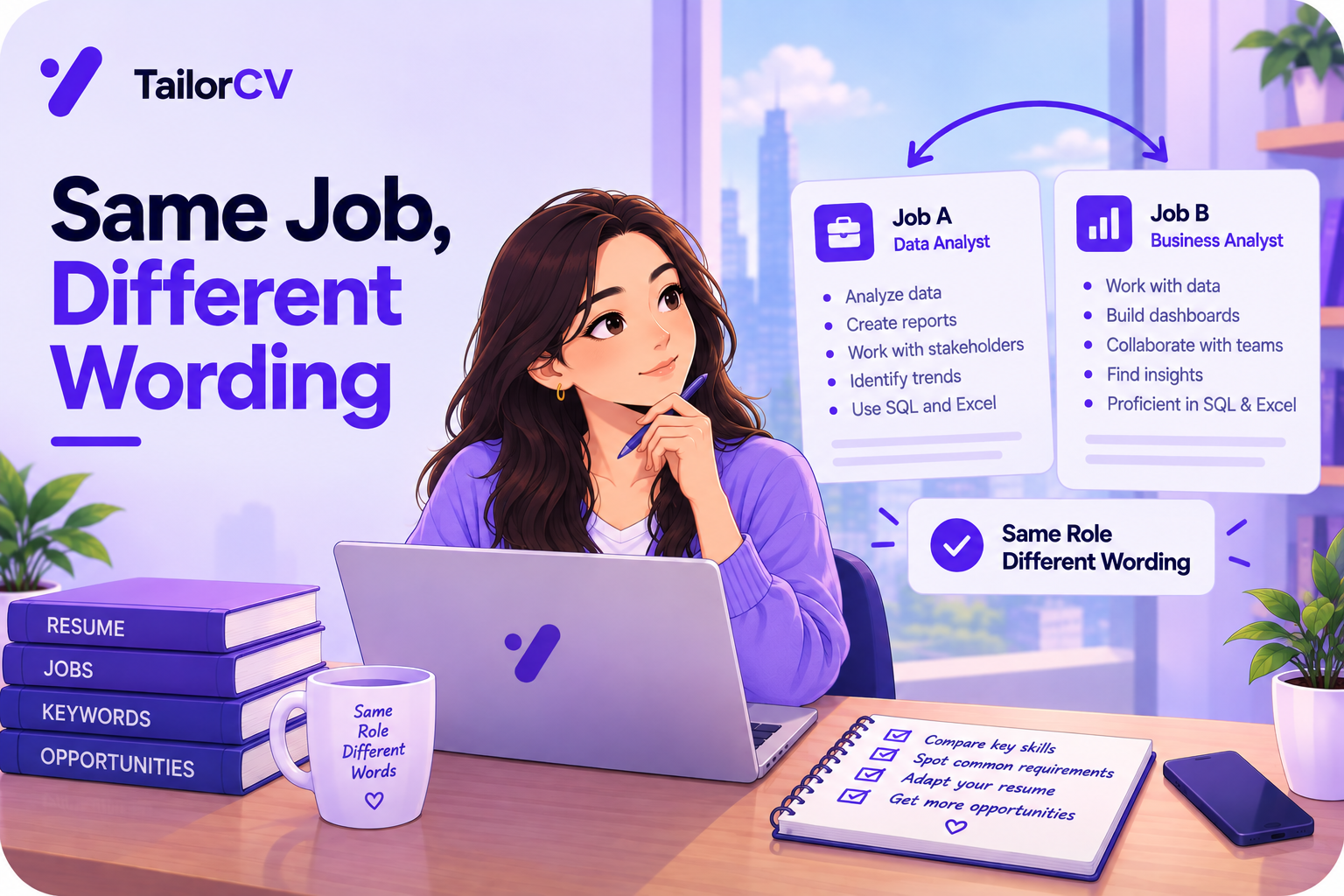
You found the role on the company's careers page, again on LinkedIn, and again in a recruiter's post - and the wording is different each time. One lists SQL and Tableau, another says "data visualisation tools", a third mentions stakeholder management the others do not. Usually it is the same job described by different people. Treat the company's own listing as the source of truth, tailor to the requirements that appear across all versions, and use the others for extra clues.
This guide covers how to confirm it is one job, how to rank the versions, and how to tailor one resume that works for all of them.
Why the Same Job Gets Different Descriptions
Knowing why versions differ tells you which to trust.
| Where you saw it | Who usually wrote or edited it | Typical differences |
|---|---|---|
| Company careers page / ATS listing | Hiring manager + HR | Most complete; closest to the real requirements |
| LinkedIn / job board (posted by company) | HR, often pasted from the ATS | Usually the same text, sometimes truncated |
| Job board aggregator (Indeed, etc.) | Scraped or re-formatted | Sections cut, formatting lost, sometimes outdated |
| Agency recruiter's post | The recruiter | Shortened, rewritten, sometimes client name hidden |
| Social media post by a team member | The hiring manager or teammate | Informal; reveals what they care about most |
| Reposted listing | HR, sometimes after edits | May reflect what they changed after a first round |
A reposted version is especially informative - the changes often show what the first round lacked. What a reposted job means and resume for a reposted job listing cover that case.
Step 1: Confirm It Is Actually One Job
Before merging versions, check they describe the same role.
Signals it is the same job
- Same company, team and location.
- Same or very similar title and level.
- Same requisition or job ID (often at the bottom of company listings).
- Posted around the same time.
- The core responsibilities describe the same work.
Signals it is two different jobs
| Difference | Likely meaning |
|---|---|
| Different level ("Analyst" vs "Senior Analyst") | Two roles, or one role open at two levels |
| Different location or team | Separate openings |
| Different requisition IDs | Separate requisitions |
| Different core skills (not just wording) | Different roles, or a changed role |
| Posted months apart | Possibly a reopened or redefined role |
If they are separate roles at the same company, treat them as two applications. Tailoring for two similar roles covers applying to both without contradicting yourself.
Step 2: Rank the Versions
When it is one job, pick a source of truth.
The company's own listing usually wins
The careers page or the company's ATS listing is typically closest to what the hiring manager wrote and what the ATS may use for matching. If you apply through a portal like Greenhouse, Lever or Workday, that listing's text is what the system compares against. Tailoring on Greenhouse, Lever and Workday covers how those portals handle your resume.
When another version deserves more weight
- A hiring manager's own social post reveals priorities in their own words. Weight its emphasis highly, though it may be less complete.
- A recruiter's version can include extra context from their conversation with the hiring manager ("they really want someone who has done X").
- A newer repost reflects the latest thinking if the company edited it.
| Version | Use it for |
|---|---|
| Company listing | The main reference: requirements, title, structure |
| Hiring manager's post | Priorities and emphasis |
| Recruiter's post or message | Extra context, what the manager stressed verbally |
| Aggregator copy | Only if the original is unavailable |
| Older or newer repost | What changed and why |
Step 3: Build the Union, Weighted by Overlap
Now combine what you learned into one set of requirements.
Sort every requirement by how many versions mention it
- In every version: core requirements. Your summary and top bullets must answer these.
- In two or more versions: strong secondary requirements. Cover them in bullets or skills.
- In only one version: extra clues. Cover them if you genuinely have them and there is room.
A worked comparison
| Requirement | Company page | Recruiter post | Priority | |
|---|---|---|---|---|
| SQL | Yes | Yes | Yes | Core |
| Dashboards / data visualisation | "Tableau" | "Tableau" | "Data viz tools" | Core |
| A/B testing | Yes | Yes | - | Strong secondary |
| Stakeholder management | - | - | Yes | Clue (recruiter context) |
| Python | "Nice to have" | "Nice to have" | - | Secondary |
| E-commerce experience | Yes | Yes | Yes | Core |
This tells you exactly where to spend your resume's best space. The general method for weighing requirements is in reading a JD like a recruiter.
Step 4: Handle Wording Differences
The versions may use different words for the same thing.
Use the company listing's exact terms for core skills
If the company page says "Tableau" and the recruiter says "data visualisation tools", use "Tableau" (if you have it) because that is what the source of truth and its ATS will look for. You can add the broader term once elsewhere.
Cover common synonyms naturally
Where versions use different phrases for the same skill ("stakeholder management" vs "cross-functional collaboration"), one bullet that genuinely shows the skill can include one of the phrases naturally. Do not stuff every variant. ATS exact match vs synonym covers how matching handles variants, and keyword stuffing vs coverage explains where coverage turns into stuffing.
Match the title from the source of truth
If the company page says "Product Analyst" and LinkedIn says "Data Analyst - Product", use the company's title in your headline if it accurately describes you. Use the posting's job title covers this.
Worked Example 1: An Analyst Seeing Three Versions
Situation: Tanvi sees a data analyst role at an e-commerce company on the careers page, LinkedIn, and in an agency recruiter's post.
Comparison: SQL, Tableau and e-commerce appear everywhere. A/B testing appears on the company page and LinkedIn. The recruiter's post alone mentions "presenting insights to senior leadership".
Summary: "Data analyst with two years in e-commerce - SQL and Tableau daily, with experience analysing A/B tests on checkout and presenting results to the leadership team."
Top bullet: "Built Tableau dashboards in SQL tracking daily orders and conversion for 12,000 SKUs, used in the weekly leadership review."
The summary answers every core requirement and the strong secondary one; the recruiter's clue (leadership presentations) appears naturally in the top bullet. She applies through the company's careers page, which her version matches most closely.
Worked Example 2: Conflicting Seniority
Situation: Rohit sees a "Marketing Manager" role on the company site asking for "3-5 years", while a recruiter describes the same role as "Senior Marketing Manager, 7+ years".
Check: Same requisition ID, same team.
Action: Rather than guessing, he asks the recruiter: "The company listing shows 3-5 years and Marketing Manager - has the scope changed?" The recruiter confirms the client upgraded the role after the first round.
He tailors toward the senior version - leading with team leadership and budget ownership - because it reflects the latest brief. Without asking, he might have tailored for the wrong level. Recruiter said "not a fit" - what it means covers reading recruiter signals like this.
Worked Example 3: A Fresher and an Informal Post
Situation: Kiran sees a graduate developer role on the company's careers page with a long, formal requirements list. The engineering manager also posted about it on LinkedIn: "Looking for grads who've built something real and can explain their trade-offs - we care less about the stack."
Action: He keeps the careers-page keywords in his skills line, but leads his projects section with his most substantial project and adds a line about a design decision:
"Built a campus room-booking app used by 3 departments; chose PostgreSQL over MongoDB for booking conflicts and transactions, and documented the trade-off."
The manager's post changed what he led with, while the company listing kept his keyword coverage intact. For fresher project framing, see fresher resume projects that get interviews.
Worked Example 4: A Posting Rewritten by AI on a Job Board
Situation: Gaurav finds a "Supply Chain Analyst" role on the company's careers page and again on an aggregator. The aggregator version is longer and more polished - it seems to have been rewritten by an AI tool, adding requirements like "advanced machine learning" and "blockchain supply-chain visibility" that the company page never mentions.
Comparison:
| Requirement | Company page | Aggregator version |
|---|---|---|
| Excel and SQL | Yes | Yes |
| Demand forecasting | Yes | Yes |
| SAP experience | Yes | Yes |
| Advanced machine learning | - | Yes |
| Blockchain visibility | - | Yes |
Decision: the company page is the source of truth. The extra aggregator requirements appear nowhere else and read like filler. He tailors to Excel, SQL, forecasting and SAP, ignores the machine learning and blockchain lines, and applies through the company's careers page.
Tailored top bullet: "Built a weekly demand forecast in Excel and SQL for 800 SKUs, pulling actuals from SAP; forecast error fell from about 28% to 17%."
For more on postings padded by AI, see JD written by AI: how to read it.
When the Company Listing Is Missing or Expired
Sometimes you only have the secondary versions - the careers page link is dead, or the role is only advertised through an agency.
Rebuild the source of truth from what you have
Use the most complete version available as your reference, then check the company's other open roles on its careers page. Teams usually describe their stack and expectations consistently across postings, so a sibling role often fills gaps in vocabulary and level. The team's engineering blog, recent announcements and employees' LinkedIn profiles help too.
Ask the recruiter for the original
Agencies often have the client's full job description. "Could you share the client's original JD? I'd like to tailor my resume to it" is a reasonable request, and most recruiters will send it.
Save Every Version Before It Disappears
Postings are edited and taken down, often before your interview. Save a copy of each version - a PDF or a pasted document with the date and source - as soon as you decide to apply.
You will use them three times: to tailor now, to prepare for interviews (interviewers often ask about the exact responsibilities listed), and to compare if the role is reposted with changes. The interview prep tool can generate likely questions from the saved description, and how to read a job description properly covers what to note while you still have it.
Which Channel Should You Apply Through?
When the same job is listed in several places, where you apply matters.
| Route | When to use it |
|---|---|
| Company careers page | Default - your application goes straight into their ATS |
| Easy-apply on LinkedIn or a job board | When it links to the same ATS requisition; check the resume uploads cleanly |
| Agency recruiter | When the recruiter approached you or has a direct relationship with the hiring manager |
| Referral | Whenever you have one - usually the strongest route |
Avoid applying through several routes to the same job. Duplicate applications can confuse ownership between an agency and the company, and occasionally cause your candidacy to be set aside. Resume matching: recruiter vs direct application and resume for a referral vs a cold application cover the trade-offs. For platform-specific tailoring, see tailoring on LinkedIn and tailoring on Naukri.
At Each Career Stage
| Stage | Where versions usually differ | What to watch |
|---|---|---|
| Fresher / graduate | Campus portal vs company careers page vs job boards | Eligibility criteria that differ between versions |
| Early career | LinkedIn vs company page vs agency posts | Tool lists that vary; match the company's |
| Mid-career | Agency vs company, often with different seniority | Confirm the level before tailoring |
| Senior | Search firm briefs vs public posting | The search brief is usually more accurate |
Freshers: check eligibility in every version
Graduate postings sometimes show different eligibility (degree, year, CGPA) on different sites. Follow the strictest official version to avoid wasting an application.
Senior candidates: the brief beats the posting
At senior levels, a search firm's detailed brief often reflects the latest conversation with the board or CEO more accurately than the public posting. Ask for it.
Edge Cases and Exceptions
The versions list different salaries
Salary ranges can differ between sites, especially aggregators that estimate pay. Trust the company or recruiter's figure, and confirm in your first conversation.
One version says remote, another says on-site
Work arrangement differences matter. Ask the recruiter before tailoring; the answer may change how you present location or relocation.
The company page is in a different language
Multinational companies sometimes post locally in one language and globally in another. Use the version in the language of your application, but check the other for missing requirements.
The role has been split into two
A repost with narrower requirements may mean the original role was split. Treat the new versions as separate jobs and decide which fits you.
Common Mistakes
Tailoring to the most detailed-looking version
A recruiter's post can look detailed but be rewritten or padded. Default to the company's own listing.
Treating every variant keyword as a separate requirement
"Tableau" and "data visualisation tools" are one requirement. Covering both once is enough.
Missing that it is actually two roles
Different levels or requisition IDs usually mean separate jobs. Check before merging.
Applying through multiple channels
Applying through an agency and the company's portal for the same role can create an ownership dispute. Pick one route.
Ignoring informal posts from the hiring manager
A manager's own words about what they care about are among the best clues you can get.
How This Comes Up in Interviews
Interviewers work from their own version of the job description - usually the company's. If you tailored to a different version, you may be surprised by what they focus on.
| Situation | What to do |
|---|---|
| The interviewer mentions a requirement you did not see | Ask which version they are working from; answer with relevant experience |
| The recruiter's pitch differs from the interviewer's questions | Trust the interviewer - they wrote or own the role |
| You saved several versions | Review all of them before the interview; prepare for the union of requirements |
| Seniority differed between versions | Clarify early: "Could you tell me how the team sees the level of this role?" |
Bring your saved versions to your preparation. The interview prep tool can generate questions from the company's listing, which is usually what the panel uses.
How This Fits With Tailoring
When a job has several versions, add a comparison step before normal tailoring:
- Confirm it is one job (IDs, level, location, team).
- Pick the source of truth - usually the company listing.
- List requirements and mark how many versions include each.
- Tailor your summary and top bullets to the core; cover secondaries in bullets and skills.
- Use the source of truth's exact terms and title.
- Apply through one channel.
The free ATS scan lets you compare your resume against each version in about a minute - if one version scores much lower, look at what it emphasises that the others do not. The AI resume optimizer can tailor toward the company listing while leaving out skills your resume does not support. For the general edit sequence, see what to change when tailoring.
Quick Checklist
- Have you confirmed it is one job (ID, level, location, team)?
- Have you picked the company listing as the source of truth?
- Have you marked each requirement by how many versions include it?
- Does your summary answer the core requirements (in every version)?
- Are core skills in the company listing's exact spelling?
- Are you applying through one channel only?
- Have you saved every version with its date and source?
Frequently Asked Questions
Which job description should I tailor my resume to if there are several versions?
Usually the company's own careers page or ATS listing, since it is closest to the hiring manager's requirements and what their system matches against. Use other versions for extra clues.
Why is the same job described differently on different sites?
Different people write or edit each version: HR on the company site, recruiters on agency posts, and aggregators that scrape and reformat. Some versions are shortened, reworded or outdated.
How do I know if two postings are the same job?
Check the company, team, location, title, level, posting date and requisition ID. If these match and the core responsibilities describe the same work, it is likely one job.
Should I apply to the same job on multiple sites?
Generally no. Pick one route - usually the company's careers page, a referral, or the recruiter who approached you. Multiple applications can cause confusion, especially with agencies.
What if the versions list different requirements?
Treat requirements in every version as core, those in two or more as secondary, and those in only one as extra clues. Tailor your best space to the core.
What if a recruiter's version conflicts with the company's?
Ask the recruiter whether the role has changed. If you cannot confirm, default to the company's listing.
Does it matter which version the ATS uses?
Yes. If you apply through the company's portal, its listing is usually what your resume is compared against, so its exact terms and title matter most.
Can I use keywords from all versions on my resume?
Use core keywords in the company listing's exact form, and include other versions' terms only where you genuinely have the skill and they fit naturally. Avoid stuffing every variant.
Why does a job posting change after I apply?
Companies edit postings as priorities shift, after early interviews, or to attract different candidates. Save the version you applied to so you can prepare accurately.
Should I contact the company if the versions conflict?
If the difference matters - seniority, location or core skills - asking the recruiter is reasonable. For small wording differences, tailor to the company listing and move on.
What to Do Now
Put all the versions you found side by side. Confirm they are one job, choose the company's listing as your source of truth, and mark each requirement by how many versions include it. Tailor your summary and top bullets to the core, then apply through one channel.
Next, read a JD written for the person already doing the job for another tricky JD type, and tailoring at volume if you are applying to many similar roles this week.
What is your resume scoring right now?
Scan it against a job description and get your ATS match score in about a minute.
Drop your resume here or choose a file
PDF only. Max 2 MB.
We never share your data or use it to train AI models.

Templates that keep this structure intact
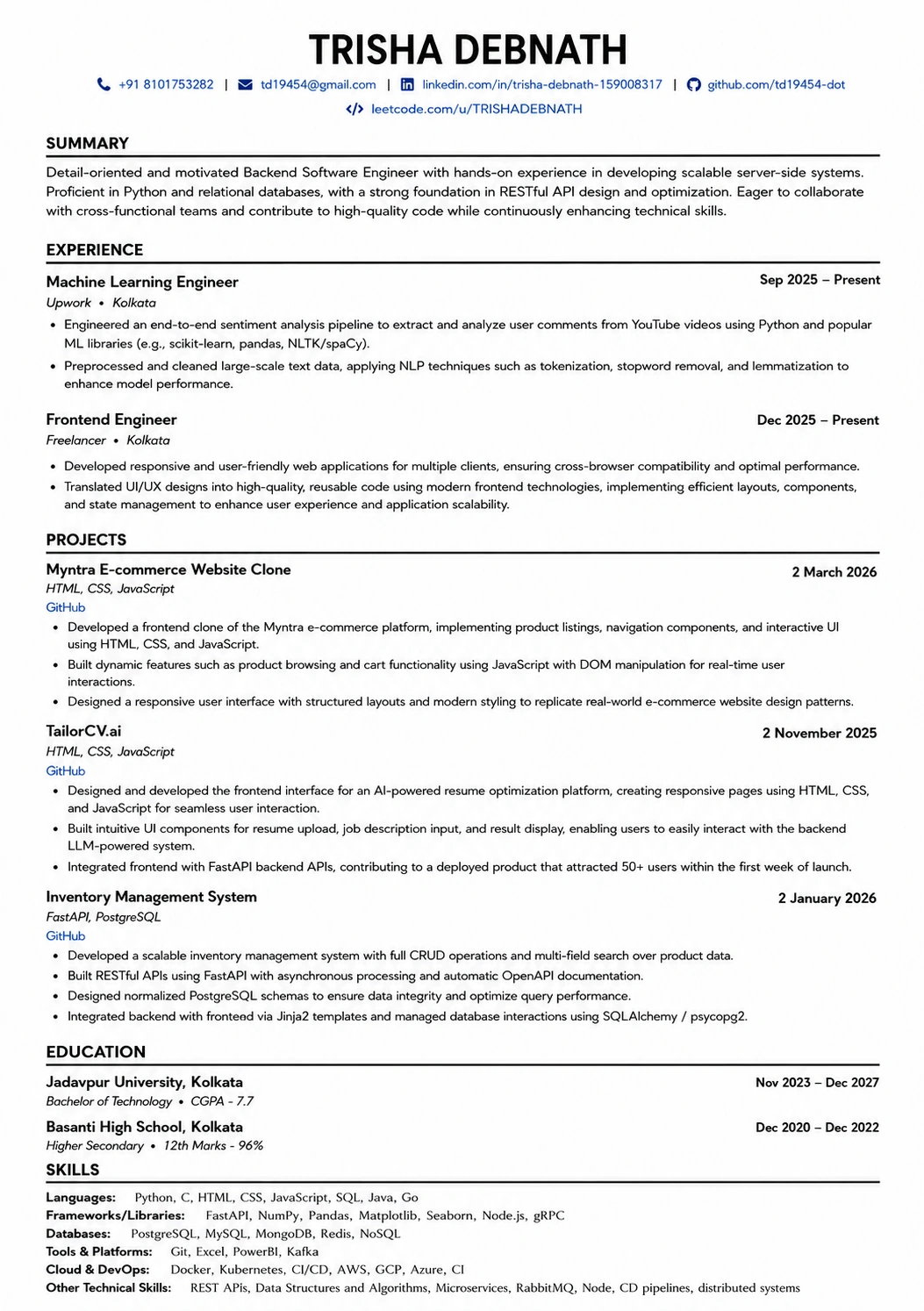
This template is ATS-tested — start from it and the formatting rules in this guide are already handled.
Was this guide useful?
Be the first to rate it.