 SS
SS

Key Takeaways
- Relevant experience is work that shows you can do the job's main tasks - regardless of title, employer type or whether you were paid.
- Employers judge relevance by task, tools, scale and context, roughly in that order. A different title doing the same tasks often counts.
- Internships, freelance work, substantial projects, part-time roles and volunteering can all count, especially early in your career.
- When a posting asks for "X years of relevant experience", count the time you spent doing the core work, not your total career length.
- Relevance is judged by the reader in seconds. If the connection is not obvious, make it obvious in your bullet wording and summary.
- Do not stretch: coursework alone rarely counts as years of experience, and overlapping roles should not be double-counted.
You are looking at a posting that asks for "relevant experience" and wondering whether your internship, freelance projects or a job with a different title counts. Usually it counts more than you think. Relevant experience is any work that proves you can do the job's core tasks - the title, the employer and even whether you were paid matter less than what you actually did.
This guide covers how employers judge relevance, what counts at each career stage, how to count years, and how to make the connection obvious on your resume.
How Employers Actually Judge Relevance
A recruiter or hiring manager scanning your resume is asking one question: has this person done the things this job needs?
The four tests, in order of weight
| Test | Question the reader asks | Example of a match |
|---|---|---|
| Task | Have they done the main activities of this role? | Building reports, managing campaigns, writing code |
| Tools | Have they used the tools this role uses? | SQL, Salesforce, Figma, AutoCAD |
| Scale | Have they worked at a similar size or complexity? | Budget, team size, users, volume |
| Context | Have they done it in a similar industry or setting? | B2B vs B2C, regulated vs not, startup vs enterprise |
Task is the heaviest. A "Customer Success Associate" who built the team's churn reports has more relevant experience for a data analyst role than a "Junior Analyst" who mostly did data entry.
Why titles mislead
Titles vary wildly between companies. An "Associate" at one firm does what a "Manager" does at another; a "Marketing Executive" might run paid campaigns or organise events. Readers who know this look past the title to the bullets - which means your bullets have to do the work. If your title is unusual, fixing a non-standard job title shows how to add a clarifier.
What Counts: A Category-by-Category Guide
| Type of experience | Counts as relevant? | Conditions |
|---|---|---|
| Full-time job, same role | Yes | - |
| Full-time job, different title but same core tasks | Usually yes | Bullets must show the tasks clearly |
| Internship | Yes, especially early career | Longer and more substantive internships count more |
| Part-time job | Yes, if the tasks match | Label it part-time; count time proportionally |
| Freelance / contract work | Yes | Real clients or deliverables; label it clearly |
| Substantial personal or academic project | Often yes, early career | Real scope, users or outcome - not a tutorial |
| Volunteer work | Yes, if tasks match | Treat like a job: title, organisation, dates |
| Apprenticeship / trainee programme | Yes | - |
| Coursework alone | Rarely as experience | Better listed under education or projects |
| Certifications | Supports skills, not experience | Useful alongside experience, not instead of it |
Internships
For freshers, internships are often the most relevant experience on the page. A three-month internship where you built something real counts. Put it above unrelated part-time work, and describe it with the same detail as a job. See internship to PPO conversion for how internships read to employers.
Freelance and contract work
Freelance counts when there were real clients and real deliverables. List it with a clear label ("Freelance UX Designer") and dates, and give examples of clients or projects. The approach for contract-heavy histories is in tailoring for freelance and contract roles.
Projects
A substantial project - with real data, real users, or a real outcome - can be relevant experience, particularly early in your career or when changing fields. A tutorial clone usually is not. Projects in a resume and side projects on your resume cover what makes a project credible.
Volunteering
Running a nonprofit's social media, managing an NGO's accounts, or organising a large community event can all be relevant if the tasks match. Give it a title, an organisation and dates, just like a job.
Counting "Years of Relevant Experience"
Postings often ask for "3+ years of relevant experience". Here is how to count honestly.
Count the time doing the core work
If you spent four years in a role but only the last two involved the core tasks the posting describes, you have roughly two years of relevant experience from that role. Count by what you did, not how long you held the title.
How different types usually count
| Experience type | How it usually counts toward years |
|---|---|
| Full-time, core tasks | Full duration |
| Full-time, core tasks part of the role | Roughly the share of time spent on them |
| Part-time | Proportionally (half-time for 2 years is about 1 year) |
| Internship | Its actual duration; some employers discount it |
| Freelance | Time actively working on client projects |
| Projects | Rarely counted as years, but support the case |
| Overlapping roles | Count the period once, not twice |
When you are close to the threshold
If the posting asks for three years and you have two and a half of genuinely relevant experience, apply - thresholds are often guidelines. If you have one year, it is a stretch. JD asks for years you don't have covers how to decide and how to present it.
How the Bar for "Relevant" Rises With Seniority
What a reader accepts as relevant changes as the role gets more senior. Early on, almost any evidence of the core tasks counts. Later, readers expect the same tasks at the right scale.
| Level | What readers accept as relevant | What they start discounting |
|---|---|---|
| Fresher / intern | Projects, internships, volunteering, coursework projects | Nothing much - any real evidence helps |
| Early career (1-3 years) | Jobs and internships doing the core tasks | Academic projects, unless exceptional |
| Mid-level (3-8 years) | Core tasks with ownership and results | Internships; tasks done only with close supervision |
| Senior (8+ years) | Core tasks at scale, with decisions and influence | Hands-on work without scope or leadership |
So a senior candidate cannot rely on "I've done this kind of work" - the reader wants evidence of doing it at the level the role needs. That is why the same bullet may need more scope added (team size, budget, decision authority) as you move up. Two years in and applying for a mid-level role covers that shift at the first step.
Making Relevance Obvious on the Page
The reader decides relevance in seconds. If they have to work out the connection, they often will not.
Lead each role with its most relevant bullet
The first bullet under each job is the one most likely to be read. Put the task that matches the posting there. See reordering bullets by relevance.
Use the posting's vocabulary for the same work
If you "prepared management information packs" and the posting says "built reporting for leadership", use their phrasing for your work. ATS exact match vs synonym explains why this helps both machines and people.
Say it in the summary
Your summary can name your relevant experience directly, so the reader knows what to look for: "Three years of B2B customer analytics - two as an analyst and one as a customer success lead building churn reports."
Before: "Customer Success Associate, 2023-2025. Managed a portfolio of client accounts and supported renewals."
After: "Customer Success Associate, 2023-2025. Built the team's churn-risk report in SQL and Excel covering 180 accounts; flagged accounts behind about ₹40 lakh of renewals, most of which were retained."
The title did not change. The relevance is now obvious to a data analyst hiring manager.
Worked Example 1: A Fresher Wondering What Counts
Situation: Ishita is applying for junior marketing roles. She has no marketing job, but she has: a two-month internship at a digital agency, a year running her college's Instagram page, and a part-time job at a café.
| Experience | Relevant? | How she presents it |
|---|---|---|
| Agency internship | Yes | First, with detail: campaigns supported, metrics |
| College Instagram (volunteer) | Yes | Second: "Social Media Lead - college cultural society", follower growth, content calendar |
| Café job | Partly | Last, one line: customer-facing experience |
"Social Media Lead, college cultural society (volunteer), 2024-2025. Planned and posted 4 pieces of content a week; grew followers from about 2,000 to 6,500 and promoted a fest attended by 3,000 students."
She has more relevant experience than she thought. For more fresher framing, see fresher resume projects that get interviews.
Worked Example 2: A Career Changer Counting Years
Situation: Vivek spent five years in accounting and has spent the last 18 months doing data analysis work within his finance team - building dashboards and automating reports in SQL and Python. He wants data analyst roles asking for "2+ years".
Honest count: about 18 months of core data analysis work, plus related data handling in earlier years.
Presentation:
- Summary: "Finance professional who has spent the last 18 months building SQL dashboards and Python automations for a 30-person finance team - moving into data analytics."
- His current role's bullets lead with the data work.
- Earlier roles are condensed, keeping bullets that show data handling (reconciliations across large datasets).
He applies to "2+ years" roles; he is close enough, and the evidence is strong. For the broader change, see resume matching for career changers.
Worked Example 3: A Mid-Career Candidate With a Different Title
Situation: Swati's title is "Programme Coordinator" at an education nonprofit. In practice, she has managed projects end to end: budgets, timelines, vendors, a team of four. She is applying for project manager roles.
Before: "Programme Coordinator. Coordinated education programmes across partner schools."
After: "Programme Coordinator (project management). Managed 6 education programmes across 40 partner schools end to end - ₹1.2 crore combined budget, a team of 4, vendor contracts and quarterly reporting to funders."
Her experience was always relevant; the resume now shows it. The title clarifier helps both ATS and human readers.
Worked Example 4: A Homemaker Returning to Work
Situation: Meena left her job as an accounts assistant eight years ago to raise her children. During that time she managed the finances of her husband's small business, kept the books for her housing society (120 flats), and ran a small tiffin service. She is applying for accounts executive roles.
What counts:
| Experience | Relevant? | How she presents it |
|---|---|---|
| Accounts assistant, 2012-2017 | Yes - same function | Original role, condensed |
| Housing society treasurer (volunteer), 2019-present | Yes | "Treasurer (volunteer), 120-flat housing society - maintain accounts, collect maintenance of about ₹30 lakh a year, prepare annual statements for audit" |
| Small-business bookkeeping, 2018-present | Yes | "Bookkeeper (part-time), family trading business - GST filings, Tally, monthly reconciliations" |
| Tiffin service | Partly | One line under "Other": customer and cost management |
Eight years that looked like a gap contain six years of relevant accounting experience. She lists a short career break line for accuracy, but the resume is led by current, relevant work. For more on how volunteer and part-time work count, see the table above; for presenting the career break itself, dates and gaps parsing errors covers formatting.
Edge Cases: Does This Count?
Experience from a family business
Yes, if you did real work - managing accounts, running operations, handling customers. List it with a proper title and dates, and describe it the same way as any job. Be ready to explain the context briefly.
Experience from a startup that failed
Yes. The company's outcome does not erase what you built or managed. Describe the work and, where relevant, what you learned.
Military or government service
Often yes - leadership, logistics, operations, security and technical roles transfer, though the vocabulary usually needs translating. See tailoring across industries for the translation method.
Experience abroad or in a different market
Yes. It may need context (company size, what the company does), but the tasks count.
Experience from 15 years ago
It counts if it is genuinely relevant, though you will present it more briefly. See how far back your experience should go.
Research or academic work
Research counts for research, analytical and technical roles - data analysis, lab work, writing. Present it with outcomes: papers, datasets, methods, tools.
Common Mistakes
Only counting jobs with matching titles
The most common mistake. People with strong relevant experience under a different title screen themselves out. Look at tasks, not titles.
Burying relevant experience under irrelevant detail
If the relevant part of a job is one bullet among six, the reader may never reach it. Lead with it.
Counting coursework as years of experience
Coursework shows knowledge, not experience. List it under education or as a project, and do not add it to your years.
Double-counting overlapping roles
If you worked a full-time job and freelanced at the same time, the overlapping period counts once toward years.
Stretching tangential experience
Attending meetings where marketing was discussed is not marketing experience. Tailoring without lying covers where the line sits.
How This Comes Up in Interviews
When relevant experience comes from non-standard places - volunteering, freelance, projects - interviewers probe it to confirm it was real work.
| Experience type | Likely question | Strong answer ingredients |
|---|---|---|
| Volunteer role | "How much time did this take, and what were you responsible for?" | Hours, responsibilities, a result |
| Freelance | "Who were your clients and what did you deliver?" | Client types, deliverables, outcomes |
| Project | "Was this for a course or self-directed? What was hardest?" | Context, decisions, obstacles |
| Different job title | "Your title was coordinator - what did you actually manage?" | Scope, budget, team, decisions |
Treat these questions as a chance to show depth, not as doubt. Prepare one detailed story for each non-standard experience on your resume. The interview story bank method keeps them organised.
How to Check Your Resume's Relevance
A quick self-test, using the posting:
- List the posting's top five requirements.
- For each, find the bullet on your resume that proves it.
- Mark any requirement with no matching bullet.
- For each gap, check your history: do you have relevant experience you left off or described vaguely?
- Add or rewrite bullets to fill the real gaps; leave genuine gaps honest.
The free ATS scan does a version of this automatically, showing which requirements your resume covers against a posting in about a minute. For turning the result into changes, see turning a scan result into three edits. If you want existing bullets reworded to make their relevance clearer, the AI resume optimizer rewrites toward the posting using only what your resume already shows.
Quick Checklist
- Have you listed the posting's top five requirements?
- For each, have you searched jobs, internships, freelance, projects and volunteering for evidence?
- Does each piece of relevant evidence appear on your resume?
- Is it near the top of its entry, in the posting's vocabulary?
- Are non-standard experiences labelled clearly (volunteer, freelance, part-time)?
- Are your years of relevant experience counted honestly?
- Can you talk about each relevant item for two minutes?
Frequently Asked Questions
What is considered relevant experience?
Any work that shows you can do the job's main tasks - including jobs with different titles, internships, freelance work, substantial projects and volunteering. Employers care most about the tasks you performed, then the tools, scale and context.
Does an internship count as relevant experience?
Yes, especially for entry-level roles. Longer, substantive internships count more. Present them with the same detail as a job.
Does freelance work count as experience?
Yes, if you worked with real clients on real deliverables. Label it clearly as freelance, include dates, and give examples of projects or clients.
Does volunteer work count as relevant experience?
It does when the tasks match the role - managing budgets, running social media, organising events, coordinating people. List it like a job with a title, organisation and dates.
How do I count years of relevant experience?
Count the time you spent doing the job's core tasks, not your total career length. Count part-time work proportionally and overlapping roles only once.
Do personal projects count as relevant experience?
Substantial projects with real scope, data, users or outcomes can count, particularly early in your career or when changing fields. They support your case but are rarely counted as years.
What if my job title doesn't match but the work does?
Your experience still counts. Make the tasks obvious in your bullets, and consider adding a short clarifier to your title, like "Programme Coordinator (project management)".
Should I apply if I have slightly less relevant experience than required?
Often yes. Experience thresholds are frequently guidelines. If you are close and your evidence is strong, apply. If you are far below, it is a stretch - see tailoring for a stretch role.
Does a career break count against relevant experience?
A break does not erase earlier experience, and work done during the break - freelance, volunteering, managing finances - can count if it matches the role.
Is teaching or tutoring relevant experience for other jobs?
Often yes: training, presenting, assessing performance and explaining complex topics transfer to training, sales, customer success and many other roles.
What to Do Now
Take the posting you are targeting and list its top five requirements. For each one, look through your whole history - jobs, internships, freelance, projects, volunteering - and find the strongest evidence. Then make sure that evidence appears on your resume, near the top of the relevant entry, in the posting's vocabulary.
Next, read when everything is already relevant if you find you have plenty of relevant experience and need to choose, or cutting irrelevant experience without creating a gap if you need to make room.
What is your resume scoring right now?
Scan it against a job description and get your ATS match score in about a minute.
Drop your resume here or choose a file
PDF only. Max 2 MB.
We never share your data or use it to train AI models.

Templates that keep this structure intact
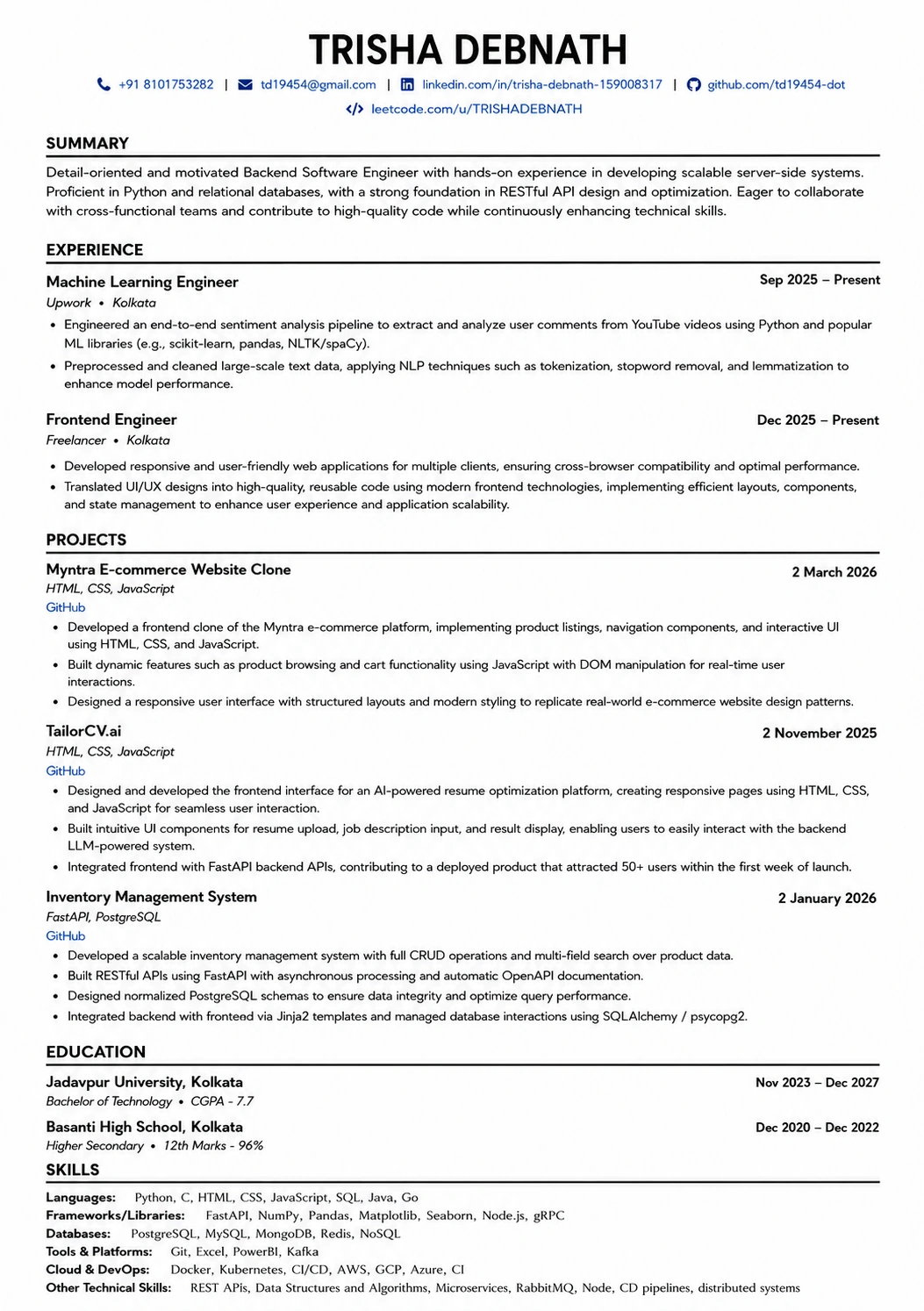
This template is ATS-tested — start from it and the formatting rules in this guide are already handled.
Was this guide useful?
Be the first to rate it.