TD
TD
Key Takeaways
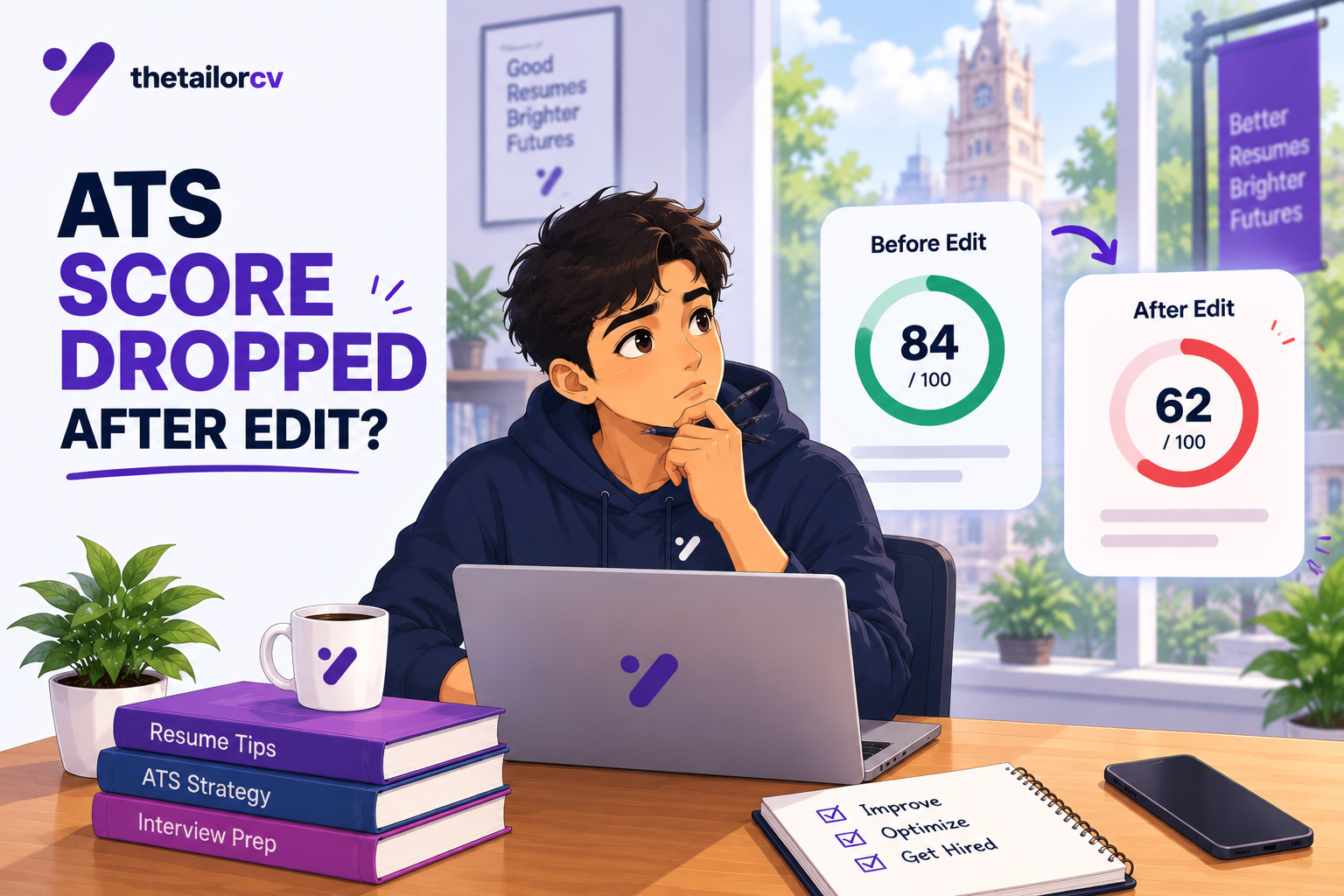
- A lower score after editing is usually an artefact of how scoring works, not evidence that your resume got worse.
- Scoring is proportional, so adding good content can lower the percentage while improving the document.
- Six causes account for nearly all drops: dilution, a lost keyword, a changed comparison, a broken layout, moved evidence, and generalised wording.
- A drop of a few points is noise. A drop of fifteen or more usually means something stopped parsing.
- Keep edits that made the resume clearer to a human, and reinstate the specific terms you accidentally removed.
You rewrote three bullets, tightened your summary, and the score went down four points.
The instinct is to undo everything. Usually that is the wrong response — and understanding why takes about two minutes.
The Thing Nobody Explains About Scoring
Most scoring is proportional: relevant content measured against total content.
That single fact explains most confusing drops. Add 80 words of genuinely good material and the relevant share of your resume falls, even though nothing relevant was removed. The numerator stayed the same; the denominator grew.
So a drop can mean your resume got worse, or it can mean your resume got longer. Those need opposite responses, which is why diagnosing the cause matters more than reacting to the number.
The Six Causes
1. You diluted the proportion
The most common cause. You added context, a new bullet, or a fuller explanation, and the percentage fell arithmetically.
How to tell: your resume got longer and no specific terms disappeared from the found list.
What to do: nothing. This is not a real problem. If the added content was useful to a human reader, keep it. Length only becomes a genuine issue at the extremes, which the resume length guide covers.
2. You removed a word without realising
Rewriting for clarity often quietly deletes a term the scanner was matching.
Before: Led stakeholder management across four business units, running monthly governance reviews.
After: Led work with four teams, running monthly reviews.
The second is cleaner English. It also dropped "stakeholder management" and "governance" — and if the posting used both, the score falls accordingly.
How to tell: compare the missing-terms list before and after. A term that moved from found to missing is your answer — reading the report properly makes this a thirty-second check.
What to do: do not revert. Write the clean version and keep the specific term:
Better: Led stakeholder management across four teams, running monthly governance reviews.
This is the single most common fixable cause, and the fix improves the sentence rather than undoing your work.
3. You scored against a different posting
Two postings for the same job title weight different things. If you re-scanned against a new posting after editing, you changed both variables at once.
How to tell: you used a different job description.
What to do: re-scan the edited resume against the original posting for a clean before-and-after. The comparison is meaningless otherwise — a point explained further in why two ATS checkers disagree, since the same principle applies across tools.
4. Your edit broke the layout
Adding a column, converting a list to a table, or moving contact details into the header can make whole sections unreadable to the parser. The text is on the page; the scanner no longer receives it.
How to tell: the drop is large — fifteen points or more — and several unrelated terms vanished at once.
What to do: run the copy-paste test. If a section you can see is absent from the paste, that is the cause, and it is worth fixing regardless of the score. Tables and columns are the usual culprits.
5. You moved evidence down the page
Some tools weight the top of the document more heavily. Relocating your skills section below your experience, or pushing a key achievement into a later role, lowers the score without removing anything.
How to tell: nothing is missing, length is similar, only the order changed.
What to do: depends why you moved it. If the new order serves the human reader better, a small scoring cost is worth paying — recruiters decide in about six seconds, and what sits in the top third matters more than the percentage. Where keywords are placed covers which positions carry the most weight.
6. You replaced a specific term with a general one
Scanners match specific named things more reliably than categories.
Scores better: Managed AWS EC2, S3 and RDS infrastructure across three environments.
Reads better, scores worse: Managed cloud infrastructure across three environments.
How to tell: you generalised deliberately for readability.
What to do: keep the specific term where the posting names it; generalise everywhere else. Whether a scanner credits a synonym at all depends on the system — exact match versus synonym explains why writing for the stricter case is safer.
Quick Diagnostic Table
| Symptom | Cause | Real problem? | Action |
|---|---|---|---|
| Longer resume, nothing missing | Dilution | No | Keep the edit |
| A term moved found → missing | Lost keyword | Yes, minor | Reinstate inside the new sentence |
| Different job description used | Changed comparison | No | Re-scan against the original |
| Drop of 15+, several terms gone | Broken layout | Yes, serious | Copy-paste test, fix structure |
| Same content, new order | Moved evidence | Usually no | Keep if it serves the reader |
| Specific term became a category | Generalised wording | Yes, minor | Restore the named term |
| Drop of 1–3 points, no pattern | Noise | No | Ignore |
How Big a Drop Should Worry You
| Drop | Meaning | Response |
|---|---|---|
| 1–3 points | Within normal variation | Ignore entirely |
| 4–8 points | Usually dilution or a lost term | Check the missing list |
| 9–14 points | Something specific changed | Compare found/missing lists |
| 15+ points | Almost always a parsing failure | Copy-paste test immediately |
The last row is the one worth acting on quickly. A large drop is rarely about wording — it is about content that stopped arriving.
A Worked Comparison
A project manager rewrote her current role for clarity. Score went from 74% to 66%.
Original bullets: - Managed stakeholder communications across six workstreams and maintained the RAID log - Ran vendor management for three delivery partners against agreed SLAs - Owned the £400k programme budget, delivered 6% under
Rewritten for readability: - Kept everyone updated across six workstreams and tracked risks - Worked with three delivery partners to keep them on schedule - Looked after the £400k budget and came in under
The rewrite is friendlier English. It also deleted stakeholder communications, RAID log, vendor management and SLAs — four terms the posting used repeatedly.
The fix was not reverting. It was writing plainly while keeping the named terms:
- Managed stakeholder communications across six workstreams, maintaining the RAID log through two scope changes
- Owned vendor management for three delivery partners, holding each to agreed SLAs
- Ran the £400k programme budget and delivered 6% under
Score returned to 78% — above where it started — and the bullets are stronger than either earlier version, because the rewrite forced her to state outcomes.
When a Drop Is Actually Good News
There is one case worth naming separately, because it looks like failure and is not.
If your edit replaced vague claims with specific, evidenced ones, the score can fall while the resume becomes materially stronger. "Significantly improved efficiency across multiple projects" contains more matchable generic language than "cut month-end close from nine days to five."
The second is shorter, more specific, and less likely to match a posting's broad phrasing. It is also the one that gets you interviewed, because weak bullets behind a good score is the failure mode scanners cannot detect.
If your edit moved you from adjectives to numbers, keep it regardless of what the percentage did.
The Judgment That Actually Matters
A score is a proxy. The real question is not "did the number go up" but "is this resume more likely to get a human to call me."
A rewrite that made your achievements concrete, cut two lines of padding and cost you three points is a good trade.
A rewrite that stuffed four extra tools into your skills list and gained eight points is a bad one, whatever the number says — and it creates interview risk, since interviewers pick questions from your skills section.
Keep edits that make the document clearer and better evidenced. Reinstate specific terms the posting actually uses. Then stop scoring and send it.
How to Edit Without Triggering a Drop
Most of this article is diagnostic. This section is preventive — the working habits that stop the problem occurring.
Keep the specific term when you simplify a sentence
The most common cause of an avoidable drop. Before deleting a phrase for readability, check whether it is a named term from the posting. If it is, rewrite around it rather than removing it.
Edit one thing at a time
Change your summary, re-scan. Change bullet order, re-scan. Changing six things at once means a drop tells you nothing about which change caused it.
This is slower on the first application and much faster afterwards, because you learn which edits move the number in your field.
Keep a plain-text copy of your terms
Before a big rewrite, paste your skills section and your first three bullets into a scratch file. If the score falls, you have an exact reference for what was there before.
Do the structural work first, then the wording
Layout changes cause the largest drops. Settle your template, run the copy-paste test, and only then start editing text. Reversing that order means re-diagnosing the same problem twice.
Know which edits are score-neutral by design
| Edit type | Expected score effect | Worth doing anyway? |
|---|---|---|
| Reordering bullets | None to slightly negative | Yes — humans read top-down |
| Turning duties into outcomes | Slightly negative | Yes — this is what gets interviews |
| Cutting an old role | Slightly positive | Usually |
| Adding scope and numbers | Neutral | Yes |
| Renaming to posting vocabulary | Positive | Yes |
| Adding marginal tools | Positive | No |
Two rows there are worth internalising: the edits that most improve your resume for a human reader are mildly negative for the score. Expecting that in advance stops you undoing good work.
Common Mistakes After a Drop
Reverting everything. You lose genuine improvements to fix a problem that may not exist.
Re-adding terms as a keyword block. Reinstate them inside sentences, not as a list appended to the bottom.
Scanning after every sentence. It turns a ten-minute tailoring job into an hour of chasing a number.
Assuming the tool is broken. Scores vary by a few points for legitimate reasons; not every movement needs an explanation.
Ignoring a 20-point drop. That one is real. Check parsing before doing anything else.
Optimising past a workable score. Once you are in a good range, more keyword work has diminishing returns and starts costing readability.
A Second Worked Case: When Reverting Was Right
Not every drop should be kept. This one should have been undone, and shows the difference.
A software engineer switched from a plain single-column resume to a two-column template because it fit more on one page. Score fell from 81% to 49%.
His instinct was that the template looked more professional, so he kept it and started adding keywords to recover the number — which is exactly the wrong response.
The copy-paste test showed why:
Senior Engineer Python, Go Acme Systems Kubernetes, Terraform 2021–Present PostgreSQL, Redis
His entire skills sidebar had interleaved with his job history. Both sections were arriving as nonsense, so no amount of added vocabulary could help — the parser was not failing to match his terms, it was failing to read them.
Reverting the template restored 81% immediately, with no wording changes at all.
The distinguishing signal was the size of the drop. A four-point fall after rewriting bullets is dilution and should be kept. A thirty-two-point fall after a layout change is structural and should be reverted. Two-column resumes are the single most common cause of the second pattern.
The general rule
| Drop size | After what change | Verdict |
|---|---|---|
| 1–8 points | Rewording, adding content | Keep the edit |
| 9–14 points | Rewording | Check for a lost term, then keep |
| 15+ points | Any change | Investigate before keeping |
| 15+ points | Layout or template change | Almost always revert |
Frequently Asked Questions
Should I undo my edits if the score dropped?
Only if you can identify a specific cause worth reverting — a lost keyword or a broken layout. A small unexplained drop is not a reason to discard genuine improvements.
How big a drop is worth worrying about?
A few points is noise. Fifteen or more, especially with several terms disappearing at once, points to a parsing problem worth fixing immediately.
Why does adding relevant experience lower my score?
Because scoring is proportional. New content increases the total against which relevance is measured, so the percentage can fall while the resume genuinely improves.
Does a lower score mean fewer interviews?
Not reliably. The score approximates keyword relevance for one posting; interviews depend on that plus bullet quality, competition and timing.
Can I get back to my old score and keep the new wording?
Usually yes. Keep the clearer sentences and reinstate the specific terms the posting names inside them. That recovers most of the difference and often exceeds the original.
My score dropped but the resume is definitely better. What now?
Send it. A resume that reads well to a human and scores slightly lower will outperform the reverse at the stage that decides your outcome.
Should I keep a copy of the previous version?
Yes — keeping versions makes before-and-after comparison possible and stops you guessing at what changed. It also matters when managing multiple resume versions across different role types.
Can a drop mean I removed something I should not have?
Occasionally, yes. If you cut an older role or a project section to save space and the score fell noticeably, that content was carrying relevant terms. Check whether it can be compressed to one line rather than deleted — what to cut from a resume covers what is genuinely safe to remove.
Does the same drop happen on every tool?
The direction usually matches; the size varies, because each tool weights sections and synonyms differently. Use one tool consistently so movement means something.
What to Do Next
Work through the six causes in order — dilution first, because it is the most common and requires no action at all. Most drops resolve at step one or two.
The fastest way to settle it is to scan both versions against the same posting and read the missing-terms lists side by side. That turns a mysterious number into a specific, fixable list, and usually shows the drop was either harmless or a single deleted word.
Scan your edited resume against the original posting and look at what moved rather than the headline figure.
If the drop turned out to be a layout failure rather than wording, the resume templates are single-column so parsing stops being a variable you have to re-diagnose.
What is your resume scoring right now?
Scan it against a job description and get your ATS match score in about a minute.
Drop your resume here or choose a file
PDF only. Max 2 MB.
We never share your data or use it to train AI models.

Templates that keep this structure intact
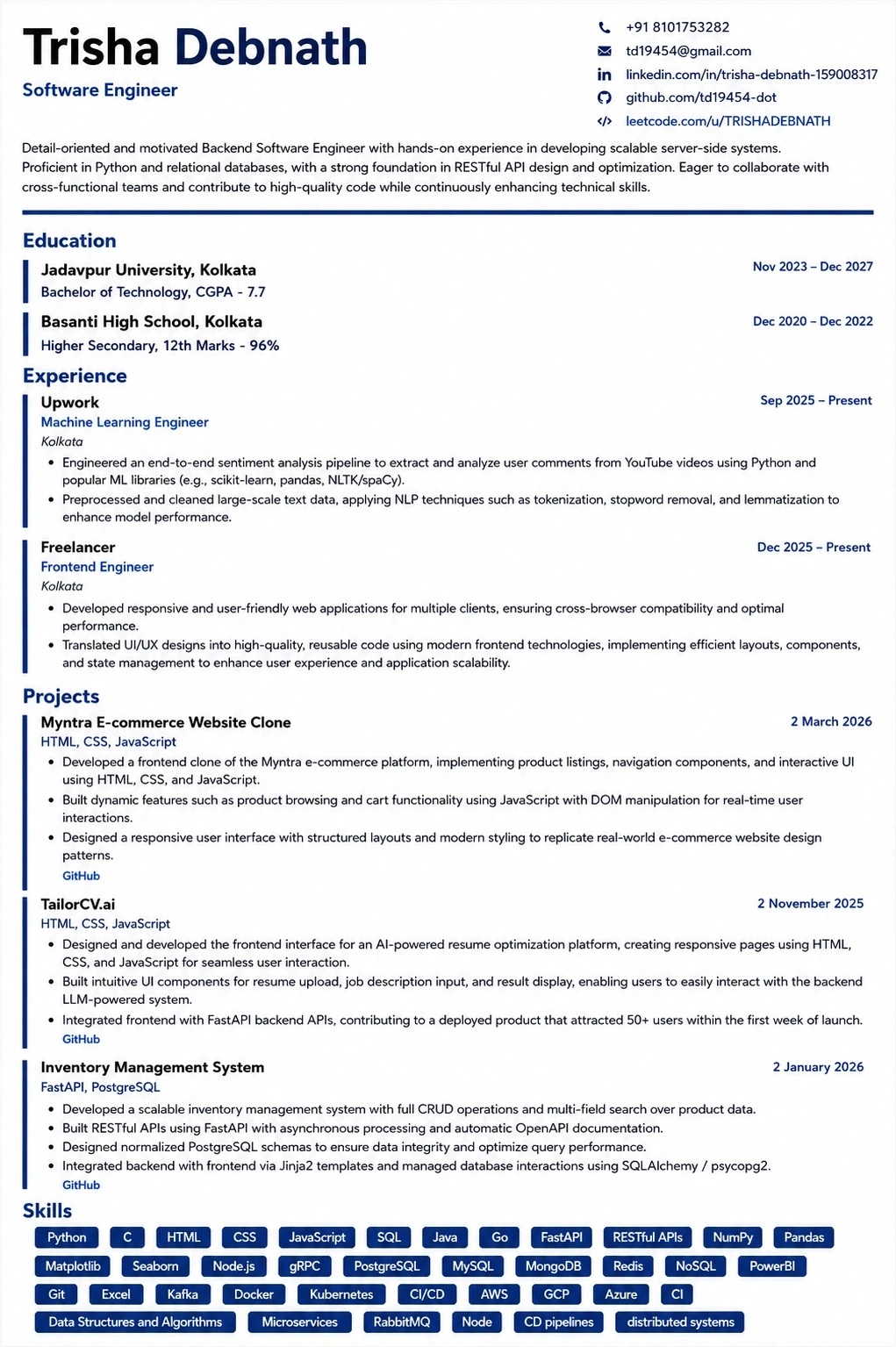
This template is ATS-tested — start from it and the formatting rules in this guide are already handled.
Was this guide useful?
Be the first to rate it.